









Microwave backhaul is here to support your increasing transport needs driven by 5G

Principal Researcher, Adjunct Professor

Principal Researcher, Adjunct Professor
Principal Researcher, Adjunct Professor
A report to be proud of
A few years ago, I wrote my first article for the annual Ericsson Microwave Outlook report. Prior to that I had been a frequent reader of that same report for many years, and had always found it to be an excellent source of information about the latest trends and technology, packaged in a very nice and easily accessible format. Over the years, the report has developed into a widely known reference with a broad audience. As an author, I was happy to be able to reach out with our research to an audience which is more far reaching than the one found at the usual conferences we as researchers attend. I also have to say I have learned so much from the preparations and interactions with the other authors of these reports. And now I’ve even made my debut as a blogger.
Now, I’m inviting you to read this year’s Ericsson Microwave Outlook, which is the eighth report since 2014. It contains six interesting articles which are authored by professionals with a profound interest in microwave backhaul, representing different organizations such as product development, product management and strategy, and research within Ericsson. The icing on the cake this year is a customer perspective on 5G and E-band provided by Telefónica. In my opinion, this is what makes the report unique since it reflects the combined perspectives of the authors and their respective organizations.
Microwave backhaul usage in different regions
The report starts with an update on the regional use of microwave backhaul. Here we see large regional differences and that the microwave share is somewhat reduced in favor of fiber. However, this reduction is compensated for by more carriers per hop and more deployments, so volumes are stable when looking forward. The regional differences are driven by historical reasons and regulatory aspects including spectrum availability and cost variability. Furthermore, local right of way rules for fiber, and even allowance for fiber deployment, guide whether fiber or microwave is the dominant backhaul media. In conclusion, microwave continues strong and clear evidence of that is that about 80 percent of the countries in the world have now opened E-band for deployment.
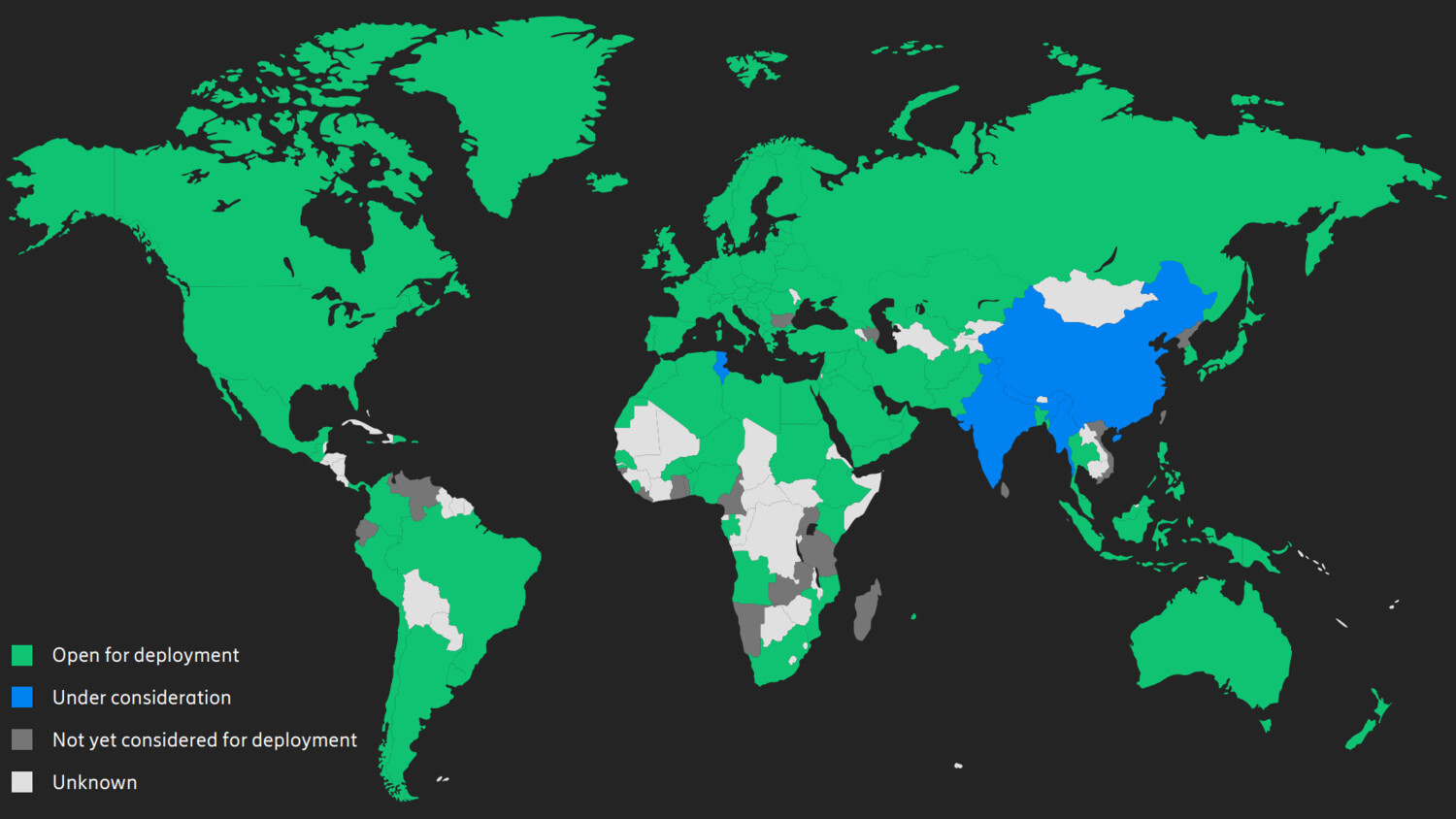
Figure 1: Global E-band deployment status
Strong E-band momentum with 5G
E-band is critical for supporting 5G capacities, and in combination with multi-band technology, it can provide high availability. E-band antennas are very high gain and have narrow beamwidths which may be impacted by mast sway caused by wind. The report presents results from 1.8 million hours of data on the monitoring of E-band links. Modern AI tools show that 68 percent of all links were not at all impacted by mast sway and that the worst impacted link still had 99.99 percent availability. The lesson here is that if deployment guidelines are followed, we don’t have to worry much about mast sway.
Telefónica Germany’s view on E-band and 5G
The importance of E-band as a 5G backhaul is also stressed in the article by Telefónica where they share their expertise and experience from E-band rollouts generously. Telefónica recognizes the strength of microwave transport and its ability to enable fast rollout of 5G networks in urban and suburban areas in Germany. To address the 60 percent year-on-year traffic growth, Telefónica Germany plans a massive deployment of E-band systems in the run-up to 2025.

Picture: Streets in Germany
The transport domain wants a slice of the network slicing cake
Network slicing is gaining momentum in 5G as an enabler of new services and market opportunities. Thus, it is an integral part of microwave backhaul since the transport domain must maintain the properties of the network slices it transports. The report’s network slicing article shows that microwave nodes have all the packet features required to support network slicing in the transport domain, making it a future-proof solution for 5G and beyond.
The need for home broadband connectivity is increasing
COVID-19 has changed the way we live and work today and made us rethink the way we want to live and work in the future with many of us preferring to combine working in the office and at home. Working from home requires quality home broadband connectivity. Fixed wireless access (FWA) is the quickest way for service providers to reach unconnected homes. Here microwave plays a key role as it provides fast time to market (TTM), low total cost of ownership (TCO) and has the required technical capabilities for low latency, scalability and advanced quality of service (QoS) control. Fiber takes time and is expensive to deploy which means it is not always a feasible option. Readers who are interested in FWA can find an interesting case study on a European suburb in the report.
Increasing the frequency reuse
Finally, how can microwave backhaul support higher traffic demands without more spectrum? Is a more aggressive frequency reuse the answer? What about interference? All these questions are addressed in the last article, where we present a simulation study of a typical network deployment in India. It is found that if we combine higher frequency reuse with traffic-aware power control, a single 112MHz channel can support much higher traffic demand without any need for additional spectrum. Indeed, this is great news for service providers with limited spectrum!
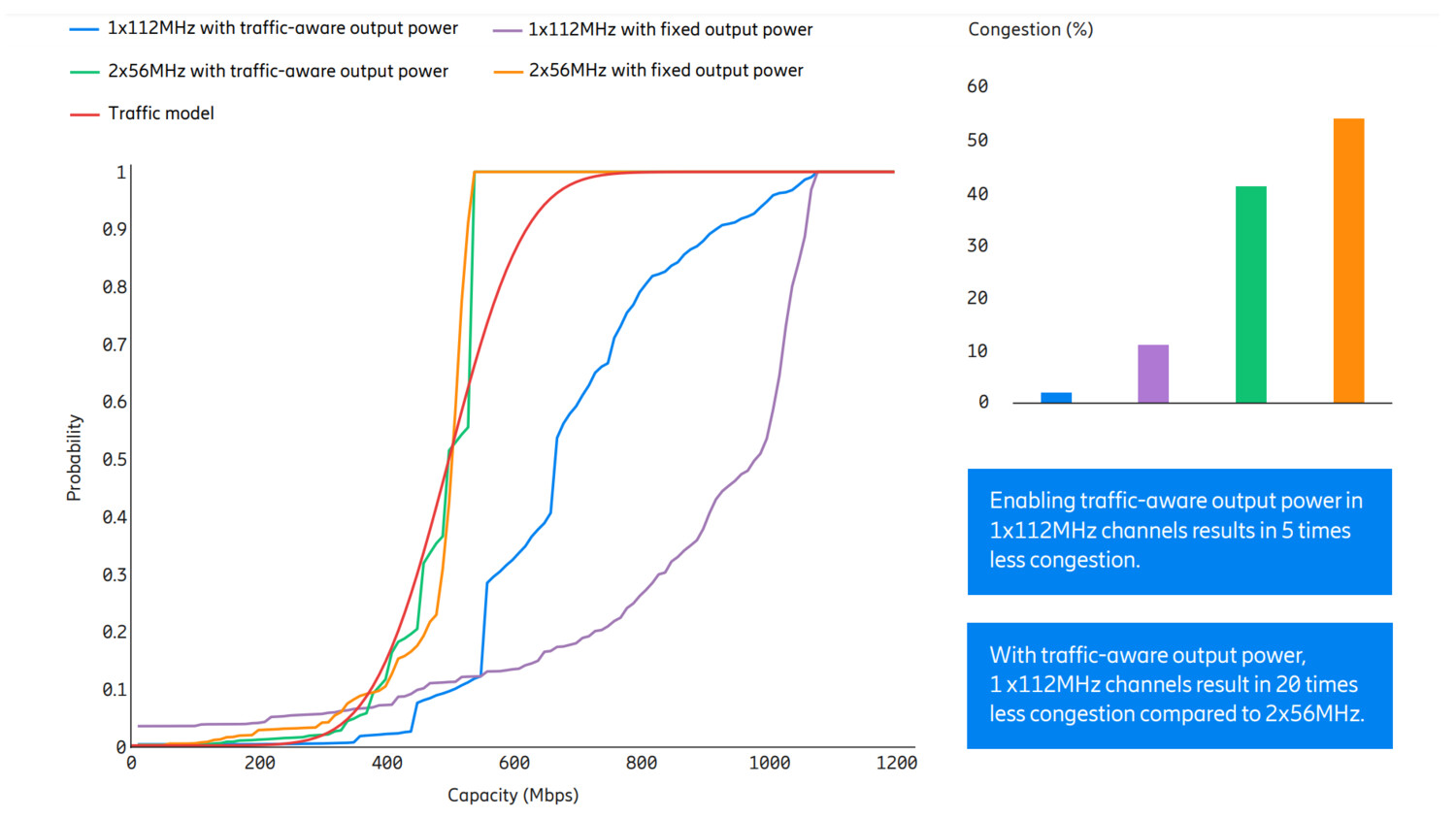
Figure 2: Comparing 1x112MHz with 2x56MHz channels in a high traffic load simulation
Like we say every year, this is the best Ericsson Microwave Outlook report so far! You are hereby invited to read it and hopefully you will agree with us.
Explore our 5G Transport solutions here