










Unlocking network transport in 5G and 6G networks
- English
- Français

Principal Researcher, Integrated radio systems

Master Researcher, ICT applications for industries

Senior Researcher, optical and radio systems
Principal Researcher, Integrated radio systems
Master Researcher, ICT applications for industries
Senior Researcher, optical and radio systems
Principal Researcher, Integrated radio systems
Master Researcher, ICT applications for industries
Senior Researcher, optical and radio systems
End-to-end Quality of Service (QoS), including services with extreme performance requirements, must be ensured across specific deployment areas: wide area (geographic), local, confined, and, in the case of nomadic services, dynamic. Of course, this all needs to be achieved in a cost-effective manner that does not require the overprovisioning of network resources.
The RAN and Core Network (CN) architectures will be based on a high level of modularity and virtualization of the network functions. Transport needs to support this by automatically providing the appropriate connectivity between those network functions.
At the same time, network operators require new solutions to fit in with the existing topology and sites in the field. Network design should therefore be future-proof, ensuring a smooth migration towards 6G in the future. Several technologies, like packet and optical technologies, can be appropriately combined to fit the radio requirements, like low latency and high throughput.
Putting it all together, the transport network must ensure a high level of availability and resiliency. It must also be “programmable” to ensure an appropriate level of flexibility. Finally, suitable solutions should be considered to avoid overprovisioning of the network resources and minimize the cost per bit.
To support this evolution, we’ve identified and demonstrated two enabling concepts:
- An E2E transport aware orchestrator to manage – dynamically and in an optimized way – the interworking among radio, transport, and cloud in a selected coverage area.
- A fully flexible and programmable transport node architecture based on novel technologies that facilitates the task of the E2E orchestrator, while guaranteeing the extreme performances of the services (for example, latency).
The E2E transport-aware orchestrator
From the network perspective, the challenge is to serve a mix of heterogenous services that vary over time and over the deployment area, providing the required QoS in the service coverage area, while avoiding overprovisioning. This process requires the network to automatically manage the network resources in smart way, according to the actual traffic needs.
In a smart factory, for example, many use cases are realized concurrently in the same premises. They demand specific, and often challenging performances to the telecommunication network which serve the industrial plant. Failing to provide such performances would immediately translate into bottlenecks in the manufacturing process.
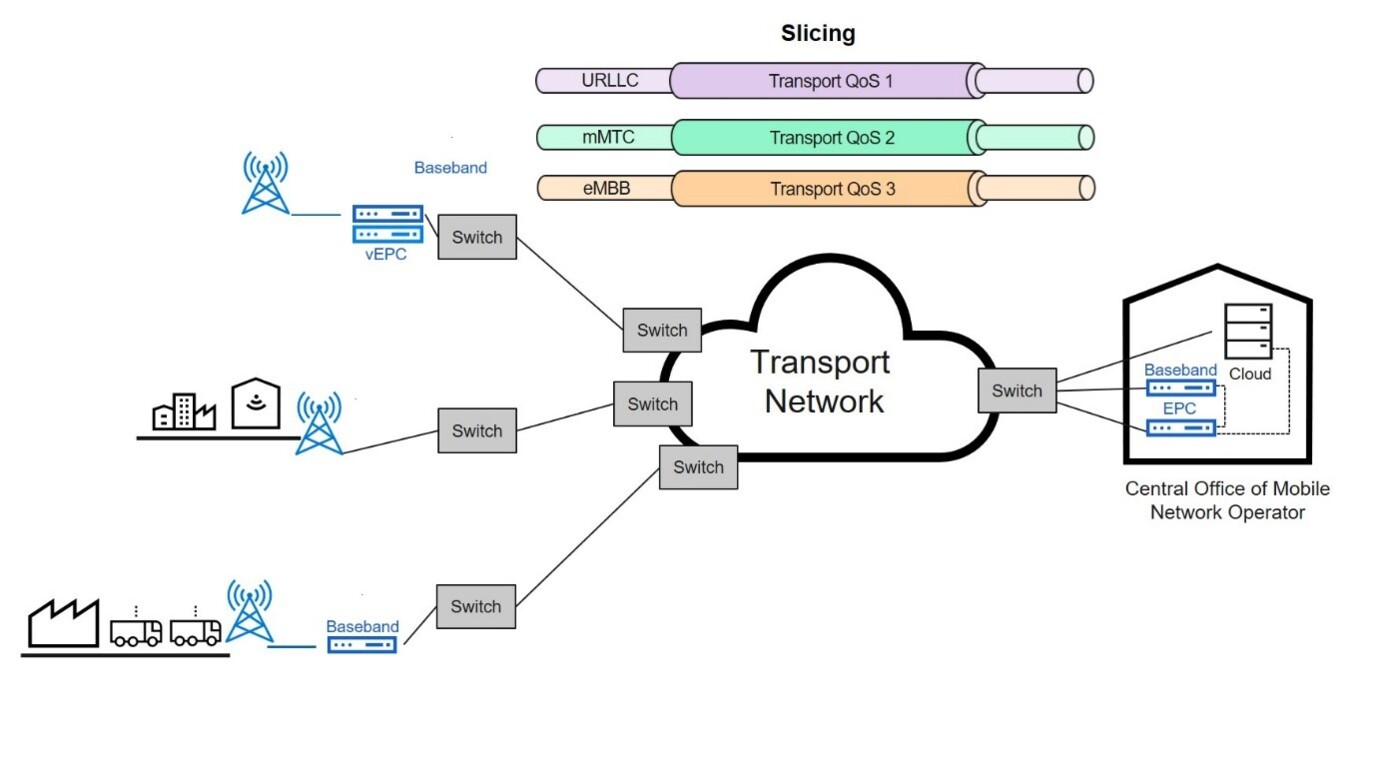
Transport sharing
To properly address these challenges, we need to work with a realistic smart factory scenario. By scenario, we mean a representative set of use cases served by an industry-grade hybrid network, including private and public sections of that network. The relevant players must be involved – the manufacturing company, industrial automation vendor, mobile network operator, and telecom equipment vendor.
Together with our partners, we carried out a real pilot project with a realistic scenario as the basis of the pilot.
The following scheme provides a simplified view of the pilot architecture where three use cases were supported in parallel by three services. The E2E QoS is delivered over three network slices.
The pilot was hosted in the COMAU plant in Turin, Italy.
Here, a designated area was covered with a dedicated 5G network (RAN and Core) connected to the central office of Italian operator, TIM. The pilot included a shared transport infrastructure, based on optical technologies deployed by Ericsson Research, which delivered radio traffic with appropriate E2E QoS. Cloud platforms, located on Comau’s site and in the operator’s central office, enabled the implementation of Network Function Virtualization (NFV) and the support of vertical applications running remotely. The following picture shows the experimental area covered by one 5G radio antenna.
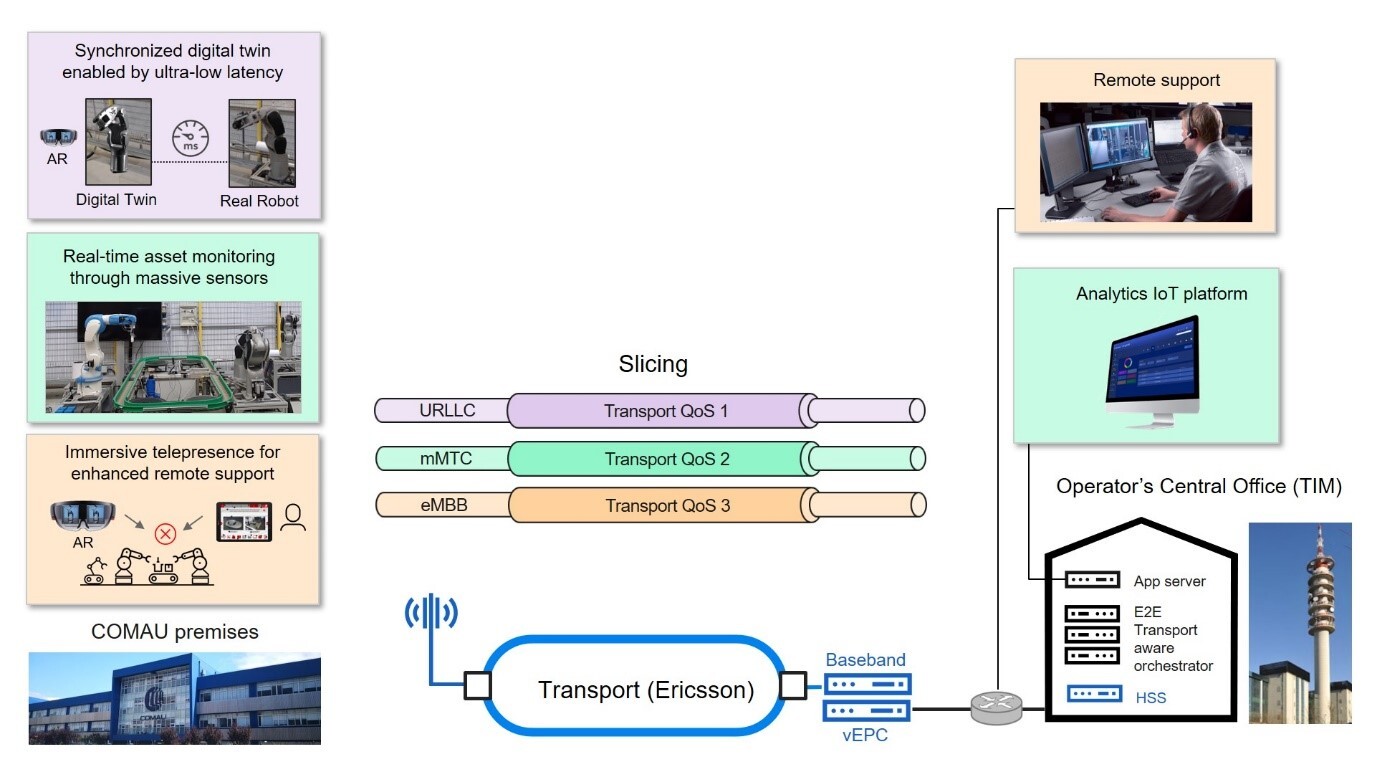
Architecture of the pilot.
The first use case captured the motion of a real robot and, through an ultra-low latency radio link, produced a synchronized digital twin. This digital replica was used to feed an Augmented Reality headset to be used by a human supervisor. The movement of the mechanical robot and of the respective virtual renderings were perfectly aligned in time. Take a look at this video to see it in action.
The second use case was dedicated to demonstrating real-time monitoring of industrial assets. Data capture from a huge amount of machinery was then sent to an application, deployed by the vertical itself, which runs in the operator’s cloud. This application elaborates on the acquired data to work on predictive maintenance, more accurate production planning forecasts, quality improvement and other insights.
The third use case demonstrated immersive telepresence for an enhanced remote support scenario where the maintenance staff were assisted by a remote expert to investigate and solve a failure using augmented reality and step-by-step digital tutorials.
The pilot was managed by the mentioned E2E transport aware orchestrator which automatically managed the interworking between radio, transport, and cloud on the selected local coverage area. The system ensured the alignment of all the resources involved in the provisioning of the services with the related E2E QoS characteristics.
End-to-end Quality of Service
It’s worth highlighting that the E2E QoS is constituted by the combination of the QoS guaranteed in the radio layer and the QoS guaranteed in the transport layer. For example, supporting the low latency service for the digital twin operation requires a specific QoS forwarding behavior in the radio network identified by a QoS Identifier (in 5G, this is called 5QI). The association of the QoS Identifier with the QoS of the service is configured by the network operator with a specific policy.
Given the E2E QoS, the orchestrator derives the corresponding QoS for the radio layer and the QoS for the transport layer. Then the orchestrator sends the corresponding requests to radio and transport networks. In this way, the E2E QoS is managed automatically and dynamically as a “unique” infrastructure, composed by radio and transport.
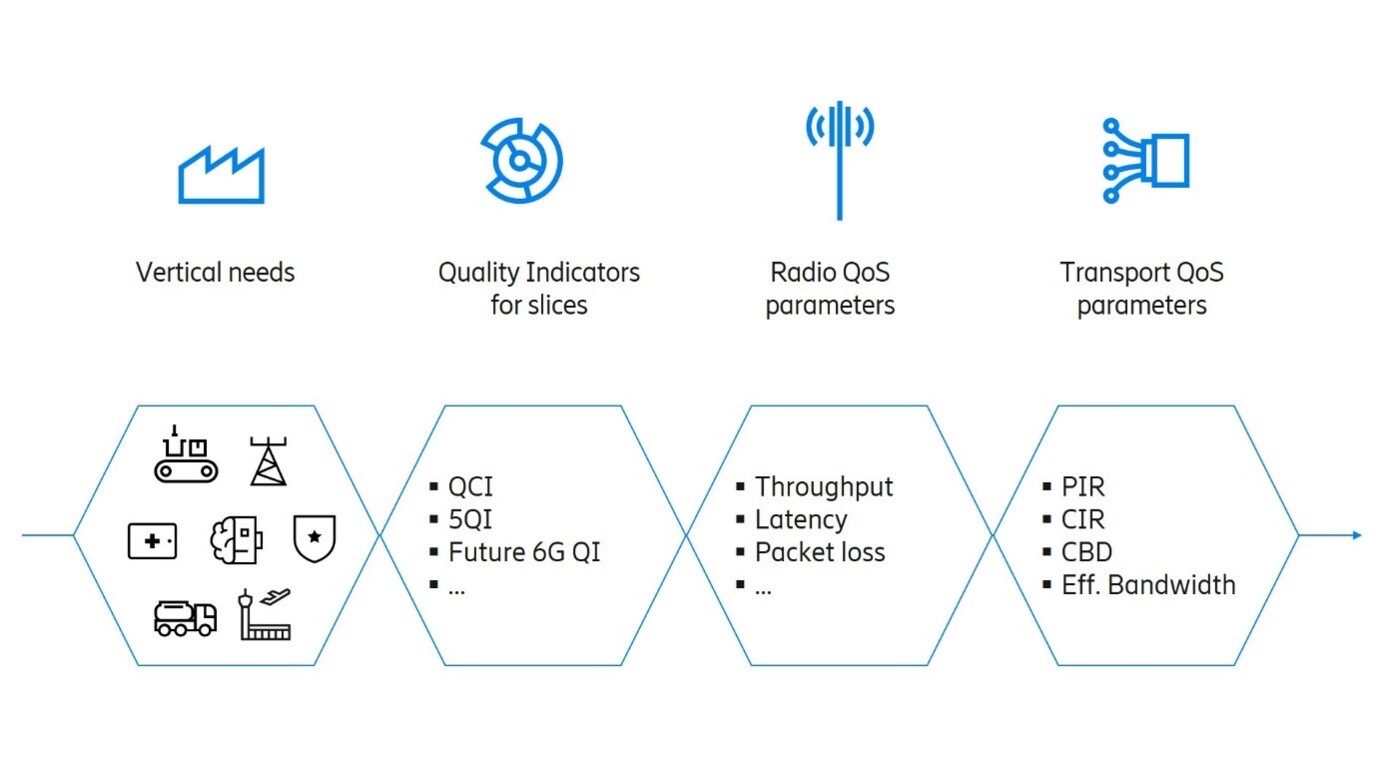
End-to-end Quality of Service
Resource placement optimization
A network service is constituted by the combination of individual Virtual Network Functions (VNF) and physical network nodes which have not undergone virtualization, namely the Physical Network Function (PNF). One of the main challenges is the optimization of resource placement, both VNF and PNF, over the underlying transport infrastructure. For example, a VNF can be connected through a simple point-to-point transport link or, alternatively, through a meshed geographical transport network. These two options imply different latency values or different availability in operating the VNF: a difference that the placement of the VNF should be aware of. Careful optimization of the network reduces the need for overprovisioning and allows it to maximize the amount of traffic that the network can serve.
The pilot has also demonstrated how the “transport awareness” in placement can be facilitated by the deployment of an abstraction mechanism. Abstraction is a “compact” description of a resource (radio, transport, and cloud), exposed with the corresponding service parameters. Abstraction hides resource details (such as quantity, vendors, location of the resource, physical details, real topology, and so on.) and makes it possible to consider the transport aspect from the start of the placement process.
Providing the required E2E QoS with an optimal use of resources can be further improved by Artificial Intelligence. We defined and deployed an AI engine to elaborate data metered at the border of the transport network. The engine determines traffic trends and behaviors, over time, across the specified coverage area. This mechanism provides insights on the actual radio traffic conditions, which could not be observed and understood otherwise. With this information available, the transport network can be optimally dimensioned and operated, further reducing the level of required overprovisioning.
The 5GPPP awards
The pilot was indicated by the 5G Public Private Partnership (5G-PPP) as one of the top-ten “role models” for two consecutive years, 2020 and 2021.
- In 2020 the pilot was recognized to have demonstrated the potential of shared networks in support of latency-critical industrial applications. The challenge was to define a transport solution unlocking the shared transport scenario while preserving all the critical transmission performances demanded by the various vertical actors connected to the shared network.
- In 2021 the pilot made the top 10 list for the second year in a row. This time, the motivation was demonstrating the potential of E2E transport-aware orchestration to serve multiple uses cases by the introduction of transport-awareness in the slicing mechanism. The concrete result was that the transport domain could maintain the properties of the network slice(s) it transported without the need to dimension the transport network to the peak of the radio traffic.
5GPP is an initiative co-led by the European Commission and ICT manufacturers, telecom operators, service providers, small and medium enterprises, and academic institutions. The mission of 5G-PPP is to explore the concrete applicability of 5G technologies to real-world use cases across various vertical sectors by providing “ubiquitous super-fast connectivity and seamless service delivery in all circumstances”.
Towards fully flexible and programmable transport (IOWN Global Forum)
Our research into flexible and programmable transport now continues towards the 6G horizon. The next step is our participation in the Innovative Optical and Wireless Network Global Forum (IOWN GF). The IOWN GF advocates for a radical change of the current wireless and optical networks, based on the introduction of new technologies that can guarantee extreme performances.
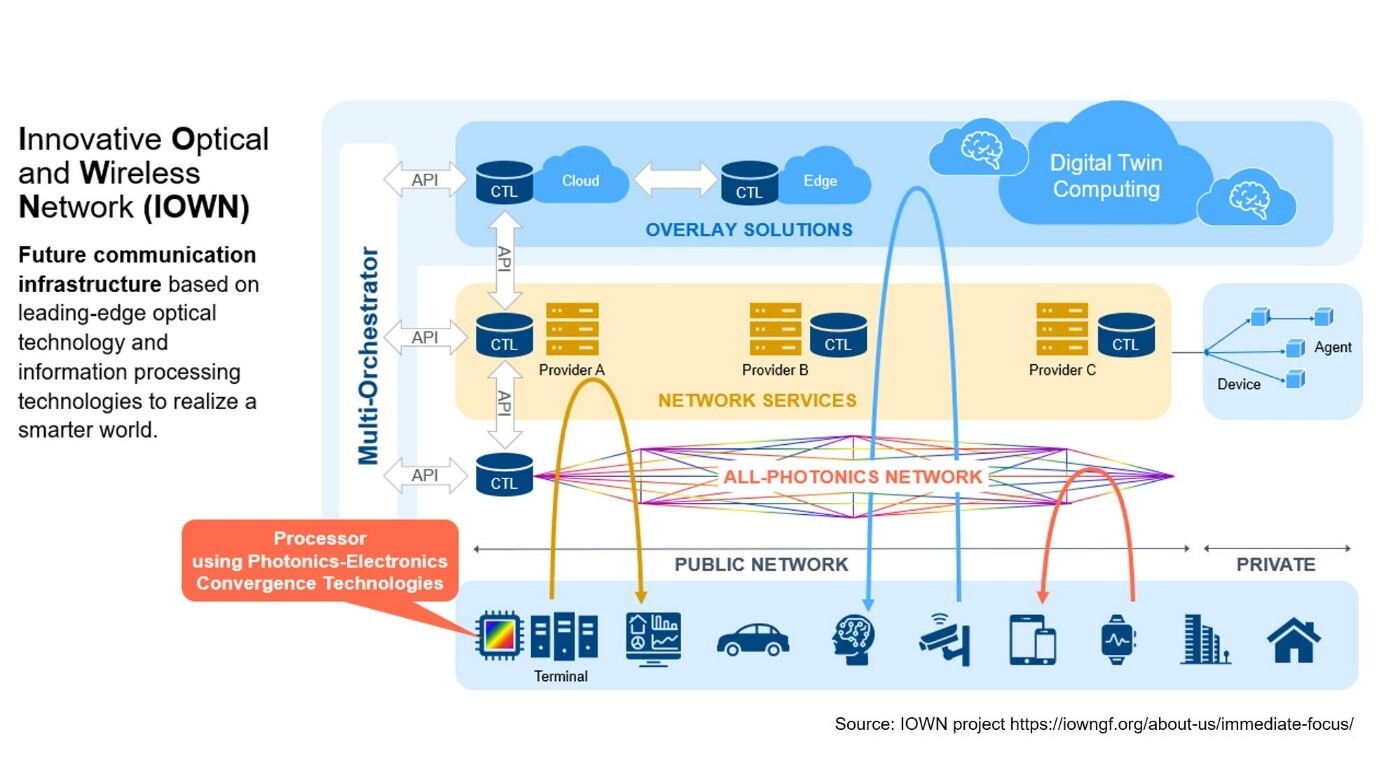
Performance Targets of All-Photonic Network
IOWN GF has introduced the concept of the All-Photonics Network: a network which incorporates new optical technologies at every level, from networks to devices, and even inside chips, to enable ultralow power consumption and ultrahigh speed processing which have not been possible until now.
There are three performance targets:
- 100-fold enhancement to energy efficiency
- 125-fold enhancement to transmission capacity
- Reduce end-to-end latency by 1/200.
Optical networks can match high bandwidth and low latency requirements. To ensure the E2E QoS at the lowest possible cost, it’s essential to introduce elements of programmability in the transport segment. Transport cost is as a combination of several elements such as hardware cost (novel technologies or the combination of existing technologies to reduce the cost of the infrastructure), inventory and configuration cost. Hence, equipment should plug and play and be remotely configurable by an E2E orchestrator. In this perspective, tunable optics open the doors to new architectures where the transport network is simplified, and the inventory can be dramatically reduced.
We will participate in IOWN GF with active research, but we’re also on the board, and are part of the leadership of IOWN GF. Over the next couple of years, we foresee many interesting results from the project, and we’ll share our insights and experiences as they happen.
Want to learn more?
Discover network slicing and mobile transport.
Learn more about Network architecture domains.