










The 5 Secrets of 5G B2B customer experience success
- English
- Français

Senior Analyst, Service Provider Transformation, Omdia

Chief Analyst, Service Provider Enterprise, Omdia

Senior Analyst, Service Provider Transformation, Omdia
Chief Analyst, Service Provider Enterprise, Omdia
Senior Analyst, Service Provider Transformation, Omdia
Chief Analyst, Service Provider Enterprise, Omdia
The critical role that telco BSS solutions play in the customer experience process is underplayed – but it’s the focus of new Omdia research, which explores insights from 4,500 enterprises in 60 countries and views from more than 400 communication service providers (CSPs)
Here’s a sneak peek from the latest Omdia report Telco BSS: The 5G B2B customer experience challenge.
1. Empower the customer
Key fact: 93 percent of B2B customers – large, small and micro business – are now happy to self-serve.
What it means: A more sophisticated B2B buyer has emerged since the pandemic who expects seamless and empowered digital experiences in which they are in control.
What CSPs must do: Industrialize service creation and management through a 21st century digital marketplace experience that delivers an excellent usability to partners and customers alike. Customers are used to the elegant interfaces of sites like Amazon, Mercado Libre and AliExpress. Now many also want the power to build and buy their own 5G solutions with limited direct intervention from suppliers. Developing governance and management of such digital marketplaces needs further work but it’s underway. As marketplace models resurge, CSPs must be prepared to play in many of them, not just their own.
2. Deliver experiential value
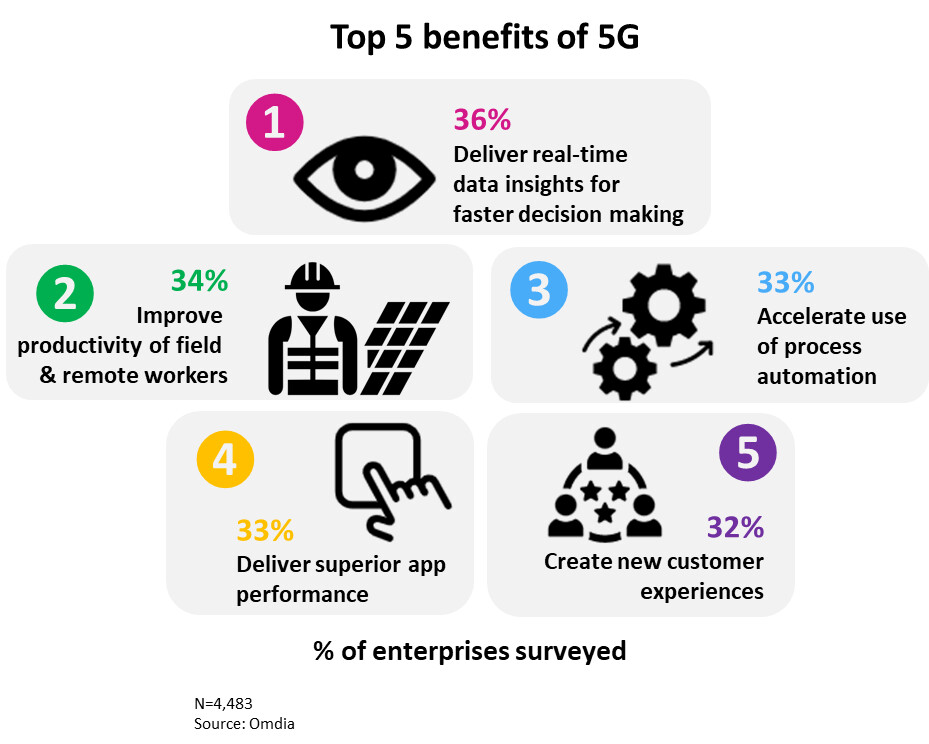
Key fact: Enterprises say that 5G’s number one benefit is delivering real-time insights for faster decision making. Indeed, business outcomes dominate why enterprises want to invest in 5G (see graphic).
What it means: What matters to enterprises is the business outcome that 5G connectivity enables. Connectivity is a beginning, not an end to a successful B2B value proposition.
What CSPs must do: Ensure that your BSS is adaptable enough to measure these ‘outcomes’ to monetize the new value that 5G brings. This demands cloud-native solutions that are constantly updated and optimized. CSPs need flexible, feature-rich environments that can adapt to diverse use cases as needed, rather than requiring hard code customization unique to a specific use case. Be prepared to support new experiential metrics that B2B customers care about to demonstrate 5G’s value to their business.
3. Work well with others
Key fact: Enterprise executives now put 5G among their top five most important technologies enabling digital transformation, along with edge computing, IoT, AI/ML and platform-driven operations.
What it means: 5G solutions are most likely to involve the integration of multiple technologies - and multiple partners - that must work together.
What CSPs must do: To ensure fruitful dialogue and smooth operations, implement a BSS architecture which leverages open and standardized APIs. This will help reduce the integration tax of onboarding, orchestrating, and offering new partner-driven services. The industry is waking up to such needs: Conformance to the TM Forum’s Open APIs ranks among the most important criteria for choosing an OSS/BSS vendor, and the TM Forum Open API manifesto has now received more than 90 signatories.
4. Operate in real time
Key fact: 34 percent of enterprises expect to use on-demand 5G network slicing within the next two years.
What it means: Enterprises’ 5G ambitions are accelerating faster than many CSPs can service them.
What CSPs must do: To get into shape to service enterprises’ rising 5G expectations ensure tight integration between your BSS, OSS and network domains. This will support dynamic configuration and consumption of 5G services. CSPs will need to orchestrate solutions across every layer of the IT and network stack to provide customers with a truly seamless experience. Not only are open APIs indispensable, but also greater use of intelligent automation to link actions from one layer to another. Not least, CSPs need such flexibility to play different roles in different industry ecosystems too.
5. Be transparent
Key fact: 8 out 10 enterprises still don’t have an integrated, real-time view of the services that they buy from CSPs.
What it means: As B2B customers become more digitally dependent, their need for real-time performance data about their services and operations on a holistic basis has gone from nice-to-have to critical. However, many are also willing to pay a premium for such valuable data and analytics.
What CSPs must do: Converge your customer platforms across lines of business. A B2B customer should be able to access all their services through whatever channel they desire. This single view should also be available to your customer care teams, who can then help recommend the next best action for customers quickly and efficiently, without needing to go through the rigmarole of ‘who are you, why are you getting in touch?’ Where data protection allows, CSPs should expose relevant customer views to their partners as well, which will help them ideate, create and optimize new services, adding value to customers and CSP relationships alike.
Read more