










Why E2E orchestration is key to winning 5G enterprise business

Senior Product Marketing Manager

Senior Product Marketing Manager
Senior Product Marketing Manager
Enterprise customers in various industry verticals can benefit from becoming more digital, using 5G as a foundational technology. Increased automation of business processes, faster time to market for new services and higher quality of service are key benefits of digitalization. Thanks to 5G, businesses of many shapes and sizes can become more agile, sustainable, competitive, and profitable. A new vendor landscape (or ecosystem of different companies) is now emerging to deliver these new enterprise services, for example in areas such as Industry 4.0 transformation, retail, and transport.
Our traditional customers, the communication service providers, are important ecosystem contributors together with system integrators, hyperscale cloud providers (HCPs), operations technology vendors and application providers. These players must be prepared to cooperate with each other and provide their part of an end-to-end service for the enterprise. By leveraging their connectivity services, service providers can and should expand from these services, by keeping an end-to-end offering involving several players together. This is where service orchestration comes into play together with service exposure.
Service provider capabilities enabled by service orchestration and service exposure
By excelling at orchestration and exposure, service providers will be in a great position to become the centerpiece of the ecosystem in addition to their connectivity business. Service orchestration makes it possible for service providers to manage resources across hybrid cloud and control the end-to-end service involving also hyperscale cloud providers and their application ecosystems. Service providers will also be able to expose various network capabilities and data to secure service level agreements, for example, and several other functions to manage the end-2-end enterprise offering and make it visible and orderable through customer portals. For enterprises, one of the most important requirements is to be able to work with more than one HCP to avoid lock-in situations. Openness and multi-HCP choice is enabled by a service orchestration solution which means that service providers will become more relevant as enterprise service providers.

Figure: Key operator capabilities enabled by service orchestration &service exposure
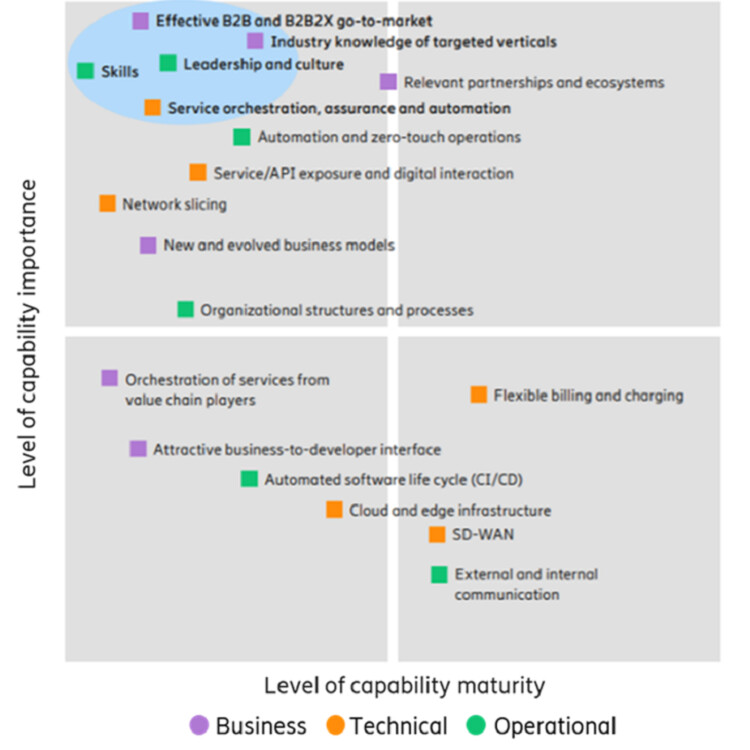
However, to be the spider in the net for enterprise services, there is quite a bit of work to be done. According to the Ericsson report Capturing business opportunities beyond mobile broadband, service providers have a handful of capability gaps to close before they can take that next step beyond being mainly connectivity providers.
The report presents the most important capabilities (business, technical and operational) needed for doing more than mobile broadband and which level of maturity service providers are on for these capabilities at presence and how important they are. The situation can of course vary between different companies. In the diagram below, the general result is presented showing that the most important gaps are related to go-to-market knowledge, industry knowledge of targeted verticals, skills and leadership and culture capabilities. The most important technical capability gap is service orchestration, assurance, and automation. At the same time as service orchestration is a key enabler for enterprise business, it is also one of the areas where the greatest improvements must be made to succeed. It’s unsurprising then that addressing this area is high on the agenda for service providers and vendors like Ericsson.
During the webinar, Pablo Tomasi, Principal Analyst at Omdia, discusses which the most important drivers are for the digital enterprise, key trends and the most important benefits with 5G from an enterprise perspective. Jochen Bockfeld, Director Common Services at Telefónica Germany, also presents key customer needs and expectations and which the most important opportunities are.
Watch the webinar now to find out more.