










Expert tips for future leaders in cloud native 5G Core

Strategic Marketing Manager 5G Core
Strategic Marketing Manager 5G Core
Strategic Marketing Manager 5G Core
We’ve heard service providers ask the question “what is the best way to prepare my network for the evolution to a Cloud native 5G Core?” many times. This is a question that echoes around all corners of the globe, so rest assured: you are not alone.
The 5G Core represents a major technology shift, as it introduces new technologies never-before-seen in mobile core networks such as a service-based architecture (SBA) and container-based cloud-native network functions that are built on microservices using Kubernetes and bare-metal cloud infrastructure. It also demands more efficient ways to operate the network, with lots of automation and orchestration tools for software life-cycle management, for example, CI/CD, service creation and network management. These new technologies are set to transform how we build, manage, operate, and monetize this new core network. To succeed and become a 5G market leader, it’s necessary not only to deploy the new 5G Core and 5G RAN but to really re-engineer your network and organization with an end-to-end vision – aiming for high degrees of automation and agility to launch new innovative services. The good news is this journey can be split into several smaller and independent legs, and you can harvest concrete and incremental benefits along the way.
To answer questions around how to build a 5G Core platform, we recently released a concise guide series that has been downloaded thousands of times by people working for service providers.
But we felt it was not enough, so together with TelecomTV we went decided to offer our customers (and potential customers) a more personal experience by allowing them to directly interact with some of our 5G Core experts and get answers to their specific questions.
In this post, I want to share some highlights of the “Ericsson Summit: How to build your cloud native 5G Core platform” and invite you to listen to the complete session where Anders Rosengren (Head of Architecture & Technology, Ericsson Digital Services), Thomas Kinnman (Head of Solution Line OSS, Ericsson Digital Services) and Víctor Ferraro Esparza (Product Manager for 5G Core Networks, Ericsson Digital Services) answer service providers’ questions around cloud infrastructure, 5G Core, 5G voice, automation and orchestration, operations and management and network security.
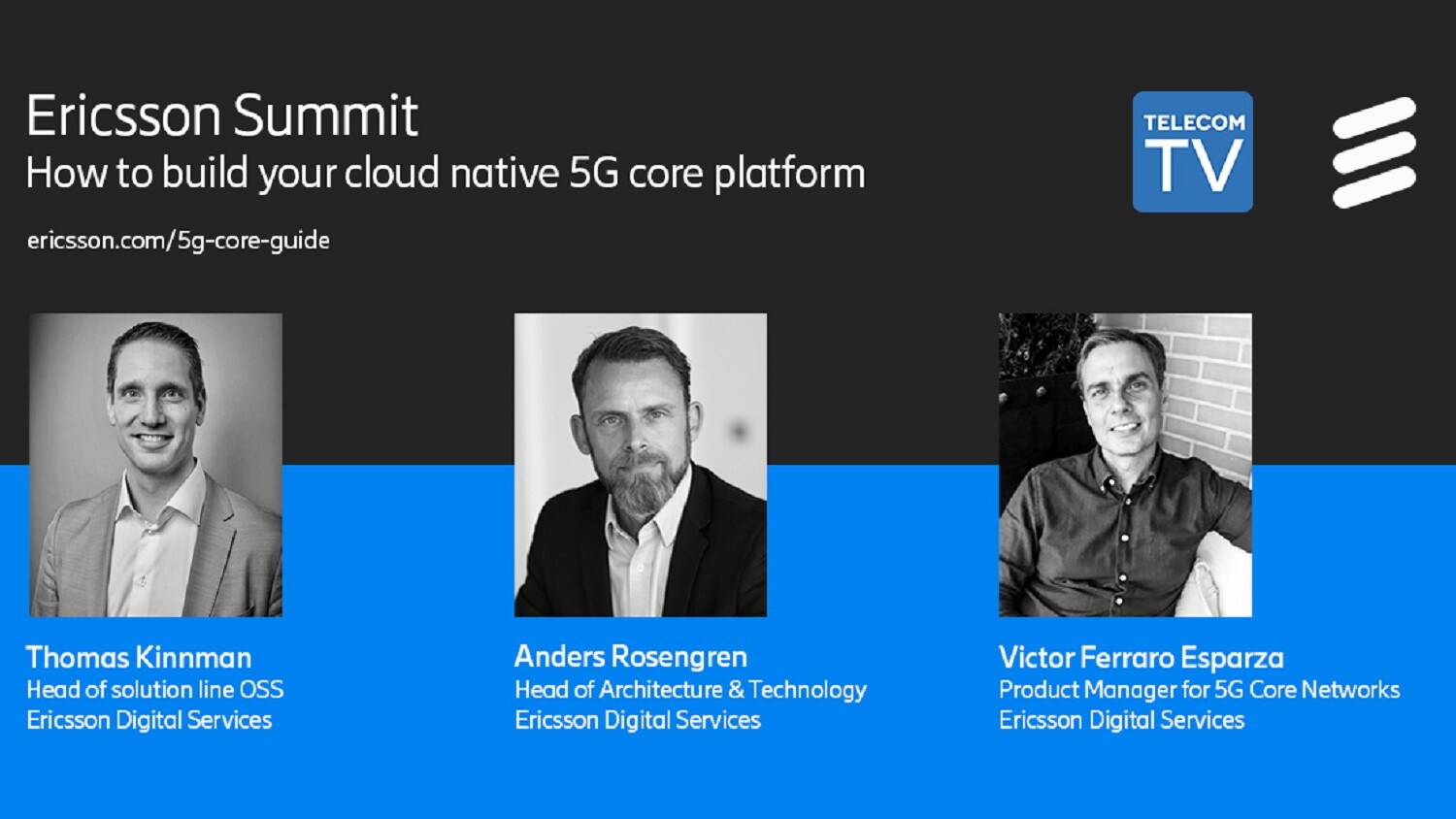
Teaser from the summit
Question: What should be the first step in this adoption of a 5G Core platform? Where should operators start?
(Anders Rosengren): “Is all starts, off-course, with planning how you will evolve your network according to your business targets and needs. Which evolution steps are you to take, deploy 5G non-standalone first and later standalone or go straight to standalone? What are your immediate needs in terms of operational efficiency? What is the LCM status of your actual network? Which 5G services are you to explore first in your market? These and other questions will have a high influence on which evolution path you should take.
But once you have decided that it is time or that you need to start deploying the new cloud-native core platform, you need to prepare a foundation to it and this foundation is the cloud infrastructure to run the cloud-native applications. I’d say that this is the very first step of the evolution to look into. This together with the evolution journey from EPC to 5G Core as these are the two fundamental elements of the 5G Core network. “
Question: Can service providers re-use the existing 4G core in a 5G core network and can the cloud-native benefits be extended to existing network deployments?
(Víctor Ferraro Esparza): “…I’m happy that you have also lifted the question about service providers existing core networks for 4G as these two network architectures will have to co-exist for many years. In order to reach full operational efficiency and speed for new services in the complete core network, service providers should consider also moving its existing 4G core into Cloud native. This may sound as a big thing but with the right solutions and strategy it can be achieved in a stepwise and smooth way. And building a common multi-access core network will also secure that network resources can simply be shifted between different access as the subscriber’s base moves into 5G. This will also mitigate the challenge services providers will have in what to do with the spare network capacity they will have in their 4G core networks once the full migration to 5G is concluded. For that, it is very important to invest in multi-access 5G Core network solutions that allows for flexible and smooth migration paths into 5G. This is what we provide with the Ericsson’s dual-mode 5G Core.”
Question: Should service providers own and run their own cloud infrastructure or rely on a third party, such as a hyperscale partner?
(Anders Rosengren): “This will likely be a mix where the HCP may host/own/run Edge infrastructure near or on the service provider edge sites to facilitate a large eco system of app developers. The service provider will most likely run the 5G Core and other performance- critical CNF’s/VNFs on their own infrastructure. They will most likely also run the orchestration. “
Question: Should automation be the starting point of the whole 5G Core process? Is this the first step for operators to take?
(Thomas Kinnman): “Network evolution and digital transformation are happening in parallel, and automation and orchestration are key enablers of these initiatives. To meet the modern business challenges and provide a diverse range of services, the 5G environment is expected to be more complex than earlier generations. The designers of 5G expect this to be solved by orchestration. Therefore, management and orchestration functions become an integral part of 5G architecture.
Automation is not simply a cost saving; it enables a more rapid path from development to deployment, bringing forward time to market by months in many cases. Therefore, orchestration should be the primary means of automating instantiation of network and service constructs. It is important to treat 5G as a driving force rather than a distraction. 5G was designed to be orchestrated, so it is a natural starting point for such initiatives. So yes, we recommend that 5G automation is treated as an early use case and aligned with other ongoing transformation programs.”
Question: 5G will be used for industries in addition to serving individual consumers, do you foresee issues with security in this scenario?
(Anders Rosengren): “As you rightly pointed out, the usage of 3GPP networks for industries as well as Mission Critical networks will increase with the deployment of 5G.
We will also see more devices connected, many new use cases and at the same time the architecture is opened up to enable the flexibility and TCO required. 5G will also become even more a critical part of the national infrastructure and thus come into focus for regulatory bodies who are now imposing more stringent requirements.
We see similar increased security requirements for industries planning to use 5G for industry applications and automation like Industry 4.0. This development does require that we as an industry put more focus on security, both on the Vendor side but also on the operator side”
Learn more
Read more about Core network
Read more about 5G Voice