










Segment Routing … is there a fit with 5G RAN transport?


Evolving RAN architectures
Before we can really dig in to where SR might fit in 5G, let’s take a moment to review the different evolving RAN architectures and their supporting connectivity requirements. As 5G matures, the traditional RAN that we know well today will disaggregate, and in some cases, virtualize. Each of these deployment models come with their own set of transport requirements and characteristics.
The classic Distributed RAN (DRAN) will still be deployed in 5G. In fact, today it is still the most commonly deployed RAN site type for most mobile network operators (MNOs). As such, while the physical connectivity may vary, the last mile connectivity for DRAN predominantly remains point-to-point, in a hub/spoke architecture where the cell site router connects directly to an aggregation router when the EVC (Ethernet Virtual Circuit) services are leased. Also, given that requirements for capacity and latency are relaxed in this type of deployment, it is the simple architecture of choice for many MNOs, including Tier-1 operators.
With Centralized RAN (CRAN), the traditional cell site disaggregates. The connectivity requirements for CRAN are more stringent as compared to DRAN in terms of latency (75µs one way) and capacity (10-25Gbps per Radio unit). Once again, simple, point-to-point connections using dark fiber and DWDM, or E-band microwave as a complement between geographically separated radio and basebands is recommended. In addition, there are recent developments to use Ethernet for fronthaul connectivity. For more on packet-based fronthaul check out - Building efficient fronthaul networks using packet technologies.
With packet Fronthaul (eCPRI radio and basebands), Fronthaul traffic can be carried over packet-based network which allows for switched connectivity between the Radio unit (RU) and Distributed Unit (DU) allowing multiple hops in between. This means Fronthaul traffic can be multiplexed with other Ethernet
traffic and transported on the same network but needs to be prioritized to avoid delay/latency. Even though theoretically we can switch the eCPRI traffic through multiple hops, it is not practically possible as the latency requirements are still extremely stringent at around 75µs.
Summarizing this section, it’s safe to say that each of the above 5G RAN architectures requires last mile connectivity to be as simple and direct as possible, with basic point-to-point IP connections.
What SR does really well
With this baseline understanding of 5G RAN connectivity, let’s explore how SR might fit. The key benefits of SR technology are:
- Simplicity and scalability: a simplified control plane removes the need for additional signaling, hence per flow state needs to be maintained only at the ingress node of an SR domain.
- Faster reroute: protection of links and nodes along with guaranteed sub 50 millisecond reroute.
- Traffic engineering: traffic steering by engineering multiple paths for each service based on the various constraints like minimum link bandwidth, max path latency, etc. Each packet can be subjected to a policy, and based on the policy applied, the SR path will be chosen and associated with the packet in advance.
SR technology will be best exploited when the network has more interconnected end points with a corresponding mesh architecture. Some questions to consider before planning to deploy or extend SR in the RAN are:
- Will my access network benefit from a more interconnected architecture?
- Do I have a complex access network architecture that needs restructuring?
- Are there new use cases / deployment strategies being planned that may warrant a redesign in the access network?
- Am I planning to use a central SDN controller architecture?
If answers to any of the questions above is “no”, then SR may not be a good fit for MNO access networks based on DRAN/CRAN today and VRAN in the future.
So, is there a fit for SR in 5G?
With new things on the horizon like advanced RAN coordination, network slicing for various use cases like 5G private networks and mobile edge computing, where will SR fit? Let’s discuss.
Advanced RAN coordination
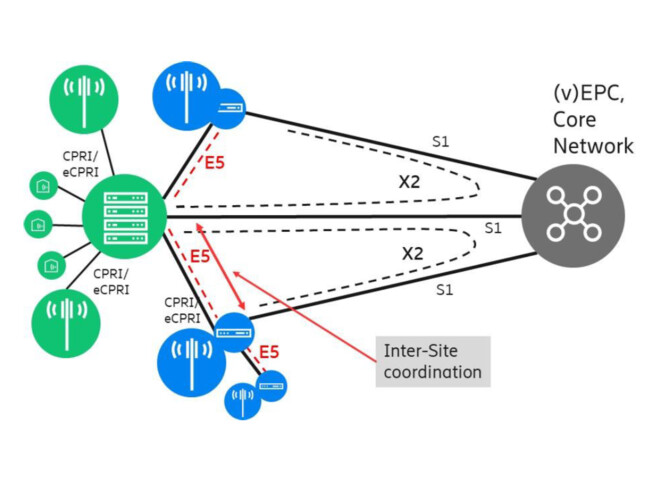
As 5G matures, more advanced functionality will emerge. One of these exciting new areas is advanced RAN coordination. Inter-cell coordination can be achieved by creating borderless coordination areas. In layman’s terms, intercell coordination need not be restricted to one hub site (CRAN) but can be expanded to interconnected hub sites to further improve subscriber mobile broadband experience. With relaxed latency requirements of 900µs RTT corresponding to 90km in fiber length, these deployments are set to increase in the near future. This means that the transport network needs to be prepared to accommodate this new architecture; allowing for inter-site traffic connectivity in the access segment.
Network Slicing
Simply put, network slicing can be defined as “one network serving multiple industries or customers”. There is certainly a lot of interest among operators as network slicing provides new opportunities for revenue generation and OPEX reduction. It’s a true end-to-end function.
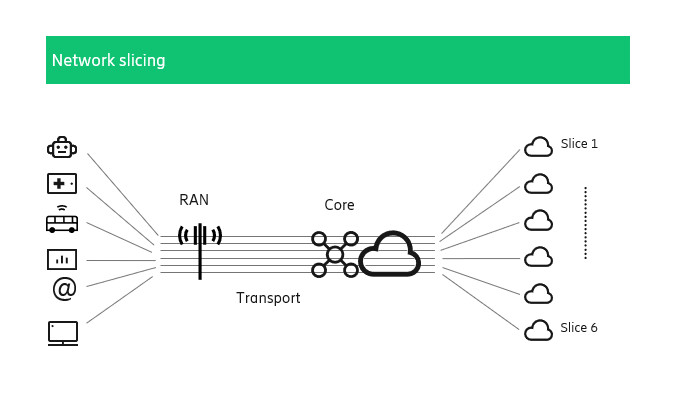
Each use case will impose different requirements on the transport network with respect to capacity, latency, availability/reliability, security and data volumes. The transport domain must maintain the properties of the
network slice it supports. On a high level, these are the transport domain requirements for establishing an E2E network slice:
- Transport resource allocation, monitoring and enforcement
- Resource alignment and mapping with RAN and Core
- Managed set-up and removal of transport resources
An interconnected transport network is certainly going to help with building a reliable mobile network with diverse routes to accommodate multiple slices with different requirements. An MPLS traffic engineered, virtual private networks (VPN) becomes critical to provide the proper traffic treatment and guarantees needed by the network slices it is supporting. Source based routing approach like SR can also be leveraged to map the network slice to the transport resource share in an IPv4 network.
Growth of Private networks and edge computing scenarios where parts of the RAN, transport and/or core portions of the operator’s public network will be shared by the enterprise network essentially means an end-to-end network slice virtually created for a particular customer.
This is likely to be a popular approach in early deployments as it is cost effective in comparison to all private network solution. Once again, all requirements of a network slice in the transport domain become relevant as discussed above.
All the above new architectures seem to imply that an interconnected end-to-end transport network brings more value to the table. To summarize, these architectures warrant a review of the transport network. They impose the following requirements
- An interconnected network that allows for connectivity not just with packet core but also among the sites that provides path diversity and more agility
- MPLS traffic engineered network to allow for introducing service VPNs which play a key role in proper treatment of network slice traffic flows
- Advanced traffic engineering capabilities that can provide QoS (Quality of Service) to individual applications and map network services to end users and applications as they traverse the network
- Source based routing techniques that provides the means to flexibly map the RAN and the core slices to and from the transport slice
With the introduction of complexity to the transport network in these new areas, ideas to simplify the operations and management of the network becomes inevitable. Segment Routing (SR-MPLS) can help in the following ways vs deploying a traditional IP/MPLS network solution:
- It simplifies the network by eliminating the need for control protocols in MPLS (such as LDP and RSVP) by moving the path state information from transit routers into the packet network.
- It is more agile and flexible as it reduces the number of nodes that need to be reconfigured for any network changes thereby reducing resource utilization
- It provides resiliency through TI-LFA (topology-independent loop-free alternate) technology that helps with improved path reliability
- Smooth transition is feasible from existing MPLS networks to SR-MPLS as it still uses MPLS in the forwarding plane
SR in 5G transport networks is not a “one size fits all solution” but a tool in the toolbox that depends on various factors as discussed above. SR-MPLS has its advantages that can help with evolving the network to accommodate newer concepts and architectures as and when needed. To learn more, check out the Broadband Forum’s work on 5G Transport that can provide a detailed layout of the functional architecture and equipment requirements. For more details, please reach out to info@broadband-forum.org.
Also, Ericsson-led work on MEF 22.3.1 (published) provides good reference material on transport services for mobile networks, specifically focusing on ethernet services for 5G Fronthaul and backhaul.