Why the 5G millimeter wave is the icing on the cake
- English
- 日本語

Sales Engagement Director, Business Area Networks

Global Partnership and Ecosystem Director

Portfolio Manager

Strategic Product Manager

Global Partner Director

Head of Product Line 5G Radio Access Network

Strategic Product Manager
Sales Engagement Director, Business Area Networks
Global Partnership and Ecosystem Director
Portfolio Manager
Strategic Product Manager
Global Partner Director
Head of Product Line 5G Radio Access Network
Strategic Product Manager
Sales Engagement Director, Business Area Networks
Global Partnership and Ecosystem Director
Portfolio Manager
Strategic Product Manager
Global Partner Director
Head of Product Line 5G Radio Access Network
Strategic Product Manager

Do you want to listen to this blog post instead of reading it? Play the blogcast
A fully coordinated, multi-layer 5G network has three layers: the low-band, the mid-band, and the high-band. Before we take a bite, let’s look at each one individually and what it brings to the table.
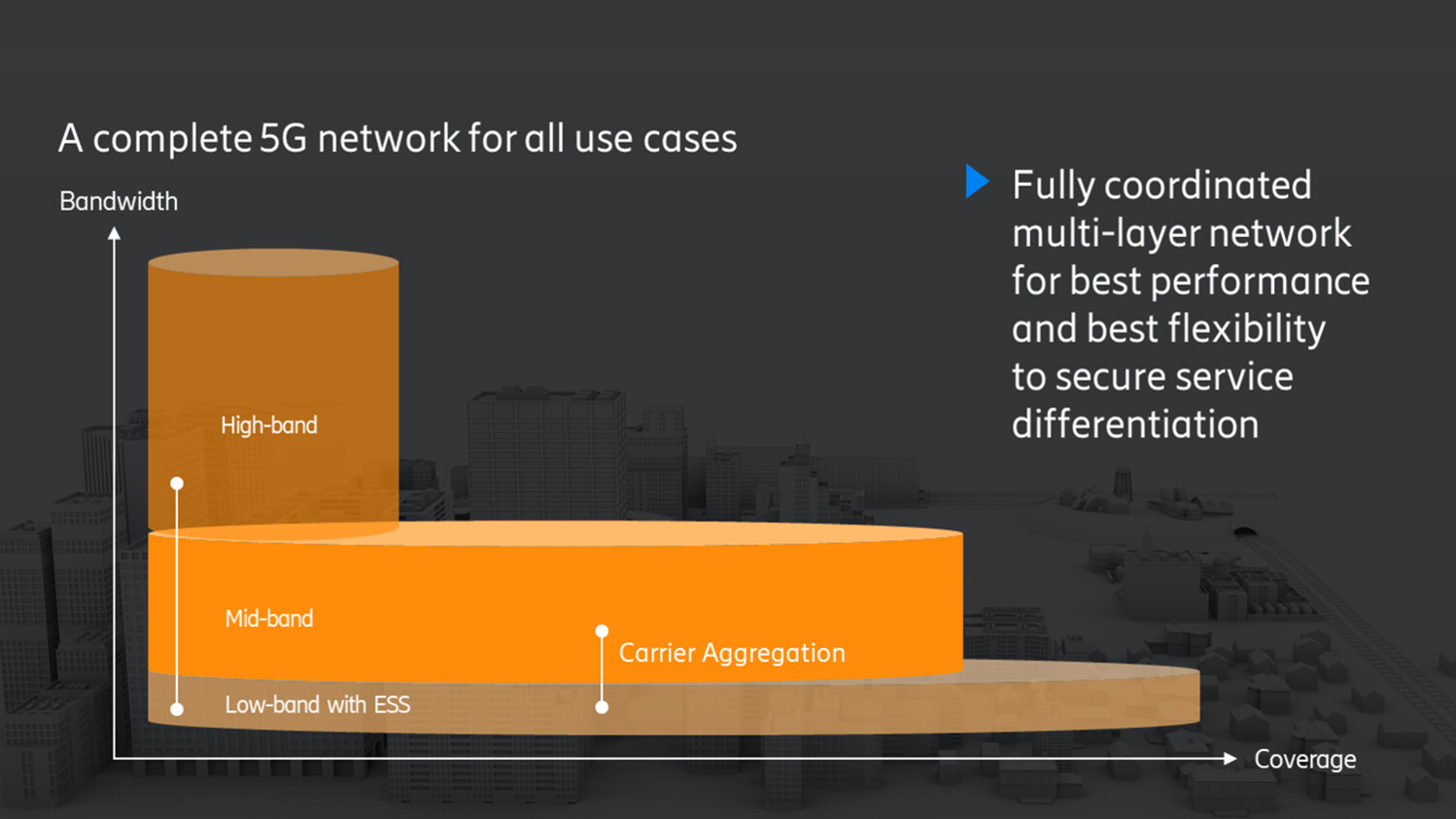
- The low-band offers the most economically feasible way to enable nationwide 5G coverage thanks to our Ericsson Spectrum Sharing (ESS) solution, award-winning at the 2020 Global Mobile Awards. The low-band also helps other time division duplex (TDD) bands to increase coverage using carrier aggregation.
- The mid-band is the sweet spot to offer 5G experiences. It combines the capability of higher system capacity with Massive MIMO (multiple input, multiple output), good coverage, and becomes already globally available, thus making it easier to scale.
- The high-band, above 24 gigahertz (GHz) offers the greatest opportunity for service providers to offer unprecedented peak rates, low latency, and high capacity. The 5G high-band or millimeter wave (mmWave) spectrum is a valuable resource when targeting sporting arenas, densely populated urban areas with a large number of mobile devices, and mission-critical services.
Ideal choice for delivering fixed wireless access broadband
Fast and reliable broadband has gained massive importance since the outbreak of the COVID-19 pandemic as so many people work from home. Fixed wireless access (FWA), delivered over 4G or 5G, is a cost-efficient broadband alternative in areas with limited availability of fixed services, such as digital subscriber line (DSL), cable, and fiber.
Today, the vast majority of FWA networks deployed operate on sub-6 GHz frequencies. The 5G mmWave can provide gigabit speeds over-the-air with FWA and eliminate the need for fiber. With the large spectrum available, adding mmWave carriers to an existing FWA network is an ideal way of boosting network capacity and providing the top-notch, end-user experience required for high-quality video streaming and more.
We recently explored how far it is possible to experience the high bitrates promised by the 5G mmWave spectrum. Achieving extremely long range requires the deployment of appropriately high-power radios and high-power devices but it is not sufficient. Ericsson software can accommodate the much longer propagation delays experienced in long-range deployment than in typical deployments.
The base station receiver does not initially know where the users with traffic are located, so it is crucial that it estimates the maximum propagation delay in the cell accurately. If the receiver expects the signal to arrive from a distance of up to 500 meters, it will miss the signal sent by a device located kilometers away.
We tested our innovation on several networks with various propagation conditions. We learned a lot and improved our software accordingly. Our most recent testing found that our solution could deliver 1 gigabit per second (Gbps) on a 400 megahertz (MHz) mmWave spectrum from approximately seven kilometers away.
Another example is Industry 4.0, which demands increased flexibility and a remodeling of the factory floor. Smart factories put extreme requirements on latency in combination with reliability. At an automotive original equipment manufacturer (OEM) site, just one minute of un-planned downtime can cost literally thousands of dollars, so we must cut the wires and replace them with a fast and reliable mobile connection.
The higher frequency, the lower the reach?
This is certainly true from a physics perspective. So much so, that we have made it our mission to find ways to mitigate the propagation challenges. Extending the coverage of mmWave usage has been our focus since the first commercial mmWave product was launched in 2018.
We make it a priority to learn together with our customers and continuously push the boundaries. Our innovative solutions are designed to address real coverage challenges so service providers may cover the area in question with fewer mmWave radios and deliver 5G gigabit speed to more users.
Beamforming is a MUST to counter the propagation challenges by concentrating the power in a beam directed to the user. For mmWave, the base station not only needs to use large antenna arrays to form highly directional beams, but the user equipment (UE) needs to perform beamforming when transmitting and receiving. This means we need to continuously create a beam pair between the base station and UE. The accuracy of the selection, and the delay in obtaining and updating the beam pair while the UE is moving, affects end-to-end performance and quality of service. Effective and efficient beam management plays a significant role here.
With our innovative two-level beam management solution, we use multiple narrow traffic beams to enable a high antenna gain and reach many users with 5G gigabit speeds. All this while maintaining low overheads and reducing initial access latency with wide access beams. This is similar to how a telescope or a pair of binoculars work. You begin by scanning the sky for stars and, once you have found one, you focus in to see better. This is why it is a good idea to have different levels of zoom: wider and narrower.
Another consideration is how fast the beam pair can be updated. Our beamforming solution provides instantaneous beam switching with zero transmission interruption. This is so users may enjoy smooth data streaming when moving frequently across the narrow beams.
In parallel to this, peak rate evolution has been a red thread to our work. We continuously improve the peak rate together with ecosystem partners to utilize the full potential of service providers’ mmWave spectrum. We have achieved world-class download speeds of 5Gbps over a commercial network. The peak-rate story on mmWave is far from over.
Optimizing deployment is also crucial for large-scale rollouts of 5G mmWave products. We are proud to be leading the global market in terms of the sizes, low weights, and power consumption of our mmWave Antenna Integrated Radios (AIR) for high-band and StreetMacro segment products.
Sometimes reality surpasses imagination
We have been working to make the high-band a reality for decades. Our pioneering use of mmWave technology could be found in handcrafted backhaul products in early GSM networks. Not in our wildest dream did we expect to see smartphones with mmWave support some 30 years later.
We revealed our first mmWave radio prototypes to customers at Mobile World Congress in 2014. Since then, close hardware integration has contributed to the decrease in size, weight and power consumption of our mmWave solutions without compromising field performance.
We made the world’s first 5G call in 2018 on commercial hardware and software platforms on a rooftop in the US. Together with our customers and partners, we had managed to launch 5G on mmWave using a 3GPP compliant router six months ahead of competition.
2020 was a big year for mmWave technology. Several compatible smartphone models appeared on the market, as well as the much anticipated mmWave-enabled iPhone. In 2021, the mmWave will likely become a more common feature of smartphones and industrial use designs, not only limited to the US.
A lot has happened since then and now consumers are already beginning to experience thrilling speeds via commercial mmWave networks. Did you know, that for instance, all major service providers in the US used 5G mmWave solutions to deliver amazing gigabit service in and around the Tampa arena during Super Bowl 2021?
Our extensive investments in R&D have produced in-depth knowledge, experience, and multiple 5G mmWave patents. We possess a leading portfolio in the global 5G mmWave patent landscape and fully own the technology we use.
Our purpose-built hardware and innovative software co-design, powered by Ericsson Silicon, places us in a unique position to fully exploit the potential of the high-band. We are still in the early days and we will produce even tighter integration to further improve performance and limit total cost of ownership. Our two-level beam management solution has fewer wide-access beams and many narrow traffic beams. Many traffic beams enable high antenna gains to reach many users with gigabit speeds. Fewer wide-access beams mean lower overheads and low latency.
Our design selections and holistic end-to-end Ericsson radio access network (RAN) architecture enables service providers to offer seamless user experiences between bands, deployments, and geography. Our technology leadership is fueled by a long-term commitment to innovation and a solid capability to build partnerships and trust with our customers and the wider ecosystem.
Close collaboration with our partners
Reaching this point has been a journey. Millimeter wave is new and sassy technology with only a few years under the belt. Along the way, we have pushed each and every boundary together with our partners on the chipset and device sides. We firmly believe that the development of the mmWave is a collaborative team effort to enhance user experiences.
Getting here has been exciting, sometimes painful, but always eventful. Every twist and turn of a mmWave device makes a big difference. Back in the beginning, we didn’t move the devices much as they were hot machines the size of refrigerators. Now, only a few years down the road, you can’t tell from the outside if a smartphone is mmWave enabled or not.
Today, our laboratories and testing facilities are busier than ever. It is here that we learn together with our partners how to advance the technological innovations that will come to market in 2021 and beyond.
It is exciting to see mmWave in everything from industry devices (private or not), laptops, smartphones at a variety of price levels, all the way through to long-range 5G mmWave customer premise equipment. We are looking forward to seeing the much-anticipated extended-reality (XR) glasses arrive on the market.
It is still early days for 5G mmWave technology and, together with our customers and the wider telecommunications ecosystem, we are committed to exploring the full potential of fully coordinated, multi-layer 5G networks. If there is one technology where capacity or speed is the least of your concerns, then it is 5G mmWave. We are proud to partner with the leading industry players on this journey.
Next time you celebrate someone’s birthday, if COVID-19 allows, we hope you remember that a 5G network looks a bit like a huge cake. Once you bite into the layer of sponge, and taste the sweet filling, you can then enjoy the icing on top.
Read more
Explore the Tech Unveiled blogs and videos
Read the paper: Leveraging the potential of 5G millimeter wave
Explore our 5G RAN key offerings
Explore 5G
Explore Industry 4.0