










How to become a better mentor for girls in ICT

Software Developer

Co-founder & CEO, Ericsson Drone Mobility

Global Campaign Director
Software Developer
Co-founder & CEO, Ericsson Drone Mobility
Global Campaign Director
Software Developer
Co-founder & CEO, Ericsson Drone Mobility
Global Campaign Director
In December 2020, Ericsson unveiled an opportunity for employees to participate in a mentorship program for girls in ICT. The initiative was in partnership with Technovation, a global non-profit organization that empowers girls and families to identify community problems and create tech and engineering solutions that develop leadership and creative problem-solving skills. The annual Technovation competition gathers girls aged 10 to 18 in more than 100 countries, and our task was to help prepare a team of girls with their solution so it was competition ready.
Our journey as mentors started with a basic idea of what we wanted to achieve, and a lot of positive enthusiasm. Did we want to build confidence in a team of girls? Yes. Did we want to encourage their interests and skills in app development, tackle social issues, drive entrepreneurship, and business thinking? Absolutely, sign us up!
In addition, the Ericsson Connect To Learn team had created a very structured program for us as mentors with plenty of information and tailored training to support us.
We were then grouped with colleagues with complementary skills. This meant software development (Kristin), business understanding (Kapil), and brand, marketing and communications know-how (Daisy). Along with these core skills, each of us naturally called on auxiliary expertise – teenager fluency (Kristin), polite but persistent analytical reasoning (Kapil), and influencing change without conflict (Daisy). We had a lot of fun planning our approach, discussing the progress, and supporting each other in how best to support the girls.
After signing up, we were matched with our team of three girls who we’d be mentoring. The girls were 13 and 14 years old and had all met at school in Singapore before ending up in different time zones and countries – the UK, Spain, Singapore. They formed their team, ‘Around the World in 80 Milliseconds’, as a fun way to stay in touch, and have since become serious about their (brilliant!) app idea beyond the competition, with plans to launch it ‘in the real world’.
Londonation: developing and supporting the team’s idea
The girls, full of energy and with a vision to help society, brainstormed many ideas and zeroed in on tackling a very critical problem in society: poverty and hunger. They drew on their own personal experiences of what they had seen and how they would like to help more. That’s where the idea for their app ‘Londonation’ was born.
The aim of the app is to make it easier for people to donate goods such as food, clothes and basic supplies to those in need – and for those in need to have a facility to find these items. It addresses two inherent problems:
- People are often willing to donate but don’t know how or where to do this.
- The recipients are people facing hard, even desperate times. However desperate their situation, it’s important for them to not feel patronized or disempowered in the donation transaction, but to decide for themselves what items they’d like to receive.
The initial focus for the service is London, a mega city with many people in need and distress, hence the name Londonation.
Because of the time zone differences, we could only schedule meetings on weekends, so we set up weekly video calls on Sundays. Apart from that, our only communication with the team was via email. After each meeting with the girls, we mentors had a quick check-in to follow up and agree how best to support the girls in the coming week. With a less dedicated team, this probably wouldn’t have been enough, but the girls showed significant progress each week and worked hard to develop their idea and all the materials required for the competition submission.
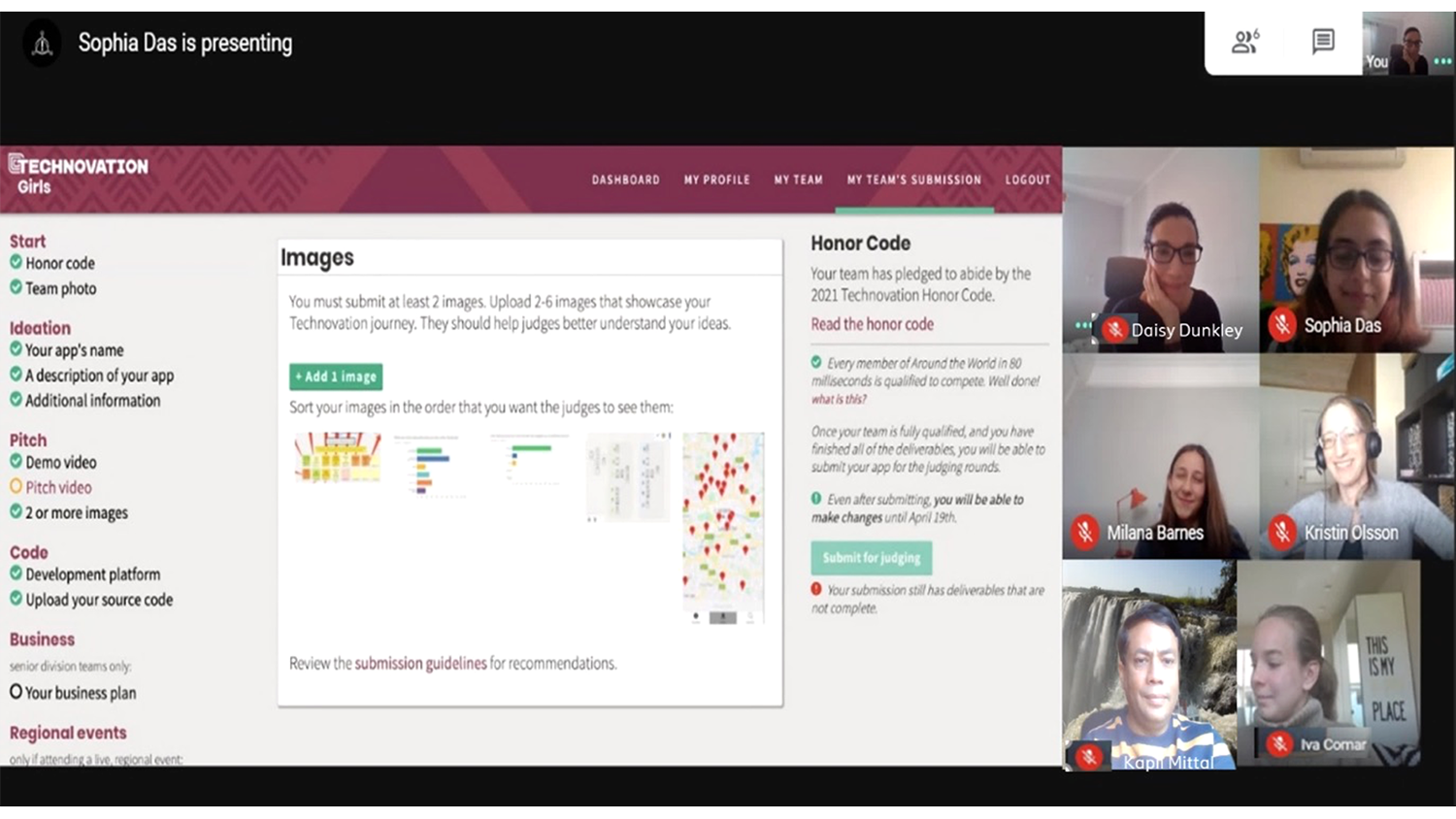
The team of mentors and mentees met virtually every Sunday for a weekly check-in on progress.
A Q&A with the mentors
Viktoria Andersson, Project Manager of the 2021 Girls Mentorship Initiative at Ericsson, sat down with the mentors to delve deeper into their experience with the Londonation team.
Q: Why did you decide to participate in this mentorship program?
Kristin: Being part of a development team handling components of Ericsson’s 5G technology, I attend a lot of technical meetings. While the range of roles and responsibilities of colleagues varies a lot, the one constant is that the vast majority are male. I’m quite often the only female in a meeting of over 10 people, for example. While I truly appreciate my colleagues (regardless of gender), I saw this program as a chance to address an imbalanced situation by encouraging more girls into ICT careers.
Kapil: Having benefited from great mentorship in my professional and personal life, I was motivated to try to do the same for others, particularly for the worthwhile cause of fostering diversity in STEM.
Daisy: I’ve taken part in coaching/teaching projects in the past and always found them incredibly rewarding, especially when you can play a part in supporting young people in their learning and development. It inevitably leads to a degree of learning and development for the coach as well!
Q: What did you think worked well and was rewarding?
Kristin: Working with colleagues with expertise in different areas was very helpful. It made the job much easier, and much more fun. I think we made a good mentor team. When we met challenges, we talked them through, shared our frustrations and ideas. Together, we managed to help the girls overcome their obstacles and finish the project.
Kapil: I believe Ericsson’s core values play a very important role. Respecting the team for their ideas, perseverance with the process, and professionalism in helping the girls to achieve their goals. An important element is understanding that mentoring is learning both ways. The way the young team led our weekly meetings, for example, was a striking lesson in focused and efficient meeting management – something we don’t always manage in corporate life!
Daisy: It was a real joy to see each of the girls find their voice as their confidence grew, along with their trust in us. They asked questions and presented their ideas with more assurance and conviction, the more we met, the more tasks they accomplished.
Q: What was it like to virtually mentor the girls?
Kristin: It was a bit of a challenge versus meeting and connecting face-to-face, but also an advantage. It meant that us mentors in Sweden and Kenya were able to support a team in the UK, Spain, and Singapore. And, with all of us now used to working or schooling remotely, we were already quite comfortable with virtual meetings.
Kapil: Kudos to the girls for making this work across time zones that were eight hours apart. They also had ongoing collaboration amongst themselves and update/planning meetings with us every Sunday.
Daisy: Virtual meetings with a group that spans generations and hasn’t met before requires a bit of extra effort to break the ice and get everyone participating. But with the familiarity that comes with regular meetings and a structured agenda to fall back on, we got there.
Five tips on how to become a great mentor
- Show your commitment as mentors. We kept up a flow of different ideas to help the girls – from tailored coding sessions to setting up an interview with a professional contact to get ‘the expert opinion’. The interview helped highlight an issue with the team’s idea, so they could arrive at the decision to make the necessary changes.
- Building trust takes time. We got there with patience and perseverance, and by keeping a positive energy in our meetings. With trust, the girls opened up and shared a lot more with us – ideas, opinions, work in progress, and so on.
- Ask open questions and listen! Ask follow-up questions and practice active listening. This would encourage the girls to keep thinking and sharing, which was needed, especially at the beginning of the project when the girls were very nervous (which they later told us) and didn’t speak unless spoken to!
- Shake up the format if it’s not working. Early on, we suggested the girls should set the agendas and run the weekly meetings. This proved a great way to give each of them a platform, build their confidence, and change the meeting dynamics.
- Make time for reflection and acknowledgment. At our last meeting, we each shared ‘two stars and a wish’ – two good things and one suggestion for improvement. With the simple format, you can share as much or as little as you like. We were blown away by how much the girls shared – detailing positive experiences, satisfaction from tackling challenges, and appreciation of the mentor support. It proved to be a great way to close the project, and a very rewarding moment for us all.
Through the girls’ own hard work, Londonation made it to the semifinals. This is a huge achievement – just over 10 percent of 1,700 submissions made it to this stage, so the team should be proud that they came so far. We’re delighted to have had the opportunity to be their mentors and we hope they continue to follow their passions.
Learn more
Read how we’re inspiring the next generation of tech superstars using 5G.
Learn more about Technovation.