







Viva Vivo Brazil: Converged charging and BSS transformation at scale

Solution Marketing OSS/BSS

Solution Marketing OSS/BSS
Solution Marketing OSS/BSS
As the largest Latin American subsidiary of The Telefonica Group, Telefonica Brazil currently serves nearly 100 million customers in a mix of B2C and B2B accounts across Brazil. Trading as Vivo Brazil, this market leading telecom service provider boasts EUR 7.5 billion in revenue annually—the second highest in The Telefonica Group—with a 33 percent market share of Brazil’s telecom business. Vivo Brazil has:
- Nearly 100 million mobile subscribers
- 33 percent mobile market share
- 4 million fiber-to-the-home (FTTH) homes connected
- 17 million fiber-to-the-home (FTTH) homes passed
- The number-one telco value brand in the market
To preserve and strengthen its market leadership, Vivo Brazil is in the process of rolling out an open, cloud-ready operations network empowered by an Online Charging System (OCS) that is part of Ericsson’s Digital BSS portfolio. These advanced, cloud-based solutions will be essential for the delivery of the innovative, real-time services that consumers and businesses expect from 5G in the future.
Building the optimal 5G ready platform
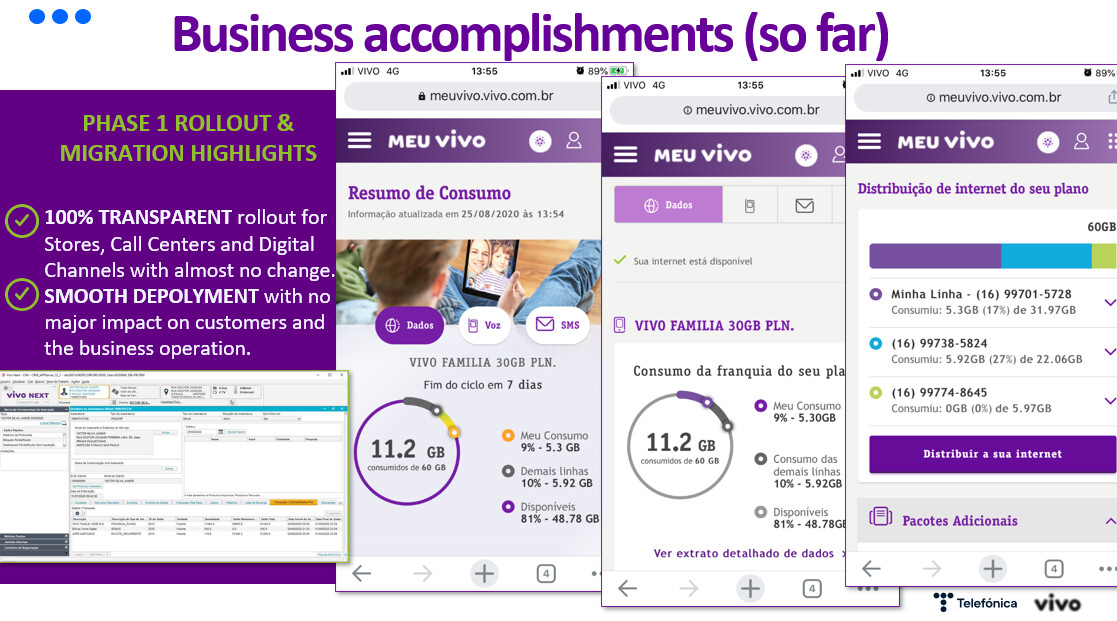
The upgraded platform will consolidate the B2C and B2B operations, automate processes ranging from ordering, billing, catalogs, and customer relationship management (CRM), as well as support the Meu Vivo (My Vivo) mobile self-care app.
While they’ve made continuous improvements over time, Vivo Brazil found this digital transformation effort to be particularly challenging because it called for migrating their entire customer base to the new platform without interrupting service. Like changing a tablecloth without disturbing the place settings on top, Vivo Brazil needed to ensure that the switchover would be completely transparent to customers and not disrupt their services in any way.
Keenly aware that tampering with this mission-critical infrastructure was a risky endeavor, Vivo’s executives aptly named the project ‘Pandora’.
“If this platform stops, the country stops!” said Vivo Brazil André Kriger emphatically in a video presentation Vivo BSS Transformation produced by Ericsson that describes Vivo Brazil’s digital charging transformation. Kriger further explained that downtime would mean that tens of millions of Vivo customers could lose their ability to call, text, or browse the internet using data services.
Vivo and Ericsson worked side by side to deploy the next gen cloud solution and seamlessly migrate subscribers over to it, with zero downtime updates, improved time to market and stable operation. What made it an even better fit is that Ericsson incorporated many of Vivo’s ideas, needs, and concerns into the design and manufacture of the new technology solution. The phase one rollout and migration was deployed smoothly, with no major impact on the customers or business operations. There was also a 100 percent transparent rollout for Vivo Brazil’s stores, call centers and digital channels.
Not only did the initial phase of deployment smoothly migrate roughly four million of the customers to the new platform, Kriger called it, “100 percent transparent…a smooth deployment…with zero downtime” in the video.
The rationale behind the transformation
Vivo Brazil embarked on this radical, ground-up transformation journey because its legacy platform had reached its ‘end –of –life', meaning it was becoming harder and harder to update and extend the code considering new and future requirements from the business, such as convergence, 5G, cloud architecture, etc. It would never been able to enable the fast-paced growth Vivo wanted to maintain customer satisfaction.
Through the Pandora project, this digital transformation enables Vivo Brazil to offer and monetize new services to consumers and enterprise customers. The company set ambitious goals, milestones, and objectives to meet as they began to roll out these Ericsson Digital BSS and converged charging solutions and consolidate their legacy B2C and B2B platforms with other network components to ensure real-time interoperability, agility, and flexibility.
In the recent press release Telefonica Brazil Vivo selects Ericsson charging”, Ericsson and Telefonica Brazil (Vivo) jointly announced that the two companies “will make Ericsson Charging the strategic monetization platform for Vivo’s prepaid, postpaid, and hybrid-consumer and enterprise-convergent charging requirements”.
The reach of Pandora
Vivo Brazil’s partnership with Ericsson is long-standing, including an initial BSS upgrade initiated in 2012. The extensive Pandora project, which commenced in mid-2018, will span 2022 and 2023. Today, Kriger says that 95 percent of the post-paid customers have already been migrated to the new platform. In 2022, mobile pre-paid, mobile hybrid and 5G stand-alone service customers should move to the new Vivo platform; and those with mobile B2B and digital-only services will move in 2023.
below illustrates the scale and complexity of Vivo Brazil’s Pandora project, replacing mission critical platforms without impact:
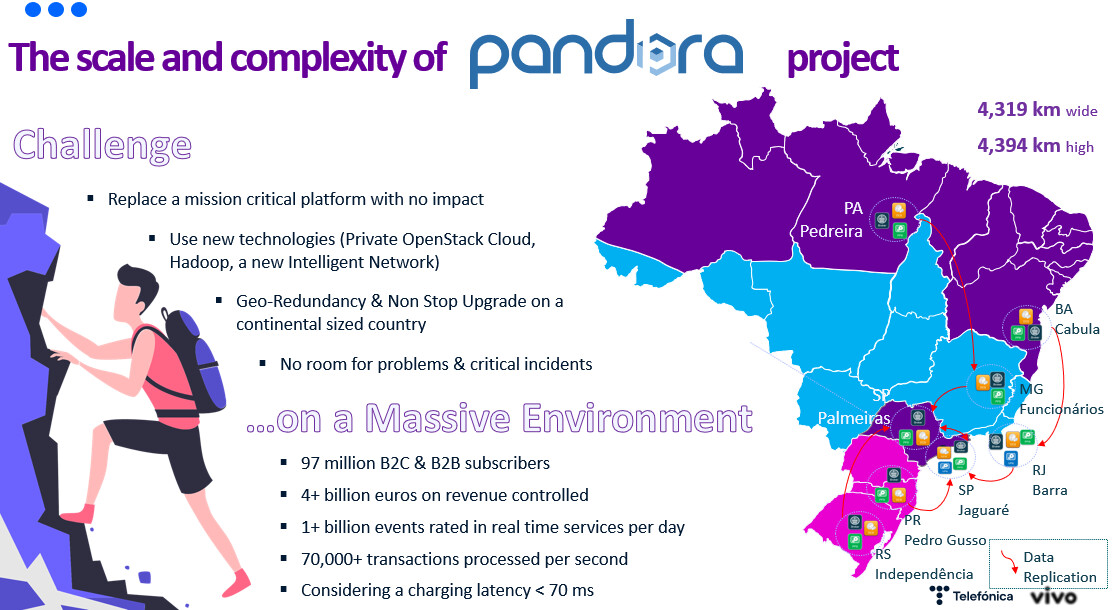
In its daily operations, Vivo Brazil generates and processes over 70,000 transactions per second, over one billion real-time service events, over 35 million invoices per month, and millions of assistance requests addressed by service agents and chatbots while maintaining a high quality of service, with a low charging latency of less than 70 milliseconds.
Kriger further explains in the Vivo BSS Transformation video that Ericsson was one of three vendors they evaluated for the job, and that Ericsson was selected for two reasons. “The first is the need to ensure continuity,” Kriger said. They needed to have total confidence that the vendor they chose would be there to support the product and stand behind them because, as he said earlier, if the platform stops, the country stops. Kriger continued, “The second one is that as the product was being built, we were able to influence the roadmap.” Ericsson considered Vivo’s requirements and how the software was going to be deployed.
“We want to drive the digital transformation in Brazil by giving our customers the best experience,” Kriger said in the Ericsson press release. “We chose the Ericsson charging solution because of its advanced technology and ability to support us in accelerating time to market for new products and services, delivering optimized operational costs, and improving customer experience with real-time information.”
This newly transformed BSS platform is making it easier for Vivo Brazil to bring new services to market, automate key functions, and monetize these new business opportunities.
Learn more
- Check out the following media assets to learn more about the massive charging and BSS transformation underway at Vivo Brazil: Vivo BSS Transformation
- Ericsson press release: Telefonica Brazil Vivo selects Ericsson Charging
- Read more about telecom BSS