










Jobs and automation: Will IoT reduce the need for human labor?
- English
- Français


Since the Industrial Revolution, at the very least, workers have feared that new technologies might make their jobs obsolete: worried they may become redundant, the Luddites burned and destroyed the machinery that was threatening them. Economists, too, have debated about the impact of technological change on labor demand. A popular view, supported by empirical evidence, is that new technologies may displace workers in certain sectors or tasks while increasing the need for others.
Among new technologies, the Internet of Things (IoT) has received a great deal of attention. Even though there is no unique, standard definition of IoT, we usually think of it as a network of “smart devices” with communication capabilities, which range from cellular networks to radio frequency identification (RFID). Public attention has focused on consumer technologies , such as wearables and self-driving cars, and its implications for security and privacy. But there is also a wide range of business and industrial applications that are often overlooked and make up the bulk of the potential value enabled by IoT. IoT technology is currently employed in numerous applications, from healthcare sensors to automated warehouses. In general, IoT can help automate and monitor processes and tasks, such as the production of goods and delivery of services, which are common in different industries (Höller et al., 2014). But IoT systems are also able to collect and share large amounts of high-quality data via the Internet, enabling businesses and governments to make better decisions. Previous research has also found a positive relationship between IoT usage and productivity growth across countries (Edquist et al., 2021). It is therefore of interest to ask: Does IoT have an effect on the labor market of a country? And, if yes, is the effect different in developed and developing countries?
Adoption and diffusion of IoT
The number of IoT devices has seen a very large increase in the last decade all over the world, and in China in particular. Figure 1 shows the number of total cellular IoT connections between 2010 and 2022 by region.
When looking at the number of connections per capita, there is a large variation across countries. Figure 2 displays the distribution of connections per 100 inhabitants across the world in 2021. Sweden has the highest rate of IoT adoption per capita, with 193 cellular IoT connections per 100 people. As with previous technologies, such as mobile broadband, there seems to be a digital divide in IoT adoption between developed and developing economies. Still, lower income countries have been catching up: in 2021, the average number of IoT connections per inhabitant in OECD countries was just 1.2 times that of non-OECD countries, down from a factor 10 in 2010.
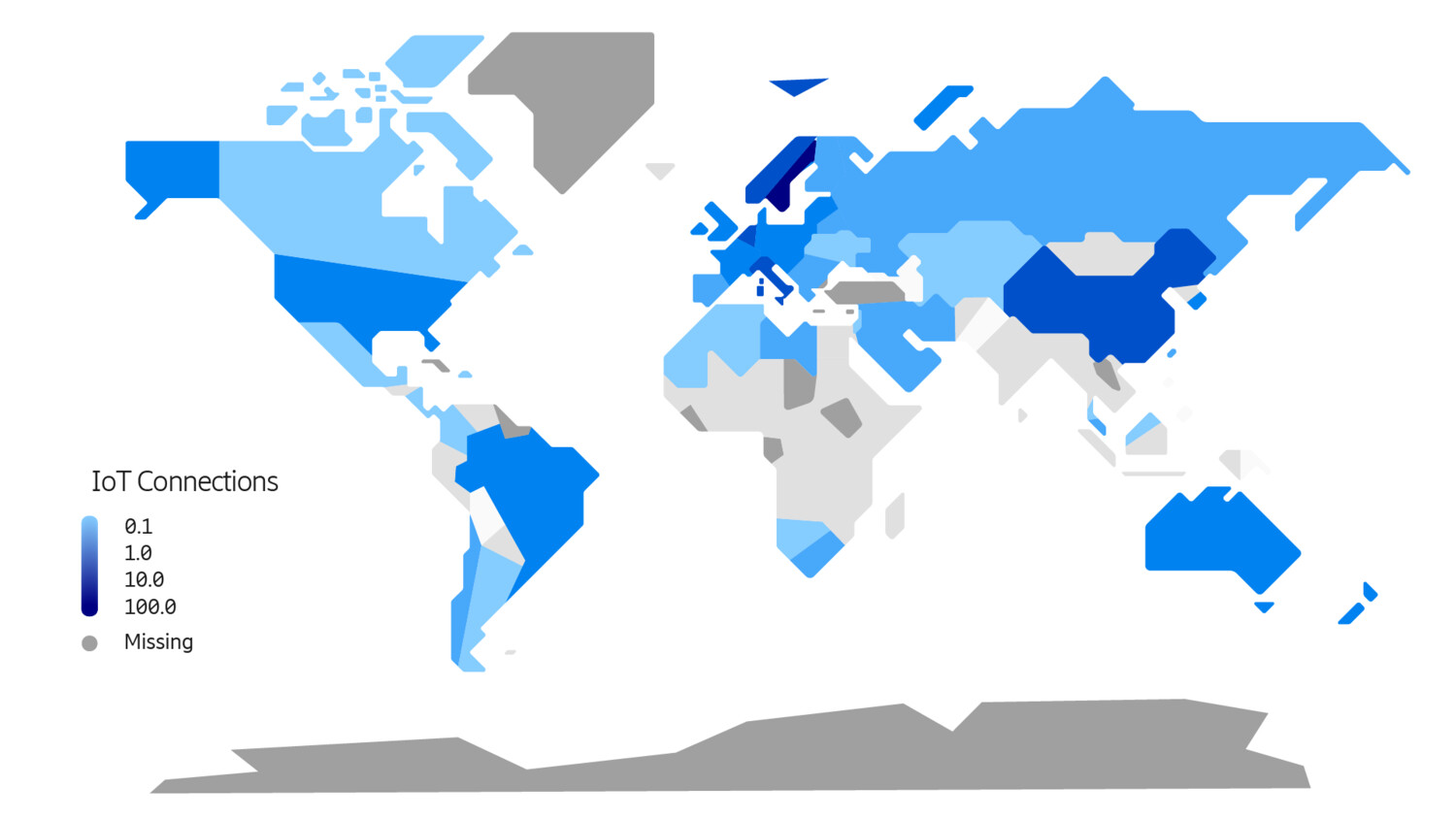
Figure 2: Number of cellular IoT connections per 100 inhabitants by country in 2021. Source: GSMA (2022).
IoT and employment
From a theoretical perspective, it is unclear IoT should have a positive or a negative overall impact on labor outcomes: while it may displace some workers by automating certain tasks, it may also create increased demand for other workers whose tasks cannot be automated.
In my thesis Connected and Employed: Empirical Evidence On The Internet of Things in a Panel of Countries, I constructed a dataset of 107 countries over the ten years between 2010 and 2019, which includes 36 OECD- and 71 non-OECD countries. Using statistical analyzes and linear regression models, I investigated the relationship between IoT adoption, defined as the number of IoT connections per 100 inhabitants in a country, and employment. To measure employment, I focused on three different metrics: the unemployment rate, the total persons employed and employment in three different sectors (agriculture, industry and services). The analysis also takes into account various economic and ICT characteristics such as GDP, human capital and fixed and mobile broadband connections that affect both employment outcomes and the adoption of IoT.
The results show no strong correlation between IoT usage and either unemployment rate or total employment in the full set of countries. However, it is more interesting to look at OECD and non-OECD countries separately, since IoT adoption rates are very different in the two samples. I find a strong and positive correlation between IoT adoption and total employment in OECD countries, which is driven by employment in the service sector. In particular, a one-unit increase in the number of IoT connections per 100 inhabitants is associated with a 0.06% increase in the number of people employed in OECD countries, holding other factors constant. To put this into perspective, in the 10 years considered this measure grew on average by 2.3 connections per year in the OECD sample, and a one-unit is therefore a relatively large increase. In Sweden, a 0.06% increase would equal about 3,000 new jobs in 2021. On the other hand, I find a negative and less strong correlation between IoT adoption and employment in the industry sector that may be driven by non-OECD countries.

Going forward
As of now, the empirical evidence seems to suggest a mostly positive relationship between cellular IoT and employment, at least in those countries where IoT usage is high. This is in line with both previous research on IoT, which finds a positive impact on productivity (Edquist et al., 2021), and on other ICTs such as mobile broadband, which has a positive impact on employment and a neutral impact on unemployment ( Atasoy, 2013; Czernich, 2014). The recurring worry that new technologies and automation would make more workers redundant compared to the new job opportunities created seems to be, at least for now, unfounded.
Learn more
Read the thesis in full: Connected and Employed: Empirical Evidence On The Internet of Things in a Panel of Countries
Read related Ericsson blog posts on the link between IoT and productivity growth , and why faster mobile networks can lead to faster economic growth.
Explore how cellular connectivity is helping to digitally transform the world of industry.
Learn more about Ericsson's commitment to driving greater digital inclusion across the world.