










Private 5G is ready for Industrial EtherNet/IP

Head of 5G for North America

Head of 5G for North America
Head of 5G for North America
Sustainability policies are growing in importance across all industrial sector verticals. Adopting more sustainable policies is becoming more and vital for business. Tethered fixed industrial assets (skids, machines, or equipment) require costly wired infrastructure for new installations; this material usage negatively impacts sustainability initiatives.
Tethered fixed industrial assets also impact the agility of industrial operations preventing quick retooling to respond to dynamic market conditions. These limitations were recently highlighted as the entire manufacturing industry had to retool its industrial operations to meet shifting demand during the pandemic: switching from soda to sanitizer, clothing to medical masks, or automotive parts to ventilators. The lesson is that agility, efficiency, resiliency, and sustainability in smart manufacturing is a critical national imperative!
In comes industrial Private 5G, an enabler of digital transformation in smart manufacturing to help deliver business outcomes such as sustainability and agility by supporting industrial key applications:
- Connected worker applications increase visibility and intelligence through mobile digital tools such as analytics, digital twins and augmented reality (AR).
- Mobile asset applications increase agility and efficiency with autonomous vehicles such as automated guided vehicles (AGVs) and autonomous mobile robots (AMR).
- Untethered fixed industrial asset applications improve sustainability by reducing the need for wired infrastructure to connect static equipment, static equipment with rotating parts (slip-ring replacement) and nomadic equipment (operational while static, non-operational while mobile). Untethered fixed industrial assets also increase agility by reducing the time to retool industrial operations to respond to changing market conditions.
Can industrial Private 5G help to enable these application use cases within manufacturing and process operations? To address this question Rockwell Automation (the industry leader in industrial automation) collaborated with Ericsson (the industry leader in cellular networking infrastructure), Qualcomm (the industry leader in embedded devices) and Verizon (the leading network service provider) partnered to help answer this question. The research collaboration evaluated industrial Private 5G technology with EtherNet/IP™ connectivity, the core industrial communications technology from Rockwell Automation. The key learning objective was to ensure that EtherNet/IP networks are ready for industrial Private 5G and to confirm that industrial Private 5G is ready for demanding EtherNet/IP applications.
The illustration is a simplified representation of the testbed developed. It represents an untethered fixed industrial asset application use case, consisting of:
- Rockwell Automation standard and safety control. One area controller with a GuardLogix® safety controller. Twelve distributed areas with FLEX 5000® standard and safety I/O, representing skids, machines or equipment. Note, the purpose of the safety controller in each distributed area was to collect testbed telemetry data only.
- Ericsson radio access network (RAN) infrastructure. Composed of a mmWave base station using 28 GHz (n261) and LTE band 2 using Release 15, and a Private 5G core (3GPP Release-15, non-standalone (NSA), on-premises).
- Qualcomm MTP. A mobile test platform for data collection and traffic flow analysis, used as an industrial 5G to Ethernet adapter, referred to as user equipment (UE).
- Verizon’s thought leadership in industrial networking innovation with 5G was an important contribution towards defining requirements, target feature sets, and scope of the testbed, including a roadmap of future validation requirements.
Research proof-of-concept collaboration
Private 5G, release 15, non-standalone (NSA), on-premiseEricsson, Qualcomm and Rockwell Automation
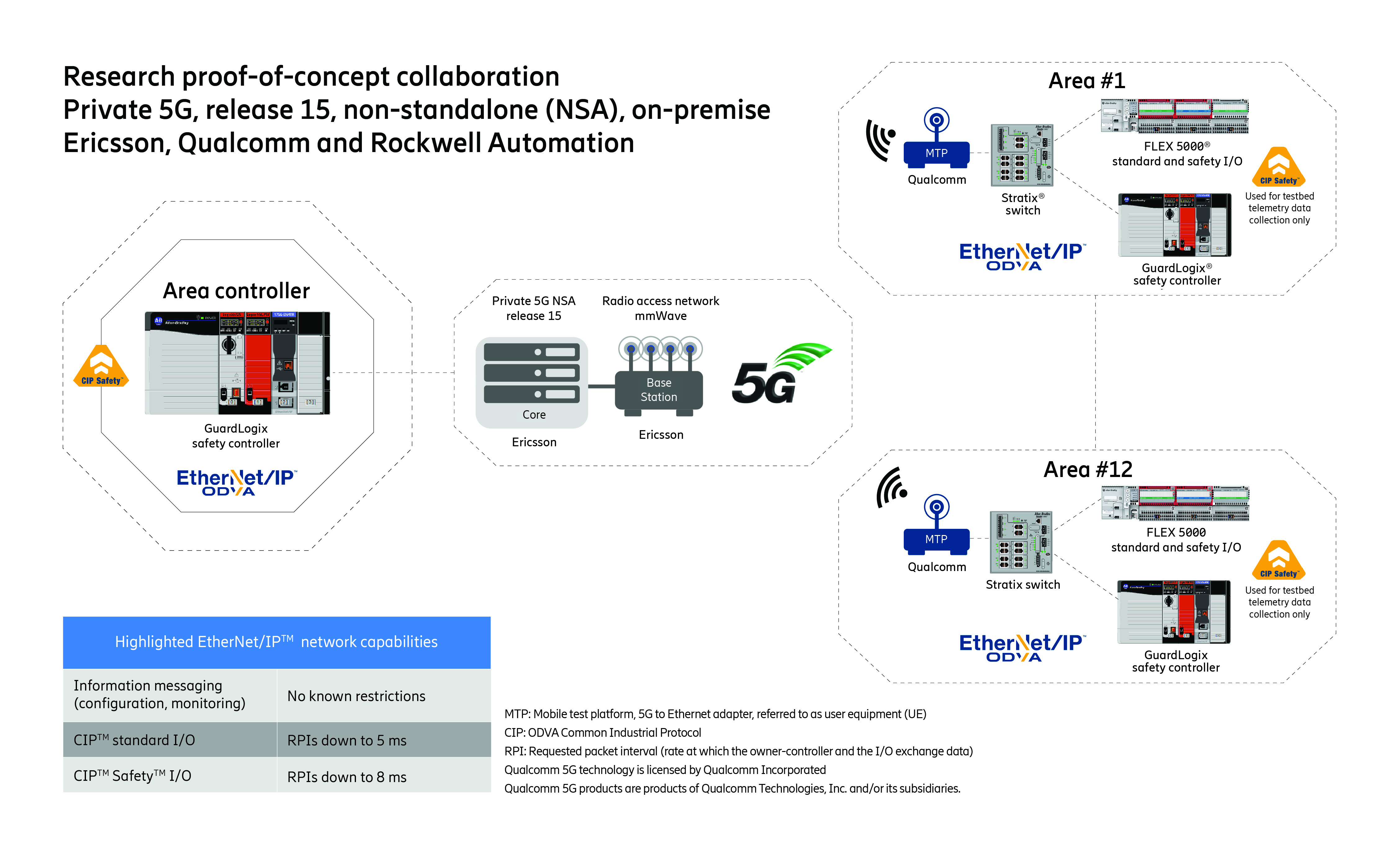
Tests were run according to a well-established test plan provided by Rockwell Automation with strict success criteria of zero faults. It outlined a series of test cases to establish reliable
EtherNet/IP standard and safety (CIP Safety™) I/O connections from the GuardLogix area controller on the left, with a range of requested packet interval (RPI) settings, over the 5G RAN to the FLEX 5000 standard and safety I/O in areas 1 through 12 on the right. RPI is the rate at which the controller and the I/O exchange data.
The successful test results demonstrated that the current state of industrial Private 5G (3GPP Release-15, NSA, on-premises, mmWave spectrum) has low enough latency and jitter to support RPI settings that are better than the Rockwell Automation default settings for EtherNet/IP standard and safety I/O connections. These RPI settings will support many untethered fixed industrial asset applications (skids, machines or equipment) that use EtherNet/IP standard and safety I/O communications.
The outcomes of the learning objective emphasized:
- EtherNet/IP is ready for industrial Private 5G.
- The current state of industrial Private 5G is ready for EtherNet/IP standard and safety I/O applications.
- Industrial Private 5G can help to enable business outcomes such as increased sustainability and improved agility within industrial operations.
The research collaboration will continue. There are plans to evaluate EtherNet/IP time synchronization (CIP Sync™) and distributed motion (CIP Motion™) applications over 3GPP Release 16 standalone (SA) industrial Private 5G. The results of an initial proof-of-concept on a Prototype Testbed were promising.
In summary, thanks to Rockwell Automation, Ericsson, Verizon, and Qualcomm Technologies Inc., we can verify that real 5G-enabled industrial automation test cases work as promised. Industrial operations can thus take advantage of the 5G standard today to meet their high-performance wireless connectivity and business assurance needs as they evolve toward smart manufacturing.
Further reading
- From Rockwell: Private 5G Offers Sustainable and Agile Operations | Rockwell Automation
- From Qualcomm: Here’s how industrial Private 5G helps enable sustainable and agile industrial operations
- Ericsson Dedicated Networks
About Ericsson:
Ericsson is one of the world’s leading providers of 5G networking technologies. We enable the full value of connectivity by creating game-changing technology and services that are easy to use, adapt, and scale, making our customers successful in a fully connected world. Our comprehensive portfolio includes Networks, Cloud Software Services, and Emerging Businesses; powered by 5G and IoT platform solutions. It is designed to help our customers to go digital, increase efficiency and find new revenue streams. Ericsson’s innovation investments have delivered the benefits of mobility and mobile broadband to billions of people globally. Ericsson stock is listed on Nasdaq Stockholm and on Nasdaq New York.
About Verizon:
Verizon Communications Inc. (NYSE, Nasdaq: VZ) was formed on June 30, 2000, and is one of the world’s leading providers of technology and communications services. Headquartered in New York City and with a presence around the world, Verizon generated revenues of $128.3 billion in 2020. The company offers data, video and voice services and solutions on its award-winning networks and platforms, delivering on customers’ demand for mobility, reliable network connectivity, security, and control.
About Qualcomm:
Qualcomm is the world’s leading wireless technology innovator and the driving force behind the development, launch, and expansion of 5G. When we connected the phone to the internet, the mobile revolution was born. Today, our foundational technologies enable the mobile ecosystem and are found in every 3G, 4G and 5G smartphone. We bring the benefits of mobile to new industries, including automotive, the Internet of Things, and computing, and are leading the way to a world where everything and everyone can communicate and interact seamlessly. Qualcomm Incorporated includes our licensing business, QTL, and the vast majority of our patent portfolio.
Qualcomm Technologies, Inc., a subsidiary of Qualcomm Incorporated, operates, along with its subsidiaries, substantially all of our engineering, research and development functions, and substantially all of our products and services businesses, including our QCT semiconductor business. To learn more about Qualcomm 5G solutions, visit this link.
About Rockwell Automation:
Rockwell Automation, Inc. (NYSE: ROK), is a global leader in industrial automation and digital transformation. We connect the imaginations of people with the potential of technology to expand what is humanly possible, making the world more productive and sustainable. Headquartered in Milwaukee, Wisconsin, Rockwell Automation employs approximately 25,000 problem solvers dedicated to our customers in more than 100 countries. To learn more about how we are bringing the Connected Enterprise to life across industrial enterprises, visit this link.
Connected Enterprise, FLEX 5000, GuardLogix, Stratix and Rockwell Automation are trademarks of Rockwell Automation Inc.
CIP, CIP Safety, CIP Sync, CIP Motion and EtherNet/IP are trademarks of ODVA, Inc.