










Unified multi domain service orchestration: a must for 5G enterprise services?

Director, BA Cloud Software and Services

Principal Architect, Line Manager

Director, CSS O&A Enterprise Orchestration & Automation

Director, BA Cloud Software and Services
Principal Architect, Line Manager
Director, CSS O&A Enterprise Orchestration & Automation
Director, BA Cloud Software and Services
Principal Architect, Line Manager
Director, CSS O&A Enterprise Orchestration & Automation
5G for enterprise
Customized 5G services for enterprises is projected to be one of the most promising opportunities of 5G technology. Offering standardized but highly customizable solutions to enterprises will enable new revenue streams for communication service providers (CSPs). The enterprise solutions offered by CSPs would span across telecom as well as enterprise application. The introduction of new non-traditional actors in the ecosystem requires more standardized and unified interfaces for seamless operations and faster time to market.
5G enables network slicing
5G enables the innovative technologies and new business opportunities that enterprises are looking for. Users want automated business and operational processes that span the whole process: from the ordering of services to activation, delivery to service de-commission. Enterprises expect services to be delivered faster, in an automated manner and with almost no manual intervention.
What is network slicing?
Network slicing plays a crucial role in enabling service providers to enter new markets and expand their business today. Network slices can be defined as logically separated and self-contained entities of the network / logical networks on top of a shared physical infrastructure. Different slices can enable / support different services with different requirements on speed, latency and reliability.
These slices, typically one for each type of service, can be completely separated and independent from each other. This means if goes wrong in one slice it will not affect the other slices.
Network slicing increases opportunities
The introduction of network slice will further increase the complexity to manage the network. Hence, there is a need to further evolve the current operations support systems (OSS) offering to seamlessly manage network slicing.
Service orchestration will be one of the key OSS components which needs to be designed as per each enterprise needs to automate use case driven network slice. It will also simplify the operations and ability to manage multiple network slices across different use cases dynamically.
Service orchestration by CSPs to enable enterprise customers
Networks have traditionally been domain specific and managed in silos, which makes the service creation and delivery towards enterprise customers both slow and costly. Service orchestration removes those silos to enable more flexible and automated networks, based on multi-vendor, multi-cloud and multi-hyperscale cloud provider (HCP) environments.
For CSPs to be successful, multi domain service automation is needed to increase efficiency by removing manual tasks related to designing, ordering, fulfilling and assuring services. Service automation is also needed to be able to achieve the zero-touch operations vision. Solutions for increased efficiency includes unified user experience, simplified modelling and an intent based approach, as discussed below.
A simplified unified solution
For example, CSPs need to launch a 5G edge service that not only spans across their network functions but also covers the enterprise domain. This can include enterprise application, 5G network functions and hyperscale infrastructure. As highlighted in the below diagram, we can segregate the layers in three logical layers covering the commercial, orchestration and infrastructure layer. Ongoing maintenance and customization require consistent modifications to all layers. Having a unified high-level user interface for configurations simplifies this complex task. Details for each level could be derived from the high-level configuration. Access to low level layer configuration can be granted to experts based on user roles. Intent based changes and full automation on all levels is another pathway to reduce complexity.
Intent based configuration
Rapidly creating, provisioning and changing customized network services requires a new simplified approach. Operators need to concentrate on defining what a customized service should provide without prescribing the details of how it can be accomplished in an optimal way. The task of the operational team is to define the desired” state. It is the task of an automated orchestration system to monitor changes in the definition of a desired state and automatically update the configurations making modifications to the current runtime state to match the newly defined desired state.
Realizing this intent-based approach requires the proper logical breakdown of an end user service. Modelling must be done on the commercial layer, multi domain orchestration (MDO) layer, single domain orchestration (SDO) layer and on the infrastructure layer. For example, on a commercial layer the service can be described in terms of availability, latency, throughput, connection security and service cost desired values. On the multi domain orchestration layer, service can be defined using 3GPP models for network slices and network slice subnets. On the core network domain level for a certain slice type templates with a set of correlated configuration parameters can be defined for each participating network function.
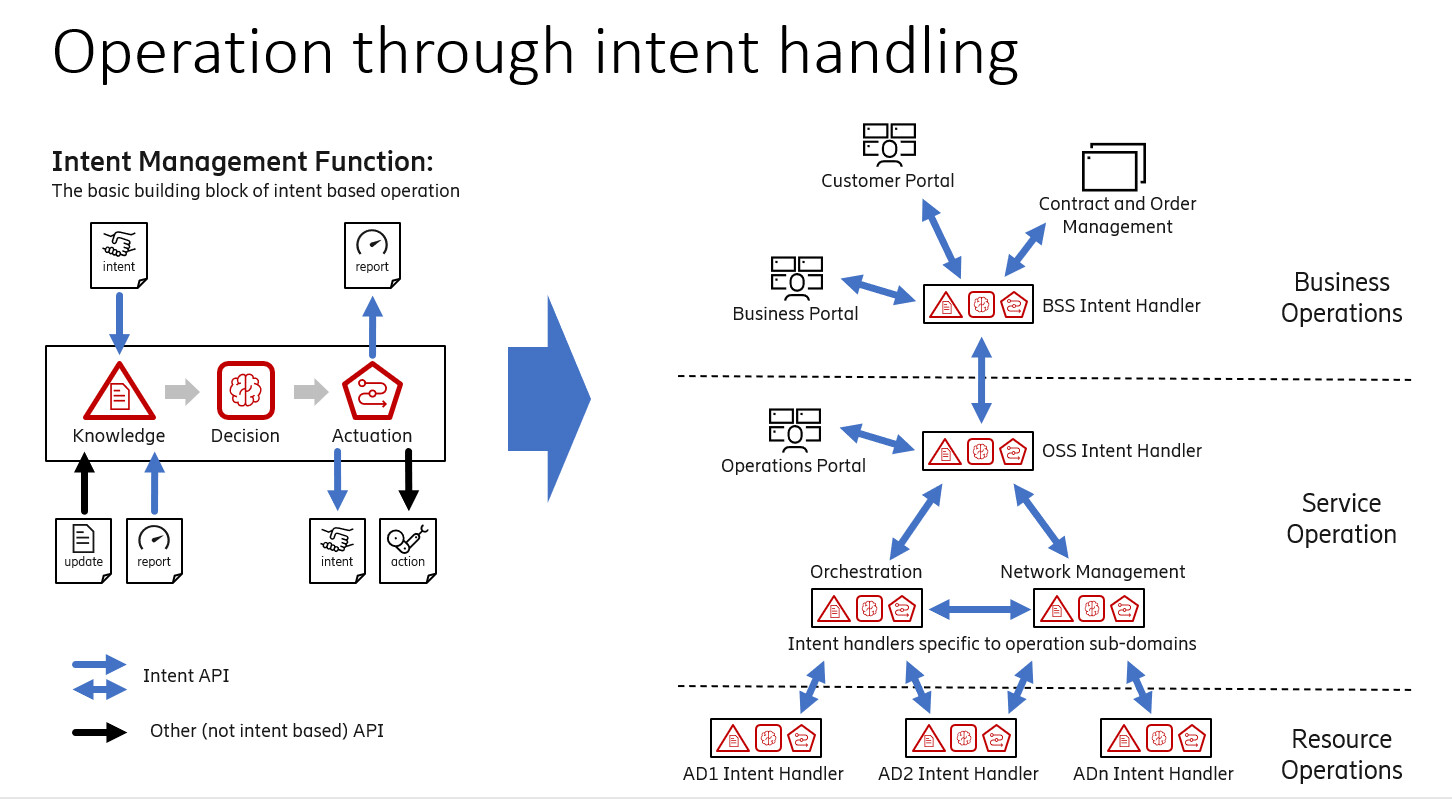
Figure 1: Intent based Design and Orchestration
Fully Automated Unified Solution
It is essential for an operations team to have a central “cockpit” where the modelling relationship between the different provisioning layers (commercial, MDO, SDO and infrastructure) can be defined and reviewed. This central layer should also define and display the necessary orchestration steps required for automatically synchronizing the desired and current provisioning state. This central modelling and orchestration layer should have role-based access: user roles control who can make changes to a modelling and processing of a layer and who is eligible to view the design and runtime provisioning data. Ideal solution model structures are defined by architects and are frequently released as per customer’s timelines. Model-based service level agreement (SLA) adjustments can be done in real time. Changes should be automatically applied with zero touch manual intervention.
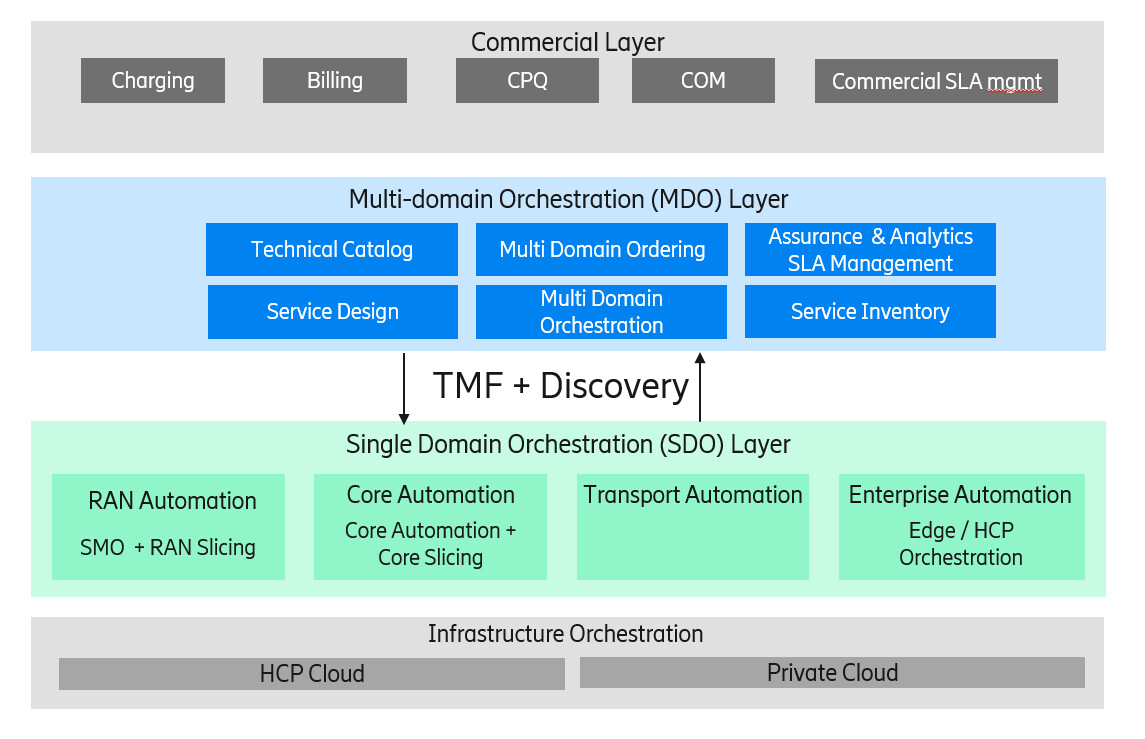
Figure 2: Automation Architecture
MDO architecture
MDO should have components supporting design time and run time activities. MDO needs to be able to support industry standards. For design time modeling a technical catalog should facilitate TM Forum Informational Framework (SID) compliant service modelling defining Customer Facing (CFSS) and Resource Facing (RFSS) models. This data is provided to the Order Management component via the TMF 645 Service Qualification API. Service Design component further breaks down these service definitions for the SDO layer using the OASIS Tosca Standard.
The order manager runtime component of MDO is responsible for accepting orders via TMF 641 Service Ordering API for creating new services, modifying, or terminating existing services. The Orchestration component is responsible for managing the fulfillment processes executing changes to the current state to match the desired state. This provisioning process is guided by the TMF Process Framework (eTOM). The orchestration module calls upon components of the single domain orchestration layer to manage the provisioning of the domain specific details. This south bound communication utilizes domain specific industry standards. For example, for network functions the ETSI SOL-003 Network Function Virtualization Life Cycle Management API is used.
The assurance module is responsible for monitoring and reporting on the overall health of the entire system stack. This module has subcomponents for providing nonfunctional common services for fault management. performance management, configuration management and logging.
The service inventory (SI) module is responsible for storing the result of all orchestration activities as the current state. Communication with the SI module is accomplished via a TMF 638 Service Inventory compliant API.
What’s next?
The level of complexity and new enterprise driven use cases will increase with adoption of 5G services globally. To keep up to the pace multi domain orchestration needs to evolve, to enable faster deployment of services, simplification and better structure. Not only does the architecture need to evolve but standardization, per industry standards, is needed for quick turnaround time and integration.
Learn more
Read more about Service Orchestration
Read more about Network Slicing
Read more about 5G for enterprises