










How enterprises can leverage the technical design of Ericsson Private 5G for their business

Strategic Product Manager, Dedicated Networks, Business Area Technologies and New Businesses

Strategic Product Manager, Dedicated Networks, Business Area Technologies and New Businesses
Strategic Product Manager, Dedicated Networks, Business Area Technologies and New Businesses
Ericsson Private 5G is a next-generation, private network tailored to drive Industry 4.0, the modernization and digitalization of infrastructures, and business process operations. Enterprises gain secure and powerful 4G/LTE and 5G Standalone (SA) connectivity, optimizing and simplifying business operations through data creation, collection, and analysis.
When we designed Ericsson Private 5G, we set out to solve real challenges that enterprises face when building a modern communications infrastructure with private networks. It must be easy to install and integrate into their operating and IT systems.
Here is a summary of the technical benefits of Ericsson Private 5G to help enterprises understand how private networks can positively impact their business with more efficient operations.
- Optimized for the user experience: with a simple interface without compromising on complexity
- Uses cloud base management structure: enabling enterprises to install the software in one hour with a minimum configuration.
- Integrates easily for IT and OT: providing quick deployment and automatic configuration
- Meets radio configuration requirements: designed to deploy radios for various demands for use cases
- Ensures reliable operations: which means less downtime for production and saves money
- Accesses Ericsson on one server: all of Ericsson's comprehensive 4G/5G product portfolio one server
- Adapts to the market quickly: 3 releases per year updated by enterprises from the management portal without disrupting business operations.
- Provides end-to-end security: which ensures data remains protected on-premises.
Here is how we thought about our design process, how we solved them and where we are going with our product.
Optimizing the User Experience with Usability X-driven design
We quickly realized that we needed to provide a product that could be installed and managed by a networking engineer who is used to managing other technologies. This led to a design where we needed to deliver all the complexity of managing, updating, upgrading Ericsson's networks element. At the same time, we needed to turn all of these network elements into a product with one coherent interface, one way of operating it. We wanted an enterprise-facing user experience that hid all the included network elements. To ensure we can deliver on these promises, we defined user personas to guide us on how they may interact with Ericsson Private 5G. We constantly verify these personas with real users to make sure we design a system that is truly easy to install and operate.
Leveraging cloud-based management structure
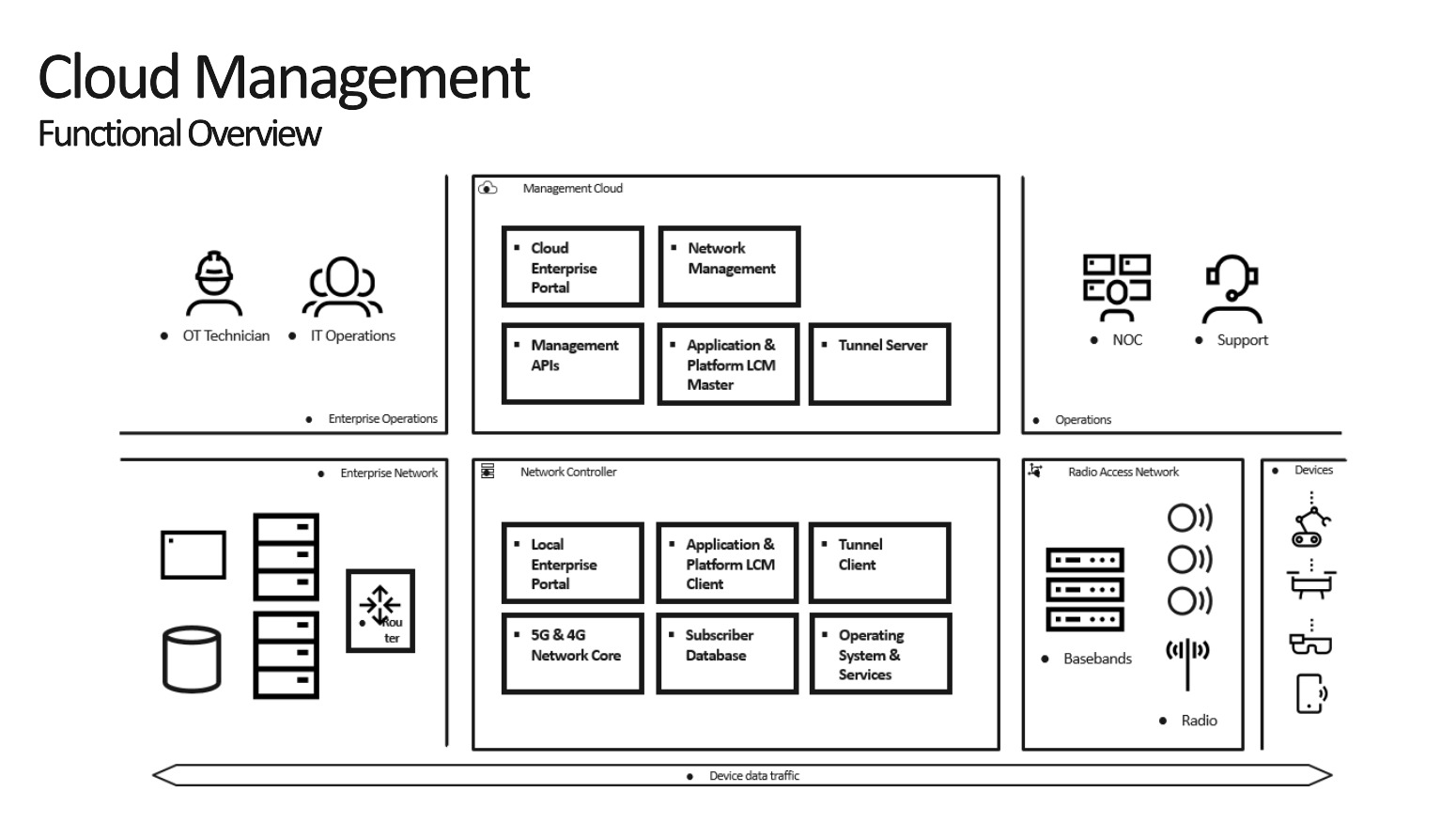
We decided to use a cloud-based management structure to offer all of Ericsson's tools in an easy-to-use way from a cloud-based management interface. Much of our efforts focused on simplifying the way users interact with Ericsson Private 5G without compromising on the required complexity "under the hood." Even though the included software is from Ericsson, there are differences in how they perform certain functions, are licensed, etc. With all the complexity in the background, simplicity was brought to the forefront by enabling enterprises to install the software in one hour with a minimum configuration. We included a uniform infrastructure for configuration management, logging, security, etc. We also had to adapt all our existing software to work within this framework. But they could also enable advanced configurations for use cases where needed.
Easy Integration in IT and OT environment
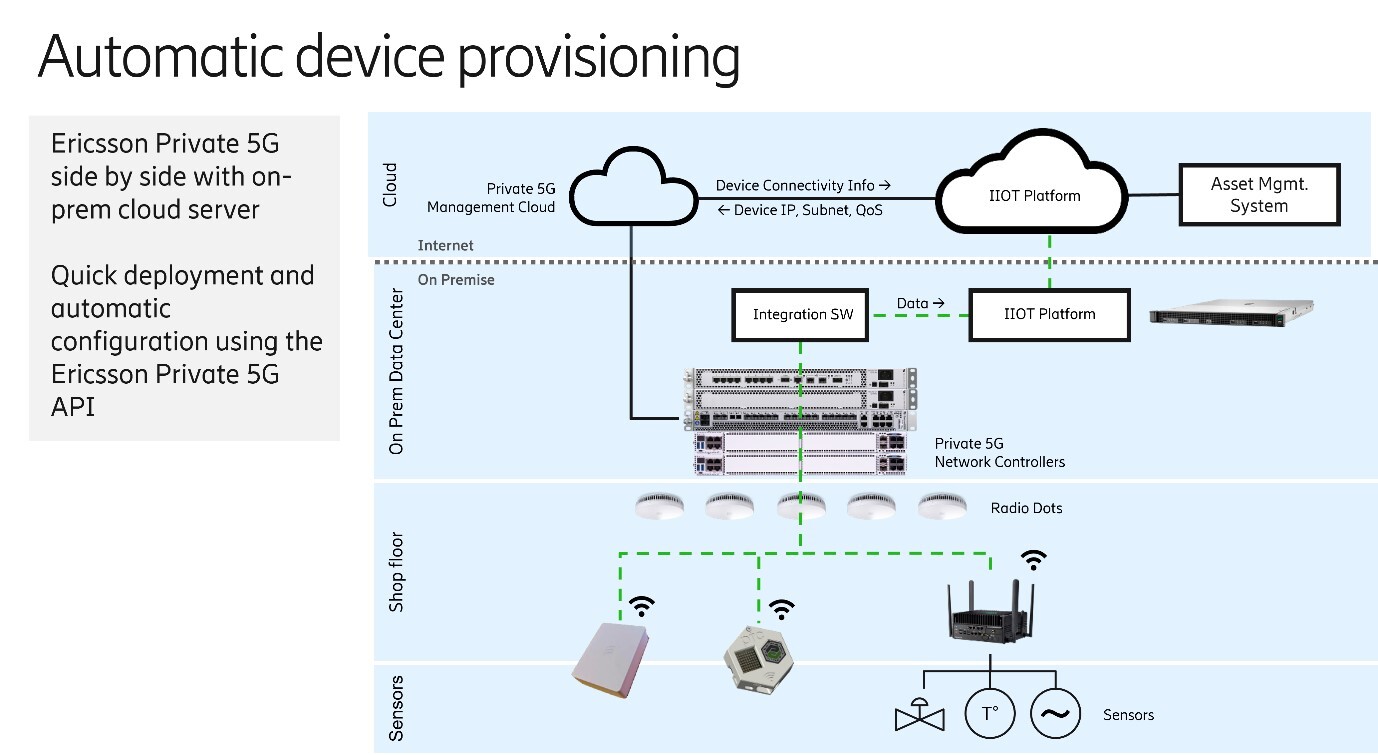
Ericsson provides a communication product for enterprises that fits into the existing IT and OT infrastructure. Therefore, we needed to adopt a strategy that made it simple to integrate Ericsson Private 5G in the industrial use cases. This led us to an API-driven design both internally in the product and to reuse part of that internal API for integration into IT/OT environments. This guaranteed a well-tested and robust design with a modern REST-based API.
Enterprises use the API to integrate into external management dashboards, asset management systems, configuration systems, and more efficiently. This strategy also makes it easy for our resellers/System Integrators to provide value on top of our solution and generate sales at the same time. We have successfully integrated with many partners using our easy-to-use REST-based API. To guarantee performance, privacy, and local survivability, we have a local version of the API. To enable remote configuration and operation, we also have a cloud-based API version.
Meeting radio configuration requirements
Configuration of radio networks in industrial environments can be very challenging since our customers have very demanding requirements on performance, robustness, uptime, etc. Yet we need to cater to simpler and less demanding cases to ensure we have a product that is easy to use and install in cases where radio planning is less complex. To do this, we opted for a design where you can deploy radios in a couple of different ways.
There are pre-defined configurations to select for the less demanding use cases, such as straightforward deployment in a warehouse. Once the hardware (HW) is installed, the enterprise is up and running in an hour.
For more demanding use cases where thorough radio planning is needed, we have implemented support for the same toolchain used when deploying our macro networks. This allows experienced radio planners to use their favorite tools and create a radio plan based on the vast Ericsson radio portfolio to develop a solution that will support even the most demanding use cases and maximize the utilization of the available spectrum.
We have built in the support of these use cases into our cloud-based management system. Once these systems are installed, they integrate with our User Interface, giving enterprises the same way to manage more elaborate radio planning installations to guarantee radio performance in complex environments. This gives customers the best performance with the available spectrum for demanding use cases and radio environments.
Ensuring reliable operations
Enterprises need their communications network to run no matter what. Having an unreliable network is costly impacts production with downtime and business. To meet this need, Ericsson Private 5G has built-in Life Cycle Management (LCM) for the network functions and the underlying operating system, container layer, and firmware to make it really easy for the enterprises to update and upgrade the complete communication network.
To minimize downtime, Ericsson Private 5G delivers a dual server setup running in an active-active configuration. Each server can carry the full load. This provides resilience in case of HW failure and keeps downtime close to zero during updates/upgrades of the system. We force all the traffic to one server during an upgrade, update the other server with the new SW, and then migrate traffic to the newly updated server. This ensures that our customers can run operations without any interruptions. We want to avoid costly site visits as much as possible. The dual server design helps us guarantee remote serviceability, thereby keeping costs down for our customers.
Accessing all of Ericsson in one server
Ericsson is a technology leader offering a comprehensive 4G/5G product portfolio. We are taking all of that and putting it in one server with an easy-to-use interface, product packaging, and licensing model that are easy to understand. We also benefit from all the features in everything from Radio to packet core that is already implemented over many years in the Ericsson products. In Ericsson Private 5G, we have taken out the complexity of 4G and 5G and delivered all of Ericsson in one server. Yet, the full Ericsson radio portfolio is available to deliver performance second to none, even for the most advanced use cases.
The effort we had to go thru here was to hide the complexity and automate the configuration of the 5G network. This led us to a management model and design choices such as a cloud-based management system, automation of configurations, SW upgrades. This is different from how this is done in operator networks and makes sure that enterprise customers can use and manage the product in a way that fits their way of working.
Adapting to the market with agility and speed
The market is evolving, and we need to learn together with our customers what their needs are and develop and update our solutions accordingly. To do this, we have a model with 3 releases per year where we drop new features needed by the market. Upgrades of the complete SW stack are automated and are scheduled by the enterprise from the management portal. This ensures that the enterprise can update their installation when they want and without disrupting their operations.
Providing end-to-end security
End-to-end security is built-in from the ground up, ensuring that data remains on-premises, secure, and inaccessible to outside parties. Security has been designed into the system from the start and is part of overall design thinking. The advantage of Ericsson Private 5G is that enterprises can protect their data on-premises. It is visible in a special security dashboard for the security administrator, with features guaranteeing a secure environment such as multi-factor authentication, built-in communication security with a 5G system, penetration testing, and more.
Read more about private networks