










5G edge user plane: key requirements for success

Strategic Product Manager, Packet Core User Plane

Strategic Product Manager, Packet Core User Plane
Strategic Product Manager, Packet Core User Plane
For the last few years, most of the conversations I’ve been having with customers around user planes have centered about a few topics: how different features are used to support new use cases and high availability schemas to secure service and maximize competitive price capacity per Gbps. Total cost of ownership (TCO) is also a constant theme for CSPs, they want to keep TCO low to secure revenues and investments, especially when it comes to attracting enterprise customers.
While service and integration costs are a recurrent item in every telco deployment, it becomes a central request when CSPs are trying to build their enterprise edge portfolio. We need an easy-to-deploy and -manage solution, to shorten the time-to-service from the moment the contract is signed to the first device carrying traffic. This will help lower TCO in this growing segment.
The flexibility vs simplicity dilemma
Most of the future use cases will increase the level of complexity and customization per application. For example, time critical communications with low latency redundancy, or a more consumer broadband type of application, demand very specific types of configurations and integration. At the same time, the market requires and strives for a one-click type of deployment concepts, where simplicity and low service costs are a must. I foresee the necessity of combining these two in principle opposite requirements to evolve to the 5G edge.
All-in-one: why less is more in the edge use plane
The cloud-native 5G Core makes it possible for the CSPs to design and precisely tailor how their networks should work and be distributed. The level of flexibility is high, enabling providers to choose the hardware that fits their needs, the most suitable networking solution, the container as a service (CaaS) system, as well as the feature combinations that 3GPP proposes and most telco vendors can deliver. This level of choice is a great evolution, but usually comes with added complexity and higher costs. Usually, in a public macro network for the consumer segment, CSPs can work with vendors to combine a high level of requirements with a moderate service and complexity cost. But the edge deployments cannot afford the same customization and complexity with a competitive offer.
I see a more plausible scenario where customers asking for simplicity have their needs met by vendors who offer a complete and integral solution, or a product that limits complexity and makes other type of deployments cost affordable. The telco main suppliers will need to have a ready-to-be-deployed product where they choose the main variables, meaning the hardware and the infrastructure as well as the networking solution. Some principles should continue to be taken under consideration, such as the cloud-native principle, last generation of chips and hardware, to have a competitive capacity. As a telco vendor, Ericsson proactively evaluates these choices, producing optimized and pre-integrated products. While we’ve been on a journey from appliance to virtual and cloud-native in the macro network, the appliance concept becomes again relevant in the new 5G edge segment.
Lifecycle management: industrialization of deployments on the edge
An interesting aspect of the 5G edge user plane is the high volume of deployment and level of distribution it's intended to achieve. Combining both the virtual private and hybrid private on-prem scenarios, the number of distributed user planes could be in the 100s on each 5G core network. This magnitude of units deployed requires a centralized system to manage the integration, assurance and lifecycle of the edge systems.
The traditional concept of telco core lifecycle management needs to be broadened in this segment. The ability to perform fast and remote onboarding of a new distributed user plane in the edge will become a crucial component. This onboarding will tend to occur in more remote locations, for example either being located locally or on premises for enterprise customers. Imagine the CSP or the vendors dedicating resources to do onsite installations in that scale – the cost could be unbearable.
An industrialized system, where the installer just needs to connect the edge user plane to the network and the rest of the process is controlled and automated from the CSP’s network operations center (as described in Figure 1), must be part of the integral solutions provided by the supplier. The process of deploying a high distributed user plane must be quick, automated and standardized.
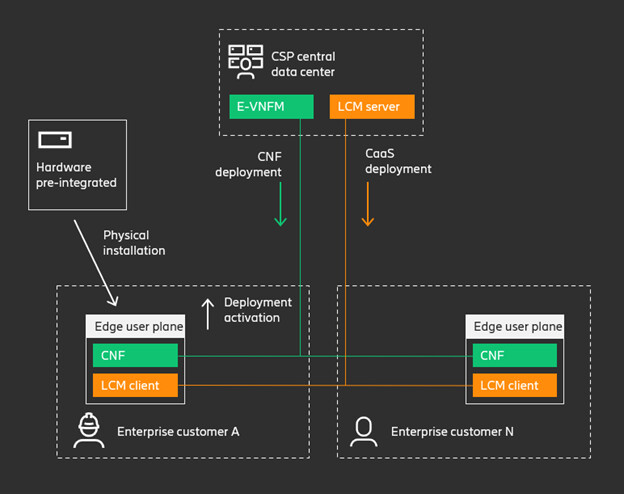
Figure 1 – Integrated lifecycle management for deployment with minimal on-premises intervention
Raising the bar and taking a step ahead in the security of the 5G hybrid private networks
5G edge deployments will transform the network topology by directly connecting the enterprise and the operator’s network in the hybrid scenario. The possibilities and future use cases that 5G architecture can make a reality are huge. This also brings along security concerns and a whole new level of potential threats. A common question from our customers about the 5G edge hybrid model is: “How can I make sure that my central core network is protected and isolated from the external world?” In addition, they also need to make sure they are meeting the strict data privacy requirements of their enterprise customers. In the initial phases of this transformation, I believe CSPs will start working with trusted enterprises to keep control of the set up and the security. In the next few years, the expansion of the hybrid private 5G networks to hundreds of enterprises, will make it extraordinary complex for CSPs to control all the deployments connected to their public core. This will be one of the challenges of the expansion of 5G to on prems edge. Related products must also include solutions, such as firewall capabilities, network address translation, tunneling, traffic isolation and encryption, that permits both CSPs to protect their infrastructure and enterprises to shield their premises and data.
Summary
The new ecosystems that 5G edge brings will transform both the network topology and the business models between enterprises, operators and telecom suppliers. User plane is a crucial piece of the puzzle, making it possible to have the higher levels of distribution required to address new use cases and enterprise requirements. For a successful 5G edge user plane journey, the new products must be fast to deploy and manage, allow for automation and have an extra degree of security and privacy.
Learn more:
Ericsson Local Packet Gateway is built and designed in the principles described above.
Learn more in the solution brief.
Discover how 5G core unleashes a new era of scalable and service-rich cloud-native networks.
Explore 5G core solutions that make it possible for you to deploy, scale and evolve your operations across multiple deployment scenarios.
iscover how private networks deliver secure, reliable and tailored connectivity for enterprise and industrial environments.