










Who are the intelligent agents in network operations and why we need them?

Sustainability and AI Marketing Driver

Sustainability and AI Marketing Driver
Sustainability and AI Marketing Driver
Have you seen the film Blade Runner? If not, I highly recommend it. Blade Runner is a masterpiece for many reasons – but one of its biggest strengths is being technologically visionary, especially in the sense of artificial intelligence (AI) evolution. For this reason, I am using it as a reference in this blog. Like this science fiction movie, I don’t want to immediately disclose who or what these intelligent agents are – what would be the fun in that? Instead, let’s first set the scene by putting things in perspective, exploring the demands of the new radio network operations and how these new demands are evolving differently depending on the communication service provider (CSP), such as different strategies, use case needs and operational models. Some time ago, I was told by a tier 1 chief technology officer: “We can´t live without customizations”. Certainly, each CSP should be able to build its own competitive differentiators and unique solutions for their customers. The challenge is how to do it in the most efficient way possible.
Intelligent RAN Automation creates competitive advantages
In the technology industry, the word ‘intelligent’ typically refers to applying AI techniques such as machine learning (ML) and deep reinforcement learning (deep RL). There are many solutions referred to as intelligent, but that doesn´t guarantee that they’re optimal. AI application ensures optimal efficiency and performance only if it’s executed where it makes sense. We must distinguish between two control loops: Real time (micro and milliseconds) and non-Real Time (seconds, days, weeks).
These control loops are referred to as distributed automation and centralized automation:
- Distributed automation requires a high volume of decisions in a very short time, and it is fully automatic. Functionality is mostly autonomous and is driven by engineered algorithms.
- Centralized automation requires network-wide coordination, more time for complex decisions and some human interaction. The use cases are mainly network design, optimization, and management, which are not implemented in real time and would require a huge amount of manual work without automation.
AI/ML-powered solutions based on self-trained algorithms are gaining efficiency when compared to rule-based, human-made solutions. AI algorithms – just like the replicants in the Blade Runner movie – improve their performance and capabilities in the newest versions. This is how intelligent RAN automation can create competitive advantages for CSPs.
The different alternatives for CSPs when using AI models
AI/ML technology introduces training, model drift concept, federated learning and a stronger need for access to high volumes of data. The lifecycle management (LCM) processes set the roles of suppliers, integrators and CSP. There are several models that can vary depending on the service provider’s role. Mainly, we talk about four alternatives:
- The trained global model: the vendor provides a model, that it has been initially trained with global data.
- The local model: the vendor provides the model and trains it with local data (service provider network data).
- The initially trained global model with retraining capability: the model retraining is done by the service provider with local data.
- The embedded model with automatic retraining: the model retraining is done autonomously in the service provider’s network with local data.
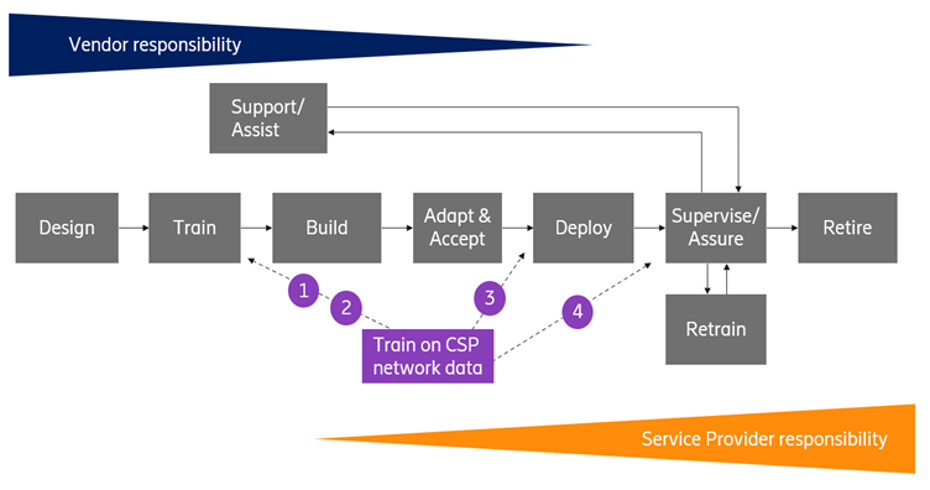
Figure 1: The different alternatives of the vendor and service provider in the AI software lifecycle management
‘Who’ are these intelligent agents, and what are their results?
These augmented humans are in the real world (not in sci-fi) a set of AI models or algorithms.
The algorithm creator or vendor provides a model that is initially trained to the service provider, and then there is a re-training with the real network data. This enables a continuous enhancement of the models and their adaptation to the always evolving environment. There are two scenarios, using simulators or emulators. Both strategies pursue similar objectives, and the main differences are in the training environment set-up, as you can see in the illustration below:

Figure 2: Different scenarios in the training environment set-up
- Emulator scenario: usually duplicates all software (SW) and hardware (HW) features like a live network replica to provide more accurate results for the operations team.
- Simulator scenario: the simulator is a SW program that models the behavior of a network. This is suited to capture general trade-offs and trends.
The application of AI techniques in networks has produced excellent results. For a European customer, Ericsson Power Optimizers helped reduce overall transmitted power by 20 percent, with 3.4 percent saved on the electricity bill per base station. Enhanced antenna tilt improved with downlink (DL) throughput by 5.5 percent and uplink (UL) throughput by 30 percent.
AI and deep reinforcement learning techniques take inspiration from human psychology to learn from the environment or data lakes. Network data is sent in real time in streams, creating a huge volume that needs to be stored and processed. To ease data management and operations, it is extremely important to select the relevant data from the field for the training. Therefore, it is mandatory to develop mechanisms to bring out just the data that is needed for the relevant use cases from specific network elements.
AI technology has been a subject of high interest in science fiction movies, as I mentioned in the beginning. But what’s happening around us is not science fiction anymore, it’s already been proven in the field with AI technologies in radio networks – we’re creating the networks of the future! The world of tomorrow is now.
Learn more
Do you want to go for a deeper dive into intelligent agents? Read guide: Intelligent Operation - How AI plays a critical role in network operations
Learn about AI based solutions in radio networks: visit our Intelligent Automation site: Intelligent RAN Automation for managing 5G complexity - Ericsson
Understand main topics of Intelligent RAN Automation in our Intelligent Guide Series: Intelligent RAN Automation Guide series - Ericsson
Interested in learning more about performance optimizers? Find the detailed insights here: New Ericsson Performance Optimizers - Ericsson