










Public safety going 4G and 5G broadband – the latest industry trends

Global Business Development Director, Mission Critical Networks

Global Business Development Director, Mission Critical Networks
Global Business Development Director, Mission Critical Networks
Organized by the Critical Communications Association (TCCA), CCW took place in Vienna in June this year. The event attracted attendees from government authorities and mobile network operators, as well as network, device and application vendors.
This year, the visitors and delegations were mainly from Europe as well as some from the Middle East, the Asia-Pacific region and North America. Public safety was the most-represented sector, though utilities and railway were also present. In this blog post I'll be focusing on the topics and discussions at the event for deploying 3GPP-based broadband services for the public safety segment.
This segment refers to the state organizations in charge of the protection of the population, such as police, fire brigade and rescue services. For their operational communications, they have traditionally relied on narrowband networks such as Tetra, Tetrapol and P25, which provide voice group calls, but those systems cannot evolve to provide broadband services, meaning that major changes are coming down the line for the vast majority of public safety bodies.
At the Ericsson booth we had the chance to hold executive meetings with government authorities, mobile network operators and partners. You can find a short tour from my colleague in this blog post: The Ericsson booth tour at Critical Communications World 2022.
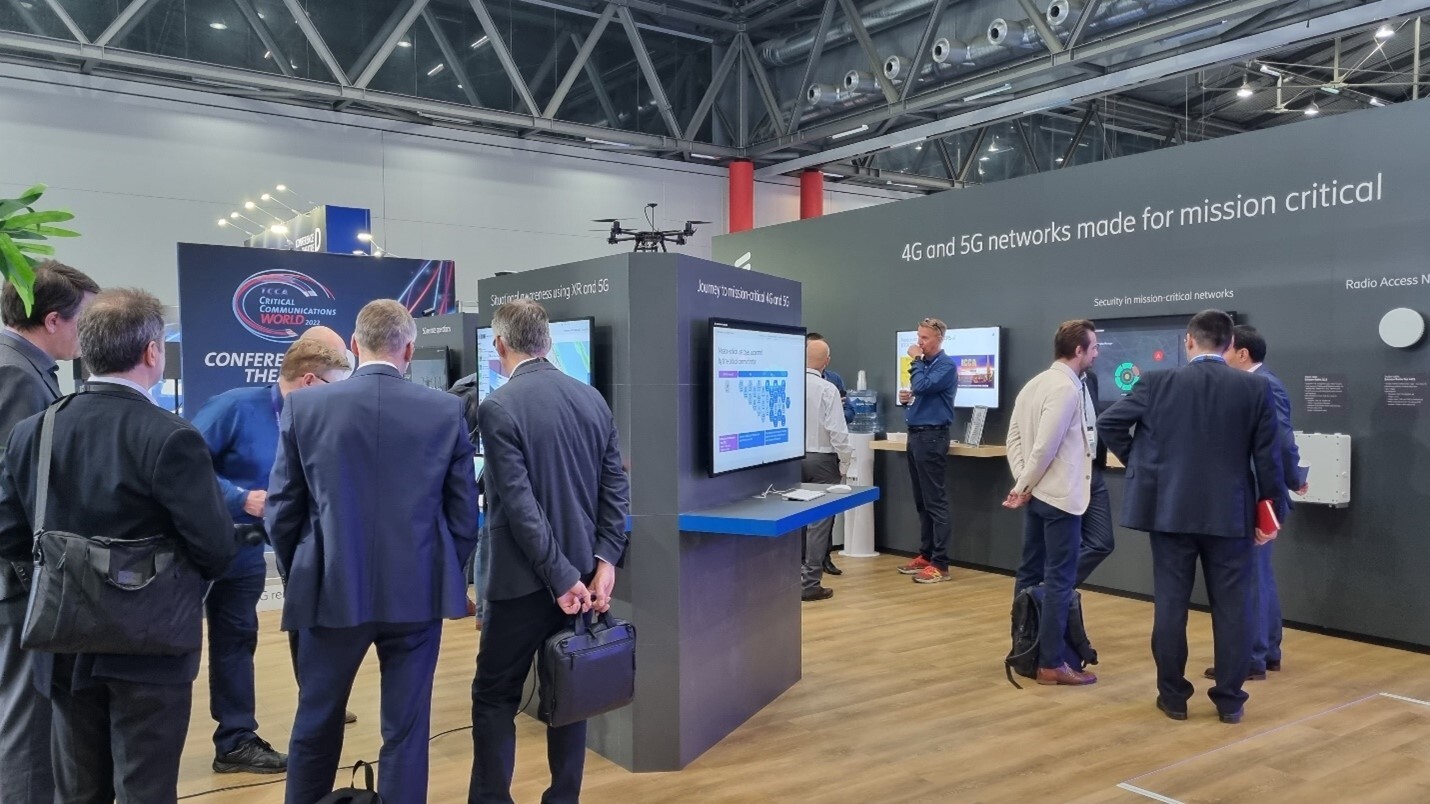
Figure 1: Ericsson booth with visitors exploring mission-critical network security and situational awareness using 5G and XR.
Besides working at our booth where the exciting conversations with visitors took place, I took part in the in-depth knowledge-sharing sessions called Focus Forums, and I also had the chance to listen to the various presentations and panel discussion in a very packed CCW program. Having worked in this industry for many years, I could witness the latest developments for the adoption of LTE and 5G for mission-critical communications. Here a couple of trends identified which the discussions at the event revolved around – most of them concern the journey to broadband that public safety is currently undertaking.
Not why, not if, but how to migrate to mission-critical broadband
The days when there was concern about whether 4G networks provide the necessary functionality and performance are now long gone. This is now recognized by government authorities and agencies, and there is a general acceptance that LTE and 5G are the way to go. Currently, almost all countries in Europe and in North America, as well as several in the Asia-Pacific region, have ongoing projects to offer broadband communications to their first responders. Early adopters are now operational, while others are in the deployment or planning phases. Technical tests and pilots have already been carried out and others are ongoing, delivering overall positive feedback. Many countries are preparing their plans to deploy mission-critical broadband and aiming towards the tendering phase. Several of these are likely to happen in 2023.
The trend also shows that many countries have ambitions to bring their mission-critical broadband network into live operations from 2025 onwards.
The focus now is how to best migrate from narrowband Land Mobile Radio (LMR) networks. This requires a holistic approach, as it is far from being only about technology and rollout. As Tero Pesonen, TCCA vice-chair, explained in the plenary session “International Collaboration For Driving Critical Communications Forward”, there are legal and regulatory aspects to sort out, budgets often need to be approved in national parliaments, and operational models need to be adapted in order for first responder organizations to best benefit from the new capabilities offered by broadband. Talking about end-users and ensuring their trust and commitment are also key factors for a successful migration.
Existing narrowband LMR networks and broadband will co-exist for a period of time and system interworking is therefore important. Several vendors showcased the newest releases of the dual Tetra/LTE devices they are bringing on the market – but whether there is a market for such devices remains to be seen. Interconnecting solutions on the network side were also sought after by event visitors. Operational topics being discussed this year at the event included the handling of apps, OS and devices, as well as cyber security.
Choosing a network architecture for mission-critical communications
Governmental authorities and the public safety operators in charge have to decide what to deploy when it comes to mission critical broadband networks for public safety. The flexibility and features of the 3GPP standards offer many possibilities, which is of course excellent when it comes to designing the network architecture that best suits the local requirements and available resources. It nevertheless increases the number of options that need to be evaluated.
Going for a dedicated core network for public safety is now a common choice throughout all the chosen network architectures I have seen. Commercial mobile network operators will most likely play a major role in providing coverage; this is achieved by connecting their core network to the public safety core network through roaming, or by connecting their radio base stations to the public safety core networks via a mechanism called radio access network (RAN) sharing (see the different possibilities in figure 2).
Deploying their own cells or base stations is being considered by some countries, mainly to complement mobile network operator coverage, or to have a hardened coverage layer to ensure the availability of the most essential service, namely group voice communication. This also depends on spectrum availability, and we observe that there is a push from certain government authorities to secure frequencies in other bands than those allocated today for public safety. Hardening, which encompasses power back-up, is an essential part of what makes a network mission-critical, and how to secure it for access networks is being evaluated.
The TCCA organized the Broadband Focus Forum, where attendees were able to hear about all aspects of 4G, 5G, devices, and apps from different speakers. It was great to see the main industry players come together to present a holistic overview of mission-critical LTE and 5G.
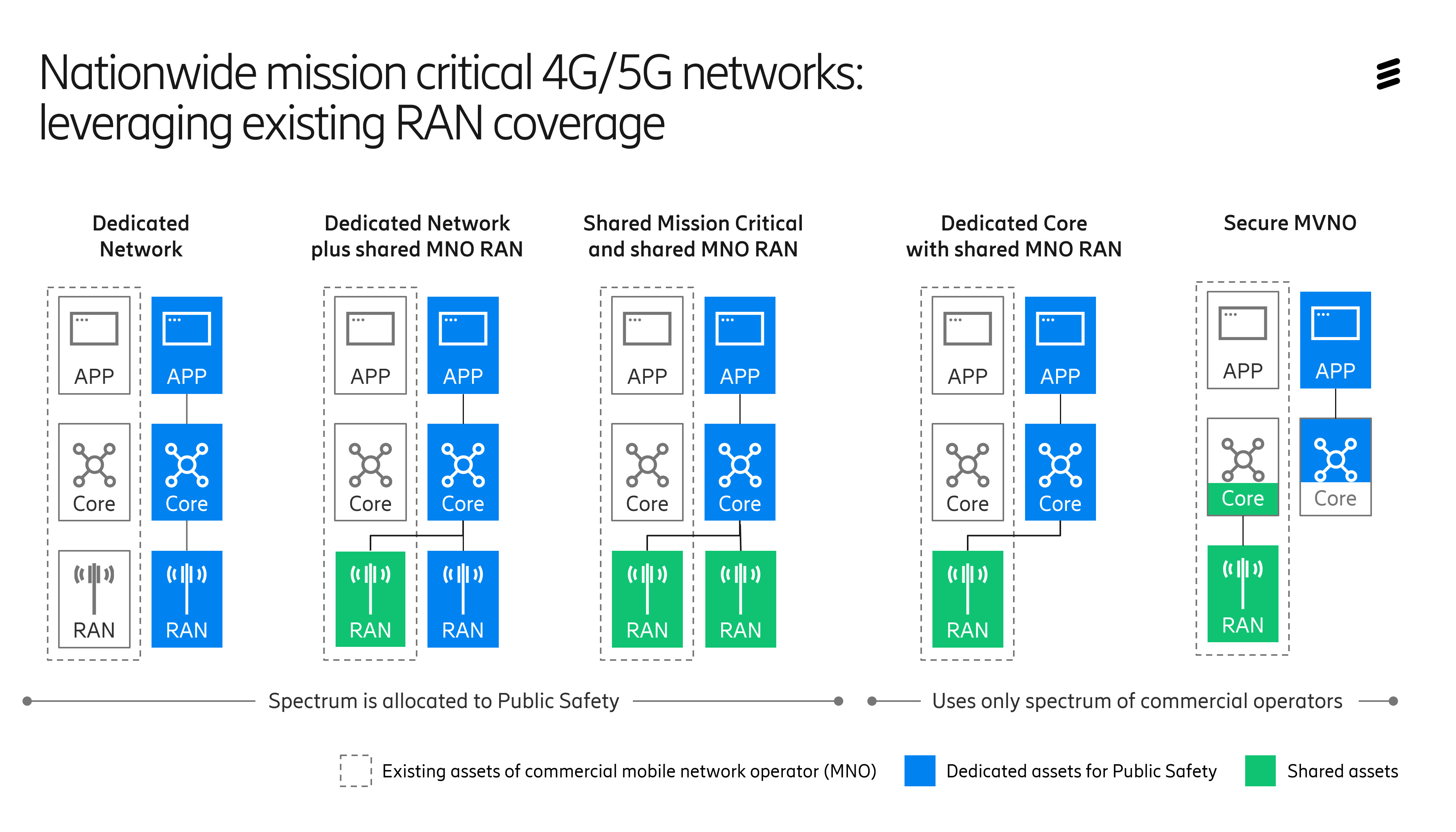
Figure 2: Various possible network architectures, showing how the RAN from a mobile network operator can be leveraged for mission critical broadband communications.
The journey starts as mission critical services mature
3GPP Mission Critical Services (usually known as MCX) refers to the application and underlying infrastructure that provide voice, video communication and data group communications in 4G and 5G. The voice part of MCX, called Mission Critical Push-To-Talk (MCPTT) is in focus, as it is the equivalent of the group calls first responders rely on in today’s narrowband networks.
A major trend my colleagues and I have observed is that while public safety agencies would like to see more functionalities in the MCX solutions currently on the market, they consider these systems to be good enough to start going live. In other words, despite areas of improvement, the stand within the community is that the existing functionalities are already sufficiently mature to proceed with MCPTT tests and first deployments.
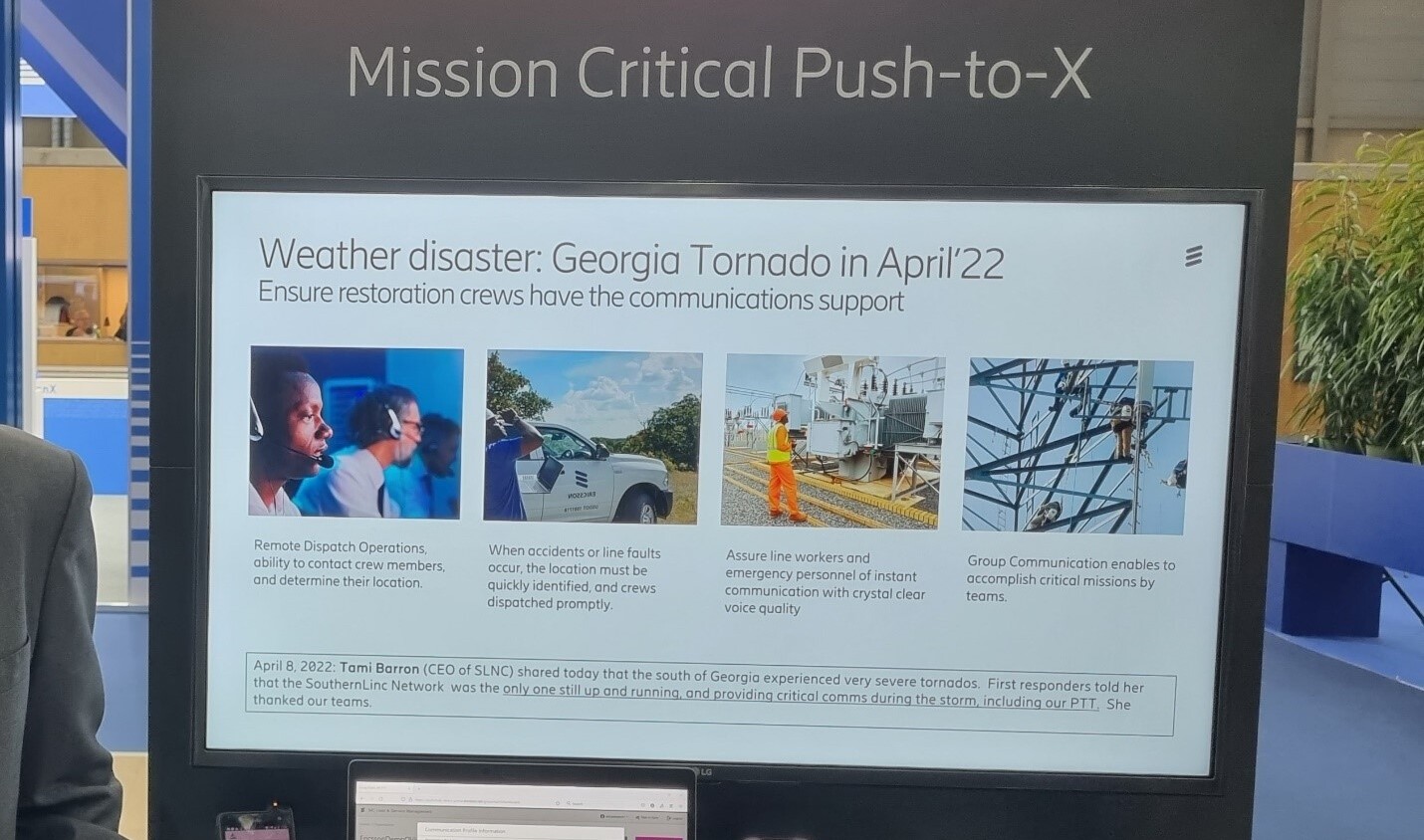
Figure 3. Ericsson Mission Critical Push-to-X supporting Southern Linc’s restoration crews during weather disaster in USA – this network with was the only network still up and running and providing critical communications during the storm.
The MCX eco-system keeps developing and the last CCW event showed it is coming into place, and it will keep evolving as part of this journey to mission-critical broadband. The organizations in charge of mobile communications services for first responders acknowledge that, as with most things in 3GPP, this is a journey. The push is now for standardized interworking, and several speakers referred to BroadWay, the EU project that aims at enabling a pan-European broadband mobile system for public safety that ensures cross-border and cross-agency communication. BroadWay is in its final phase where pilots are realized and verified, which puts the promise of interoperability on the horizon.
Starting with 4G or wait for 5G: is it really a debate?
While everyone is getting acquainted with what 5G has to offer to mission-critical communications, deciding whether the nationwide broadband network for public safety should be 4G or 5G doesn’t seem to be a hugely important topic.
FirstNet in the USA is looking at the potential of 5G, and they plan to go first to 5G NSA and then to 5G SA (NSA = non-standalone, i.e., 5G is relying on existing 4G infrastructure; SA = Standalone). But when Brian Hobson from the U.S. Government First Responder Network Authority was asked during the panel discussion “How can we move from 4G to 5G or 6G?” whether users care “about the Gs”, he replied “in short: no. They care about things that work.” The fact is that 5G will enable new use cases and offer benefits compared to 4G, but the users won’t see what is specifically 5G compared to 4G; they will see a continued evolution in the means they will have at their disposal to carry on their duties.
5G is also an evolution of 4G, and several 5G concepts such as network slicing and virtualization also apply to 4G. LTE base stations can be connected to 5G cores. Deployed 4G networks are software-upgradable to 5G. Many of the 3GPP mission-critical network enablers are already standardized for 5G, and more will come in Release 17, which is due later this year. Mission Critical group communications, also called push-to-X services or MCX, is planned to be integrated in 5G in Release 18. For the time being, the LTE part of a non-standalone 5G network can be used to support the mission-critical services. This means that there are neither drawbacks nor risks starting with 4G, especially since the use of 4G devices is already proven in the field.
The 3GPP standards will evolve, so it is important to get on that train and ensure that what is deployed is upgradable to the following releases and “Gs”. After all, it’s a journey, not a one-time deployment project.
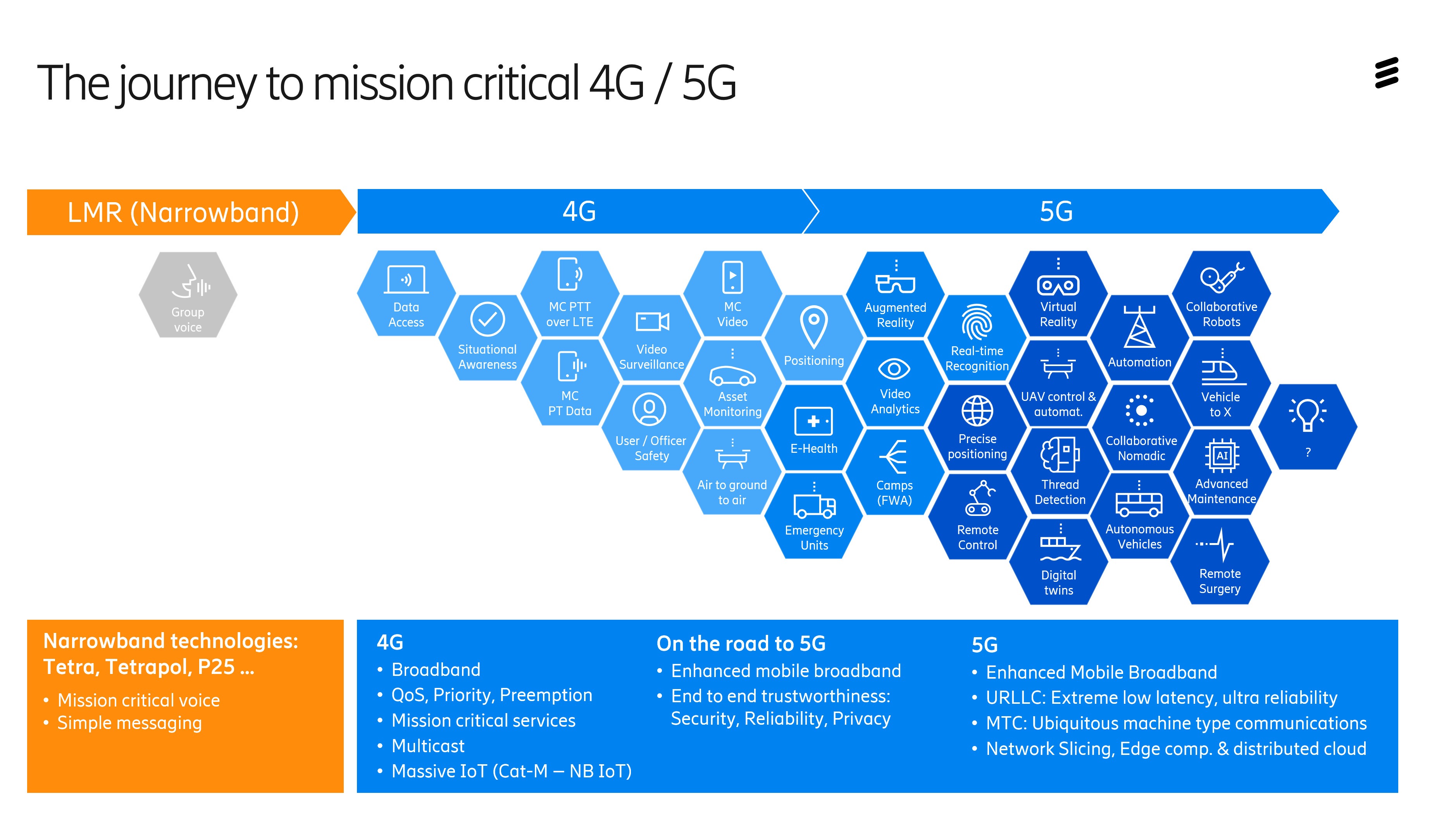
Figure 4: Examples of public safety uses cases enabled by the deployment of 4G and 5G networks.
Resilient broadband from vehicles, drones and even outer space!
Increasing the resilience of mission-critical services for public safety is of course of utmost importance. Small deployable networks, also called cell on wheels (CoW) or tactical bubbles, have long been considered to maintain the availability of the service in case of major outages or disasters, and so are drones and satellites. What we see now is that they are becoming an integral part of the overall deployment plans for mission-critical broadband. These mobile systems are now also better served by the industry - new solutions are coming to the market and 5G brings new integration and interworking possibilities.
Satellite communications are not new and, given its ubiquity, availability and resilience, are also used for public safety. Satellites can offer coverage extensions and represent a back-up solution to terrestrial networks in case of outages and disasters. In order to leverage satellite communications for mission-critical use cases, multiple technologies have to be combined. But soon 3GPP will be addressing Non-Terrestrial Networks (NTN), with the target of enabling direct broadband communication between satellites and commercially-available off-the-shelf 5G devices. This will enable a vast range of devices that will then be reachable via satellite. The use of Low Earth Orbit satellites (LEO) can provide latencies that are sufficiently low for mission-critical communications.
How public safety communications could concretely benefit from these future 5G Non-Terrestrial Networks is an open question that TCCA wants to address. A task force has been set up to identify if and how the functionalities, operations, performance and security requirements from the mission-critical community can be met by 5G NTN networks, and to identify the challenges and the opportunities. Renaud Mellies from the French Ministry of Interior is leading that task force, and he appealed the audience to join forces during the plenary session about “Non-terrestrial Networks For Critical Communications”.
Ericsson, Qualcomm and Thales have recently announced that they plan to test and validate 5G NTN by focusing on smartphone use cases. They stated in their joint press release that “national government communications may be a main use case, to enhance safe and secure national security and public safety government networks.”
Summary – Broadband for mission-critical networks is a journey
While many countries are preparing their plans to adopt mission-critical broadband and heading to tendering phase in the coming 18 months, early adopters are already operational, learning day by day how to benefit from the possibilities offered by broadband. It can be expected that in three years’ time, most of the countries in Europe, North America and the Asia-Pacific region will have live mission-critical networks in operation for their first responders. Traditional vendors of narrowband mission-critical systems are seen to focus more and more on broadband use cases than before. The extremely high bandwidth and ultra-low latency 5G can offer are generally not yet required for the public safety use cases currently being considered, but broadband is a journey, and this will come as technology and innovation progresses.
Learn more
To learn more about the migration to mission critical 4G and 5G please consult our paper: Migration to mission critical 4G and 5G - The technical and operational aspects for adopting 3GPP based broadband services