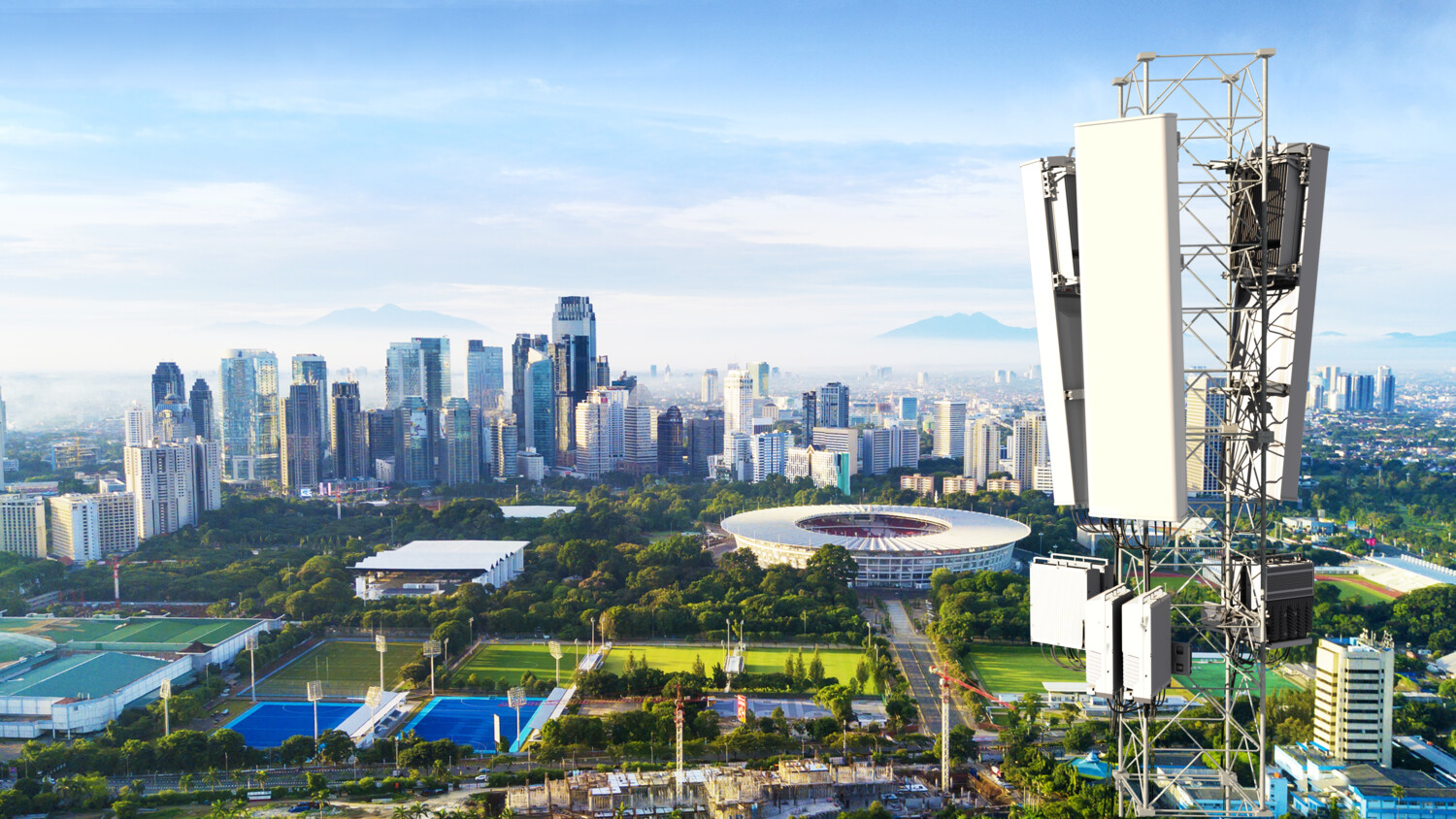
1. Accelerating 5G network deployment and monetization
It goes without saying that for 5G to be monetized, it first has to be deployed. Towercos have a major role in making the deployment of 5G as quick and efficient as possible, not least because the priority continues to be getting it rolled out outdoors and they are already deeply involved in the provision of real estate and services to the major players.
Towercos are ideally placed to play a major part in how the deployment happens, from offering infrastructure solutions to entering into strategic partnerships with communications service providers (CSPs) to offer flexible solutions, all while maintaining and improving sustainability, energy efficiency and network performance.
The need to monetize 5G does not mean that there is an endless budget available for its deployment – CSPs are very aware of their capital and operational expenditure and are always looking for ways to reduce, or in some cases, eliminate them.
The successful towercos of the future will be the ones that manage to balance the need for a fast, smooth roll-out with a lean, value-for-money proposition that CSPs could not feasibly do by themselves.
2. Embracing digitalization and automation for operational efficiency
One development that is accelerating the ability of towercos to plan and dimension their commercial offerings is the use of digital twins, where a digital version of an existing site is created in order for changes to be thoroughly planned and tested before introducing them to the real world. This can also be used for the creation of new sites, allowing for the testing of many different configurations before a final decision on a physical deployment is made.
This is a process that is gaining traction across the board, and it’s easy to see why. Rigorously putting a solution or design through its paces in the digital world reduces the chances of having to roll back changes in the real world once it has been implemented, and the digital twins use all data available – not just photos or drone videos of proposed locations.
The digital twins can test both the physical aspects of the site as well as the demands for energy and network throughput, ensuring that upgrades or changes are made to last.
As with digital twins, the amount of available data generated by towerco operations provides a platform for CSPs to make better-informed decisions, as well as creating powerful arguments as to why CSPs should consider deepening their partnerships with them.
Towercos can generate data around site conditions and usage in real time, illustrating where things can be improved and where savings can be made. Based on this, CSPs can make decisions around their 5G deployments, knowing that their calculations are correct and that they will be able to meet the needs of their customers from the moment the service is switched on.
This data-driven approach removes uncertainty, shortening the time to market for new products and services and ensures that any expansion happens in a controlled and manageable fashion.
3. Leveraging smart energy solutions to meet cost challenges
The recent global spike in energy prices has focused the attention of CSPs on energy prices like never before. Whereas energy costs were previously perceived to be relatively affordable, high prices and market volatility have ensured that providers have an increasing focus on where they are getting their power from and whether or not they are using it effectively.
Ericsson Smart Site offers an energy management solution whereby the site operator can take control of how they use energy, mainly to reduce energy costs and CO2 levels, but also to manage and reduce the increased risk levels associated with energy supply. If a grid outage should happen, operators need how to keep service going - for instance, there is the ability to switch energy sources based on the cost or the time of day, powering the network from the grid when financially viable, and switching to battery power or other sources to avoid high tariffs at other times.
Going forward the energy management will be integrated with energy grids, enabling the operator of the site energy to create revenue streams from their energy usage and storage. This could be done by participating in Frequency Regulation and Demand Response programs.
Historically the energy cost has been borne by the CSP either by receiving the bill themselves or passthrough from the towerco. With smart energy functions the towerco can enable energy-as-a-service. The motivating factor is by site sharing and investing in smart energy systems and storage the cost of energy can be brought down, and the winnings could be split between the towerco and tenant(s).
4. Exploring the indoor network-neutral host business opportunity
Users and real estate owners alike want the best possible service in their buildings, but not at any price. They also want to maintain the aesthetics of their buildings – few if any building managers want cables in plain sight, nor do they want an array of access points of different shapes and sizes hanging off every available surface.
Driven by the demands of the real estate industry, towercos are building their own indoor systems and managing that equipment on behalf of the operators and offering networks as a service. For CSPs, sharing neutral host infrastructure allows them to not only reduce CAPEX while serving more buildings, but also improve operational and energy efficiency.
In terms of the physical nature of the equipment used, building owners and managers are looking for equipment that runs smoothly and efficiently and doesn’t take up too much space. Legacy solutions often require dedicated rooms and ventilation solutions – any reduction in the size of equipment deployed and the specialized conditions required for it to work properly are very welcome.
The issue of energy efficiency also arises, and it is likely to be a factor in every discussion between CSPs and towercos in the short and medium term. Both parties are looking for solutions that are both efficient and future-proof, enabling them to keep costs to a minimum and ensuring that any future changes will be as simple as possible to implement.
5. Taking the lead on sustainability
Just like in domestic markets, finding renewable sources of electricity to power various networks is becoming more and more important. Though the equipment to harvest and store it costs money, solar and wind energy are basically free, and harnessing these sources while reducing dependence on fossil fuels is a priority for most, if not all, CSPs.
In recent years, every system that Ericsson has delivered is prepared for plug-and-play solar energy, and the focus now is deploying solar solutions on-site. Tests have shown that energy savings of 20 percent can be achieved with six panels measuring 12m square in Sweden & Germany. Every site is unique, and there are resources available to design structures for sites - we can help to plan and solve problems using simulations, assessments & deployment to ensure that towercos and CSPs can quickly begin to enjoy cheaper energy without sacrificing performance.
Ericsson also has a vast array of new technologies that are designed to be as energy-efficient as possible, powering down during off-peak times and capable of waking quickly to meet surges in demand. Coupled with machine learning and artificial intelligence (AI), these solutions evolve over time, learning the set-up and patterns of the network and adapting the energy consumption accordingly.
For instance, there is the ability to switch energy sources based on the cost or the time of day, powering the network from the grid when financially viable, and switching to battery power or other sources to avoid high tariffs at other times.
In our discussions with them, many customers are telling us that sustainability goals may well override some of financial goals in the short and medium term. Not only do they want cheaper energy, they also need it to be more sustainable, coming from renewable sources that have a minimal impact on the environment both when they are harvested and used.
Ericsson is well-placed to assist them. Aside from the smart solutions and solar and wind energy mentioned above, we also have a full suite of batteries and hydrogen fuel cells with hydrogen as an alternative to the regular electricity grid. There will always be those who will want to prioritize solar and wind to charge their batteries, but in cases where that is not possible, the hydrogen fuel cells offer an excellent alternative to the grid.
The challenge coming down the line is how to add more batteries; just as is happening with homes, it will become standard for towercos to have more solar panels onsite, and we expect fuel cells to become something of a more niche solution. Deploy more batteries and more solar panels will make an enormous difference - not every towerco will be able to benefit from that scenario, but many will be seeking to leverage our experience from places like Belgium, Netherlands, Luxembourg and Egypt, where we have successfully deployed wind-based energy solutions.
A towering opportunity
Many of the issues and trends listed above will grow in importance in the coming years while others may recede, but one thing is certain – CSPs and towercos will continue to depend on one another to deliver the services that customers want, and it is in the interests of both parties to work together as quickly as possible to find sustainable ways of doing so.
To deliver on its potential to change the digital landscape, 5G needs to be deployed far beyond the bustling urban centers and landmark buildings that we have all come to expect. The more CSPs and towercos work together to find solutions that are speedy and sustainable, the more likely it is that customers will be able to enjoy connectivity wherever they are, be that a college or hospital campus or an indoor residential setting.
This list of trends is by no means exhaustive, but it does illustrate how what once appeared to be a simple matter of renting space to deploy equipment has become a much more complex subject. The basic needs remain the same – CSPs need to deploy and manage equipment close to their users, and towercos are rapidly evolving to help them do so.
Ericsson continues to pave the way, working hand in hand with towercos and CSPs to identify the sticking points and to streamline how they deploy and manage their solutions, indoors and outdoors.
Read further