








Designing a sensor-driven world: the research take on zero-energy devices
- English
- 简体中文
- In the era of 6G, the world will be filled with trillions of low-cost, low-compute sensors that can power themselves and share data in real time.
- Such use cases, including tactile clothing, will depend on energy harvested from ambient sources, including vibration-, thermal-, photovoltaic-, and radio frequency energy.

Senior Expert, Cellular radio networks

Research leader microwave systems

Senior Expert, Cellular radio networks
Research leader microwave systems
Senior Expert, Cellular radio networks
Research leader microwave systems
Imagine your city brimming with trillions of low-cost sensors covering walls, ceilings, floors and the skies around you.
Imagine if those sensors didn’t even require any batteries but could power themselves from ambient energy and share collected data in real time over a ubiquitous network.
This may sound dystopian, for some even terrifying, that is until you begin to add up the immeasurable value that trillions of sensors could bring to industries, communities, and sustainability efforts worldwide. The prospect then becomes game changing.
Advancing energy harvesting technologies will be crucial to making this possible. Below, we take a look at some of the biggest research challenges in the fields of ambient and radio energy harvesting in the coming years.
Zero-energy devices and 6G networks
In less than a decade, our societies will function and evolve based on real-time data from trillions of simple, low-cost, zero-energy sensors distributed We refer to this new class of devices as zero-energy devices and they are part of our vision for future 6G systems.
Compared to smart phones or mobile broadband devices, many future connected sensors would be extremely low cost, low performant, and consume just a small fraction of the energy. It must be possible to mass deploy such devices in an affordable and sustainable way, and the 6G network needs to support that.
Limited energy consumption would mean being in a deep sleep for long periods of time. When activated, they would then only have the capability to transmit data for a brief period before requiring further energy harvesting.
Talking about Physical world only makes sense in relation to an existence of a digital world. But a digital world has not been mentioned here (yet), so doesn’t fit.
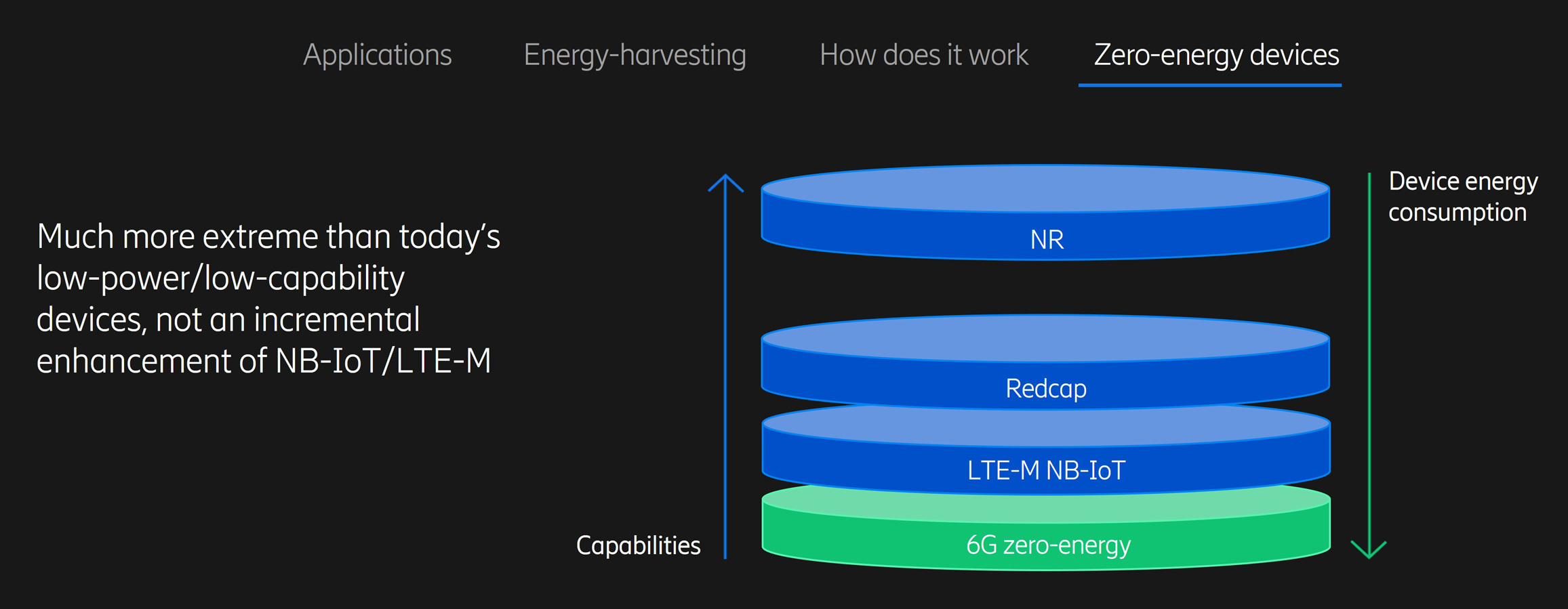
Above: Scaling down to scale up – the comparable expected compute and energy consumption of future 6G zero-energy devices
Today’s mobile networks are designed to support devices that can communicate for relatively long periods of time allowing for a continuous exchange of control and management data.
To support future zero-energy devices, we must design a network that can quickly detect, control and, if needed, update credentials to communicate securely with a massive number of devices operating under severe energy limitations. This is one of the visions we have with future 6G mobile networks.
Quantity over compute power: the value of trillions of zero-energy devices
Let’s begin with a question that’s relevant: if zero-energy devices have less compute power and capabilities, what is the value of deploying them instead of fewer more precise and more performant sensors in carefully selected positions?
If this was a question asked 10-15 years ago the answer would likely have been “none”. However, with recent years’ rapid evolution of big data, machine learning and artificial intelligence we can do things today with a massive amount of simple datapoints that was hard to imagine just a few years back.
One example is pressure sensors – not devices, but rather those that we as humans have as part of our skin. Each of these sensor cells across our body is not very precise nor does it give much useful information, but the assembled information from many of these sensors gives us much deeper insights compared to fewer sensors that are perhaps more receptive.
As humans, we never stop training our brains to interpret the information transmitted simultaneously from these cells. We then draw complex conclusions as to what they mean. For example, the sensor cells in our foot let us know in real time if we are standing on our toes or our heel, likewise if we are standing on a smooth, rough or sharp surface.
A world powered by harvested energy
Imagine monitoring your glucose levels, automating your business and monitoring your home with harvested energy from zero-energy devices.
Read the article
Energy harvesting technologies for zero-energy devices
Zero-energy devices can be as small as a fiber and contain chipsets that are only visible through the lens of a microscope. When it comes to power supply, given that batteries are simply too costly and impractical, the power must derive organically from ambient energy sources.
At Ericsson Research, we have identified four primary ambient energy outlets for future zero-energy devices:
- vibration energy, such as electromagnetic and piezoelectric energy
- thermal energy, such as thermoelectric and pyroelectric energy
- photovoltaic energy, such as that harvested by solar cells
- radio frequency energy
What are the characteristics of each energy harvesting alternative and how well are they suited to future possible zero-energy device use cases? We take a deeper look below.
Ambient energy harvesting
In a physical environment we will have access to multiple options for energy harvesting. In the figure below, you can find some examples with their expected power ranges.
By far the most used ambient energy source today is the sun. The total energy beaming onto earth every second is very high and may easily be in the watt range when converted to electrical power via a small solar panel.
Vibration is another common energy source. If we imagine for example a use case where we would like to continuously monitor the quality of a railway track, a vibration powered sensor could become active when a train passes by. Here, it could register to the network, measure and transmit the measured rail parameters before going back into deep sleep mode when the train has passed by.
On the opposite side of the ambient energy source grid, we find wireless chargers, acoustic noise, and energy from radio signals themselves. However, using energy from a radio signal to power a wirelessly connected device is not a new idea. The same idea is the basis for common RFID tags or contactless payment chipsets. The only downside is that they operate only over short distances. If we were to use mobile networks, we could theoretically reach higher output powers from the radio base station and thus support better coverage. However, as you can see in the figure below, realistically we are still talking about powers in the order of micro-Watts or less. With that level of energy, we could realistically cover a medium sized room or corridor, a coverage of 20 meters, or maybe up to 50 meters with a clear line-of-sight.
In reality, the most suitable energy source/s for a given application will depend on the requirements of the application and vary from case-to-case.
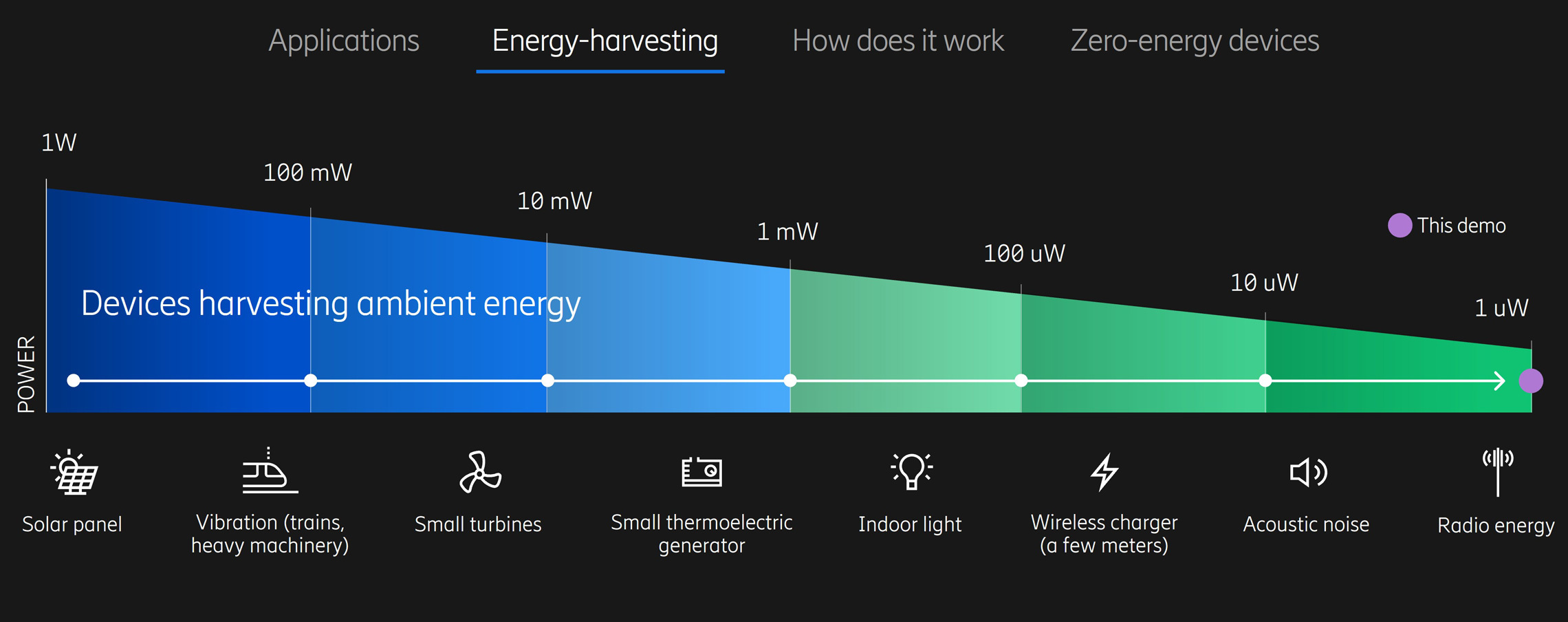
Above: Examples of energy sources and usable power levels for devices harvesting ambient energy
Tactile textiles: one of many future zero-energy device use cases
In a research project by MIT, researchers tried to mimic the functionality of countless numbers of pressure sensors in the skin by integrating thousands of simple pressure sensors in a tactile textile created by interweaving slightly piezoresistive threads into a knitted textile. Using the tactile textile, the researchers created a few different clothing articles, e.g. a vest, a sock, and a glove.
By monitoring and storing the response of the sensing textiles when applying different pressure patterns to the sensors and training machine learning algorithms on the sensor responses, the researchers could mimic the human learning process and build artificial intelligence models to draw conclusions on the actions of the object wearing the textile.
The results of the project were impressive, however there was one challenge that remained: the sensing textiles were powered and connected via a network of cables that were not very practical when moving around.
So, what if we instead could retrieve the information from the pressure sensors using a wireless connection? In a second cooperation with MIT we undertook to meet this challenge by designing an energy efficient radio transceiver that could power and monitor the sensor information in the tactile textile wirelessly. We showcased this at MWC 2023 and you can see some of the highlights from the demo in the video below.
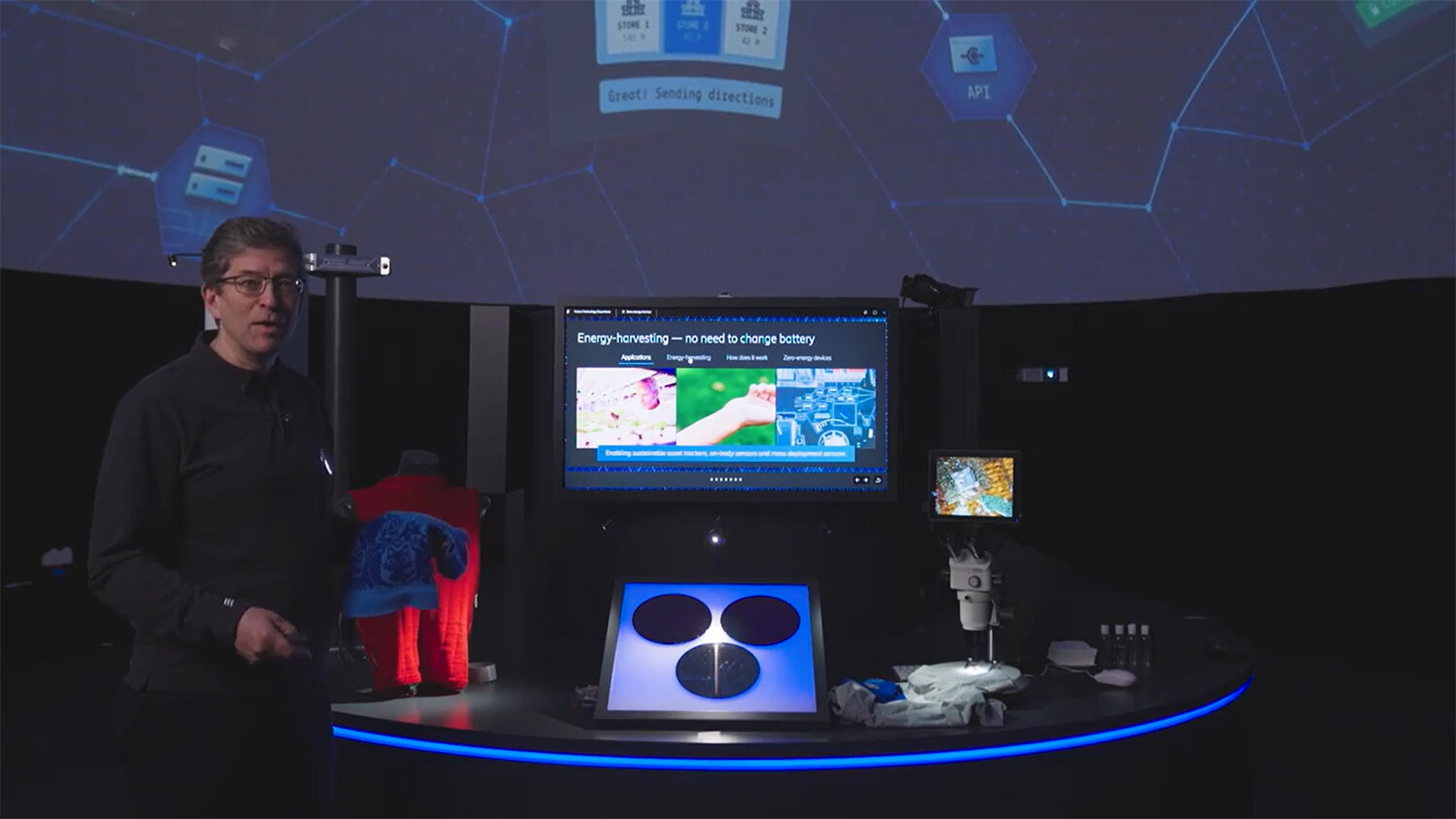
Above: The potential of wireless sensing textile and zero-energy devices showcased at MWC 2023 in cooperation with MIT
Exploring radio energy harvesting for tactile textiles
Although radio energy is a weak ambient energy source it is attractive as it is ubiquitous, that is, it is always available where there is mobile network coverage.
Addressing the challenge outlined above of designing a radio transceiver able to transfer the sensor information in a tactile textile, we decided to design a zero-energy back-scattering device able to harvest the energy from a 3.5 GHz 3GPP mobile network.
The principle for radio energy harvesting is relatively simple:
- An antenna captures the signal and feeds it into a rectifier.
- The rectifier is in fact a diode allowing positive voltages to pass through.
- Any negative voltages are blocked, and a DC voltage is therefore created at the output of the rectifier.
- The voltage is connected to the transceiver circuit, i.e. the load allowing the transceiver to operate.
When the tag is activated, the bit rate is in the order of 100 bps transmitted in short 3.5ms packages where each package has a bit rate of close to 40 Mbps.
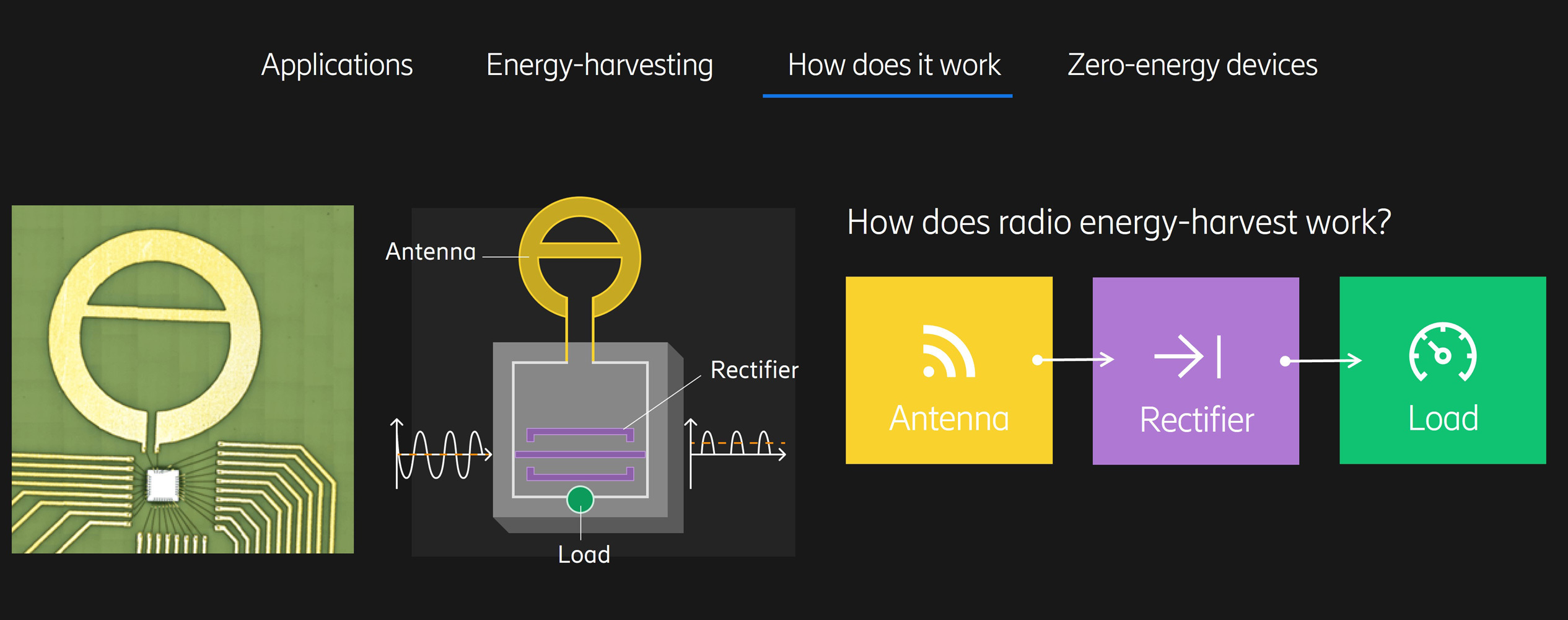
Above: The principle for a radio energy harvester using a rectifier
As the available energy is so low it is important that the radio energy harvester is energy efficient. In the current work we decided to implement the rectifier in a three atom thick Molybdenum-di-Sulfide (MoS2) layer while the backscattering radio transceiver was made in silicon.
The weak energy source also prevented us from storing any energy and we therefore implemented the zero-energy device as a passive, backscattering device. The rectifier was able to support frequencies up to 10GHz and the design of efficient rectifiers. You can read more about this in this research article.
The MoS2 rectifier was deposited on top of the low energy radio transceiver chipset designed in silicon. Thereby we could benefit from both advantages of MoS2, and the advantages of a radio transceiver chipset made in a silicon ecosystem, one good example of the benefits of heterogeneous integration. Find out more in this research article.
The principle of heterogeneous integration in this work are shown in the figure below. Moving from left to right in the figure we start with:
- the radio transceiver circuit designed and processed in standard CMOS silicon technology,
- a three atom-thick MoS2 layer is deposited on top of the silicon,
- transistors for the rectifier circuit are processed in the MoS2 layer, and
- connectors are added forwarding the harvested voltage into the transceiver circuit.
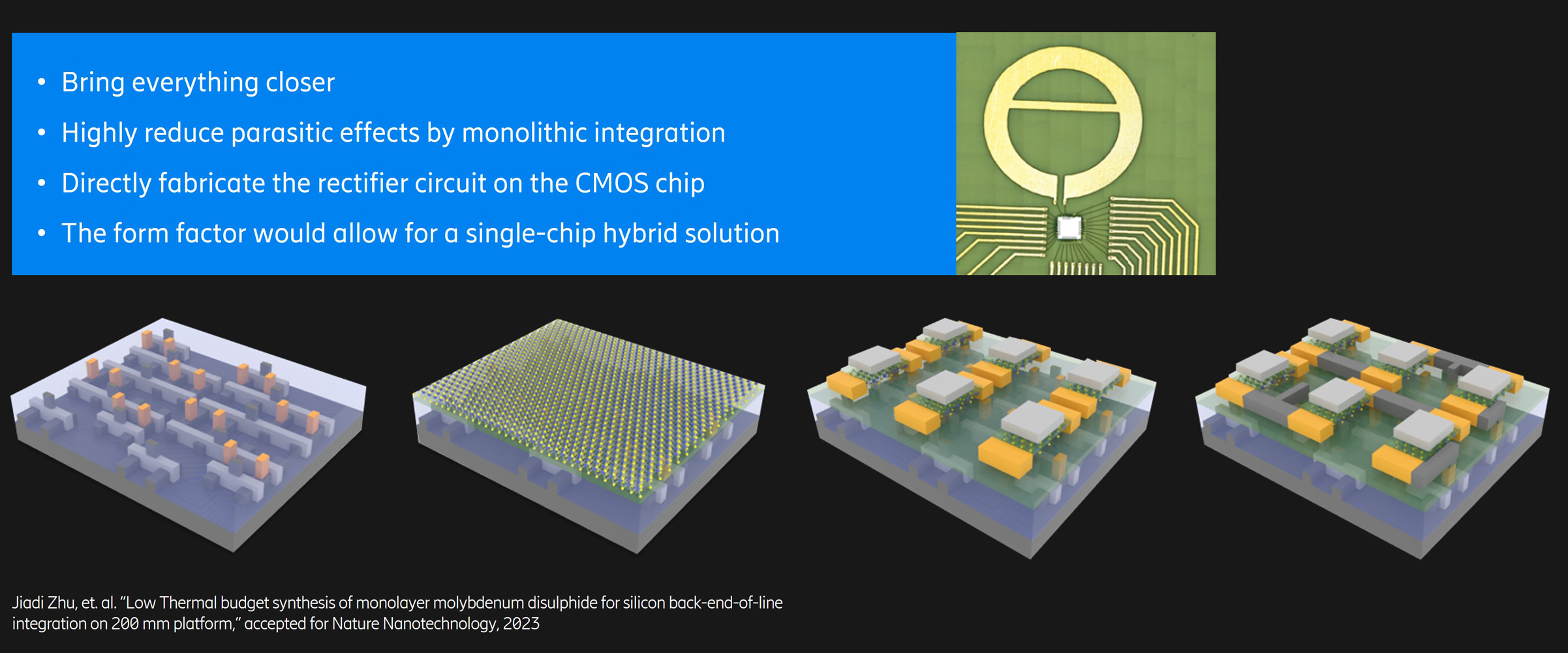
Above: Principle for heterogenous integration of a radio energy harvester with a silicon chipset
Network research challenges for zero-energy devices
Zero-energy devices are not only challenging from a device perspective, but they are also an interesting research topic from a network perspective.
In traditional cellular networks, there is a basic assumption that the device is, roughly speaking, “always” reachable. This means that mobility when the device is connected can be based on measurement reports from the device. Paging is possible as the device wakes up at regular time instances to check for paging messages. Furthermore, many radio-network protocols assume that the device remembers the outcome of previous actions – in principle a message sent to the device can assume that actions contained in a previous message have been taken.
However, all of this is likely not true for a zero-energy device. All messages need to be self-contained and independent of previous messages as it cannot be guaranteed that those messages were properly received. Mobility needs to be reconsidered, and physical-layer properties such as waveforms, coding, and modulation need to be selected based on the ultra-low amount of energy available in many of the zero-energy scenarios.
The future of zero-energy devices: limited by our imagination only
At the Mobile World Congress in Barcelona we showed a glimpse of what may be possible when future 6G networks are able to offer zero-energy connectivity.
Connecting a massive number of sensors wirelessly using zero-energy devices can open up a huge area of new opportunities, largely limited by peoples’ imagination only.
For example, what about integrating the MIT-developed sensors above into the socks of a golf player, using the data to practice the golf swing? Or imagine a team of football players with sensors in their clothes, what enhanced experience will the fans get from the additional statistics and data obtained? Can elderly people stay longer in their home environment if they are equipped with tactile textile clothing, triggering alarms and call for help if they fall?
The list can be made longer but these are some examples we mentioned to the around 8000 visitors we met for four days, showcasing zero-energy sensors at Mobile World Congress 2023 in Barcelona at the end of February 2023. The zero-energy devices were one of four 6G technology components shown, all located in a futuristic dome inside the Ericsson exhibit area.
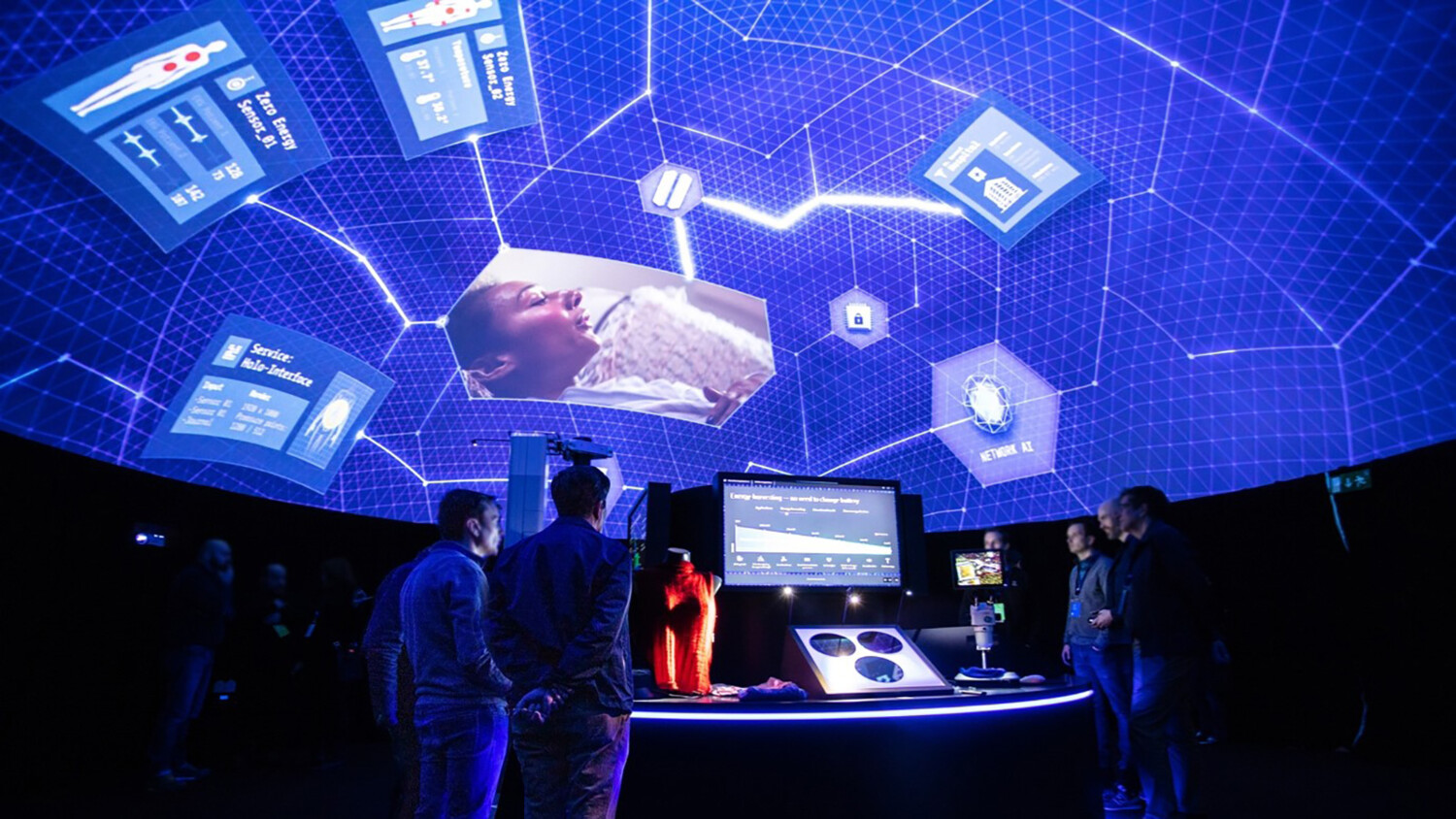
Above: Ericsson showcasing tactile clothing in cooperation with MIT at MWC 2023
There was an enormous interest in our story around the sensors and zero-energy devices. We received a huge number of questions – the most common one being “Can you wash the sweater?” (which you can although it has not been the focus of the research prototype).
Showcasing the sensors, exemplified by the sweater, as well as the zero-energy device prototype, triggered a lot of imagination among the visitors with comments such as “Wow, this is true research!”, “…mind boggling…”, “…truly future looking…”, and “I have no academic degree, but this I understand fully”. New use cases were suggested by the visitors, for example policemen wearing the sweaters in a riot situation to be able to get help if they fall, or as a way to prevent early infant mortality for babies sleeping in a high-risk position.
After those four intense but highly stimulating days, we are back in our research office, energized and ready to tackle new 6G challenges!
Learn more
Read the Imagine Possible Perspectives article: Powering our world with harvested ambient energy
Read the blog post: Zero-energy devices – a new opportunity in 6G
Read the blog post: Near-immortal devices and a sustainable deploy-and-forget future
Read the blog post: All data, everywhere, all at once: Can 5G and zero-energy devices create the perfect future workspace?
Read the press release: Ericsson and MIT enter into collaboration agreements to research next generation of mobile networks
Read more on energy sharing: Energy from everywhere