










One 6G network for all services – from massive IoT to enhanced mobile broadband
- English
- 简体中文
- In 4G and 5G, support for services other than mobile broadband – especially those provided by lower-end IoT devices – was introduced only in later releases. This led to unnecessarily complicated solutions, especially in 4G, and delayed market adoption of such services in both 4G and 5G.
- 6G needs to support a wider range of services already in the first specification release. This blog post explores the key priorities for the first release, with a deeper look at Massive IoT services.

Principal Researcher, RAN massive IoT
Principal Researcher, RAN massive IoT
Principal Researcher, RAN massive IoT
The first generations of cellular networks, 1G and 2G, were developed primarily to support voice. 3G extended this to support video and (in later releases) mobile broadband (MBB), but the broad market success of MBB came with the introduction of 4G. Building upon this momentum, the first release of 5G focused on providing an enhanced MBB solution with improved performance compared to 4G, as well as on extending services beyond consumer use cases to include for example industrial automatation.
Now, it is time to define which services and device segments 6G should initially focus on. In addition to delivering a superior mobile broadband experience for smartphone users, 6G should also, from the very beginning, provide support for other existing and new services, and a wide range of devices suitable for these. In particular, support should be ensured for low-end devices used for services with less demanding data rate requirements.
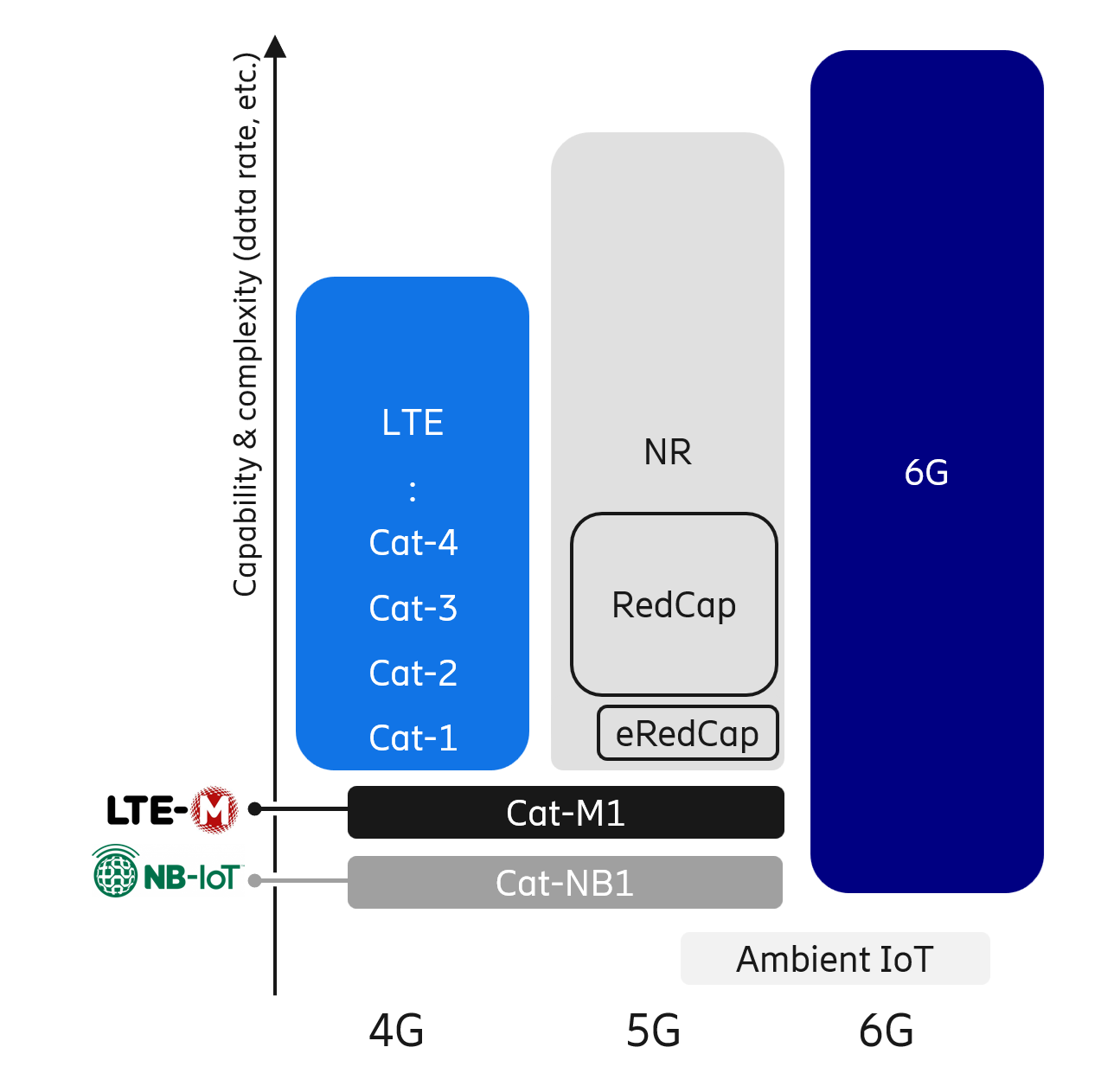
Figure 1 - Illustration of device segments from 4G to 6G
For both 4G and 5G, support for lower-end devices and IoT was not introduced from the start, but in a subsequent standards release. LTE-M and NB-IoT were introduced in the sixth 4G release to address massive IoT use cases, such as smart metering, utilities, and asset tracking – so-called low-power wide-area (LPWA) use cases. Likewise, support for RedCap (Reduced Capability) devices was introduced in the third 5G release to address broadband IoT use cases like smart wearables, industrial automation, and more.
Introducing these solutions at a later stage than the first release made the solutions complicated and slowed down their market introduction. For example, to handle the reduced device capabilities, changes to initial access had to be introduced for RedCap; new system information messages had to be defined for LTE-M; and NB-IoT is essentially a separate radio access technology altogether.
Note that Ambient IoT is included in the figure for completeness. However, the target maximum distance between a base station and a device in Release 19 Ambient IoT is just 15 meters. This is not adequate for cellular IoT use cases, why Ambient IoT is not further discussed here as a cellular solution.
6G device capability span to support a wide range of services
6G needs to both support existing 4G and 5G use cases and continue to expand the range of supported services compared to earlier generations to allow for new market opportunities and revenue streams.
Figure 2 illustrates the range of services 6G should initially focus on, from those at the bottom with low requirements on data rate, latency, reliability, etc. (utilities, smart meters) to those at the top with high requirements (entertainment, gaming, XR, time-critical communication).
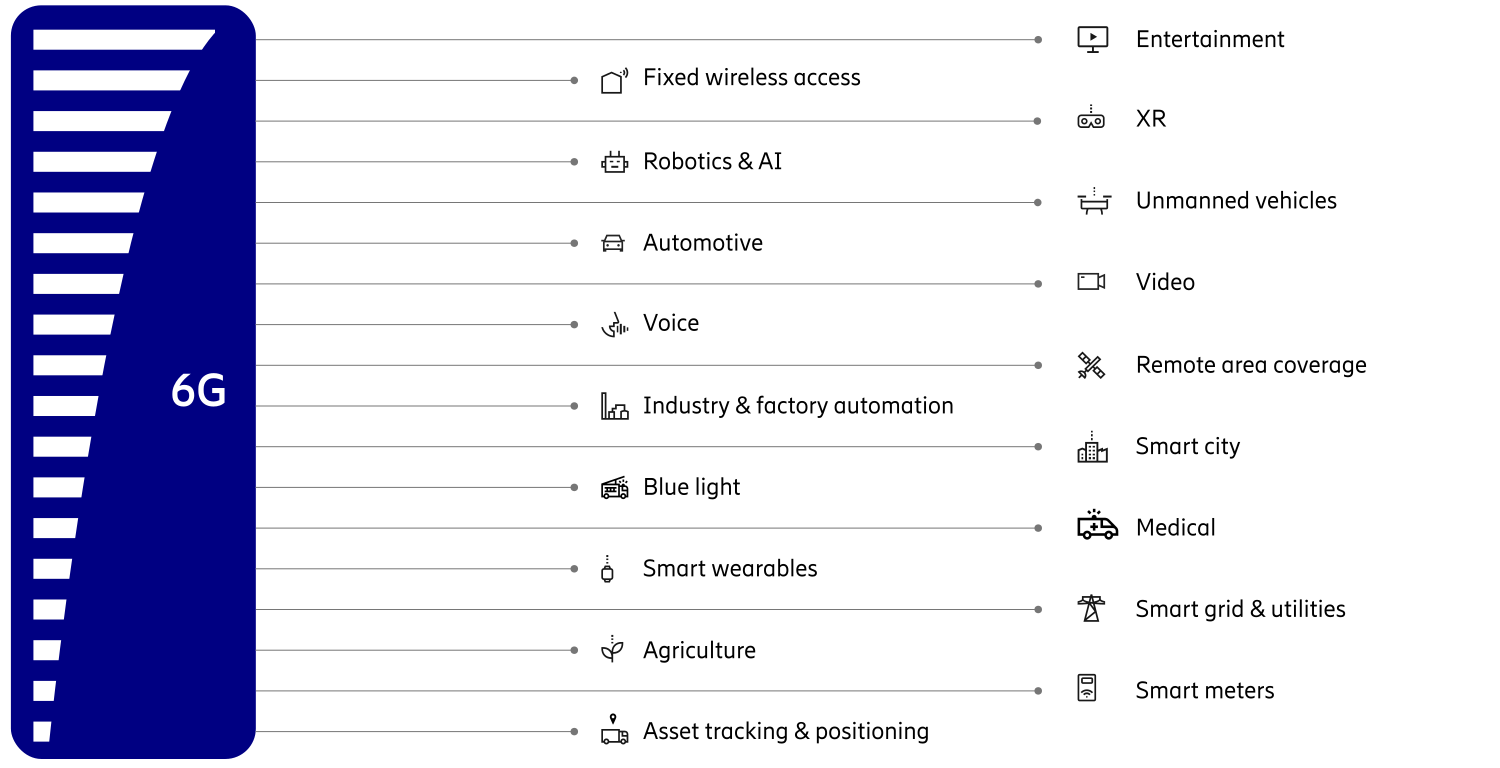
Figure 2 – Wide 6G range of device capabilities to support diverse services
The figure is only illustrative since it is difficult to compare very different requirements with each other, for example comparing positioning accuracy with uplink latency requirements.
However, the figure illustrates the wide range of services and requirements and the very diverse device capabilities that must be supported in 6G. A cutting-edge device is required for high-end use cases, for example 8K video streaming to an XR headset. Such a high-end device would also be able to serve less demanding use cases, but that would not be economically feasible. Neither does it scale well to, for example, equip every streetlight in a smart city with such an expensive high-end device. Therefore, a common 6G radio access technology must scale to support a wide range of 6G device capabilities, from high-performance devices for high-end use cases to cheap devices for low-end use cases.
The question for the upcoming 6G design is where to draw the line for the high-end and low-end capabilities, respectively.
For the high end, the answer is essentially determined by the capabilities required to support advanced use cases, such as immersive communication, anticipated to become popular in 2030 and beyond (see ongoing work on IMT-2030 requirements for 6G classification).
For the low end, where to draw the line is a more delicate question. It must be a conscious decision to make 6G applicable to all relevant use cases while at the same time not negatively impacting the 6G design and higher-end device performance.
Any device capabilities between these two endpoints should be supported by the standard, and market demand can determine later what will be commercialized.
6G low-end device capabilities for massive IoT
For the low-end device capabilities, 6G should simplify things compared to 4G and 5G by including sufficient support from the start. That is, the initial 6G release should support low enough devices capabilities to serve all relevant low-end use cases but without mandating a separate solution and negatively impacting MBB performance.
In many situations, low-end use cases with less demanding requirements, that is, the ones at the bottom of Figure 2, can be served by highly capable devices. However, as explained above, those are expensive and, therefore, not economically viable for all large-scale massive IoT deployments. The most important aspects for reducing device cost, within the control of 3GPP standardization, are the support of a narrower device bandwidth, fewer receive antennas, and half-duplex frequency division duplex (FDD), as illustrated in the lower part of Figure 3.
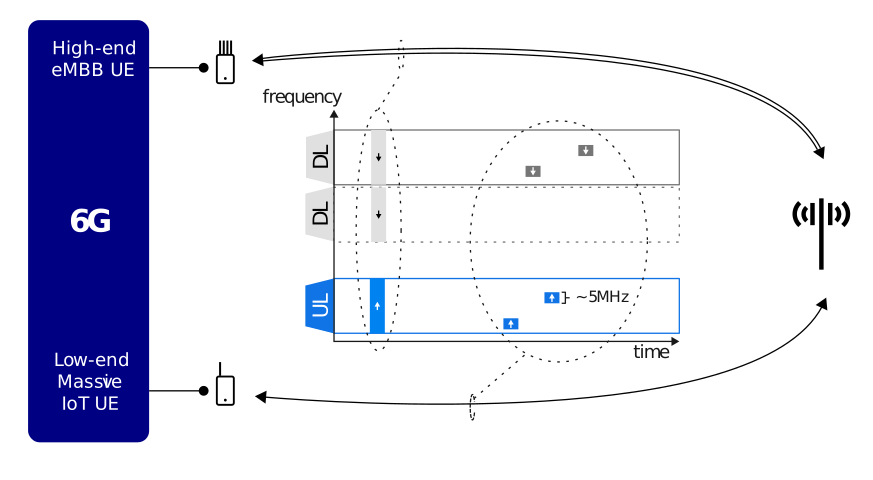
Figure 3 - Difference between high-end and low-end 6G device capabilities (FDD).
To support full-duplex operation, where each device is capable of simultaneous transmission and reception on different frequencies, the devices need to be equipped with relatively expensive duplex filters. A separate duplex filter may be required per supported frequency band. Therefore, these devices become relatively expensive when the device supports multiple frequency bands, which is most often the case.
With half-duplex operation, the device switches between reception and transmission and does not need to receive and transmit simultaneously. This means that the duplex filters can be replaced by a cheaper switch, which can be used for all frequency bands, allowing for a reduced device cost.
In 5G, devices need to support 2 or 4 receive antennas (in frequency bands below or above 2.5 GHz, respectively) and therefore, significant device cost reduction can be achieved by reducing the support to only 1 receive antenna. In 3GPP, this has been done in the past for LTE-M and NB-IoT in Release 13, for LTE Cat-1bis in Release 14, and for NR RedCap in Release 17.
Device cost can also be significantly reduced by reducing the bandwidth that the device needs to support. This has been adopted in the past for NB-IoT which supports 200 kHz device bandwidth, for LTE‑M which supports 1.4 MHz device bandwidth, and for NR RedCap which supports 20 MHz device bandwidth. For NB-IoT, the main motivation behind going for such an extremely narrow device bandwidth was to enable re-farming of GSM carriers (rather than purely device cost reasons). For 6G, there does not seem to be a need to support carrier bandwidths smaller than 3 MHz since few operators have carriers with less than 3 MHz bandwidth.
More importantly, as shown in Figure 4, device complexity is not significantly reduced when going to very narrow device bandwidths. The illustrated device complexity corresponds to the estimated device modem bill-of-material (BoM) cost.
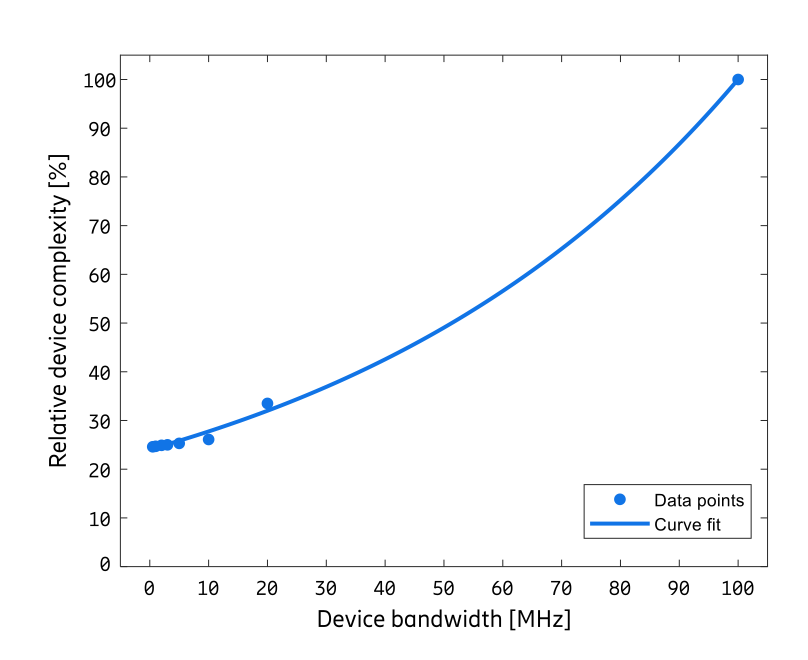
Figure 4 - Relation between device complexity and device bandwidth
The results were obtained using the evaluation methodology described in 3GPP TR 38.875. As seen from the figure, going below a device bandwidth of 5 MHz would lower device complexity by barely a few percent compared to 5 MHz. This means that from a device complexity point of view, a device bandwidth of several MHz (for example, 5 MHz) is suitable.
The device cost is impacted by device complexity but also by other factors. The impact of economy-of-scale should not be underestimated. If a device type can address many use cases and thus be produced and sold in large volumes, this will help push the device price down. Therefore, use cases where, for example, 1 MHz device bandwidth would suffice, would be better to address with a somewhat higher device bandwidth, for example, 5 MHz, since there is no significant cost reduction as indicated by Figure 4.
The observation that there seems to be no need to support carrier bandwidths narrower than 3 MHz and no significant further device complexity reduction from supporting a device bandwidth narrower than a few MHz is very helpful. It means that the 6G design may support all relevant use cases with one network without the performance penalty associated with the support of extremely narrow bandwidths.
Supporting a somewhat larger device bandwidth is also beneficial for IoT key performance indicators (KPIs). It would help to improve downlink coverage, increase data rates to better support software and firmware upgrades and voice services (which may provide added value for some IoT use cases). Battery life can be prolonged by allowing the device to return to a power saving state more quickly.
Supporting a too narrow bandwidth for low-end devices would, for example, mean that the 6G reference signals (such as SSB) and system information broadcast transmissions would have to be sent within this narrow bandwidth, which could have a noticeable negative impact on the performance for high-end devices such as eMBB devices. Also, when an eMBB device triggers an initial access before the device capabilities are known by the network, the network would initially need to assume the device is a simple, low-end device with a narrow bandwidth and schedule it accordingly. This means scheduling and data transmission are sub-optimal for any device other than the assumed lowest-end device until the device capabilities are made known to the network.
For this reason, a good choice for low-end device bandwidth is wide enough to receive the 6G SSB for eMBB use cases. This is, of course, pending the upcoming 6G design in 3GPP, but if it is similar to 5G, a 5-MHz device bandwidth could be suitable for low-end devices in lower frequency bands.
In summary, a good starting point for defining the low end of device capabilities could be to support a device bandwidth of 5 MHz, 1 receive antenna, and half-duplex FDD operation. Note that a 5-MHz device can still operate within a carrier bandwidth of several hundreds of MHz, but all data, reference signals, system information, and other transmissions to and from the device need to be scheduled within 5 MHz.
These devices could also operate in more narrow carriers. For example, a 5-MHz device operating in a 3-MHz carrier, in the same way more capable devices supporting a much wider bandwidth would. In this case, the device would be configured to only transmit and receive within the 3-MHz carrier, even though the it is otherwise capable of transmitting and receiving with wider bandwidths – and the technical challenge is for the network to broadcast all signals within 3 MHz bandwidth.
For the IoT use cases and other use cases near the bottom of Figure 2, data rate and latency are not as important as for more high-end use cases. However, there are other KPIs which are crucial for fulfilling the requirements for the targeted use cases, such as long device battery life, extensive coverage, GPS-less positioning, efficient transmission of small data payloads, high capacity to support massive numbers of IoT devices, and longevity of service support.
Therefore, if an IoT device is supported in the field, it should preferably just work without the need for manual maintenance or other manual involvement for as long as the service is still needed, which for IoT use cases may be 10-20 years or even longer. These aspects should be taken into consideration for the 6G design. Any technical solutions, such as use of wake-up receivers for battery life extension or signalling overhead reduction for small-data transmissions, should also ideally be introduced as generic 6G features that can be supported also by devices with higher capabilities.
6G high-end device capabilities for eMBB performance
The 6G high-end devices are, for example, intended for flagship smartphones and support all the highest capabilities as illustrated in the upper part of Figure 3. Technologies such as multi-user massive input massive output (MIMO) and multiple transmit and receive antennas, quick processing, rapid activation of carrier aggregation, high-order modulation, and wide device transmit/receive bandwidths covering carriers at least 200 MHz wide. New cm-wave frequency bands, a streamlined processing timeline with redesigned control signalling, uplink-downlink decoupling, and interruption-free mobility mechanism are other examples of technology components not used in 5G but envisioned for 6G. A more complete description can be found in the blog post 6G RAN – key building blocks for new 6G radio access networks.
Utilizing more spectrum resources is perhaps the most important way to achieve higher data rates and performance. In addition to the frequency bands supported for 5G, the cmWave frequency bands in 7-15 GHz can provide the possibility to boost the data rate further when needed for demanding applications for 6G. Sub-10 GHz is the most promising frequency range.
Both 4G and 5G support carrier aggregation, which also improves the data rate by utilizing more spectrum resources and multiple carriers for data transmission, but in a somewhat limiting manner. For example, the time it takes to configure and activate additional carriers in 4G/5G can be relatively long, meaning that the data may already have been transmitted by the time all carriers are activated in the device. In 6G, improved performance could therefore be achieved by quicker setup for faster access to a larger transmission bandwidth for (high-end) devices supporting carrier aggregation.
Uplink-downlink decoupling is another example of more advanced handling of multiple carriers in 6G. Given the difference in transmit power and antenna configurations, a device in a location with less favorable radio conditions could sometimes be better served if it could transmit in a lower frequency band but receive high-speed data on wider bandwidth in a higher frequency band.
MIMO is yet another example where 6G will enhance the performance compared to 5G. In the downlink, MIMO will become even more massive with thousands of antenna elements. The existing mechanism for reporting channel-state information from the device to the base station needs to be reconsidered to address this. In the uplink, multi-layer transmission and beamforming will be more important than in 5G, for example to address use cases such as fixed wireless access.
These are some examples of advanced technology highly beneficial for high-end devices but not needed or feasible in terms of complexity for cost-sensitive low-end massive IoT devices. Other technology components may be relevant for both high- and low-end devices, for example the unified control signalling. Nevertheless, it is important to design a single 6G radio access technology that can scale across this wide range of device types.
Everything in between
Above, the definitions of the low-end and high-end capabilities of 6G are discussed, but all the relevant use cases in between should also be supported, as seen in Figure 2. The 6G standard should enable support for all device capabilities between these endpoints, without gaps. That is, features and generous parameter ranges should be supported in the standard, and it will be left to the market to determine what to implement. For example, when the use case for AI-driven lightweight augmented reality glasses takes off in the consumer market, time-to-market can be minimized if the required device capabilities are supported already in the first 6G release. Therefore, there is a lot to gain from supporting flexible device capabilities already in the first 6G release.