










How high-performance antennas can drive network excellence in North America
-
North America are global leaders in 5G – but evolving demands mean networks always need to be one step ahead.
-
Through real-world scenarios, learn how advanced antennas are the unseen enablers, dynamically delivering robust and secure coverage, from remote rural communities to global golf events

Head of Ericsson Antenna System, Americas

Head of Network Product Solutions, Ericsson Americas

Head of Ericsson Antenna System, Americas
Head of Network Product Solutions, Ericsson Americas
Head of Ericsson Antenna System, Americas
Head of Network Product Solutions, Ericsson Americas
It’s easy to become swept up in the latest technologies that leverage 5G. From sleek augmented reality glasses to the wildest new generation of real-time AI interfaces, it’s an incredibly exciting time. But most people rarely turn their thoughts to the connectivity that is so essential to make the use of these things possible – and even less think about the antennas quietly working in the background to deliver that connectivity.
North America is the global leader when it comes to 5G adoption, with 71 percent of mobile subscriptions already on 5G, a figure projected to reach 91 percent by 2030, according to the most recent Ericsson Mobility Report from June 2025. But this dynamic growth brings its own set of challenges, as data traffic reaches unprecedented levels and demand continues to grow for new, advanced services. The pressure is on for networks to evolve to become not only high performing, but also agile and programmable, capable of delivering tailored connectivity for specific users and use cases.
Possibly the most transformative factor is the shift from predominantly download traffic, to a more two-way flow, with ever-growing demands for uplink capacity. Applications like video calls, cloud uploads, IoT and AI which once seemed futuristic are now mainstream, driving uplink payload year-over-year increases of over 100 percent in 5G networks. Communication service providers (CSPs) have seen this changing need, moving their own goals away from just strong speed test results and download throughputs, to delivering uplink that ensures excellent customer experiences for these use cases.
To do this, CSPs have been transitioning to radio hardware with more received channels to facilitate better uplink gains and meet these escalating demands. While many have already deployed four transmit, four receive (4T4R) multiband radios instead of the previous single-band 2T2R units, we’re also seeing a push towards 4T8R (yielding double the uplink gain, or +3dB gain) to robustly boost uplink performance and extend continuous 5G coverage. What does this have to do with antennas, you ask?
Passive antennas: the unsung heroes enabling 5G’s potential
Much as you wouldn’t purchase a sports car and then install bicycle tires, upgrading radios without addressing antennas is a great way to waste resources and create performance bottlenecks. To maximize network benefits, antennas must keep pace and be able to transmit and receive efficiently and precisely. As network programmability and the evolution of antenna technology progresses, antennas are becoming more than passive components. They are the gateway to the network – the first touch point between the end user and the network, and a crucial enabler of high-performing, energy-efficient and programmable networks.
So how do antennas help meet these rising demands? For us at Ericsson, it all begins with innovation – seeing each new challenge as an exciting new opportunity. It may sound cliched, but for us, this relentless pursuit of improvement and excellence is what keeps the field and our work engaging, even after decades working in the industry. Our new trio net design antennas are a prime example – the result of years of innovation, precisely built and engineered to maximize network impact by optimizing antenna design, pattern and systems.
As described in detail in a separate blog post, the benefits are already proven – 15 percent higher uplink throughput, 29 percent reduced radio output power and 35 percent lower smartphone energy consumption to name a few, achieved through superior FDD mid-band utilization, improved carrier aggregation and higher modulation and MIMO schemes. They also significantly lower the total cost of ownership (TCO), while contributing to sustainability targets, improving safety and ease of installation and offering exceptional durability and resilience to challenging environmental conditions.

Video 1:01 min | Latest trio net antenna solutions
But the easiest way to understand the tangible impacts of these innovations is through real-world scenarios – so let’s dive in.
Connecting and securing diverse environments, from rural to urban
As we are both outdoor enthusiasts, (Rodrigo can often be found cycling or competing in triathlons in his free time, while Ranjeet indulges his love of nature by hiking in our spectacular national parks), we’ll begin by heading to the more remote regions of North America. Just as we push our limits, exploring new frontiers and navigating challenging terrain, so too do CSPs – but their priority is on expanding coverage, connecting rural homes and providing access to key services. As the weakest link in a radio network (the uplink) determines the cell size, uplink is crucial for delivering coverage in these regions. Ericsson’s highly efficient antennas ensure robust uplink performance and wide coverage, as FDD bands allow a single site to cover vast distances, also reducing TCO thanks to reduced site costs and energy consumption.
Now let’s return to the urban hustle and bustle. In the office of a modern enterprise, employees need reliable and secure connectivity every day for devices like laptops, tablets and smartphones. Wi-fi is the standard solution – but it can fall short when staff or devices need to move between locations or buildings, or when sensitive data is involved. Can cellular be the answer? Of course, high-performing indoor coverage can be achieved in commercial buildings using dedicated solutions such as small cells comprised of Radio Dots. But in many cases, including most residential buildings, a dedicated indoor solution doesn’t make sense. And here, antennas can make all the difference.
For effective “outside-in” indoor penetration and coverage, strong uplink is again the challenge – and as we’ve discussed, this is where Ericsson's high-performance antennas shine. They ensure the device's signal effectively reaches the outdoor base station, maintaining a robust two-way connection for data uploads, cloud access and video calls. As we do here at the Ericsson office, employees can use eSIM laptops to connect directly to the outdoor 5G network, taking advantage of seamless indoor connectivity with full mobility, while being more secure than public Wi-Fi. But our exploration doesn’t end in the big city – it’s time to head to the golf course.
Advanced antennas in action: dynamic capacity for major public events
Like many sports, golf draws massive crowds and audiences to its headline tournaments, which number among the world’s biggest events. The demand to bring wireless cameras and full HDR footage captured live from even the most distant holes is understandable. And now, by leveraging private 5G, immersive new features such as augmented reality and virtual map visualizations can bring fans closer than ever. But live broadcasting from remote cameras poses a significant challenge, as high uplink throughput is essential – and it must be achieved without restrictive cables.
A key factor in realizing this is TDD and FDD carrier aggregation (CA), where multiple frequencies, including both TDD and FDD bands, are combined. This approach not only creates a wider bandwidth and enables the network to handle more data more efficiently, but also significantly improves coverage, particularly by leveraging FDD bands for long-distance reach in diverse environments and boosting uplink performance.
Ericsson's advanced antennas also excel when it comes to beam efficiency and passive intermodulation (PIM) performance, which reduces interference, delivering superior signal quality and coverage, ensuring that uplink CA can kick in, enabling high-quality video transmission over 5G. But what about when crowds surge between holes or facilities, and demands move and fluctuate drastically?
Application Programming Interfaces (APIs) can work in conjunction with rApps based on O-RAN standard to facilitate dynamic, real-time adjustments to antenna patterns. This means the network can instantly adjust the cell shape, tilt and power based on real-time statistics, optimizing coverage and capacity on-the-go. For example, rApps can send instructions that influence Remote Electrical Tilt (RET) units in antennas, allowing for remote control and dynamic adjustment of the antenna tilt with high precision (+/- 0.5 degree resolution) to optimize coverage and capacity – such as when crowds or broadcasts move across a vast course in a major golf tournament.
When it comes to security and durability, no compromises can be made. Some public events and broadcasts are of national or even global significance, making reliable connectivity critical – another significant challenge when extreme environmental conditions and cyberattacks are an everyday reality for communications infrastructure. The Ericsson RET system features an encrypted interface, preventing unauthorized access that could lead to network outages or compromise security. The RET component has also been tested for more than 10 000 cycles of continuous tilt variation, ensuring it will not fail even when under continuous operation – and can also be replaced without replacing the entire antenna, leading to significant maintenance savings and reducing costly downtime.
Enabling intent-driven automation for a programmable future
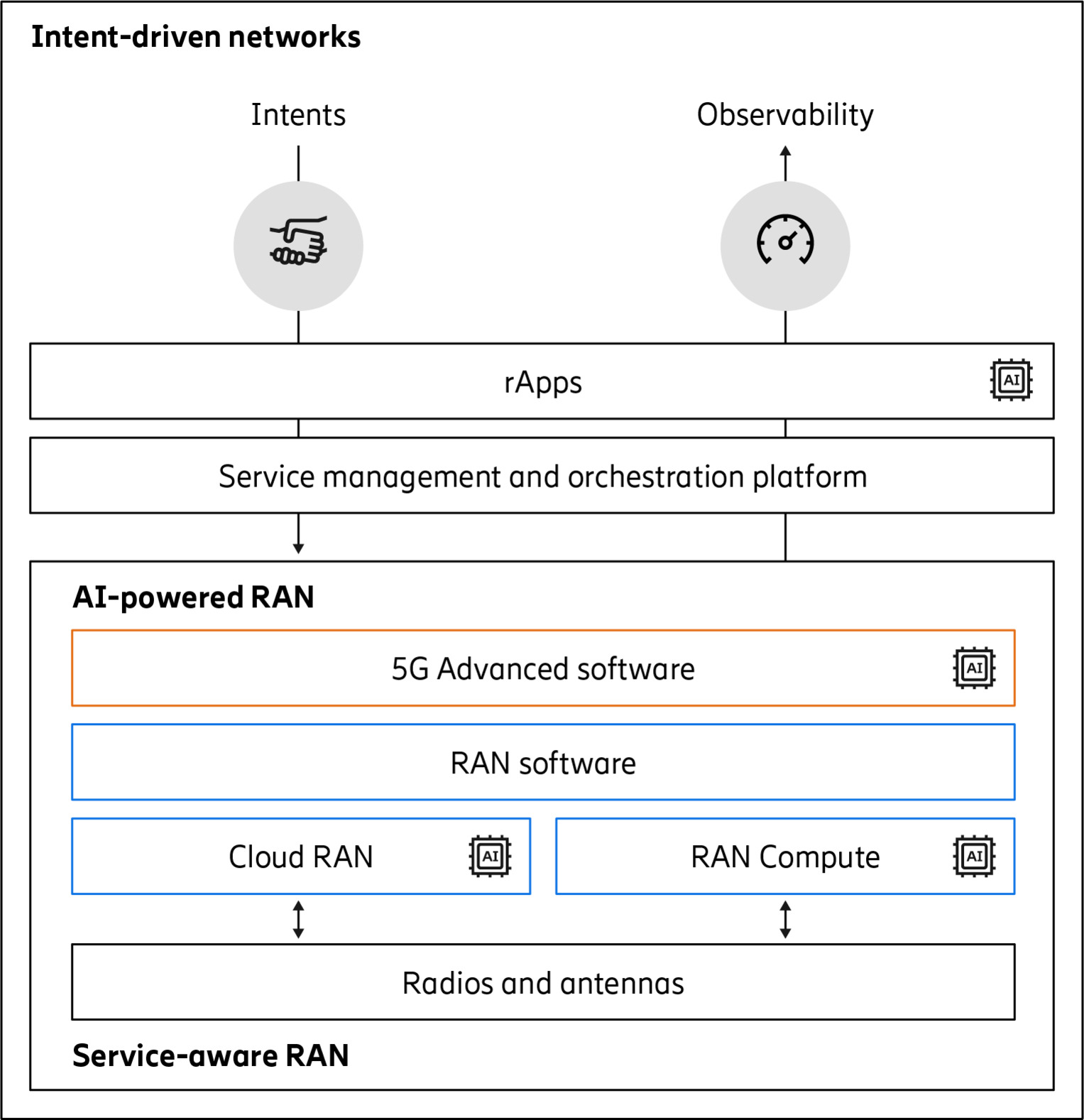
So, what comes next? Networks are rapidly moving toward intent-based automation, where a high-level user or CSP’s intent, such as "provide 100 Mbps uplink throughput in this area for cloud gaming", triggers the network to dynamically adjust its settings. The network intelligently decides what is required to achieve that intent, breaking down high-level objectives into low-level requirements, and taking the necessary actions.
A process flow diagram showing the progression from collaboration to performance through structured stages.
Antennas are an integral part of this chain of programmability. As demonstrated in the RET example from the golf tournament scenario, they can respond to instructions from rApps, adjusting characteristics like cell shape, tilt, and power to meet the specified intent. This ensures continuous optimization of user experience and energy consumption. It also enables CSPs to monetize differentiated services like network slicing by guaranteeing a specific quality of experience, or to manage their networks as sustainably and efficiently as possible.
Of course, as in most areas, AI will have a significant role to play in this evolution. AI helps shorten antenna development cycle time, plus ensure that they are optimally designed for a given condition. AI will be crucial for network management, analysis and optimizing the balance between user experience and energy consumption. AI can also be used in digital twins of the network, to predict and respond to simulated situations, feeding instructions that will influence real-world antenna performance.
As part of this transition to fully programmable networks, we also expect our Antenna Monitoring Units (AMUs) to become a key and integrated part in future antennas. AMUs are components designed to enable the remote monitoring of passive antennas, providing GPS and internal alignment sensor data. This allows real-time visibility into site configuration and facilitates proactive maintenance and upgrades based on accurate and secure information, taking us one step closer to fully automated, programmable networks.
Until then, our commitment to constant innovation will ensure we keep pushing the boundaries. We’ll continue driving integration with open architectures and emerging technologies. And of course, we’ll keep optimizing our systems to deliver exceptional levels of connectivity, service and experience for CSPs and users everywhere – from the biggest city, to the most remote peak, working behind the scenes to power North America's journey to a programmable, AI-powered 5G future.
Read more
- Explore more benefits and solutions from Ericsson Antenna System.
- Learn more about our trio net antennas and design.
- Find out how our antennas performed in the field, in a recent benchmark study.
- Discover how antenna technology is driving network transformation for North American operators.
- Learn why antennas are key for maximizing network impact in North America.
- Explore the seven tenets of a modern antenna strategy.
Explore modern network management approaches that give you greater visibility and control across today's increasingly complex networks.
Learn how network slicing enables customized connectivity with assured performance for enterprise, consumer and industry-specific services.