








How Ericsson and Princeton are shaping the future of wireless technology together
- Many wireless breakthroughs begin in university laboratories. At Ericsson, we engage with academia to shape future technologies, with Princeton as a leading example.
- Ericsson and Princeton's NextG program collaborate on fundamental research spanning sensing, communication and hardware, including the use of orbital angular momentum (OAM) for short-range sensing and communication.

Research manager, Radio

Senior Researcher, Radio
Research manager, Radio
Senior Researcher, Radio
Research manager, Radio
Senior Researcher, Radio
Many wireless breakthroughs that eventually reach products and standards begin in university laboratories, where researchers have the freedom to explore technologies before their applications are fully understood.
Ericsson complements its global in-house research capability with close collaborations with academic partners such as Princeton University in the US when approaching long-term technology challenges. Turbo-codes and MIMO are famous examples of academic breakthroughs that have shaped today’s networks.
Areas such as integrated sensing and communication (ISAC), terrestrial-satellite convergence, and Artificial Intelligence (AI) - native network design require work across multiple disciplines. They involve fundamental questions in electromagnetics, hardware, signal processing, networking and artificial intelligence—questions that may take years of research to answer.
Princeton – leading by example
Here in the US, we engage with government agencies, publicly funded research programs and leading university research centers to explore the boundaries of wireless communication.
The Princeton NextG research program is one of our longstanding and most valued engagements in the U.S. It brings together leading researchers to work on next-generation wireless and networking, spanning integrated circuits, spectrum technologies, artificial intelligence and sensing.
Our approach to this partnership aligns with all of our academic engagements: Ericsson works closely with researchers addressing the most difficult technical problems, contributes practical industry experience, leverages our global presence to connect related efforts, and helps promising ideas progress toward future standards and products.
Experimentation is essential. Our most valuable partnerships are often with universities that combine strong theoretical foundations with the ability to build and test. Ideas become more useful when they can be evaluated in hardware, demonstrated in realistic environments, and challenged by practical constraints.
NextG operates an industry affiliate program through which member companies can participate in targeted research with faculty and PhD students. Ericsson is an affiliate, and our relationship with Princeton has developed into one of our most productive academic collaborations.
The center is co-led by Professors Kaushik Sengupta and Yasaman Ghasempour of Princeton’s Department of Electrical and Computer Engineering. Ericsson’s research engagement runs deepest with Prof. Ghasempour and her research group in Princeton’s Smart Wireless Agile Networks (SWAN) Lab. The group works across sensing, communication and hardware. One of the lab’s distinguishing features is its range: the research extends from electromagnetic theory and antenna design to working prototypes that can be readily demonstrated in the center’s labs.
Ericsson’s collaboration with Prof. Ghasempour focuses on using orbital angular momentum, or OAM, for short-range sensing and communication. OAM is a modulation type in which the electromagnetic wavefront twists around its axis of propagation. While conventional wireless systems transmit a planar wave, an OAM wave takes the shape of a corkscrew. Mutually orthogonal OAM waveforms can be generated to increase channel capacity and enhance both sensing and communication.
Here we illustrate the helical wave fronts of three orthogonal OAM modes -1, 0 and 1 with the signal strength illustrated by a thermal colormap. Modes -1 and 1 rotate in counter-clockwise and clockwise directions, respectively, while mode 0 corresponds to the regular planar wavefront that we are used to in cellular communication.
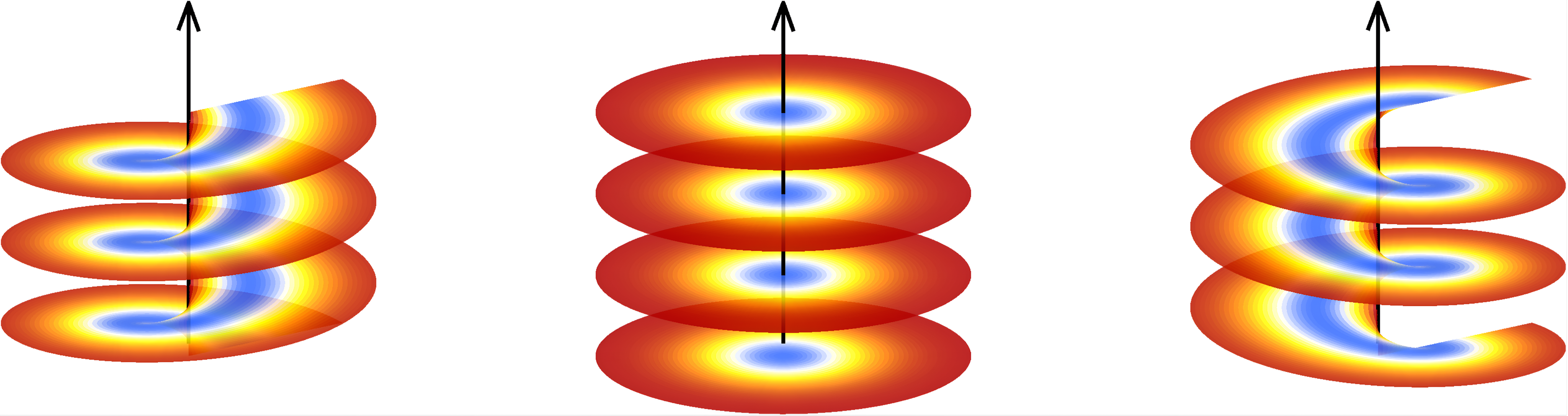
Figure 1: Orthogonal OAM modes -1, 0 and 1.
The first phase of the collaboration, led by Princeton PhD student Ruiyi Shen, resulted in a publication in Nature Communications. The current phase is developing passive, battery-less and chip-less OAM-coded backscatter tags—a technology with potential applications in object identification and asset tracking. Most recently, Prof. Ghasempour and Ruiyi showed in yet another Nature publication how OAM transmissions can be used to detect atmospheric turbulence.
Beyond OAM, the Ericsson-Princeton collaboration has also published an overview of ISAC that combines academic research with an industrial outlook.
Every spring, Princeton invites researchers, industry leaders and policymakers to the annual NextG Symposium. The 2026 symposium focused on integrated sensing and communication, spectrum policy, quantum computing and artificial intelligence. It was also an opportunity for faculty members to present their research.
The symposium showed how the SWAN Lab’s work extends well beyond OAM. Princeton students presented work on self-curving Airy beams that can sense around corners, an approach that could be relevant to autonomous vehicles operating in obstructed environments.
Other work explored distributed near-field beam shaping, which could help extend the useful range of high-frequency wireless links. This is becoming increasingly relevant as larger antenna arrays enable the use of new frequency ranges such as cmWave. Together, these projects illustrate how academic collaboration addresses fundamental questions through both conceptual and experimental work.
The program also addressed broader developments that will influence wireless technology. Arielle Roth, head of the National Telecommunications and Information Administration (NTIA), discussed the US administration’s plans to make 800 MHz of additional mobile spectrum available to help secure US leadership in the build-out of 6G.
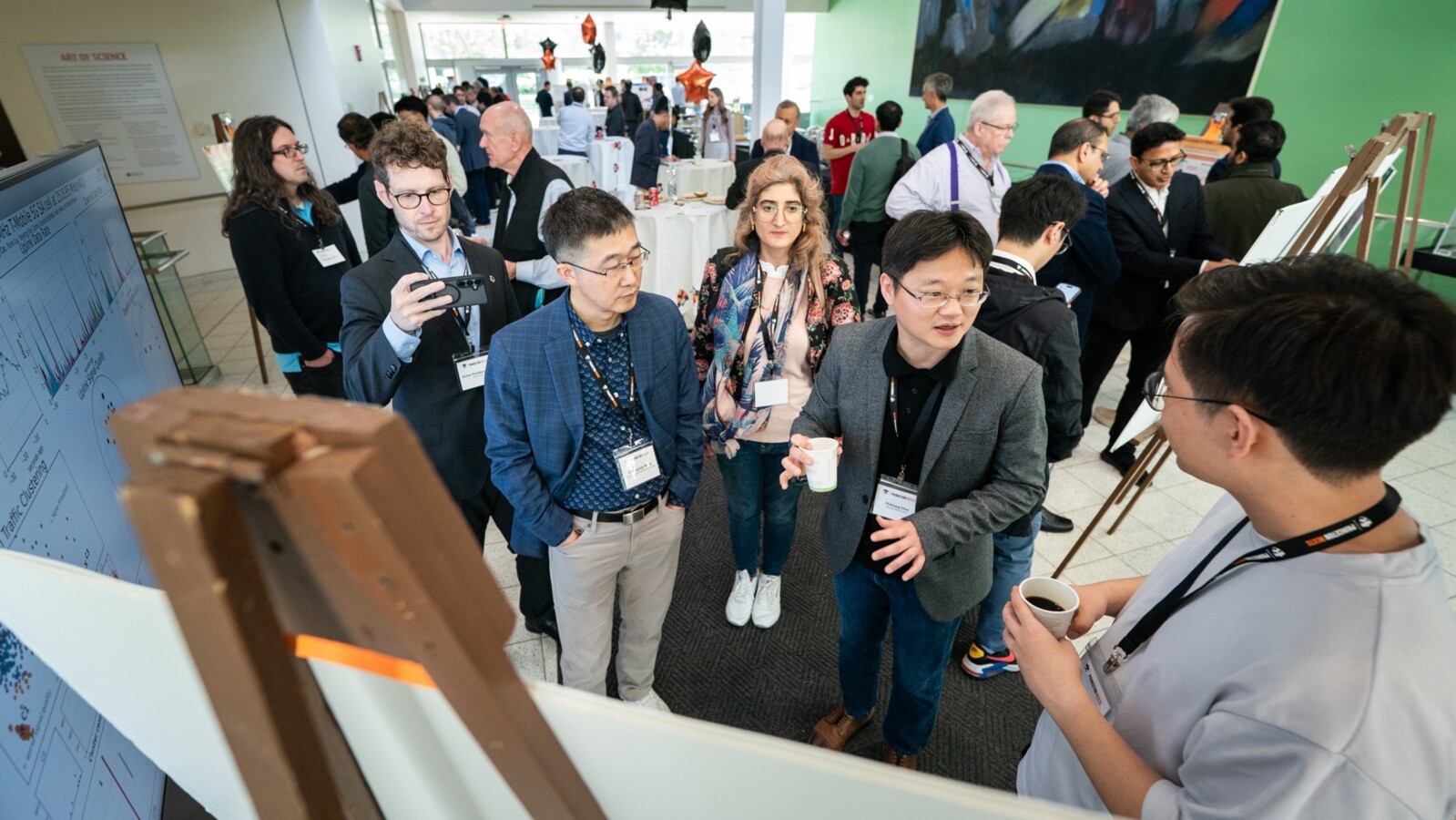
Photo by Tori Repp/Fotobuddy
Expanding the collaboration
The collaboration between Princeton, through Prof. Ghasempour, and Ericsson has recently expanded through a research award from the National Science Foundation’s VINES program. VINES—Verticals-enabling Intelligent Network Systems—is a federal flagship program taking a leading role in next-generation wireless research, including 6G research collaborations. It brings together universities, industry and governments across the US, Finland, Sweden, India and Japan.
In our Princeton collaboration, the awarded project focuses on disaster response—a scenario in which communication infrastructure may be damaged or unavailable precisely when connectivity is most important. Led by Prof. Ghasempour, with Ericsson as the industry partner, the project will develop Artificial Intelligence (AI) - enabled sensing to support damage assessment, coverage restoration and emergency responders in challenging environments. Ericsson contributes network infrastructure expertise and helps ensure the research is grounded in real deployment scenarios. The work includes wireless digital twinning, sensing and mobile edge computing.
The technologies will be evaluated through several over-the-air demonstrations. This creates a path from fundamental research to realistic validation without losing sight of the underlying technical challenges.
A core pillar of our academic collaborations is our commitment to nurturing the next generation of researchers. Ericsson Research has been hosting Ph.D. summer interns from leading U.S. schools, including Princeton, to work on 6G research and other emerging technologies. This has yielded joint publications, patent filings, and direct exposure for the students to standards-driven industrial research.
Academic collaboration also creates opportunities to discuss research challenges and test emerging ideas in larger public forums. At September’s IEEE VTC in Boston, Prof. Ghasempour moderated the panel “The Sky as Spectrum: Cellular Networks for Drones and Against Them,” which Olof Liberg had the honor to participate in. The discussion covered the challenges of detecting drones with cellular base stations, the gap between simulation and real-world experimentation, and the role of aerial connectivity. The panel also discussed how cellular sensing systems need to be hardened to resist spoofing, interference and other forms of attack.
Preparing for what comes next
The Ericsson–Princeton engagement illustrates the purpose of research partnerships. Their value is not limited to addressing a narrow research question. Continuous discussion helps develop novel ideas, experimental setups and future talent that the industry will need when building the next generation of technology.
For Ericsson, investing in this work means early awareness of fundamental challenges, a role in shaping how emerging technologies progress toward deployment, and an opportunity to introduce ourselves to leading talent. All essential components when preparing our company for the next G.