










What is the future of 6G? Insights from the 6G@UT forum
- At the 6G@UT forum, leaders from industry, academia, and government explored how 6G will develop through AI-native networks, integrated sensing, digital twins, non-terrestrial connectivity and new radio access capabilities.
- The discussions made clear that 6G will build on 5G while moving toward a more intelligent, continuously evolving network platform designed for new traffic patterns, autonomous systems, AI workloads, and future services.

Research manager, Radio
Research manager, Radio
Research manager, Radio
What will the development of 6G actually look like? That question brought together industry, academia, and policymakers at this year’s 6G@UT forum, hosted by The University of Texas at Austin.
The conclusion? That the answers are still coming together. But the forum made clear that 6G development is moving fast, with the role of AI, digital twins, and integrated sensing and communiction (ISAC) beginning to take shape.
A shared platform for an evolving ecosystem
The forum reflected the reality that 6G is built in a joint effort across academia, industry and government. Researchers, operators, vendors, and policymakers all face different sides of the same challenge. To support emerging services, future networks must handle traffic patterns that look nothing like today and do so with far greater intelligence and efficiency.
The hosts opened the event by outlining the 6G@UT program's four inter-connected themes: AI-native networks, 6G radio access, non-terrestrial networks, and network digital twins. Across all four areas, the boundaries between communications, computing, and sensing are dissolving.
6G: an evolution with revolutionary ambition
A foundation of discussions across the day was that 6G will build on the evolution of 5G but with significantly higher ambition.
Ericsson Chief Technology Officer Erik Ekudden described the network as an “intelligent fabric” that will serve not just people, but AI workloads, autonomous vehicles, and industries that all will benefit wireless connectivity. 6G will feature meaningful energy reduction, up to 200 percent downlink capacity gain through centimeter-wave massive MIMO, and a tenfold uplink improvement for cell-edge users. He pointed to an ISAC demonstration already running in the United States as evidence that these aren't distant goals.
Ekudden used uplink as a prime example of the need for evolving networks. Uplink traffic is now growing faster than downlink in 80 percent of the world's networks. This shift, driven by autonomous vehicles, AI agents, and sensor-rich devices, will require a fundamental shift in how we assign network resources. Rob Soni, Vice President of Radio Access Network (RAN) Technology at AT&T noted that autonomous vehicles are expected to generate significant uplink data per vehicle per day. The 9:1 downlink-to-uplink ratio that has shaped network design for years is eroding, and 6G architecture will need to reflect that reality.
Ekudden, Soni and Dr. Thomas Rondeau, Principal Director for FutureG at the US Department of War, agreed that 6G should be a continuously evolving platform rather than a hardware cycle measured in decades. AT&T’s vision of “build once, innovate continuously” aligns closely with Ericsson’s roadmap toward Level 4 network autonomy, where fully autonomous networks optimize themselves through AI.
John Smee, Global Head of Wireless Research at Qualcomm, said that the 6G device ecosystem will include an expanding array of devices from smart glasses to humanoid robots. He also said that a high-performing 6G physical layer is essential due to the inherent uplink power constraints in mobile devices and added that Qualcomm is targeting pre-commercial 6G devices by 2028.
AI is not just a tool
The clearest consensus of the day was that 6G will be AI-native from the ground up. This means embedding AI in the design of the network itself rather than bolting it on as an afterthought.
Speakers from across the ecosystem highlighted how machine learning is reshaping wireless research itself from the lowest layers in the stack including channel estimation and link adaptation to system-level decision making.
In a keynote that drew audible reactions, Jakob Hoydis, a Distinguished Research Scientist at NVIDIA, showed how large language models can now invent wireless algorithms autonomously. His team tasked twenty AI agents with a channel estimation problem using a framework called "The AI Telco Engineer." Without human supervision, the agents arrived at state-of-the-art performance in eight hours at a compute cost of roughly a hundred dollars. In comparison, Hoydis noted that the conventional path to the same result had taken his team three weeks.
He then showed Anthropic's Claude model autonomously implementing a fully calibrated channel simulator in 48 hours from written 3GPP specifications.
The implication goes beyond speed. If AI can generate research-grade algorithms autonomously, the need for trusted data, controlled experimentation, and explainable behavior becomes even more critical.
Beyond communication: sensing as a native capability
ISAC was one of the most tangible 6G capabilities discussed. Networks that sense their physical environment while communicating can open the door to cases like mobility safety and situational awareness.
Outside the conference room, Ericsson presented an ISAC proof of concept implemented in an outdoor testing network. In addition, Dr Rondeau pointed to the LA 2028 Olympics as an excellent near-term opportunity to showcase ISACs full capabilities.
Speakers were careful to note that expanding sensing into new domains raises questions around trust, robustness, and responsible use. These points will need answers before wide deployment.
Digital twins: connecting models to reality
Digital twins came up across multiple sessions as tools to bridge simulation and real-world behavior. They provide tools for researchers and operators to explore new scenarios, train AI models, and evaluate system behavior before deployment.
An important takeaway was that digital twins are not static models. They depend on data quality, continuous calibration, and transparency about their assumptions and limitations. As networks become more autonomous, the credibility of their digital representations becomes increasingly critical.
Looking up: non-terrestrial networks
A fireside chat between Professor Todd Humphreys of UT Austin and industry analyst Joe Madden concluded that satellite connectivity will be native to 6G. During the discussion, Madden predicted Amazon’s move to acquire Globalstar, which was announced the week after the event. The forum's 6G panelists noted the EU is already shifting from population-based to area-based coverage requirements, driven in part by NTN economics. AT&T’s Soni framed NTN as extending the connectivity fabric “into space” for resilience, reach, and continuity.
From presentations to hands-on experimentation
A technology showcase covered ISAC capabilities, AI-explainable receivers, and network digital twin technologies from Ericsson, Interdigital, and Keysight.
Student posters addressed core research challenges, including uplink channel estimation using diffusion models, advanced channel coding techniques, and new approaches to radio propagation modeling. These interactions reinforced that progress toward 6G depends on both established roadmaps and nurturing the next generation of researchers who will challenge today’s assumptions.
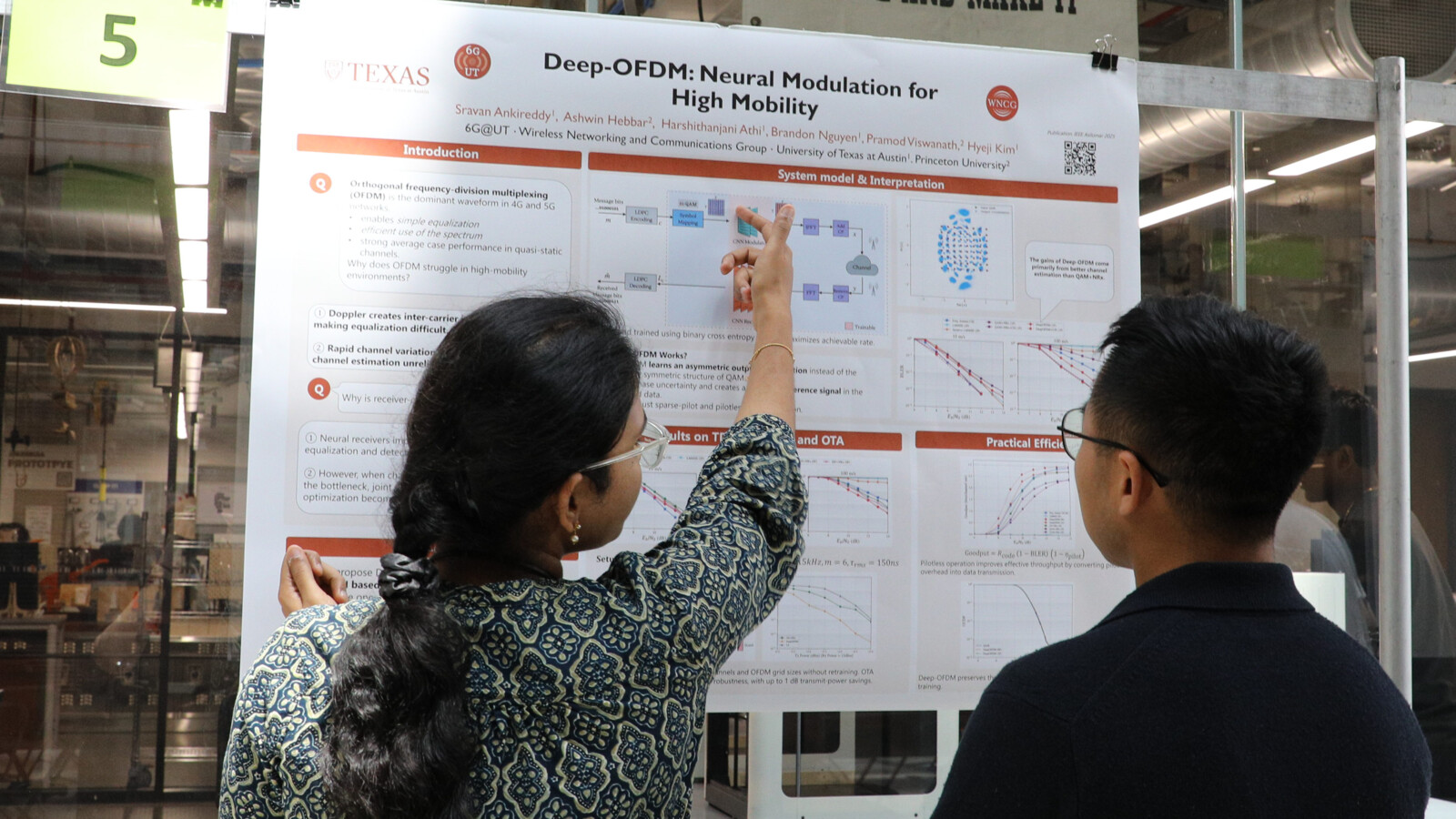
Image credit: University of Texas at Austin
Collaboration as the real outcome
The most important outcome of the event was the conversations between researchers and engineers from different disciplines and institutions. 6G is taking shape through collaboration, and the United States is clearly working to be the global leader.
For Ericsson, partnering with universities like UT Austin is central to that approach. Academic collaboration creates space for long-term exploration, critical questioning, and the kind of foundational research that underpins sustainable innovation.
All of the sessions from the event are available online.
Further reading
- Ericsson 6G – follow the journey to future networks
- Sensing in 6G: Use cases and architecture
- From Connectivity to Perception: How ISAC Advances U.S. Defense and Government Missions
- 6G - Taking radio access technologies to the next level
- Ericsson Site Digital Twin – The evolution of Intelligent Deployment
- Satellite direct-to-device communication: two approaches for 3GPP global connectivity