

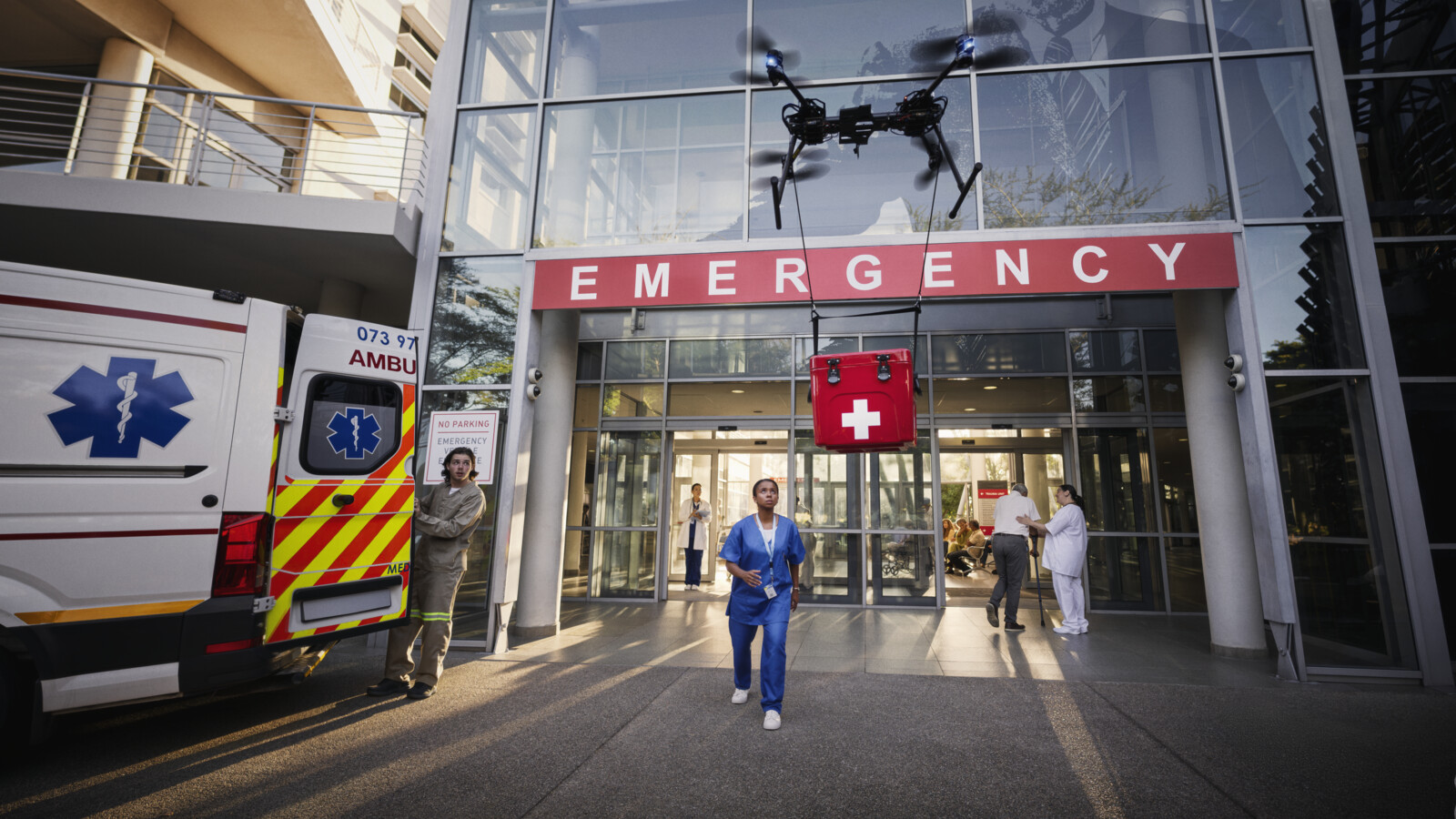








- Artificial intelligence (AI) is moving into the physical world, unlocking an entirely new set of possibilities—from robot to drones to wearable and brain computer interfaces.
- Telecom networks are uniquely positioned to allow AI to operate safely, reliably, and on a scale.

Vice President, Head of AI Innovation and Head of Ericsson Silicon Valley Site
Vice President, Head of AI Innovation and Head of Ericsson Silicon Valley Site
Vice President, Head of AI Innovation and Head of Ericsson Silicon Valley Site
I keep coming back to the same thought: AI is no longer staying put.
For years, most of what we called AI lived safely inside software. Models made recommendations. Systems optimized processes. If something failed, the impact was usually a bad prediction or a slow response.
That era is ending.
AI is now stepping into the physical world. It is moving arms, wheels, wings, and sometimes even humans themselves. Robots are leaving cages. Drones are leaving predefined corridors. Wearables and exoskeletons are becoming adaptive instead of static. Brain computer interfaces are turning signals into action.
This shift opens up an entirely new set of possibilities. And it forces us to ask a different question. What does AI need to operate safely, reliably, and at scale in the real world? My answer is simple. Physical AI needs a nervous system.

From digital intelligence to embodied intelligence
When intelligence becomes embodied, the rules change. Decisions are no longer abstract. They literally have weight, momentum, and consequences. For example:
- A robot that hesitates does not just look slow. It loses balance.
- A humanoid that misjudges timing does not just fail a task. It falls.
- A drone that reacts too late does not just miss a waypoint. It collides.
In these systems, perception, reasoning, and action must stay tightly coupled. That coupling cannot rely on a single device, nor can it tolerate unpredictable behavior in the infrastructure connecting everything together.
This is where telecom enters the picture, not only as connectivity, but as a core part of the intelligence loop. Telecom networks already understand time, motion, mobility, and scale. With AI built into the network itself, we can turn those capabilities into something much more powerful. Advanced connectivity becomes the backbone of reliable coordination.
Latency is no longer a performance metric
In Physical AI, latency stops being a number on a slide. It becomes a physical constraint.
Control loops for motion, balance, and interaction often run at millisecond timescales. Vision and sensor fusion must align precisely with actuation. Any jitter or delay shows up immediately in the behavior of the system.
Purely local intelligence struggles with cost, power, and adaptability. Purely centralized intelligence struggles with physics. The only viable path is distributed intelligence, where computation, learning, and decision-making are shared across devices, edges, and the network.
This is a telecom problem in the best possible way.
With AI-native networks, we can place intelligence where it makes sense, move it when conditions change, and guarantee the behavior that physical systems depend on. We can treat latency, reliability, and synchronization as first-class services, not side effects.
Herding the robots
Humanoids and general-purpose robots reveal just how demanding Physical AI really is.
These machines are expected to assist humans across a wide range of tasks, adapting to context rather than following scripts. Something as simple as picking up an object already exposes the challenge. A robotic hand contains dozens of motors, sensors, and control loops. A single human intent must be decomposed into coordinated actions, where every finger, joint, and actuator responds in precise timing.

That coordination does not stop at the device. General-purpose robots rely on real-time communication to align perception, planning, and execution across the hand, the body, nearby systems, and often the edge or cloud. Telecom AI plays a critical role in keeping this coordination reliable and predictable as conditions change. When intent turns into motion at this level of complexity, the network becomes part of how intelligence is expressed, not just how data is moved.
Drones and the power of collective intelligence
The moment you introduce swarms of drones, shared airspace, and dynamic missions, intelligence becomes collective. Each drone sees part of the world. The system must see the whole.

Telecom networks already excel at managing massive numbers of moving endpoints under constantly changing conditions. When combined with AI, the network becomes the coordination layer for autonomy. It can understand congestion, predict conflicts, and orchestrate behavior across fleets in real time.
In this model, the drone is not just connected to the network. It is shaped by it. Decisions emerge from the interaction between local autonomy and network-level awareness.
This is how we scale autonomy without losing control.
Exoskeletons, BCIs and AI that listens to the human body
Some of the most interesting Physical AI systems are not about replacing humans, but about extending them.
Exoskeletons, assistive wearables, and adaptive prosthetics must operate in constant dialogue with the human body. They must respond to intention, compensate for fatigue, and adapt without ever feeling intrusive.
Brain computer interfaces (BCIs) push Physical AI into a deeply personal space, where intent, action, and response are closely coupled. BCIs do not operate in isolation. Neural signals often need to be shared with external devices. That interaction depends on continuous, real-time connectivity between the brain interface and the physical world.
Telecom AI enables this balance. It allows learning to happen across populations while keeping sensitive data local. It allows models to adapt globally while decisions remain personal and immediate. It allows updates, coordination, and safety mechanisms to operate invisibly in the background.
This is human-in-the-loop AI done right. And it depends on the network behaving predictably, every time.
What telecom uniquely brings to Physical AI
The technology stack around Physical AI is expanding fast. New chips. New models. New devices appear every year.
Telecom plays a different role. We operate the layer that must hold under all of it. Across vendors. Across borders. Across industries. Under regulation and in the real world.
This position gives us responsibility but also leverage.
The network is becoming active part in Physical AI. Controlled latency. Reliability by design. Security embedded, not added later.
We should design networks assuming machines will negotiate with each other. Assuming humans will share control with AI. Assuming intelligence will move dynamically across the stack.
AI-native networks, digital twins of physical systems, programmable radio access, and intent-driven orchestration are not internal optimizations. They are the foundation for Physical AI that is safe, scalable, and trustworthy.
The nervous system no one notices
Physical AI will capture attention. Robots will walk, fly, and collaborate. Interfaces will blur boundaries we once thought were fixed.
The nervous system behind it all will remain mostly invisible. The infrastructure intelligence depends on.
Without it, nothing works.
Telecom AI is that nervous system.
Read more
Telecom AI - transforming telecom with next-gen AI