










6G gains momentum as industry aligns on future networks
- English
- 简体中文
- With growing momentum in standardization, prototyping and ecosystem collaboration, 6G is moving from early concept evaluation toward industry alignment on the most important aspects needed for future networks.
- Recent industry discussions have highlighted AI-native networks, new service capabilities and evolving performance needs as key drivers shaping how 6G will be introduced and scaled.

Strategic Research Communication Director

6G Portfolio Strategy, Business Area Networks
Strategic Research Communication Director
6G Portfolio Strategy, Business Area Networks
Strategic Research Communication Director
6G Portfolio Strategy, Business Area Networks
Mobile World Congress (MWC) is a useful checkpoint for tracking how the industry’s thinking on 6G is evolving, and this year we noticed a big change. In 2023, discussions focused on vision and breakthrough technologies for a future that still felt far off. In 2024 and 2025, attention moved toward what 6G might need to deliver, alongside some skepticism about “starting 6G too early”.
This year the tone was quite different. CSPs, vendors, regulators, analysts and the media are all notably more positive about 6G and focused on concrete opportunities and practical preparation. Three leading device chipset vendors – Apple, MediaTek and Qualcomm – joined us in the Ericsson MWC pavilion to showcase the latest progress from our 6G prototyping work, which are all significant steps on the path to 6G commercialization. We’ve clearly moved beyond the pure research phase. Now is the time for the industry to get ready for 6G and plan for a smooth introduction!
In short, we identified three main themes at MWC 2026:
- Growing momentum and eagerness to understand how to prepare for 6G.
6G standardization is underway in 3GPP and ecosystem prototyping of 6G concepts with partner collaborations is accelerating. The focus is shifting toward what operators need to do today to prepare for commercialization – including how to ensure a smooth migration path from 5G. - A clearer value proposition.
The conversation about 6G is becoming more concrete regarding its benefits and differentiators compared to previous Gs. Where and how can it add the most value? The industry is converging on a mix of new and enhanced use cases, both in communication and beyond communication – such as sensing and positioning – as well as quantifiable improvements in performance, reliability and energy efficiency. - The tight relationship between 6G and AI.
AI is no longer just something that runs on top of the network – it is becoming a fundamental part of how networks are designed, operated and monetized.
AI and 6G: a symbiotic relationship
Let’s start with the AI discussion.
Everywhere you looked at MWC 2026, it was clear that AI, cloud and mobile technologies are converging – and together they’re reshaping how systems sense, learn and act. This points toward 6G becoming what we at Ericsson describe as an “intelligent fabric”: an open, secure infrastructure where distributed (and increasingly autonomous) AI agents can collaborate at machine timescales – with predictable and verifiable performance.
6G for AI
As AI-driven applications scale, connectivity becomes more critical than ever before. Networks will need to do more than move data – they’ll need to support distributed compute and expose new types of intelligence. The 6G/AI intelligent fabric is about more than adding compute and enhancing connectivity. It’s also about exposing capabilities such as sensing, positioning, timing and AI inference.
We demonstrated several examples of this convergence in practice at MWC. One scenario, presented together with our partner Dassault Systèmes, showed how integrated sensing and communication (ISAC) data, positioning data and IoT data management can feed into a city digital twin and be used by AI agents to support emergency response decisions. Importantly, this demo was implemented end-to-end, with real sensing of objects in a city environment.
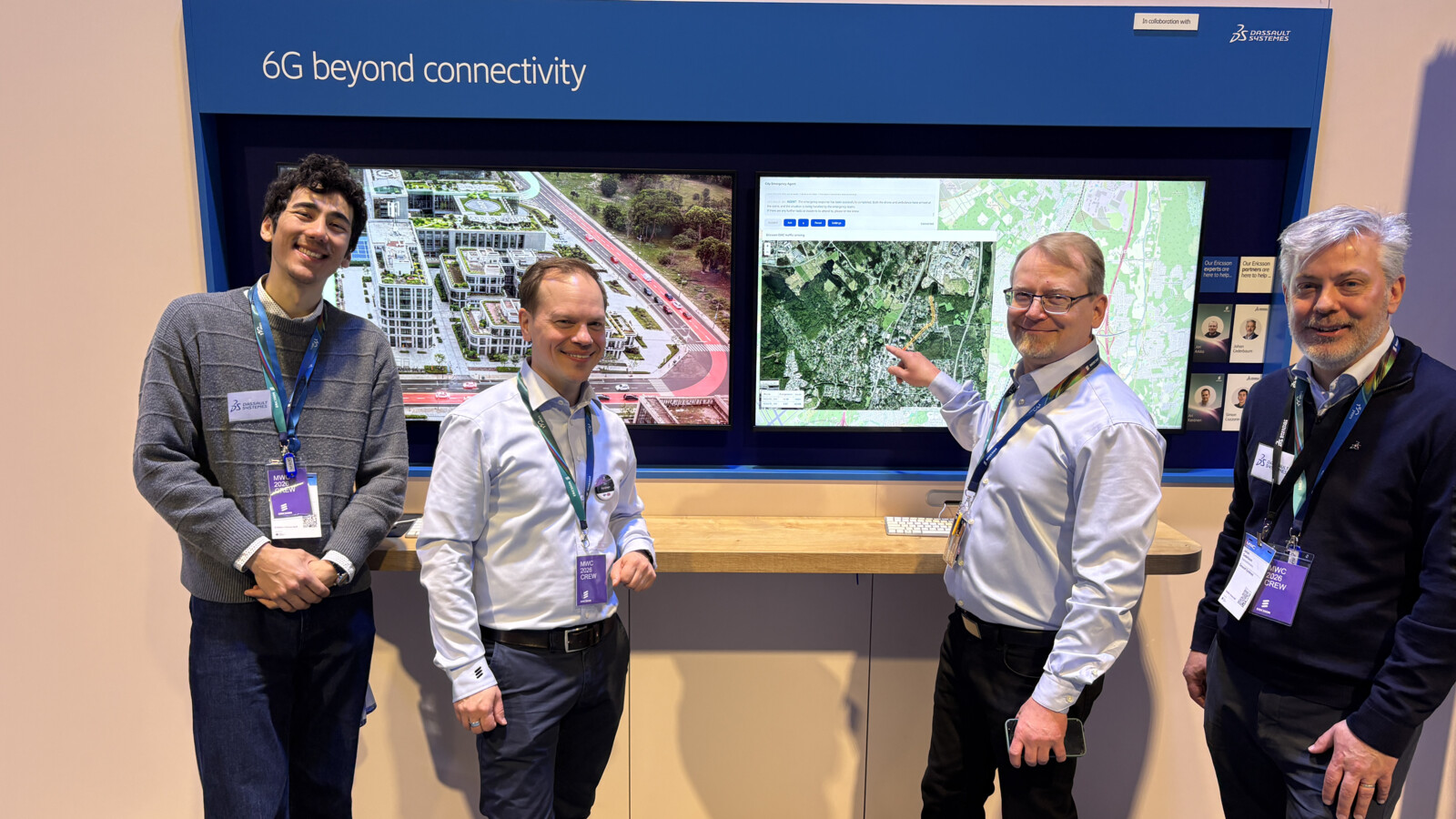
Demo showing how AI agents can use 6G capabilities beyond connectivity to support emergency response decisions
AI for 6G
AI is going to reshape how networks themselves are built and operated. The ambition is for 6G to be AI-native from day one, throughout the network stack. It will enable much higher levels of automation and move toward autonomous networks with minimal human intervention, progressing toward TM Forum Autonomous Networks Level 4 and beyond. We’re also seeing early examples of AI-driven performance optimizations in RAN functions, even operating at physical layer ultra-fast time scales – for instance, AI-based receivers where neural networks replace parts of the traditional signal-processing chain and improve uplink performance in specific scenarios.
Our research continues to push the boundaries of physics-aware AI models for radio and network functions. For example, we demonstrated a physics-inspired AI receiver at MWC that improves OFDM symbol detection accuracy using a hybrid foundation model approach. The hybrid model approach combines AI learning with pre-existing knowledge from radio-channel physics as well as learning and knowledge across multiple network layers, network equipment, physical environments and more. The concept has the potential to substantially reduce cost compared with state-of-the-art black-box models, while also providing better interpretability.
In addition to improving symbol detection, the hybrid model can also provide other insights that help solve tasks such as interference detection and mitigation, subscriber location and mobility, and energy performance optimization.
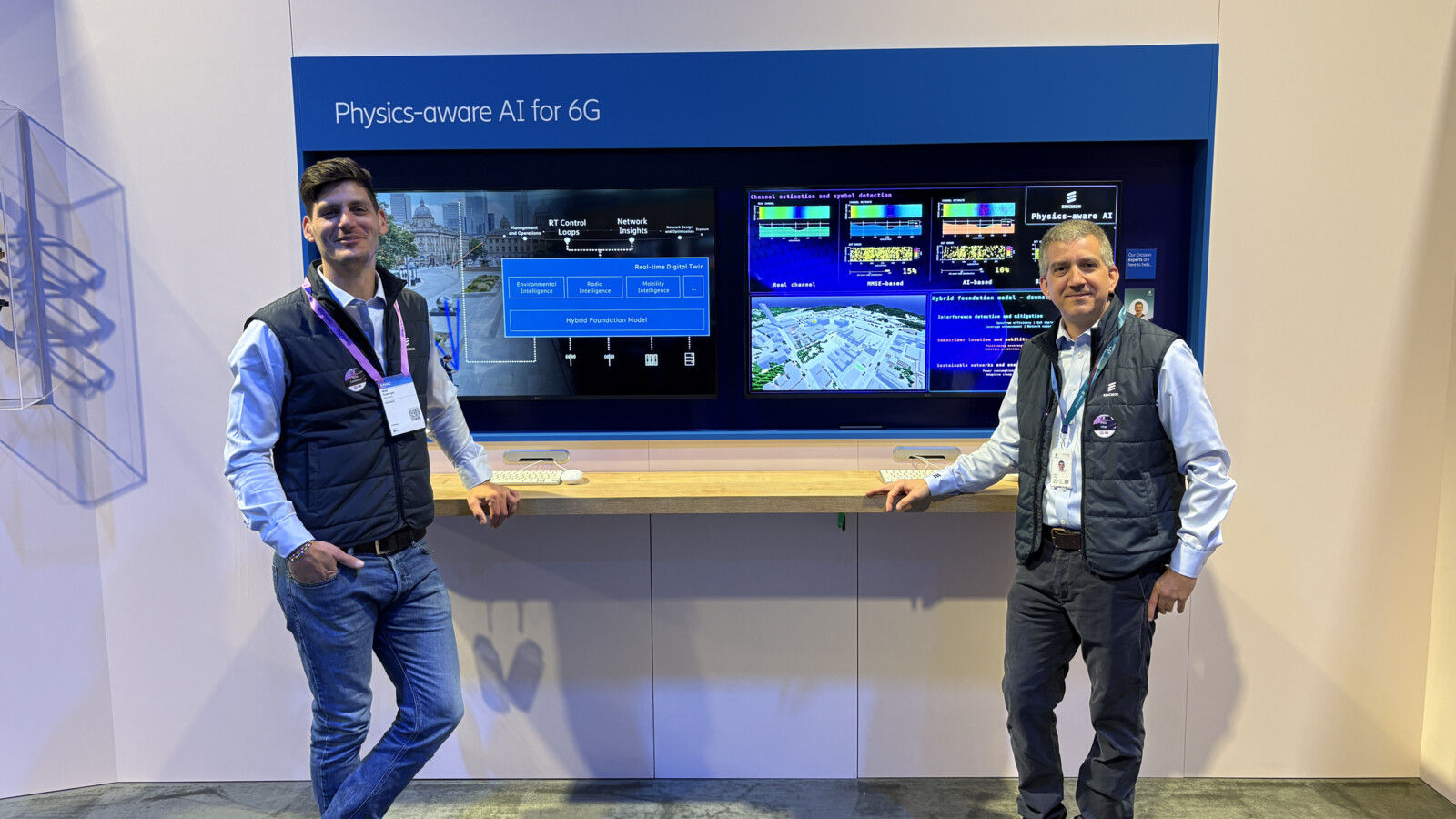
Demo of a physics-aware AI radio receiver using a hybrid foundation model approach
6G capabilities for the 2030s
One thing that has become clearer since last year is that AI-powered wearable devices, autonomous systems and connected robotics are no longer just concepts – they’re already taking off in the networks of today.
6G will build on this momentum. The real opportunity isn’t just to enable new use cases, but to scale both new and existing ones through improvements in uplink performance, latency, reliability, coverage and energy efficiency that match real deployment needs and market demand. (For examples and early performance indicators, check out this blog post.)
As these use cases scale, demand for uplink capacity and consistent coverage is expected to grow significantly. Ericsson’s latest ConsumerLab report highlights that by 2030, 40% of consumers are expected to use agentic AI services daily. One in four users may access AI across multiple devices, while 45% anticipate using AI outdoors. As AI-driven use cases expand, uplink data demand is projected to triple every five years, underscoring the need for robust uplink performance and consistent coverage.
Beyond connectivity, 6G is also expected to expose entirely new categories of network services. Spatial information derived from ISAC is one of the most talked-about opportunities right now – but it’s only part of the picture. Advanced positioning, time synchronization, distributed compute and AI inference can all become consumable services through APIs, opening up new developer ecosystems and differentiated offerings.
At MWC, we visualized interactive scenes of the future where new 6G capabilities and performance enhancements make a measurable difference in real-world situations. One example showed how an uplink data-rate improvement combined with network generated spatial data could enable a holographic call: mixed reality glasses stream a continuously scanned view of the environment (including facial expressions) to a cloud/edge renderer, complemented by ISAC-derived spatial data from the network to improve realism and responsiveness for the remote party.
Another example focused on an enterprise operations scenario: autonomous mobile robots supporting the logistics of a food truck. Here, services such as SIM density insights, positioning and ISAC-based traffic monitoring were fed into a city digital twin and consumed by AI agents to optimize business operations.
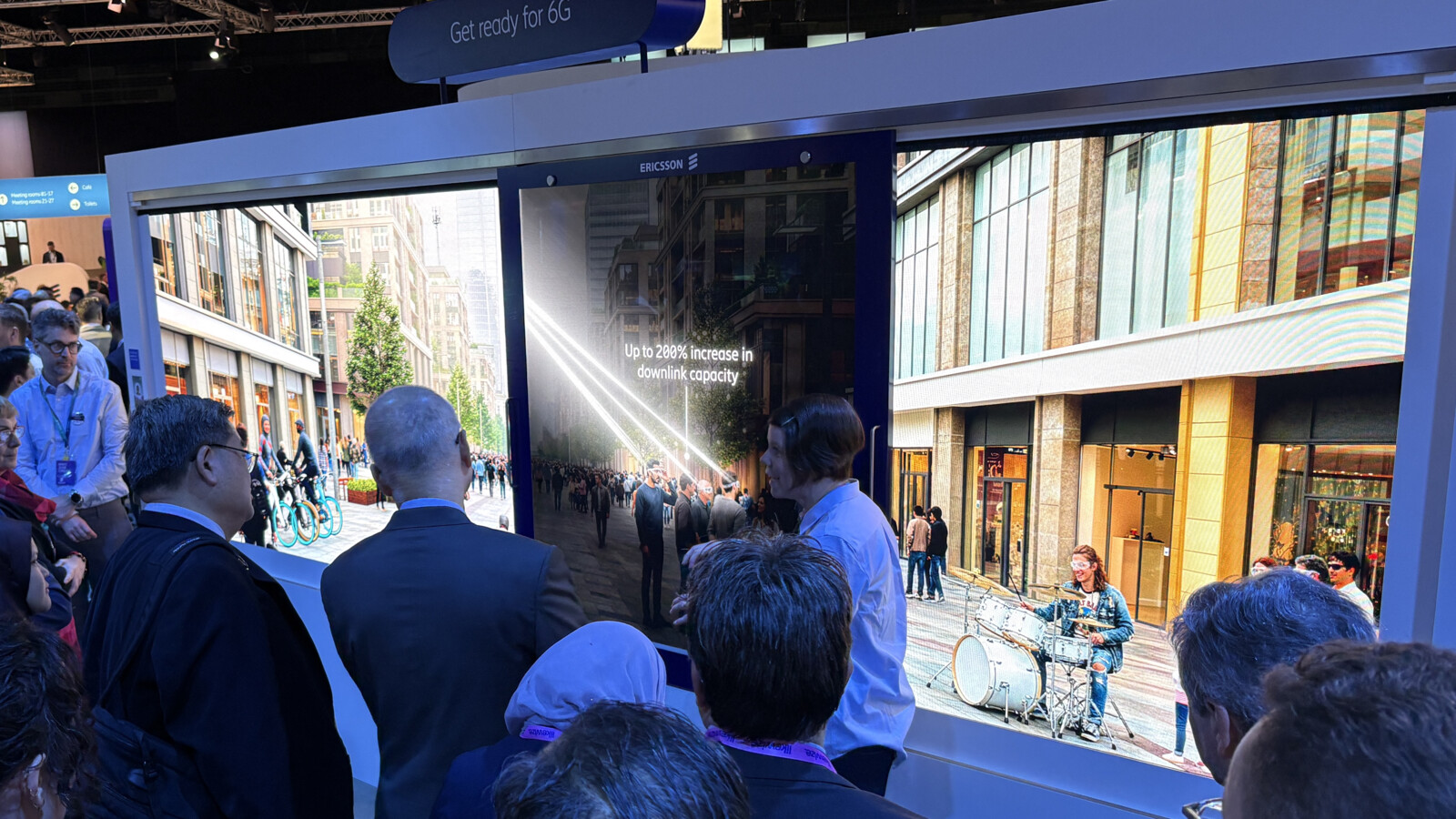
Demo of 6G capabilities and performance enhancements in practical future scenarios
Collaborations driving 6G closer to real solutions
To make the progress toward 6G more tangible, we showcased several demos and prototypes at MWC. These collaborations aren’t just about demonstrations – they’re turning 6G concepts into working systems and starting the journey toward commercialization.
6G prototype and device evolution with Qualcomm
Together with Qualcomm, we’re prototyping key 6G physical-layer capabilities and exploring performance in the centimeter-wave (cmWave) range – an important step toward shaping future 6G radio design. Our collaboration focuses on validating 6G potential based on agreed study items for 3GPP 6G Release 20, including a 400 MHz component carrier with 30 kHz subcarrier spacing. We also demonstrated emerging AI and AR experiences with new device form factors, highlighting how 5G Advanced capabilities can evolve into 6G with improved uplink performance, device-network collaboration and wide-area experiences at scale.
6G prototype system with MediaTek
With MediaTek, we brought a 6G prototype system into live operation at MWC integrating Ericsson 6G RAN prototype with a MediaTek 6G device prototype including radios and baseband processing up to the IP layer. This platform is being used to validate anticipated 6G features relevant for ongoing standardization. The demo included a data call with radios connected over coaxial cables and highlighted contention-based buffer status reporting, a 6G feature designed to reduce latency at scale – critical for AI-enhanced XR and other demanding applications.
Live Multi-RAT Spectrum Sharing demo with Apple
In collaboration with Apple, we demonstrated Multi-RAT Spectrum Sharing (MRSS) between 5G and 6G. This approach enables smooth coexistence and migration, allowing 6G to be introduced in existing spectrum without degrading the 5G user experience. The live over-the-air demo showed real-time interoperability between 5G and a simulated 6G system, validating MRSS performance in a real implementation and complemented with simulations of a large-scale deployment scenario – a big step forward compared to our MRSS demo at MWC 2025.
Panel discussion about the 6G value proposition
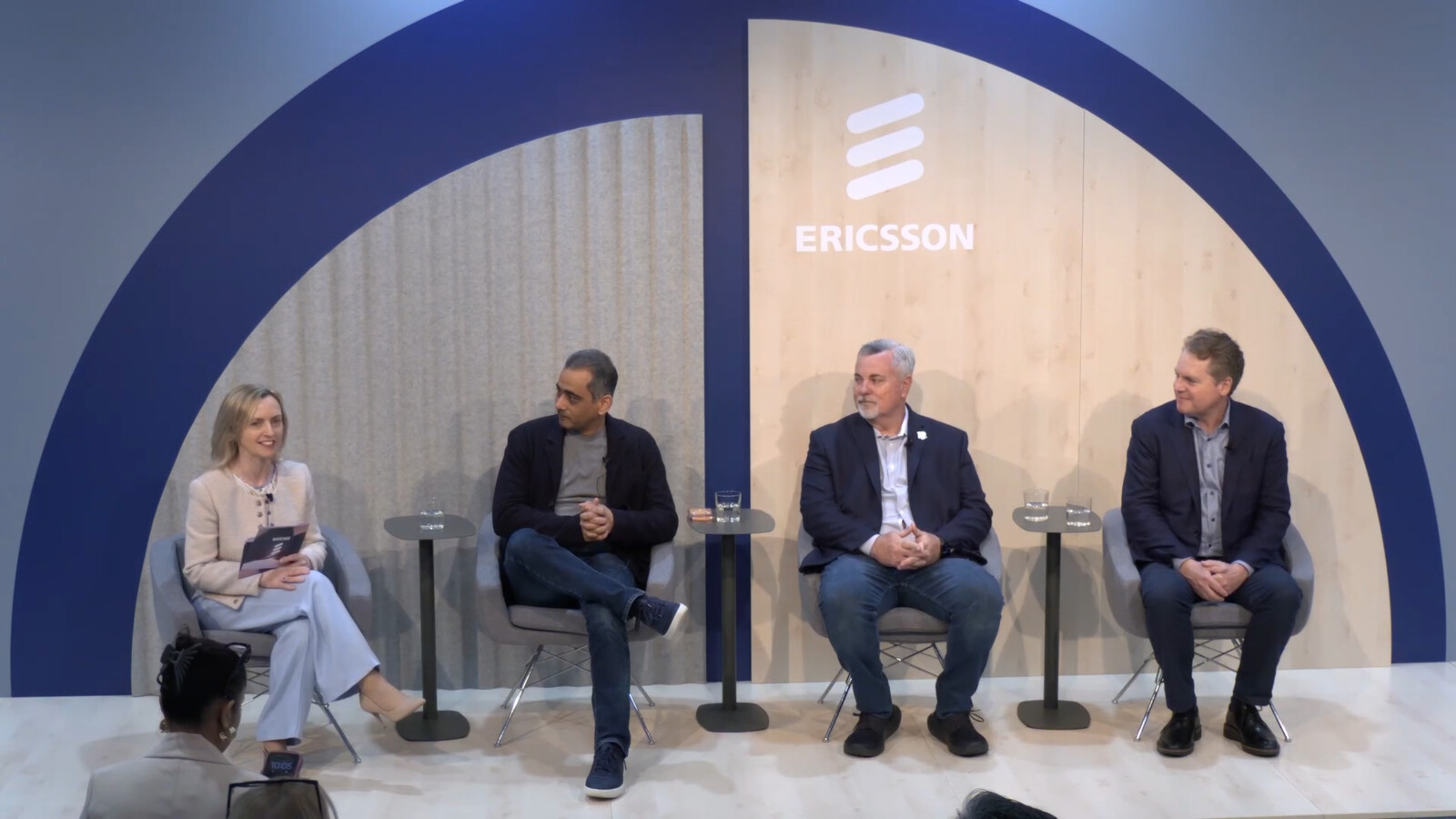
At the Ericsson pavilion, we hosted a lively panel with representatives from three US-based industry leaders – AT&T, T-Mobile and Qualcomm. The discussion focused on key challenges and opportunities, and how the US is positioned to influence 6G standards, innovation and adoption.
The panel discussion revealed strong alignment on 6G as an AI-native network, with intelligence built in end to end. The speakers also highlighted that traffic patterns are shifting – particularly with rapidly growing uplink demand driven by content creation, connected devices and AI applications – placing new demands on performance and reliability.
Another clear message from the panelists was a strong desire to evolve through software and programmability, rather than relying on large-scale hardware replacement cycles. At the same time, they pointed out that energy efficiency – across both networks and devices – remains a critical priority for CSPs.
The discussion also revealed a shared recognition of the importance of avoiding fragmentation. For 6G to scale globally, standards need to remain aligned, the ecosystem needs to collaborate, and security must be built in from the start.
In conclusion
MWC 2026 marked a clear shift in the 6G conversation – from vision to execution and from research on 6G fundamentals to concept validation in preparation for real deployments. AI is emerging as a central driver, shaping both the capabilities that 6G will enable and how networks themselves are designed and operated. At the same time, progress in standardization, prototyping and ecosystem collaboration is turning concepts into something much more tangible.
Many hours of innovation, dedication and teamwork went into bringing our 6G demos and concepts at MWC to life. We’re grateful to everyone who contributed – from the teams building and testing in our labs, to the researchers coming up with and evaluating 6G concepts, to the colleagues engaging with visitors on the show floor in Barcelona, to the staff working behind the scenes to make it all happen.
A special thank you goes out to our partners. Your contributions – both in joint development back home and in demonstrations at MWC – help turn promising 6G ideas into interoperable prototypes and, ultimately, real-world impact.
And finally, thanks to the baristas who kept us fueled on “Ericsson coffees” during the entire MWC 2026!

Read more
Watch these videos going deeper into our partner collaborations:
Learn more about 6G networks