










From classical to quantum: Transforming RAN planning for future networks
- Hybrid quantum-classical intelligence boosts autonomous networks by combining classical algorithms with quantum computing to solve complex network planning and optimization tasks more efficiently.
- This approach improves network operations with smarter, more accurate decisions and paves the way for fully autonomous, realtime nextgeneration networks.

Senior Researcher, Quantum compute

Senior Researcher, Cloud intelligence

Senior Research Manager

Head of Research & Innovation, Cognitive Network Solutions, Business Area Cloud Software & Services

Research Specialist, Business Area Cloud Software and Services
Senior Researcher, Quantum compute
Senior Researcher, Cloud intelligence
Senior Research Manager
Head of Research & Innovation, Cognitive Network Solutions, Business Area Cloud Software & Services
Research Specialist, Business Area Cloud Software and Services
Senior Researcher, Quantum compute
Senior Researcher, Cloud intelligence
Senior Research Manager
Head of Research & Innovation, Cognitive Network Solutions, Business Area Cloud Software & Services
Research Specialist, Business Area Cloud Software and Services
Rising complexity in network management
In today’s rapidly evolving mobile networks, planning has become more complex than ever. As operators scale 5G deployments and prepare for 6G capabilities, traditional static methods struggle to keep pace with dynamic user behavior, fluctuating traffic demands, and ultra-dense network topologies. Massive data volumes, tight interdependencies between coverage, capacity, and mobility, and the overall computational complexity associated with modern large-scale management tasks are stretching traditional planning tools to their limits.
Operators face a multi-dimensional challenge: they must ensure seamless service, manage resources efficiently, adapt to changing usage patterns, and continuously optimize performance; all while controlling operational costs. Even with some automation, existing heuristic-based tools sometimes need to rely on simplified models or approximations to keep computations tractable, which can lead to non-optimal configurations when network conditions change rapidly. Traditional optimization cycles can take hours, or even days, to recompute configurations, and the need to balance accuracy with computational feasibility often forces operators to adopt heuristic solutions rather than fully exploring the high-dimensional search space.
One clear example of this evolution is Tracking Area (TA) planning. As networks densify and mobility patterns become less predictable, conventional TA designs increasingly struggle to deliver optimal results. Tracking Areas (TA) define the regions in which idle‑mode users are tracked. If TAs are too small, frequent TA updates increase signaling overhead; if too large, paging messages must be broadcast across unnecessarily wide areas, consuming radio and core resources. These trade‑offs make TA configuration a complex task that directly impacts both resource efficiency and user experience. Advanced computational approaches can help operators navigate these trade‑offs more effectively.
This shift represents a foundational change in telecommunications. Moving from heuristic-driven planning toward intelligent, automated, and computationally advanced network management is not just a technical upgrade; it is a strategic necessity. As networks grow in scale, complexity, and diversity of services, the ability to optimize configurations efficiently and proactively will directly influence performance, cost, and customer satisfaction.
The next sections explore why TA planning must be reimagined and how hybrid quantum-classical approaches provide a promising path forward.
Why quantum computing helps?
Modern networks generate optimization problems that grow too large for classical computing to handle efficiently. While TA planning is one example, similar complexity appears in other planning tasks such as antenna tilt planning or neighbor relation planning, with thousands of interconnected cells while considering handovers, paging loads, capacity constraints, and shifting mobility patterns. The number of possible arrangements grows exponentially, making exhaustive exploration impractical for classical methods. TA planning also involves a fundamental trade‑off: smaller Tracking Areas (TA) increase TA‑update frequency and signaling overhead, whereas larger TAs raise paging load because paging messages must be broadcast across wider areas. These opposing effects must be carefully balanced, making TA planning a computationally challenging task.
Quantum computing offers a new approach. Unlike classical computers, which evaluate one solution at a time, quantum processors can represent and explore many potential solutions simultaneously. Imagine trying to find the fastest route through a city with thousands of roads. A classical computer checks one route at a time, while a quantum computer can consider many routes simultaneously--making it much faster at finding the best solution.
This allows them to tackle large optimization problems with multiple interacting variables; exactly the type of challenge seen in TA planning.
Quantum computing isn’t just a new technology: it’s a paradigm shift for network planning. It enables telecom operators to tackle challenges such as dynamic resource allocation planning, mobility planning, and ultra-dense deployments planning with unprecedented efficiency.
Quantum-enabled network planning leverages the unique capabilities of quantum computing to explore large and complex spaces and identify high quality configurations that may not be reachable through classical heuristic methods. By evaluating multiple candidate configurations simultaneously, quantum algorithms can complement classical approaches and enhance the quality of planning outcomes.
Because today’s quantum devices are still in the NISQ (Noisy Intermediate-Scale Quantum) stage, they cannot yet handle end-to-end network planning alone. Hybrid quantum‑classical approaches therefore combine classical algorithms, which generate an initial feasible TA layout with quantum techniques that explore alternative partitions and refine the result. This synergy provides both stability and exploratory depth, enabling high‑quality TA planning at scales suited to next‑generation networks.
The limitations of NISQ hardware make this hybrid approach particularly relevant, as current quantum systems benefit greatly from classical preprocessing and post‑processing.
A hybrid quantum–classical pipeline for TA planning
As mobile networks evolve toward higher density and service diversity, planning tasks increasingly involve large datasets, intricate mobility interactions, and complex operational constraints. Hybrid quantum-classical approaches provide an effective way to manage this complexity by combining classical preprocessing with quantum enhanced exploration of large solution spaces. Classical computation structures and reduces the problem, while quantum techniques evaluate candidate configurations efficiently by sampling diverse possibilities in parallel.
In this hybrid paradigm, classical systems deliver mature analytics and reliable constraint handling, and quantum algorithms complement them by navigating combinatorial spaces that are difficult for classical methods to fully explore. Although the evaluations in this work were conducted using a quantum simulator, the formulation and circuit structures reflect hardware-native quantum workflows suitable for future quantum processors as they mature. The journey from understanding network mobility patterns to producing an optimized TA design follows a three‑stage hybrid workflow, as depicted in Figure 1.
Once this generic workflow is established, it can be tailored to specific planning use cases such as TA design. TA planning must balance signaling efficiency, mobility behavior, and paging performance, and hybrid quantum-classical methods provide a scalable way to explore alternative TA configurations that meet these requirements.
Stage one: Classical data processing and initial clustering
The first stage builds a deep understanding of mobility relationships across the network. Inter‑cell handover statistics are used as a proxy for idle‑mode mobility, complemented by paging load information, connectivity graphs, and cell characteristics. These inputs form a mobility graph that captures interaction patterns between cells under varying traffic conditions.
Classical clustering methods such as classical spectral clustering and the classical Louvain community detection are applied to create baseline TA candidates. These techniques reduce the scale of the planning problem while preserving the most relevant relationships for TA grouping, providing a strong starting point for quantum refinement.
Stage two: Quantum-driven refinement and optimization
Once candidate clusters are created, the problem transitions to the quantum layer, where complex relationships can be explored more efficiently. TA planning constraints are converted into quantum-ready formulations, such as QUBO or Hamiltonian models, reflecting inter-TA handovers, connectivity, and capacity limits.
Quantum execution leverages variational quantum algorithms and quantum annealing techniques to evaluate large numbers of cluster arrangements simultaneously, uncovering patterns that classical methods may miss. The quantum simulations were executed using qubit configurations consistent with the hardware‑native parameters summarized in Table 1, enabling the exploration of alternative TA layouts that may yield more efficient signaling or paging performance. Quantum‑refined solutions are then transformed into actionable TA groupings for validation.
Stage three: Classical validation and operational alignment
The final stage ensures that the recommendations are feasible and aligned with real network requirements. Constraint verification confirms that TA sizes, paging budgets, and mobility policies are correctly satisfied, ensuring that the proposed configuration adheres to operational limits. Performance assessment evaluates the resulting signaling load, TA‑update frequency, and overall mobility efficiency under realistic traffic conditions, providing a clear view of how the TA design behaves in practice.
Additional refinement cycles can be performed when quantum-derived solutions require adjustment, allowing the pipeline to converge toward a configuration that is both operationally consistent and scalable. This is done by observing configurations and refining the quantum approach. This ensures that the final TA design is ready for integration into live network environments.
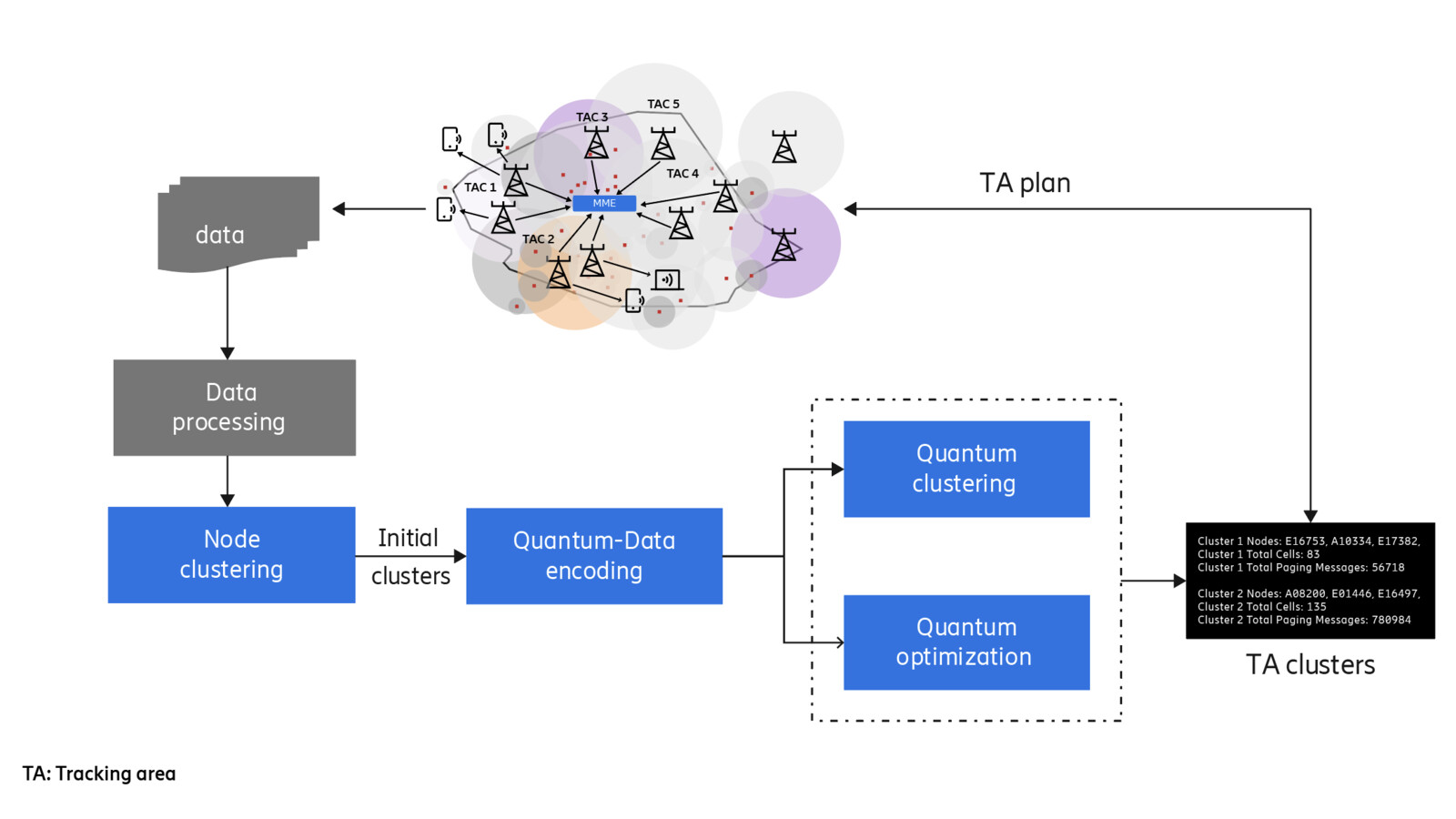
Figure 1: High-level view of the hybrid classical-quantum solution for tracking area management
Evaluation on network data
The hybrid quantum-classical approach presented in the aforementioned process has a potential advantage for a range of network planning tasks. In the following, we evaluated it for one typical use-case involving TA planning.
To assess the practical performance of the hybrid quantum-classical workflow, it was investigated for TA planning using a large operational dataset covering 1,509 gNBs. The dataset included real mobility patterns, paging activity, cell numbers, that accurately reflect how users move through the network. This approach allowed the evaluation to mirror real planning challenges rather than relying on simplified or synthetic scenarios.
The results for the two hybrid variants where classical pre-clustering (classical spectral clustering and the classical Louvain community detection) was followed by quantum refinement were then compared against the baseline design which was obtained by means of a state-of-the-art heuristic algorithm. This comparison provided a clear view of each method’s performance under real-world conditions and highlighted where hybrid techniques offer tangible benefits.
Key findings: The evaluation revealed consistent trends. Louvain-based methods produced balanced, well-structured clusters that aligned naturally with user mobility patterns. When these classical clusters were further refined using quantum optimization, the improvements became even more pronounced.
As evident in Figure 2, the hybrid Louvain-quantum (Louvain-QUBO) approach achieved the strongest overall performance: inter-TA handovers were reduced by 36.4%, while the maximum paging traffic and the maximum number of cells per TA were also decreased by 25.0% and 13.6%, respectively; all indicating a more efficient TA planning.
Spectral clustering alone reduced TA updates but tended to create oversized clusters, which could result in uneven cluster sizes and a disparate distribution of the number of paging messages.
Summary insight: Across the full evaluation, classical Louvain clustering combined with quantum optimization emerged as the most effective and robust method. It consistently delivered high-quality TA layouts and clearly demonstrates why hybrid quantum-classical pipelines are becoming a compelling option for future network planning challenges.
Key benefits of hybrid quantum–classical TA planning
The evaluation of the hybrid quantum-classical approach revealed several advantages that directly translate into more efficient and scalable TA planning. These benefits emerge from combining classical preprocessing with quantum‑driven refinement, enabling improved performance across operational, mobility, and scalability dimensions, and are summarized in the key areas outlined below.
Operational efficiency: Hybrid workflows reduce the time needed to explore, evaluate, and refine TA configurations, compressing optimization cycles from hours or days to more practical durations and lowering the operational burden on engineering teams.
Adaptive and balanced designs: By coupling classical pre-clustering with quantum refinement, the resulting network layouts better reflect real mobility behavior, reducing unnecessary inter-TA handovers, lowering paging traffic, and producing more balanced TAs.
Scalability for 6G: Hybrid methods scale naturally to large datasets, complex constraints, and dynamic traffic, preparing networks to handle dense 6G topologies that classical methods struggle to manage.
Planning agility: Faster configuration updates enable operators to respond to traffic surges, mobility anomalies, or new service demands in near-real time, maintaining optimal network performance.
Performance and reliability: Classical clustering ensures stable baseline layouts, while quantum refinement navigates complex solution spaces for improved outcomes. This synergy produces near-optimal solutions consistently.
Future-proofing: Hybrid workflows allow CSPs to gain immediate benefits from quantum computing while positioning themselves to leverage more powerful quantum hardware as it matures.
Conclusion
Hybrid quantum-classical solutions represent a major step forward in network planning and optimization. By combining the interpretability and reliability of classical algorithms with the computational power of quantum refinement, operators can tackle problems that were previously intractable, creating more efficient, balanced, and adaptive TA configurations. Using the hybrid quantum-classical approach, a 36.4% reduction in inter-TA handovers has been achieved, resulting in improved network efficiency compared to traditional methods, while the maximum paging traffic and the maximum number of cells per TA were reduced by 25.0% and 13.6%, respectively, and the resulting configurations are more balanced. As quantum computers continue to evolve, the advantage is expected to become more pronounced at larger scales as we run our quantum algorithm on real fault tolerant quantum hardware.
This approach not only improves current network performance, reducing signaling, TA updates and paging traffic, but also prepares networks for the demands of 6G and beyond. Faster, smarter, and more scalable planning enables operators to proactively respond to dynamic traffic patterns and evolving service requirements, ensuring optimal user experiences while controlling operational costs.
As hybrid quantum-classical techniques continue to mature, they will become a cornerstone of intelligent, future-ready network operations, providing CSPs with a competitive advantage in increasingly complex and dynamic mobile networks.
Figure 2(a): Number of cells per TA (maximum)
Figure 2(b): Number of paging messages per TA (maximum)
Figure 2(c): Number of inter TA updates