










How quantum light expands the horizons of network security
- Fiber optic networks can be physically attacked by taping light inside fibers, using hard-to-detect techniques, creating serious blind spots.
- Quantum light uses nonclassical states to reduce measurement noise below classical limits, revealing even the faintest eavesdropping signatures.

Principal Quantum Engineer

Global Head of AI, Quantum and Blockchain Execution

Senior Quantum Engineer, Blockchain and Quantum Product Line Ericsson
Principal Quantum Engineer
Global Head of AI, Quantum and Blockchain Execution
Senior Quantum Engineer, Blockchain and Quantum Product Line Ericsson
Principal Quantum Engineer
Global Head of AI, Quantum and Blockchain Execution
Senior Quantum Engineer, Blockchain and Quantum Product Line Ericsson
When James Clerk Maxwell published his electromagnetic theory in 1865, it seemed that the nature of light was finally fully understood, revealing that it was composed of relatively simple electromagnetic waves. However, the true nature of light, whether it behaved as a wave or a particle, remained a topic of debate dating back to the 17th century with Christiaan Huygens and Isaac Newton. Both wave and particle theories had compelling arguments.
The wave theory, championed by Huygens, explained phenomena such as diffraction and Young's double-slit experiment, while Newton favored the particle theory, which accounted for light's straight-line propagation and refraction, among other effects. Because of Newton's towering influence in physics, his support for the particle nature of light had a lasting impact. In 1901, Max Planck introduced his theory of black-body radiation, followed by Albert Einstein's 1905 interpretation of light as quantized electromagnetic radiation, which necessitated a new quantum-mechanical description of light.
The term photon was coined in 1928 by Arthur Compton, derived from the Ancient Greek word for light. In 1927, Paul Dirac provided the first quantum mechanical solution to the interaction between atoms and light fields, and shortly thereafter, in 1932, Enrico Fermi presented a comprehensive review of quantum electrodynamics. The next pivotal step came in 1963, when Roy Glauber developed a rigorous quantum-mechanical theory of optical coherence, introducing the framework of coherence functions and correlation functions that form the foundation of modern quantum optics. Ultimately, Glauber’s work earned him the Nobel Prize in Physics in 2005. It is precisely this quantum-mechanical framework, describing light in terms of discrete photons, that underpins the eavesdropping detection techniques we are exploring here.
Quantum light as a security probe: phase-sensitive detection in optical fibers
Keeping optical fiber networks secure is becoming increasingly critical, and quantum technology may hold the key to detecting eavesdroppers with greater precision. As data traffic grows and fiber optic networks become the backbone of global communications, protecting the physical layer is a growing priority. Unlike cyberattacks that target software or protocols, physical eavesdropping targets the light itself, the actual signal traveling through the fiber.
How do attackers tap into optical fibers?
There are several known methods that bad actors use to intercept fiber-transmitted data:
- Clip-on couplers that capture light leaking from the fiber using a second fiber or photodetector.
- Passive optical splitters that divert a portion of the signal outside the fiber for interception.
- Evanescent coupling, where the fiber's coating is partially stripped to expose the cladding, allowing a second fiber to capture the escaping light.
Each of these techniques can be subtle and difficult to detect, which is exactly why more sensitive detection methods are needed.
Detecting the undetectable with phase-sensitive OTDR
One of the most powerful techniques for spotting eavesdroppers today is phase-sensitive optical time-domain reflectometry (φ-OTDR). This method works by detecting tiny changes in the phase of light that bounces back through the fiber. It can resolve phase changes as small as 0.1 to 1 radians over distances of 20 to 50 kilometers.
But what if we could do even better?
That is where quantum light comes in. By combining quantum optical states with optical tomography, we can push phase sensitivity below 0.1 radians, reaching a level of precision that classical light simply cannot achieve.
Why is quantum light different?
The sensitivity of any phase measurement (Δθ) is ultimately bounded by the phase uncertainty (Δϕ) of the light state being used. In quantum mechanics, this is not a technical limitation, but a fundamental one. The more precisely you know one property of a quantum state, the less precisely you can know its complementary property. This is the Heisenberg uncertainty principle at work.
In practice, measuring the full information of a weak optical signal requires capturing both its amplitude and phase simultaneously. This is done using a technique called heterodyne detection, where the signal is mixed with a reference light source to extract two components, the in-phase (I) and quadrature (Q), that, together, describe the complete signal.
At the quantum level, these components correspond to mode quadratures q̂ and p̂, respectively. Measuring both at the same time introduces an irreducible noise floor called vacuum noise or shot noise. This is not an imperfection in the equipment, but rather a consequence of the quantum nature of light itself. By engineering quantum light states that minimize uncertainty in the phase direction such as squeezed states or single-photon-added coherent states, we can surpass the standard noise limit and detect the faint disturbances that a physical eavesdropper would cause. This opens a promising new path toward quantum-enhanced physical-layer security for optical fiber networks.
Measuring phase more precisely: coherent light versus quantum light
To understand how quantum light can improve eavesdropper detection, we need to ask a precise question: how accurately can we estimate the phase of the backreflected light? The answer depends entirely on the type of light we use.
Below, we derive the phase uncertainty for three types of light: classical coherent light, which is our baseline, and two quantum states, namely single-photon-added coherent (SPAC) states and phase-squeezed coherent states (PSCS). All three are compared on equal footing.
The framework: quadratures and heterodyne detection
As mentioned before, heterodyne detection measures the two quadratures—the in-phase component, q̂, and the quadrature component, p̂, — simultaneously. Under heterodyne detection with a very strong local oscillator strength, the phase of the signal can be estimated as
φ = atan2(⟨p⟩p, ⟨q⟩p)
In this equation, ⟨p⟩ₚ and ⟨q⟩ₚ are the expectation values of the mode quadratures q̂ and p̂., which can be described through the Glauber–Sudarshan P quasi-probability distribution:
E[q̂]het = ⟨q⟩p, E[p̂]het = ⟨p⟩p,
Using standard error propagation, the variance of the phase estimate is as follows:
Var[ϕ] = nT · ↔ V · n ⟨p⟩P2 + ⟨q⟩P2
Here, ↔ V is the covariance matrix of the two quadratures, while n is the unit vector in phase space perpendicular to (⟨q⟩ₚ ⟨p⟩ₚ)). The best possible phase resolution is achieved when n is aligned with the eigenvector corresponding to the smallest eigenvalue of ↔ V , which is the direction in phase space where the quantum noise is minimal. The central idea is that the geometry of quantum noise in phase space directly determines how precisely we can read the phase.
The covariance matrix ↔ V elements under heterodyne detection are the following:
Var[q̂]het = 1 + ⟨(Δq)²⟩p, Var[p̂]het = 1 + ⟨(Δp)²⟩p
cov[q̂, p̂]het = ⟨Δq Δp⟩p,
The +1 terms are the irreducible vacuum-noise contributions from the two open ports of the heterodyne detector, which is a fundamental quantum cost of measuring both quadratures simultaneously. The remaining terms depend on the quantum state of the light, described through the Glauber–Sudarshan P quasi-probability distribution.
Case 1: coherent light (the classical baseline)
For a coherent state, the P-distribution is a Dirac delta function, where all quantum uncertainty is minimal and isotropic. There are no excess correlations between quadratures, and the covariance matrix is simply the identity, scaled by the vacuum noise. The phase uncertainty thus becomes:
Δϕcoherent = √(Var[ϕ]coherent) = 1 √2 |α|
In this case, |α| is the amplitude of the coherent state—essentially a measure of the signal power. This is the standard quantum limit (SQL), also called the shot-noise limit. It sets the baseline, stating that no classical light source can do better than this for a given signal amplitude.
Case 2: SPAC states
A SPAC state is created by adding exactly one photon to a coherent state. This is the simplest possible quantum enhancement, during which one quantum of excitation is added on top of a classical field. The state sits between a purely quantum single-photon state and a classical coherent state. For a SPAC state, the quadrature covariance matrix is no longer isotropic.
The eigenvalue corresponding to the eigenvector n is V₂ = 1
1 + |α|² while the other eigenvalue corresponding to the perpendicular eigenvector is actually the smaller one V₁ = V₂ − 2|α|²
(1 + |α|²)²
, This means that the phase uncertainty is as follows:
ΔϕSPACS = √(Var[ϕ]SPACS) = 1 √2 |α| √( 1 + |α|²
2 + |α|²
)
The extra factor under the square root is always less than |1|, meaning the SPAC state always achieves better phase sensitivity than coherent light at the same amplitude. The improvement is most pronounced at low photon numbers and diminishes as alpha grows large. On a physical level, this makes sense, since adding one photon to a very bright beam changes very little.
Even the simplest quantum state modification, one added photon, is enough to beat the coherent state limit on phase estimation. This sets up the comparison with squeezed states, where the improvement is both larger and more controllable.
Case 3: PSCS
Squeezed light is engineered to reduce quantum noise below the standard quantum limit in one quadrature, at the cost of increased noise in the conjugate quadrature. This correlates with what the Heisenberg uncertainty principle permits. In a phase-squeezed state, the noise is deliberately minimized in the phase direction, making it the ideal candidate for phase-sensitive measurements
The squeezing is characterized by a squeezing strength r≥ 0 and an angle θ that sets the direction of squeezing in phase space, as shown in Figure 1
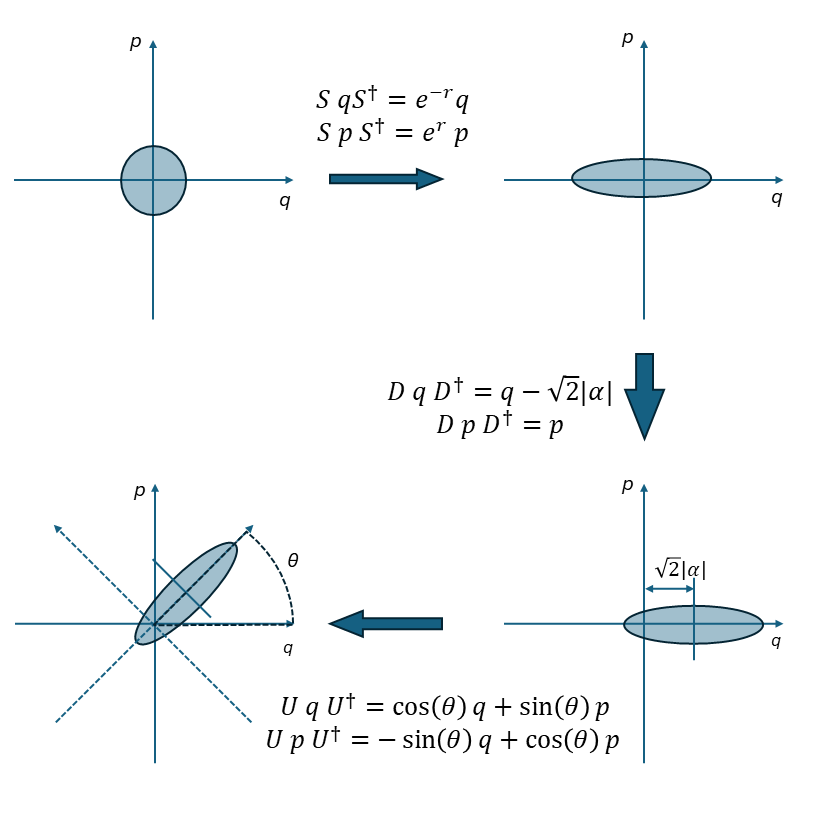
Figure 1. The linear canonical transformations on the quadratures q and p that produce a phase-squeezed coherent state. Due to the operator properties of the rotation transformation on the creation and annihilation operators, this amounts to only one squeezing operation with a complex squeezing parameter ξ=r e^(2 i θ), and one displacement operation with a complex displacement α=|α| e^(i θ). Notice that the double phase for the squeezing is compared to the displacement. Also, this state is anti-squeezed in amplitude.
The covariance matrix eigenvalue in the squeezed direction is:
V₁ = (1 + e (-2r))/2,
This leads to a phase uncertainty of the following:
Δ[ϕ]PSCS = √(Var[ϕ]PSCS) = 1 √2 |α| √( 1 + e (-2r)
2
)
As the squeezing strength r increases, the factor √( 1 + e (-2r) 2
) decreases below 1 and approaches 1/√2 for large r. The phase uncertainty is reduced below the shot-noise limit. This is the quantum advantage of squeezed light for phase estimation.
Note that all three results share the same structure:
Δϕ = 1 √2 |α|
* (quantum correction factor)
The common factor |α| reflects the fact that all three states are built on or referenced to a coherent state amplitude. Larger |α| means more signal power and better phase resolution for all three, but the quantum states consistently outperform classical coherent light at the same power level.
By deliberately concentrating quantum noise away from the phase direction, phase-squeezed light breaks below the shot-noise limit on phase uncertainty in a way that is directly tunable, more squeezing means better phase resolution, making it the most powerful of the three states for detecting the subtle phase disturbances an eavesdropper would leave behind.
In the next section, we will put numbers to these formulas and show how much quantum light can improve the detection of an eavesdropper on a real fiber link.
Putting it to numbers: how much better can quantum light actually be?
While the theory is compelling, the real question is how big of a practical difference these quantum states make.
Figure 2 answers this directly. As shown there, it plots the phase uncertainty Δϕ as a function of signal amplitude |α| for four types of light: a classical coherent state, a SPAC state, and two PSCSs with 3 dB and 10 dB of squeezing.
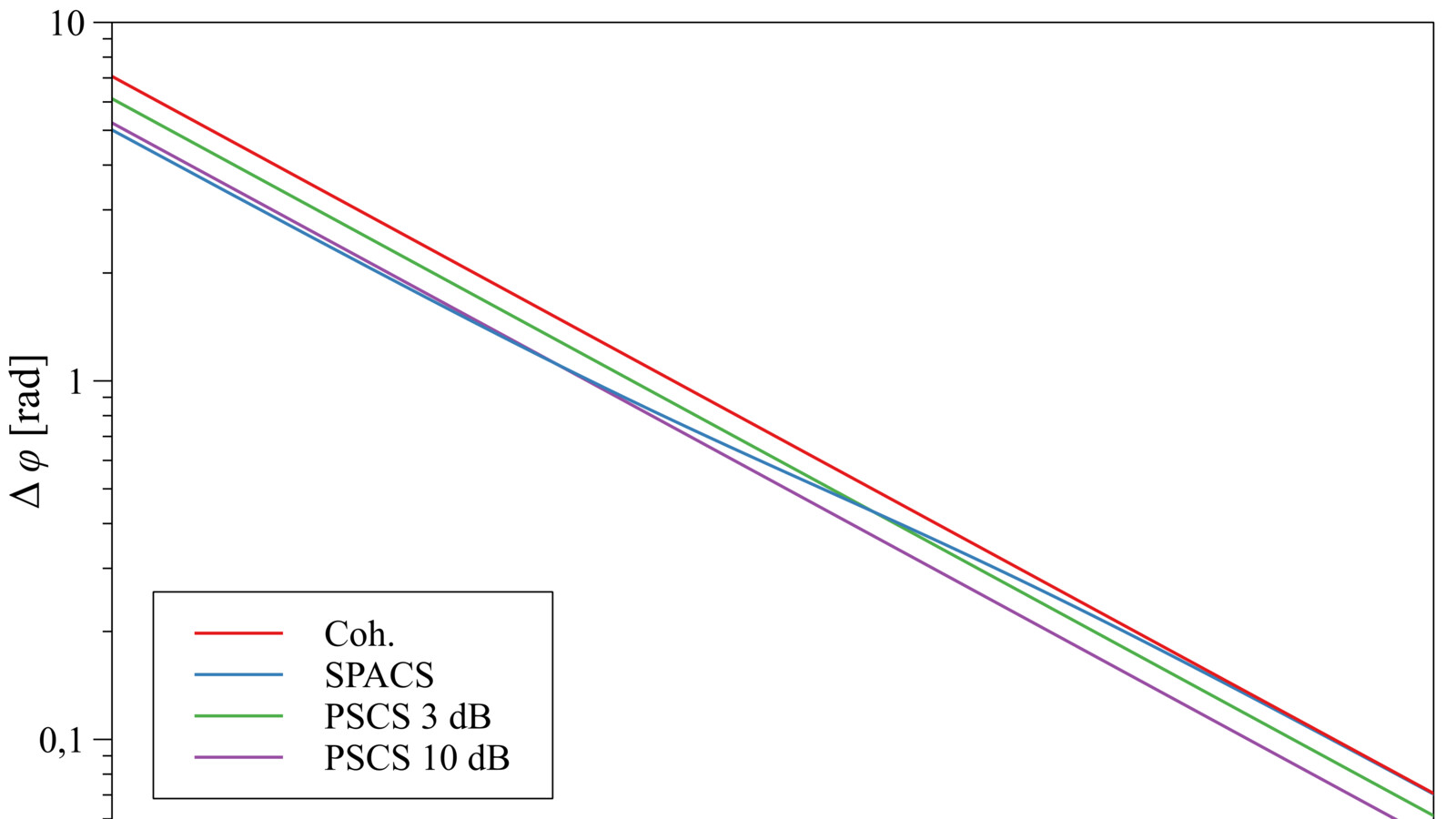
Figure 2. Phase uncertainty as a function of displacement for different quantum states of light: coherent state (red curve), SPACS (blue curve), PSCS with 3 dB squeezing (green curve), and PSCS with 10 dB squeezing (purple curve). The SPACS shows a clear advantage for displacements less than 1. On the other hand, it always has a lower variance than a coherent state at a given displacement. The PSCSs show uniformly lower phase uncertainty than a coherent state for displacements.
As demonstrated above, all four curves decrease as the signal gets stronger. This makes intuitive sense: a brighter signal carries more information. So, the phase can be estimated more precisely regardless of the type of light. Also, all four curves scale similarly with signal strength, appearing nearly parallel on the logarithmic scale, with the fundamental dependence on |α| being the same for all states. However, the four curves are not equal, because they are vertically offset from one another. That offset is actually the quantum advantage.
Reading from top to bottom, this means the following:
- Coherent light, or the shot-noise limit, which is the best any classical light source can achieve, sits at the top, providing the baseline against which everything else is measured.
- SPAC states fall below the coherent curve, offering a modest but real improvement most pronounced at low signal amplitudes (|α| < 1), where the single added photon represents a significant relative boost to the quantum state.
- Phase-squeezed light at 3 dB sits lower still, showing a uniform reduction in phase uncertainty across all signal levels.
- Phase-squeezed light at 10 dB achieves the lowest phase uncertainty of all, with the strongest suppression of phase fluctuations in the plot.
Why this matters for detecting eavesdroppers
The connection to security is direct. An eavesdropper who intercepts and re-transmits light cannot avoid introducing extra noise. This is not a limitation of technology, but a consequence of two fundamental quantum principles: the no-cloning theorem and the Heisenberg uncertainty principle . The former states that you cannot perfectly copy an unknown quantum state, while the latter says that measuring the light disturbs it. This means that any physical tap on the fiber will leave a noise fingerprint. The question is whether our detection system is sensitive enough to see it.
This is where quantum light gives us a decisive edge:
- Coherent light sets the noise floor: We can only flag an eavesdropper if the observed noise rises above the shot-noise limit because a clever attacker may keep their disturbance small.
- SPAC states and squeezed states operate with intrinsically lower phase uncertainty: The legitimate signal sits below the shot-noise limit, creating a tighter security bound. Even a tiny perturbation caused by an eavesdropper becomes visible because it pushes the observed noise above a much lower threshold.
- The more squeezing, the tighter the bound: At 10 dB of squeezing, the detection threshold for anomalies is significantly lower than at 3 dB, which is precisely why the purple curve in Figure 2 represents the most sensitive probe.
In short, quantum light does not just measure phase more precisely, it makes it harder for eavesdroppers to hide.
Conclusion
When most people hear quantum technology, they think of quantum computers. But quantum computing is only one piece of a much larger revolution already underway. Eavesdropping detection is one among the many examples. Quantum technology is already enabling:
- atomic clocks and quantum sensors that are precise enough to detect gravitational shifts underground
- quantum networks that distribute entanglement across cities and continents
- quantum-enhanced imaging that sees through noise classical systems cannot overcome
At Ericsson, we are exploring how these quantum optical techniques can be integrated into real network environments, bringing fundamental physics closer to practical, deployable security solutions.