










Your guide to L4S: delivering smooth, low-latency services in congested networks
- As 5G Standalone matures, application experience is defined by latency, packet loss and stability – no longer peak speed only
- Low Latency, Low Loss and Scalable throughput (L4S) enables smooth, low-latency services even under stressed network conditions, helping CSPs offer experience-based, differentiated connectivity.

Master Researcher

Strategic Product Management
Master Researcher
Strategic Product Management
Master Researcher
Strategic Product Management
Business rationale
With the introduction of new technology and advanced mobile applications, user experience is no longer defined only by coverage and peak data rates. For both CSPs and application teams, the practical question is: can the network keep latency low, avoid loss, and stay stable when the real world gets messy—mobility, variable radio conditions, and sudden load shifts?
Mobile networks are dynamic by nature: users move, traffic comes in bursts, and the radio link changes from moment to moment. At the same time, applications are increasingly diverse. Some services can ride out jitter and delay. Others—especially interactive and real time workloads—degrade quickly when latency spikes or throughput becomes irregular.
Low Latency, Low Loss and Scalable throughput (L4S) is congestion control framework standard adopted by Internet Engineering Task Force (IETF), 3rd Generation Partnership Project (3GPP) and Data Over Cable Service Interface Specification (DOCSIS). It uses fast, precise congestion signaling so endpoints can adapt early—before queues grow, latency rises, and packets start dropping. The outcome is smoother performance under load, particularly for latency sensitive and interactive services.
This matters because traditional best-effort delivery often fails in exactly the moments users care about most—when cells are busy or conditions change quickly. Services like interactive video and collaboration, cloud gaming and extended reality (XR), remote control and automation, and professional field operations are sensitive to delay and loss. For application developers, L4S helps maintain responsiveness and visual quality with fewer “sudden drops.” For CSPs, it enables new experience-based offers that are easier to scale, compared to developing connectivity solutions tailored to specific applications.
For CSPs, L4S is a key building block on the journey toward differentiated connectivity. By combining early congestion feedback with fast endpoint adaptation, L4S helps keep latency and loss low even when network load increases or radio conditions fluctuate. That means CSPs can deliver more predictable performance for selected flows and services—supporting differentiated connectivity that feels consistent to users and actionable for developers.
The blog post draws on insights from our L4S solution paper. Download the full paper to dive deeper into the topic and learn more about the technology and its benefits.
Explore L4S solution briefWhat’s changing in applications
If you build or operate digital services, you already know that “average” network performance isn’t what users experience. What matters is how the connection behaves moment to moment—latency, loss, and throughput stability. The more interactive the service, the less tolerance it has for spikes and packet drops. Here are a few examples where L4S can make a tangible difference:
- Live and interactive video (for example AR-assisted remote support or collaboration), where latency variation shows up immediately as lag, freezes, or degraded interaction.
- Cloud gaming and XR, which depend on tight feedback loops and stable throughput to stay responsive and avoid quality “cliffs” under load.
- Remote control and automation (for example industrial operations, drones, and remote driving), where delay and loss directly impact precision, safety margins, and control stability.
- field-based professional services, such as media and content creation including photojournalism, where unreliable packet delivery can have immediate business consequences
- multi-modal AI applications, such as AI-assisted field operations, require continuous context awareness, stable throughput and fast feedback loops to maintain real-time responsiveness and interaction quality
- physical AI applications, such as robotics, require continuous real-time uplink of video and sensor data, where low latency and minimal jitter are critical to ensure safe and accurate remote control

Why best-effort breaks down
So why is this hard to guarantee in mobile networks? A few familiar stress factors tend to drive latency spikes, loss, and inconsistent throughput:
- Network congestion in crowded areas, large venues, or during seasonal and live events.
- Radio coverage limitations, especially at cell edges or in complex indoor environments.
- Dynamic traffic patterns where sudden spikes in demand can impact application performance.
- Operational constraints, such as imperfect network planning or temporary failures.
Quality of service (QoS) mechanisms can prioritize traffic, but prioritization alone does not remove congestion. Under high load, even prioritized users can see queues grow and latency rise as capacity becomes constrained. What’s needed is a way for applications to degrade gracefully—adjusting early and smoothly such as compression, resolution, and frame rate (e.g., FaceTime) and for graphics, reducing geometry complexity via vertex count rather than hitting abrupt quality drops.
Where L4S changes the equation
The concept of differentiated connectivity becomes most relevant when the network resources are congested or/and challenging and varying radio conditions. That’s when queues build up, latency grows, and interactive services can go from “fine” to “frustrating” in seconds. If we want predictable experiences at scale, we need congestion handling that reacts faster than traditional best-effort behavior.
L4S changes the feedback loop. It provides earlier and more precise congestion signals than loss- or delay-based approaches, using explicit congestion notification (ECN) marking as queues start to form. Endpoints can then adjust sending rates before latency climbs—helping real time applications stay responsive and helping CSPs protect experience for the traffic that matters.The interaction between the application and a 5G network is illustrated in Figure 1
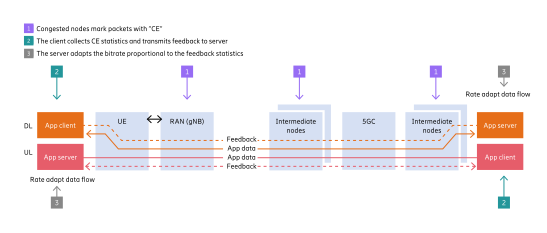
Figure 1 : Application and network interaction
In the next section we describe, at a high level, how L4S works and how it complements the 5G QoS framework in 5G Standalone networks. The accompanying L4S solution paper provides the full technical depth, figures, and deployment considerations.
Technical principles behind L4S
At its core, L4S is a practical collaboration between the network and the endpoints. The network watches its queues and, as congestion begins to form, it signals early by marking packets. L4S capable endpoints then respond by adapting their sending behavior quickly and smoothly, keeping queues short. The simple intuition is: signal early, adjust early—so users feel responsiveness instead of buffering and lag.
L4S does not replace QoS; it complements it. QoS helps you classify and prioritize traffic. L4S improves how congestion is managed in real time—using ECN as the signal, with standardized rules for early marking and for how endpoints interpret and react to those signals. The result is lower queuing delay and fewer packet losses, even as load increases.
In 5G Standalone networks, L4S fits alongside the standardized 5G QoS framework. L4S capable traffic can be handled separately from classic best-effort flows, helping protect latency sensitive services when networks become busy. Congestion marking is performed close to the air interface—where the network has the best view of fast changing radio conditions—so the signal is timely and reflects what users actually experience.
L4S also separates responsibilities cleanly: endpoints handle congestion control and rate adaptation, while the network handles congestion marking as illustrated in figure 2. That keeps L4S access-agnostic and consistent across technologies—for example, 5G mobile and DOCSIS cable—so developers can target one behavior end to end rather than tuning for each access network.
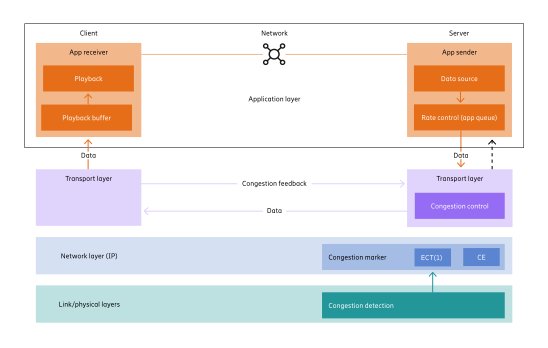
Figure 2: L4S handling in mobile network
How L4S translates into real-world gains
SoftBank Corp. – enabling ultra‑low‑latency XR on a live 5G Standalone network
On its live 5G Standalone network, SoftBank Corp. (“SoftBank”) used L4S to support next‑generation XR services that demand consistently low and predictable latency. By combining L4S with 5G Advanced and differentiated connectivity capabilities, SoftBank achieved around a 90% reduction in latency compared to a baseline without these capabilities. This demonstrates how L4S can help keep highly interactive services stable under real network load.
MasOrange – improving responsiveness for real‑time services at scale
MasOrange introduced L4S to improve responsiveness for real‑time services such as live video, cloud gaming, and AR/VR in dense urban environments. With L4S helping to reduce queuing delay and packet loss under load, MasOrange reports benefits for consumers across 20 major Spanish cities, including Madrid and Barcelona. The result is more predictable performance for time‑sensitive applications—without compromising overall network efficiency—marking a practical step toward experience-driven connectivity.
Ericsson portfolio proposition for L4S
At Ericsson, we take an end to end approach to L4S—from 5G RAN and Core to the transport network—so service providers can realize the benefits consistently, not only in isolated domains. For CSP technical decision makers, this matters because differentiated connectivity depends on predictable behavior across the full path. For developers, it means the network can provide clearer, earlier congestion feedback that your applications can actually use.
L4S is complemented by 5G Advanced RAN capabilities such as radio scheduling and prioritization. Together, these features help limit delay variation when radio conditions change, supporting stable low latency even under load.
Ericsson’s L4S solution is built on standardized foundations and aligned with 3GPP specifications. It leverages the existing 5G QoS framework so CSPs can introduce L4S in a controlled, interoperable way. Latency sensitive L4S traffic can be isolated from more bursty best-effort flows, helping protect critical experiences when congestion appears.
By integrating with QoS and scheduling and performing congestion marking in the RAN (uplink and downlink), L4S provides timely feedback to endpoints. This is especially important for interactive services, where a few extra milliseconds can change the experience.
Together, these capabilities help move beyond best-effort delivery toward a more predictable, experience-driven model—where low latency, low loss, and stable performance can be delivered when it matters most.
L4S role in the broader differentiated connectivity framework
Differentiated connectivity is about moving beyond best-effort delivery toward connectivity defined by experience, where predictable latency, packet loss, and throughput are critical to application performance. In Ericsson’s Differentiated Connectivity framework, this shift is enabled through a limited set of common performance levels that translate application requirements into measurable network behavior. Within this model, L4S plays a complementary role by improving how these performance levels behave under congestion. Rather than defining a service tier on its own, L4S strengthens performance levels by enabling early, explicit congestion signaling between the network and applications, allowing latency sensitive traffic to degrade gracefully instead of suffering abrupt quality drops when capacity or radio conditions are constrained.
L4S is positioned as an essential end to end capability alongside network slicing, QoS, and traffic steering in realizing differentiated connectivity. Implemented across Ericsson’s RAN, Core, and Transport portfolios and combined with 5G Advanced capabilities such as latency priority scheduling and rate-controlled scheduling, L4S acts as a key enabler for experience-based differentiations at scale. In this way, L4S is not a standalone feature, but one of the foundational building blocks that helps service providers deliver predictable, resilient experiences as they transition from best-effort to performance-based connectivity offerings.
As networks move beyond best-effort connectivity, L4S helps deliver graceful performance degradation instead of abrupt quality drops when capacity or radio conditions become constrained. By providing early congestion signals and enabling fast adaptation, L4S supports more stable and predictable experiences for latency sensitive applications—and becomes a practical building block for differentiated connectivity in 5G Standalone.
Source: Ericsson’s differentiated connectivity handbook
Read more:
Want to go deeper? Read the full L4S solution paper for architecture details, figures, standardization context, and deployment considerations across RAN, Core, and Transport—plus guidance on what’s required end to end for L4S to deliver its full value.