










Why the factory of the future needs both people and automation
- True industrial competitiveness depends on knowing what to automate and where human judgment matters most.
- Ericsson’s USA 5G Smart Factory shows how local production, workforce development and sustainable design can both strengthen resilience and accelerate innovation.

Head of the Ericsson USA 5G Smart Factory
Head of the Ericsson USA 5G Smart Factory
Head of the Ericsson USA 5G Smart Factory
For years, the dominant vision of advanced manufacturing was the fully automated "lights-out" factory. It is an appealing idea, and if you are manufacturing a single, stable product at massive scale, it can make sense.
But in practice, most advanced manufacturing doesn’t look like that. In the modern factory, production cycles are accelerating, and new designs often replace old ones before the automation built for them has paid off. In an environment defined by frequent New Product Introductions (NPI), a factory that must stop production every two years to fully re-automate is not resilient.
When Ericsson built its USA 5G Smart Factory in Lewisville, Texas, our early ambition leaned toward full automation. But as the factory matured, we saw that manufacturing 5G technology requires flexibility, judgment and close collaboration between engineering and operations.
We now automate only where it creates the most value, keeping people at the center of work that requires problem-solving, quality assurance and real-time decision-making.
Finding this balance is the most important lesson from Lewisville, and it is one any advanced manufacturer can apply. The most resilient manufacturers are not choosing between automation and people. Instead, they are automating what is stable and repetitive and designing the rest of the operation around what people do best.
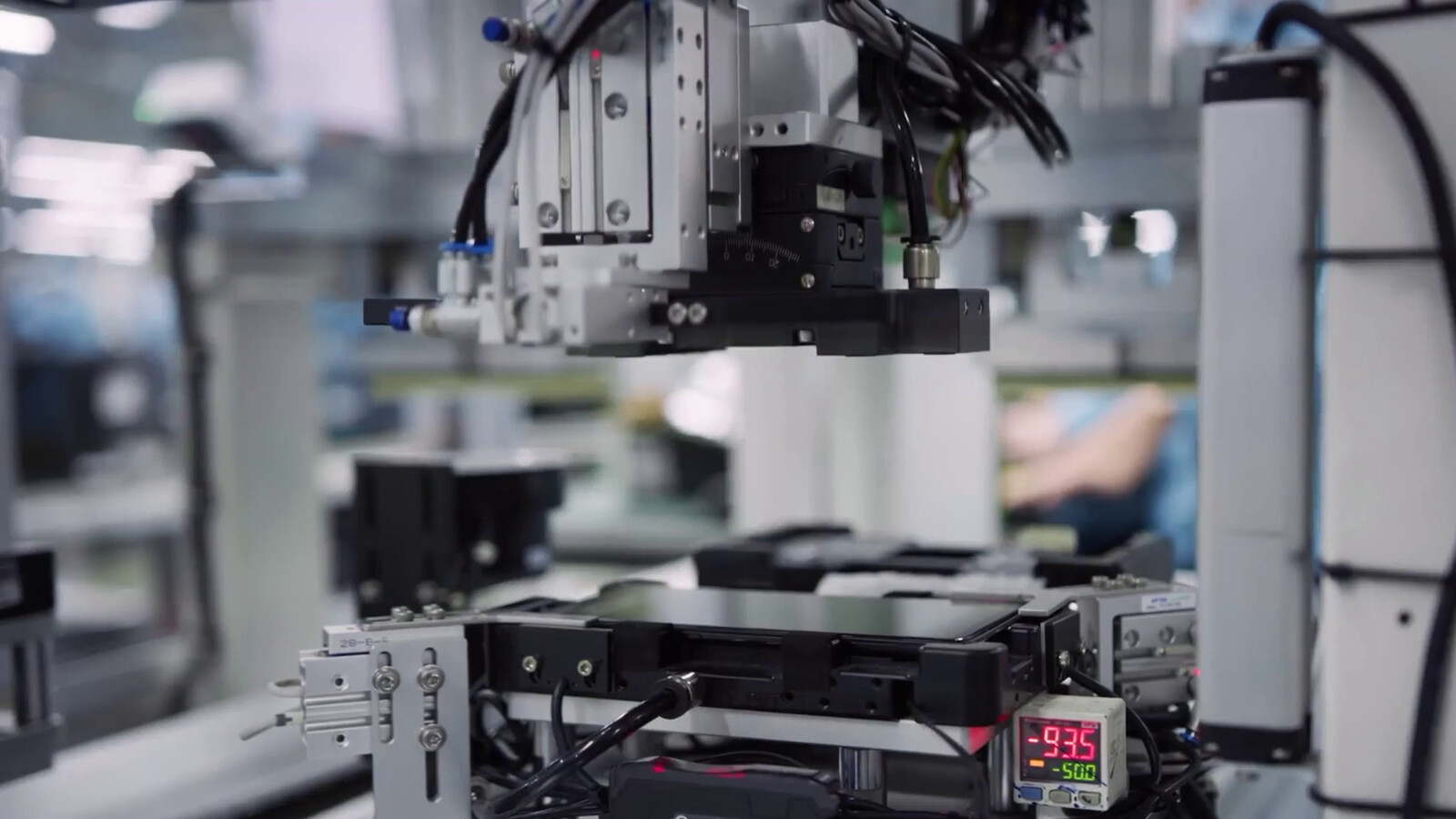
Please watch the following video from the World Economic Forum on factories of the future and featuring our factory in Lewisville:
What makes automation work
Since opening in March 2020, our production lines have run continuously. By balancing human flexibility with machine efficiency, we have scaled our workforce threefold and achieved an eightfold increase in production volume. Today, our 300,000-square-foot facility employs over 565 people.
As the first large-scale manufacturer of 5G radio network technology in the US, we produce equipment like Massive MIMO and RAN compute for major American communication service providers. By manufacturing in the US for the US market, we shorten delivery times, reduce supply chain complexity and accelerate time to market.
Our teams work side-by-side with autonomous mobile robots that handle material movement in the production process. We also collect data from connected sensors, production machines and factory systems.
To enable efficient scaling of volumes, we use artificial intelligence (AI) to reduce “time to insight.” We are building data models and chat interfaces that allow employees to query systems in the same language they use on the factory floor.
Our private 5G network is the backbone of this setup. On our production floor, just two Ericsson 5G Radio Dots, which are high-performing nodes for 4G and 5G connectivity, provide coverage comparable to 28 Wi-Fi access points. 5G is also more secure and provides guaranteed service compared to Wi-Fi.
For example, because our autonomous mobile robots (AMRs) must navigate a dynamic factory floor, our engineering team designed a custom solution to connect them to our private 5G network. With low latency and high bandwidth, the ARMs can share lidar readings with each other in real time. If one robot encounters an obstacle, it alerts the rest of the fleet so they can identify a different route. This shift from Wi-Fi to 5G has allowed our robots to complete material-handling missions 10 to 15 percent faster.
People are the point
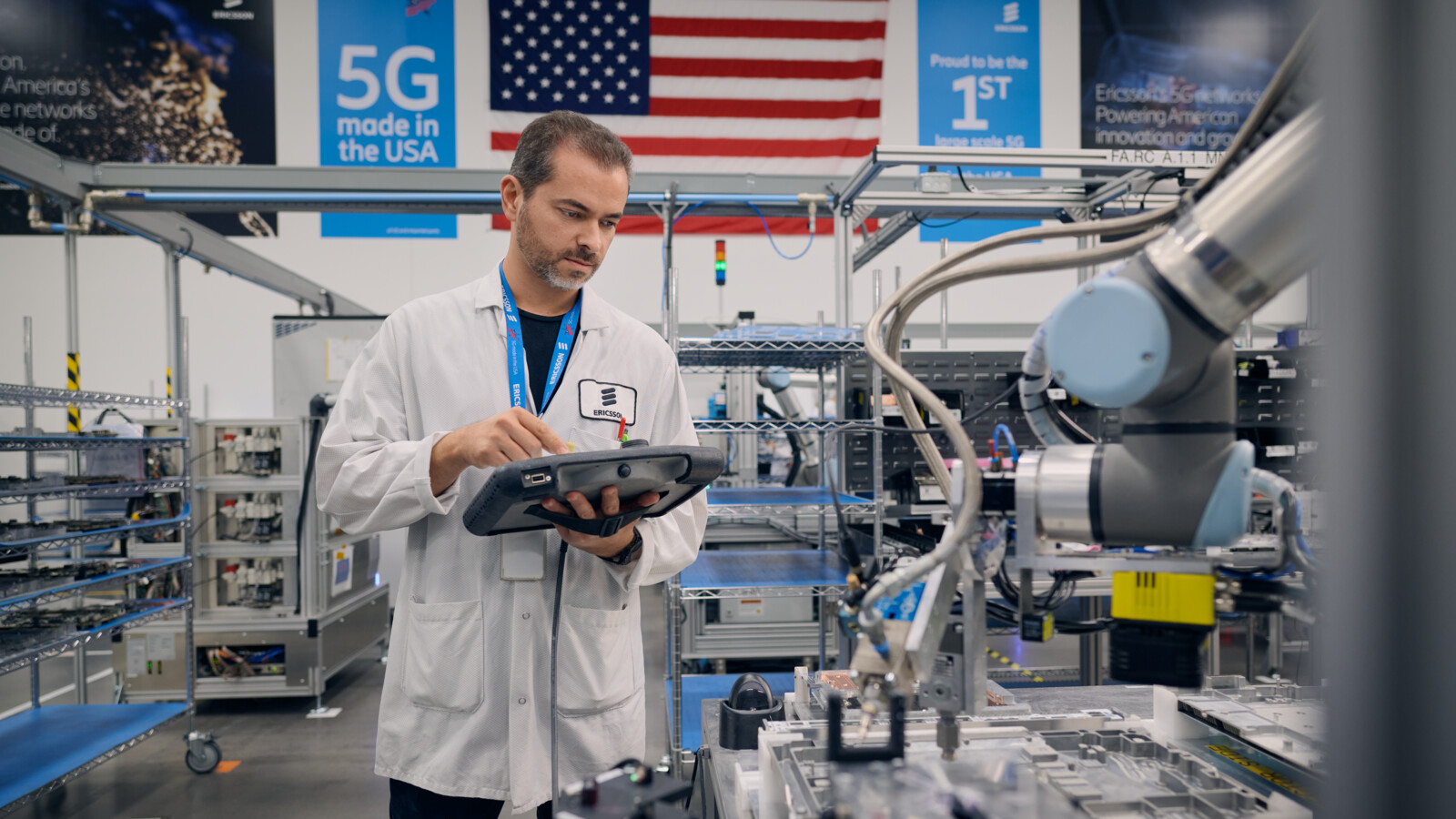
A modern manufacturing job is clean, highly connected and collaborative.
When automation handles repetitive and physically demanding tasks, people onsite can focus on the work that requires judgment. This approach creates space for new technical roles and career pathways that did not exist before, and it helps build the resilient, highly skilled workforce required to sustain advanced manufacturing.
In an environment shaped by frequent industralization, this also means that skills must evolve continuously. Every new product introduction becomes an opportunity to develop our operators and engineers as well as push teams beyond execution into collaboration, and real-time problem-solving even before prototyping begins. This is where we build capability and challenge each other as we learn together.
When visitors tour our facility, they often ask: “Are all these people engineers?” The answer is that many developed those technical capabilities here. We have hired and trained people from retail, automotive repair, healthcare, the military and many other backgrounds to work safely on high-tech lines in four to six weeks. Our training team of 13 people has developed over 200 graduates and counting.
Sustainability by design
Deploying advanced technologies at scale — robotics, sensors, connectivity and AI — increases energy and resource demands. This means that the more connected a facility becomes, the more important it is that its physical foundation is efficient by design. Sustainability must be treated as a precondition for running responsibly and for keeping costs down.
As an example, our factory runs on 100 percent renewable electricity, with onsite solar panels designed to provide around 17 percent of our power. A 40,000-gallon rainwater harvesting system collects and filters rainwater for indoor use, enabling a 75 percent reduction in water usage.
Overall, the building is designed to be 24 percent more energy efficient than comparable structures, and connected energy-monitoring systems support an estimated five percent reduction in energy costs through precise tracking and control. This commitment to a sustainable design and operations earned our site LEED Gold Certification and a World Economic Forum Sustainability Lighthouse distinction.
A model others can adapt
The lesson we learned from the USA 5G Smart Factory is that advanced manufacturing requires integrated decisions. Automation should be applied where it improves safety, quality, speed or resilience. At the same time, workforce development must be built into operations, and sustainability must be integrated from the start.
For manufacturers, policymakers and investors, the core point is simple: technology and people are not a trade-off. And the factory of the future will be connected, adaptable, sustainable and powered by people who know how to use technology to solve real problems.