










Focus on the customer: building Swisscom's autonomous network
- Swisscom and Ericsson are building Switzerland’s “Best Net” — a smarter, more responsive network designed around what customers actually need, from reliable connectivity at busy sporting events to dependable support for businesses in the field.
- Ahead of the OSS/BSS Summit 2026 in Zurich, Swisscom and Ericsson reflect on their shared ambition for innovation, automation, and keeping customers happy.

Global Head of Sales, Service Management and Orchestration - Ericsson

EVP Mobile Network, Mobile Services & B2B Telco, Swisscom

Global Head of Sales, Service Management and Orchestration - Ericsson
EVP Mobile Network, Mobile Services & B2B Telco, Swisscom
Global Head of Sales, Service Management and Orchestration - Ericsson
EVP Mobile Network, Mobile Services & B2B Telco, Swisscom
When you have put in the work as partners, there’s nothing wrong in taking pride in a good result.
Swisscom and Ericsson have had good cause to celebrate in recent years, as the network we created was recognized as Switzerland’s best through nine consecutive Connect test wins and 11 consecutive Chip test wins.
We share a common goal of building the communications infrastructure that gives Swisscom’s users, whether they’re individual subscribers, small businesses or big enterprises, the absolute best connectivity in Switzerland. In short, we build the “Best Net”. With each improvement and update, we’re not only delivering the network these users need today but setting down the infrastructure for the networks that will power their, and our, future.
We have worked together closely for more than ten years, to continuously ensure the network is one step ahead of the customers’ needs. We are now entering a phase of enabling and facilitate genuinely differentiated connectivity that suits customers’ needs, where users can rely on predictable, assured performance characteristics delivered through a network slice which is powered by automation. Think of things like a guarantee that a fan can access video streaming while in the crowd to get a replay of the action at a sports event, or a company that can be sure their engineering teams in the field can access AI-based augmented reality assistance whenever needed.
We got to this great position through a transformation marked by serious speed in innovation and network evolution. This is enabled by exceptional collaboration and co-creation between the two companies’ teams, who work together to build smart automation and autonomous network operations to remove operational complexity while delivering brilliant customer experience.
All of this is what supports the core business outcome Swisscom needs, namely driving new and reliable revenue channels, growth and profit. As we prepare to showcase some of our joint achievement and progress on the road to real differentiated connectivity at the upcoming Ericsson OSS/BSS Summit in Zurich, we wanted to share a portion of the story of how we got to where we are today, and how Swisscom and Ericsson are moving beyond traditional network management and scripted automation toward intelligent autonomous systems. All in the service of our shared goal – the best connectivity powering happy users.
Intelligence-driven customer experience assurance
Creating new services isn’t the big challenge. The key item to overcome is how to deliver services consistently at the level we commit to. Ensuring the underlying architecture supporting these systems and offerings is flexible and easily upgradeable is a necessary place to start. Not only do autonomous networks operations support the advanced services necessary for a happy customer, they are also the essential component to fixing technical problems and preventing issues before they occur and then rapidly resolving them if they do, before they create subscriber dissatisfaction.
Swisscom has, for a long time, had a particular focus on Service Key Performance Indicators (SKPIs), metrics that directly reflect what customers experience. It goes alongside "subscriber-centric observability": placing the focus on the experience and metrics related to individual subscribers for the services they use, rather than just infrastructure or aggregate system metrics. This requires a different way of thinking about network intelligence, and this focus on end-to-end observability is a key element that ensures Swisscom’s journey to autonomous networks is delivering the success needed.
The journey to Service KPIs is supported by the long-standing collaboration between Ericsson and Swisscom for subscriber analytics, enabled by Ericsson Expert Analytics. On top of this, enter the latest agentic AI innovation. We are working on agentic network intelligence (ANI), testing and demonstrating a new initiative that helps managers detect and manage issues across different domains.
The proposed system observes and collects vast amounts of data from across the network, analyzes it through the lens of "what matters to customers" and surfaces actionable insights to the operations team. When a potential customer-impacting issue is detected, a range of dedicated AI agents act on a rich knowledge plane prepared from past, and real-time, tickets and data. They identify a root cause, prepare a recommended action and present it to the manager-on-duty for approval through an insight card as well as a chat interface for any queries.
This "manager-in-the-loop" approach maintains human oversight while dramatically accelerating decision-making. Importantly, each automated action and interaction with the manager-in-the-loop becomes training data that improves future decisions. It's a virtuous cycle: more intelligent analytics lead to better decisions, which lead to better outcomes, which lead to smarter algorithms fed by a more robust knowledge plane, which lead to even better decisions.
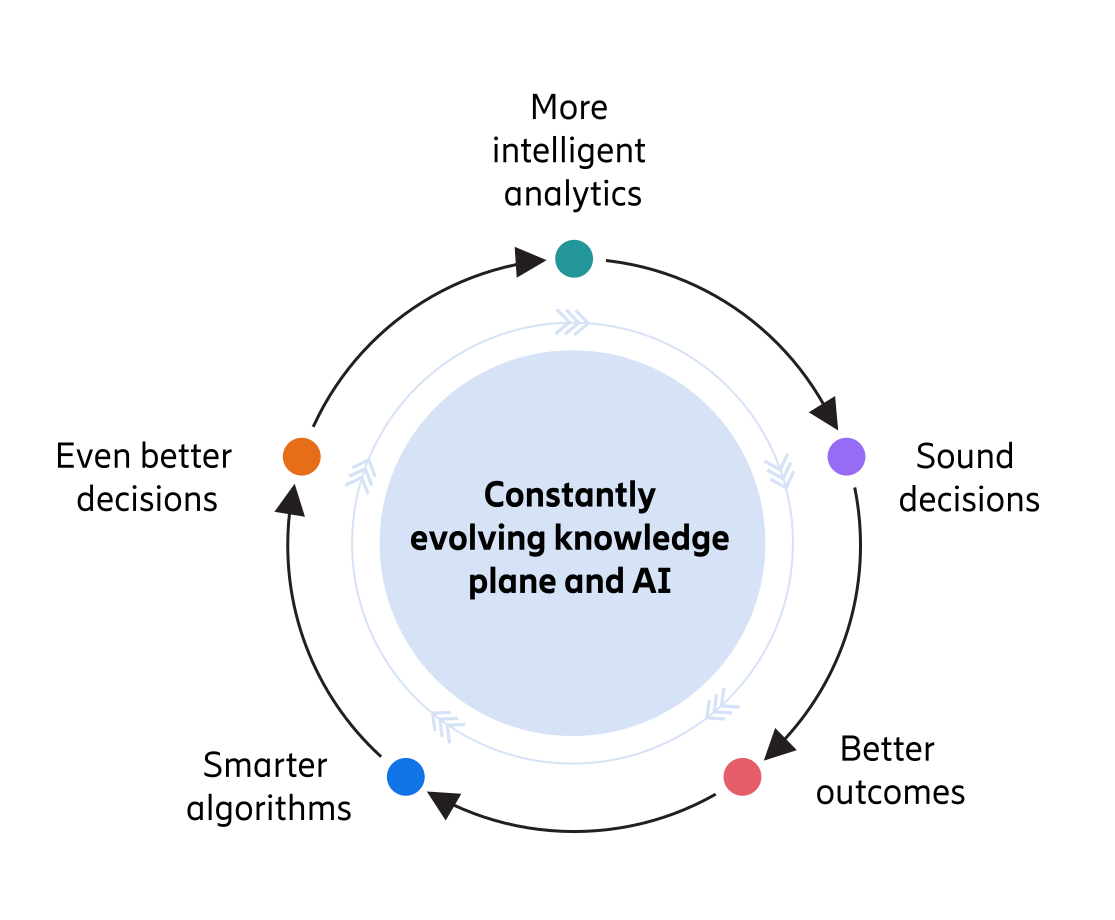
Figure 1: The Virtuous Cycle
This loop from detection to presenting a manager with options has a five-minute turnaround target, minimizing the potential time a subscriber is impacted by an issue. The next logical step might be to close the loop – with a sophisticated enough system, the decisions for remediating straightforward issues could be taken autonomously, but let’s not run before we walk.
This represents operationalized autonomy. Not a theoretical exercise in machine learning, but a proposal for a practical system transforming how we detect, understand, and resolve network issues at scale. Delegates at the upcoming OSS/BSS Summit in Zurich in October can see how our agentic network intelligence work firsthand through one of our joint demonstrations on-site.
Building on cloud-native foundations
Autonomy is not possible on outdated infrastructure and outdated applications. Transforming the core network and its management systems to a cloud-native infrastructure and cloud-native network functions has been vital to ensure the network’s architecture is modern, flexible, and capable of continuous evolution. It’s an ongoing process, with 6M subscriptions expected to be migrated to the fully cloud-native core network by the end of the year, phasing out the legacy software. This enables a true cloud-native operating model, with continuous integration and continuous deployment of the latest software at minimal effort.
This transformation has given Swisscom and Ericsson the reliable, flexible foundation from which we can increase the breadth of our exploration of how we can build more autonomy and efficiency to the core network. Promising, ongoing, projects including the expansion of automation in lifecycle management (LCM), configuration management (CM) and orchestration of the cloud-native core network functions. And Swisscom is working with Ericsson to explore how it will implement core-specific automation applications (cApps) using the Ericsson Intelligent Automation Platform (EIAP).
This transformation has been a time-consuming challenge, but also a true success. Without this reliable, automated infrastructure layer, and the spirit of constant evolution that underpins it, the more ambitious autonomy initiatives we pursue that will form the bedrock of a differentiated connectivity set of offers, delivered over the best network, simply would not be possible.
From manual intervention to closed-loop automation
Within the Radio Access Network (RAN), that spirit also shines brightly. Swisscom has taken a major leap in automation, replacing legacy SON (Self-Organizing Network) systems with an AI-enabled, closed-loop automation system, based on the Ericsson Intelligent Automation Platform (EIAP).
Swisscom’s stated strategy is to continue evolving towards a fully automated network, with EIAP as a key functional component to execute on this strategy. EIAP gives Swisscom an open and standardized platform that enables scalability, interoperability and integration across its ecosystem. EIAP includes the Ericsson Intelligent Controller (EIC) and an ecosystem of so-called rApps on top.
Over the past few months, we have collaborated to bring the first rApps into production, the latest step in a long, symbiotic relationship where the two companies have worked together from early stages of prototyping the rApps to the near final stage we have reached today. The latest step in that journey has been the completion this summer of the FOA (First Office Application) of the Remote Electrical Tilt (RET) cell shaper rApp, an application which optimizes remote electrical tilt on base station antennas, improving coverage and capacity – and therefore improving the service the customer receives. This rApp delivered reliable 4G and 5G automated optimization with zero execution failures.
The rApp was able to correctly identify problematic cells and apply the appropriate tilt adjustments to improve radio quality, user experience and steer traffic according to the defined optimization strategy. Clear improvements were observed where they matter most, namely in the worst-performing cells as well as in the worst user sessions. For instance, for a group of cells with a high number of bad-quality sessions, 5G download throughput improved by 13 percent. For a group of cells with a high number of overshooting issues, the VoLTE drop rate decreased by 51 percent, while 4G download throughput improved by 13 percent.
This successful trial is an important milestone, enabling us to evaluate the maturity of the platform and the new, AI-based RET Cell Shaper algorithm in a real production environment.
Looking ahead, our collaboration will focus on scaling the number of use cases in key areas like radio network optimization, network configuration, traffic management, network slicing management, energy savings, among others with the target to fully exploit the potential of EIAP, while progressing towards full integration with the Swisscom ecosystem. This will allow us to move from individual use cases towards a scalable and fully integrated automation platform supporting our shared vision of a fully autonomous network.
Here we can really see the synergy between technical innovation and business value, amplified by a practice of close co-creation between Swisscom and Ericsson. Autonomy means optimizing for what matters most: customer experience, reliability, and efficiency working in concert rather than competition.
The continuous innovation mindset
Complexity grows, customer expectations expand, and technology advances. Our shared goals remain clear, and we know what it will take to achieve them.
Together, we’re building an organizational culture across the two organizations where cloud-native thinking, automation mindset, and customer focus interlock.
We’re also working on further connecting the resource (the physical and virtual infrastructure of the network) and service layer (which is responsible for what customers actually buy and use like their phone plans - handling service orchestration, catalog management, fulfilment, assurance and more) and making sure the whole set-up is observed and tracked throughout.
We're genuinely proud of the progress we've made together, the above representing just a selection, but a selection that represents tangible business value and operational impact.
We also see significant success in other areas, most notably in our efforts to introduce advanced RAN energy-saving features. Combining key energy saving features in Ericsson’s Massive MIMO radios with a Swisscom machine learning-driven automation framework designed to orchestrate these energy-saving features at scale means we are able to reduce the energy consumed while keeping customer experience impact to an absolute minimum. The systems we've built are live, delivering real benefits in efficiency, reliability, and innovation velocity. But we're not satisfied yet. We can't be.
From vision to reality
The above projects in cloud-native transformation, the deployment of EIAP and RAN automation aren't theoretical exercises or science projects without clear business goals underpinning them. The capabilities we describe are reshaping how Swisscom’s customers experience their connected lives today and tomorrow, and how Swisscom as a business thrives as a result. Network intelligence informs automation, which enables autonomy, which directly improves the differentiated experiences customers can quickly and easily access through an array of reliable revenue-generating services, thereby driving business growth.
There's much more to come. The Ericsson OSS BSS Summit will showcase additional innovations and deeper insights into our partnership, as well as our separate ideas and those of other service providers across the world. The essence of our message here and at the summit is simple: when you build autonomous networks with the customer at the center, with clear understanding of the business goals you want to hit, technology becomes what it should be: a tool that creates genuine value for all concerned.