









Future network outlook
Trends, needs and use cases are being investigated for the emerging start of the 6G work and are continuously being refined. Horizontalization and e2e considerations as well as immersive communication are such examples.
High-level needs
From a future point of view, networks must be designed to include requirements for society- , mission-, and business critical networks as these increasingly rely on a digital infrastructure to be able to address the needs of the 2030 society through network capabilities, which in turn are delivered by technical solutions.
Four areas of drivers have been identified, addressing above needs and thus indicating the direction which future 6G networks should take.
The main driver for networks is to improve in coverage, efficiency, and trustworthiness aspects, as well as addressing new services and product introduction as well as application demands of novel advanced services; Inclusion & Integrity, Sustainability & Resilience, Security & Trust and Digitalization in order to meet application demands.
We expect mobile networks to be gradually upgraded to support 6G technology. Similarly to 5G which was both an improvement and expansion of 4G, it’s likely that 6G will be a continued improvement of the “5G triangle” of eMBB, URLLC, mMTC services, while also adding new capabilities for delivering networking in the cyber-physical world , as shown in Figure 2.
Integration of new capabilities expanding the network's scope includes; Compute, Artificial Intelligence (AI) and Sensing as examples.
This expanded framework, endorsed by ITU-R [1], represents a significant shift in network functionality. It moves beyond traditional communication services, positioning networks as multifaceted platforms capable of supporting a wide array of advanced applications.
The introduction of these new dimensions requires robust business and efficient mechanisms for market exposure thus ensuring that the technological advancements align with practical, market-driven needs.
The challenge lies in seamlessly integrating these new capabilities while maintaining and improving existing services. Such evolution aims to create a more versatile and powerful network infrastructure, capable of supporting the emerging technologies and use cases.
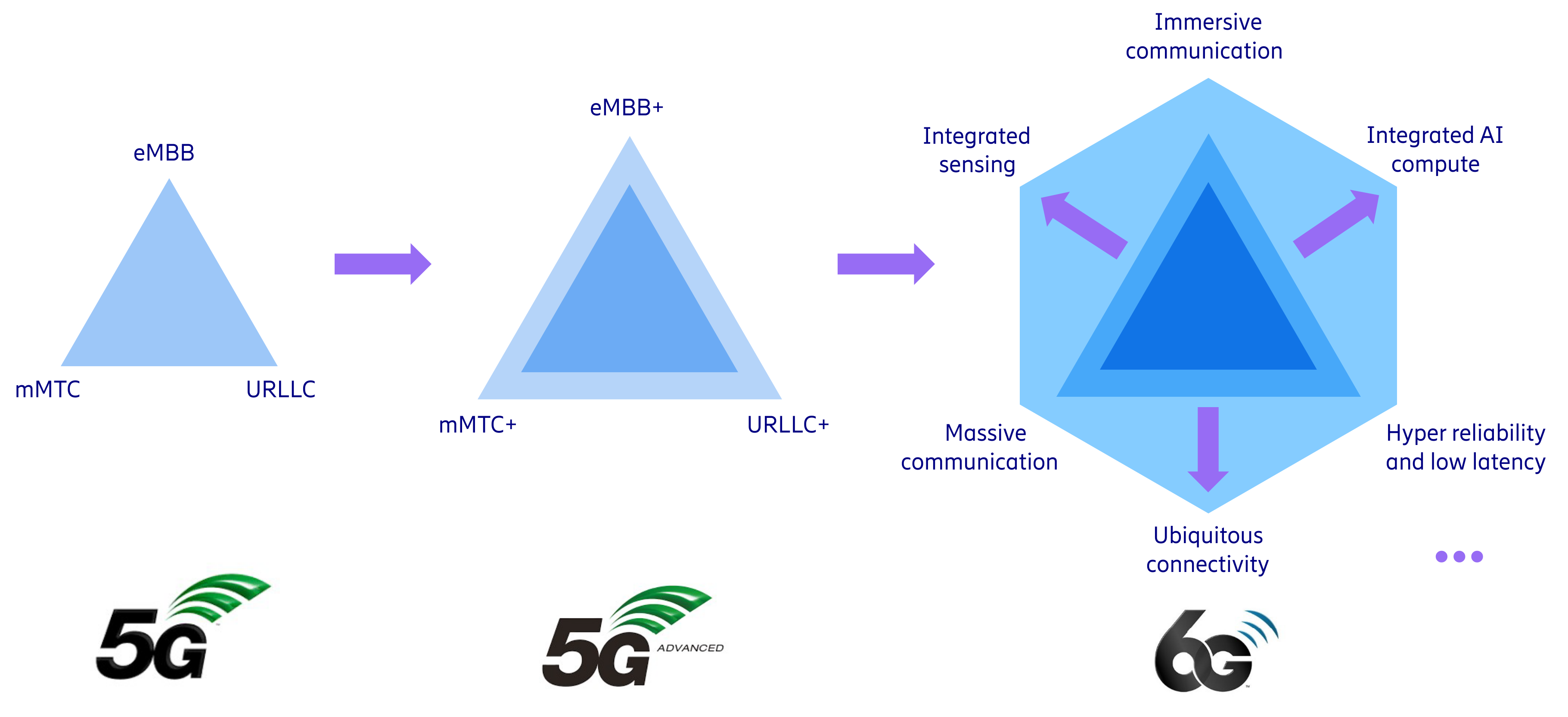
Figure 2 Evolving 5G and the journey to 6G: enhancing and expanding into new cyber-physical services
Major capabilities and use case trends
A number of use case examples have been identified for the 2030 networks stretching across Global Digitalization - Mixed reality - Autonomous Networks - Critical Services.
Increased requirements on the network capabilities can be identified, such as increased Up Link (UL) capacity, improved positioning accuracy and coverage, and improved support for service guarantees, etc.
Above use case examples in relation to the broader changes in the network are outlined below, referred to as networking and technology trends, needed to enable them. Existing 5G use cases, e.g. Fixed Wireless Access (FWA) will evolve into 6G.
Networking trends
- Networks as platforms for connectivity and beyond
Ericsson envisions networks evolving beyond connectivity into platforms that process data and offer advanced services—AI-driven sensing, localization, and reliable links—supporting applications for drones, digital twins, etc. - Performance differentiation
While apps generally rely on best-effort mobile broadband, a growing demand can be seen for enhanced performance of future networks to provide dynamic APIs, robust SLAs, enabling mixed-reality integration. - Data and AI everywhere
AI, including AI Agents, will optimize networks and cut costs using e.g. on-network digital twins to enable predictive analytics or acting in intent-driven operations. - Diverse requirements, diverse deployments
Future networks will be heterogeneous across technologies and deployments. Enterprises are expected to integrate private networks with public networks and public cloud to serve segments such as critical communications. - Resilient networks
Network resilience and cybersecurity are critical as 6G must be able to handle increasingly challenging failure types to maintain seamless coverage and end-to-end service guarantees for critical services amid global challenges like climate change and geopolitical tensions. - Programmable Networks
The transition to programmable networks [2], is driven by the demand for more versatile and customized products and services introduction. CSPs can leverage intelligent automation and real-time data for network optimization through Service Management and Orchestration Architecture. Intent-driven operations, powered by AI, will allow networks to autonomously execute desired outcomes, responding to dynamic consumer and enterprise demands.
Main technology trends
Above we listed network specific trends aimed towards 6G capabilities for use-cases in a cyber-physical world. In the following, we will also highlight several broader technological trends with implications on mobile networks and their architecture.
- Horizontalization: Open interfaces now span multiple layers. Cloudification and multi-vendor vertical interfaces are essential as networks go cloud native introducing Kubernetes-based public and private infrastructure. Hybrid cloud alters security, delivery, and end-to-end NRAR(Network Reliability Availability and Resilience).
- Softwarization: Telecom is software-first and programmable. Ericsson relies on extensive open source, making supply chain integrity and update practices vital. DevOps, CI/CD, telemetry and MLOps speed up time to market, though lifecycle management across diverse deployments remains challenging. Targeted observability and user-specific optimization matter. Specialized compute (GPUs, FPGAs, AI ASICs) pushes clouds toward real-time, deterministic behavior. AI and agentic LLMs will reshape API development and app creation.
- End to end encryption: With 6G, most traffic and metadata will be encrypted, reducing network visibility. Apps will decide what data to share, requiring mutual value, especially for mixed reality and efficient eMBB which raises questions about user-plane security termination. Zero Trust will grow, with differing E2E expectations for enterprise control versus consumer privacy.
- Resource efficiency: Sustainability is constraint and opportunity. Networks must support SDG (Sustainable Development Goals)-aligned use cases while minimizing spectrum, energy, materials and operations overhead. Deep sleep modes, legacy retirement, and early hardware/software choices are needed to meet performance with minimal power, including sensing and AI.
- Digital twins: Digital Twins will anchor the cyber-physical world, mirroring networks at defined fidelity to predict impact, validate slices, improve energy efficiency, QoS, assurance, reliability and resilience. They reduce deployment risk by, e.g. offline verification. Device-level twins should be kept separate from network operations to avoid confusion.
- Generative and agentic AI: GenAI moves into devices and apps, driving uplink need with local content creation which affects energy, data access and regulation. Agentic AI, agents that perceive, reason and act, will accelerate Autonomous Networks (intent-based control, predictive cross-domain optimization, etc.). Early value will be in customer care and operations expanding into embedded intelligence and AIaaS, lowering barriers for Hyperscalers and AI-native entrants.
- Enterprise convergence: OT, IT and telecom now form networks shaped by as-a-service models. Enterprises embed connectivity into processes and favor standardized IT/web practices. NaaS and CPaaS shift toward outcome-based recurring services.