








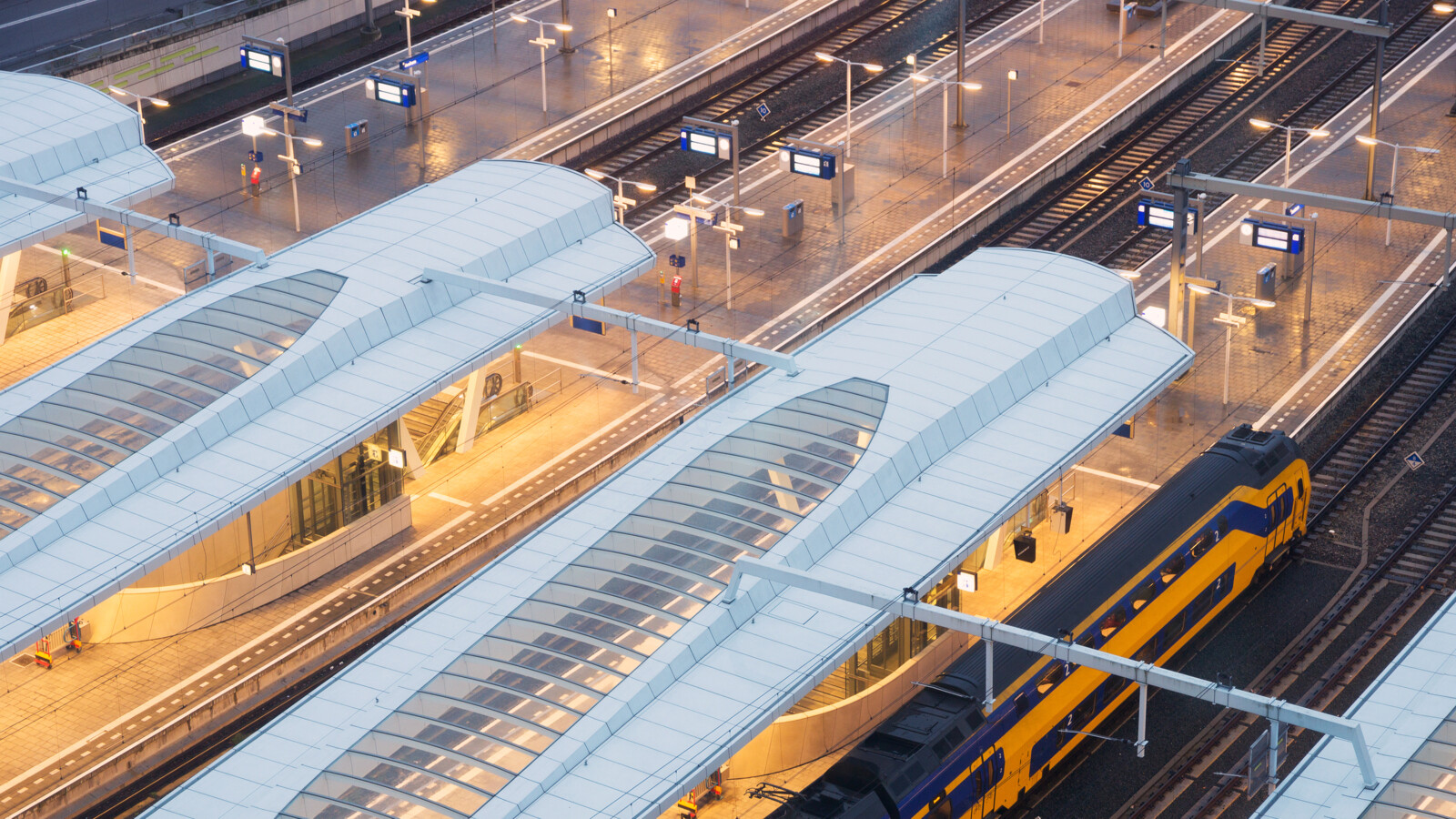
The railways need a new way to communicate
For the past 25 years, Europe's railways have relied on GSM-R – a 2G-based radio communication system that has served the industry well but is now approaching the end of its useful life. As train operations become increasingly digitalized and demand grows for higher-capacity, lower-latency connectivity, GSM-R simply can't keep pace.
The solution is the Future Railway Mobile Communication System (FRMCS) – a 5G-based communications standard designed to support the next generation of rail operations across Europe and beyond. But before FRMCS can be rolled out at scale, its specifications must be rigorously tested and validated in real-world conditions.
That's exactly what FP2-MORANE-2 is designed to do.
What is FP2-MORANE-2?
FP2-MORANE-2 is a Horizon Europe initiative flagship project, co-funded by the Europe’s Rail Joint Undertaking (EU-RAIL) and the European Smart Networks and Services Joint Undertaking (SNS JU). It is the direct successor to the original MORANE project – the program that first brought GSM-R to life in Europe. This time, the mission is to test, validate, and refine the FRMCS V2 specifications through both laboratory and live field environments, ultimately producing a robust V3 set of specifications ready for commercial deployment.
Running across 33 months, starting in 2025, the project is structured into six work packages covering everything from test design and system preparation through to field execution, dissemination, and project management. Testing is carried out in three vendor-operated laboratories – run by Ericsson, Nokia, and Kontron – and across five live railway tracks in Spain, Germany, Sweden, and the Netherlands.
The Europe’s Rail Grant Agreement for FP2-MORANE-2 is engaging a large European consortium led by UIC. The consortium brings together railway operators, infrastructure managers, and technology suppliers, each contributing deep expertise in GSM-R, FRMCS, and rail operations. The project has the full backing of European railway stakeholders, including the European Commission and EU-Rail, and its outcomes are expected to feed directly into European regulatory frameworks via the CCS Technical Standards for Interoperability.
Why does it matter?
FRMCS will underpin critical railway functions – from safety signalling and emergency calls to automated train operation and real-time surveillance – for the next 15 to 20 years. Getting the specifications right isn't just a technical exercise; it's a prerequisite for safe, efficient, and interoperable rail travel across an entire continent.
Standardization is at the heart of this. By building FRMCS on globally recognized 5G specifications from 3GPP and ETSI, the rail industry ensures that trains can cross borders without reconfiguring their communications equipment, that multiple vendors can supply compatible systems, and that the technology can evolve – from 5G toward 6G and beyond – without requiring full network replacement.
This approach also prevents vendor lock-in, promotes market competition, and lowers the long-term cost of ownership for railway operators. For passengers and freight customers, the result is a more reliable, more connected, and more resilient rail network.
Ericsson's role: from the lab to the track
Ericsson is a core contributor to FP2-MORANE-2 across all six work packages, bringing both technical leadership and a significant share of the lab and the field-testing infrastructure.
Leading the lab testing phase
As task leader for Work Package 3 (WP3), Ericsson is responsible for ensuring that all three test laboratories – spanning Ericsson, Kontron, and Nokia – are operational on schedule and interconnected across Europe via secure VPN tunnels and leased lines. This distributed lab environment enables collaborative testing of the full FRMCS ecosystem, with hardware configurations designed to simulate real-world conditions and replicate the field test track.
In Work Package 4 (WP4), Ericsson provides the Radio Access Network (RAN) and Core Network for four of the five field test tracks – the most complex contribution of any participant in the project. This also means the Ericsson Lab has needed to host the highest number of consortium partners for pre-testing ahead of field tests.
The lab testing phase runs from August to November 2026, providing a critical foundation for the field testing that follows.
WP4: Delivering RAN and Core Network across four tracks
In Work Package 4 (WP4), Ericsson provides the Radio Access Network (RAN) and Core Network for four of the five field test tracks – the most complex contribution of any participant in the project.
Each track tests a distinct aspect of FRMCS deployment in real operational environments:
- Netherlands: Ericsson acts as a home network, testing national roaming with and without the multipath function in partnership with mobile network operator (MNO) KPN. In addition, public subscription will be tested. Coverage along the track is provided across four frequency bands – 1900 MHz (dedicated for FRMCS), and 700, 2100, and 3500 MHz from the MNO – testing how FRMCS can leverage existing MNO infrastructure when dedicated coverage is unavailable or needs augmentation.
- Sweden: In collaboration with Telia, Ericsson tests a Multi-Operator Core Network (MOCN) configuration, where Telia's baseband units, radio units, and spectrum are shared between both operators. A single cell broadcasts two PLMN IDs simultaneously, demonstrating another practical approach to extending FRMCS coverage through shared infrastructure.
- Germany: Ericsson simulates a cross-border handover between two 5G Standalone networks in partnership with another network vendor, testing the migration and de-migration of live services at a network boundary. Ericsson acts as the visiting network, using a Home Routing and Roaming architecture.
- Spain: The high-speed track tests FRMCS applications performance at 300 km/h, pushing the system to its limits and generating essential data on how the network behaves under the demands of high-speed rail operations.
A foundation for European rail's digital future
FP2-MORANE-2 represents a pivotal moment for European rail. By validating FRMCS in realistic, multi-vendor, cross-border environments, the project will produce the evidence base needed to finalize the V3 specifications and begin the continent-wide migration away from GSM-R.
For Ericsson, participation in this program reflects a long-standing commitment to connecting critical infrastructure – and to ensuring that the standards shaping tomorrow's railways are built on a solid, tested, and interoperable foundation.
The transition to FRMCS is not a distant ambition. It is underway. And the work being done in MORANE-2 today will determine how safely, smoothly, and swiftly European railways can make that journey.
To learn more about how Ericsson is integrating FRMCS with 5G technology, read our white paper: Integrating FRMCS with 5G Technology
FP2-MORANE-2 is co-funded by the European Union. Views and opinions expressed are those of the author(s) only and do not necessarily reflect those of the European Union. Neither the European Union nor the granting authority can be held responsible for them.