










By Thomas Choi, Vice President Licensing, and Rickard Sjöberg, Expert Video Compression
HEVC’s Global impact and Ericsson’s contribution
Since the 1980s, Ericsson has been building video codec standards. This includes Advanced Video Coding (AVC/H.264) in 2003, High Efficiency Video Coding (HEVC/H.265) in 2013, and Versatile Video Coding (VVC/H.266) in 2020. Currently, we are working on next-generation codecs for the 6G era. This article focuses on HEVC, which is now embedded in most consumer electronics, such as smartphones, laptops, televisions, and set-top boxes. HEVC is also used by major streaming services such as Amazon, Netflix and Disney+.
As digital video expands across the globe, modern communication networks face growing technical demands. By 2028, video is expected to represent 80% of all mobile data traffic. Managing this volume requires efficient compression. HEVC reduces bitrate around 50% compared to AVC, making high-resolution formats like 4K and HDR feasible within existing infrastructure.
For industry, HEVC lowers distribution and storage costs, allowing streaming providers to scale their services. For consumers, this translates into smoother streaming, fewer interruptions, lower mobile data consumption, and consistently high picture quality, even during peak hours. At a societal level, HEVC supports digital inclusion, facilitates remote education and telemedicine, and lowers overall network energy consumption.
Ericsson has been at the forefront of video codec development for over four decades, contributing foundational innovations. We combine significant R&D investment with active participation in video codec standardisation, and good faith licensing negotiations. In this way, Ericsson supports a healthy innovation ecosystem while preparing for the immersive video demands of the 6G era.
The infrastructure challenge: Scaling for Global demand
Digital video has become omnipresent in daily life, being captured, displayed, stored and transmitted countless times per day. While uncompressed video retains every pixel and colour value for every frame, the resulting amount of data is immense and, thus, unsustainable for modern networks.
This becomes even clearer when we consider that, as video resolutions increase, the bitrate rises sharply. For instance, uncompressed 4K video at 60fps can exceed 12 Gbit/s. Such data rates go beyond practical limits for storage, transmission, and real-time delivery. The intensified use of high-quality video places increasing pressure on mobile networks. Indeed, video consumption currently accounts for approximately 76% of global mobile data traffic and is expected to continue to grow in the coming years.
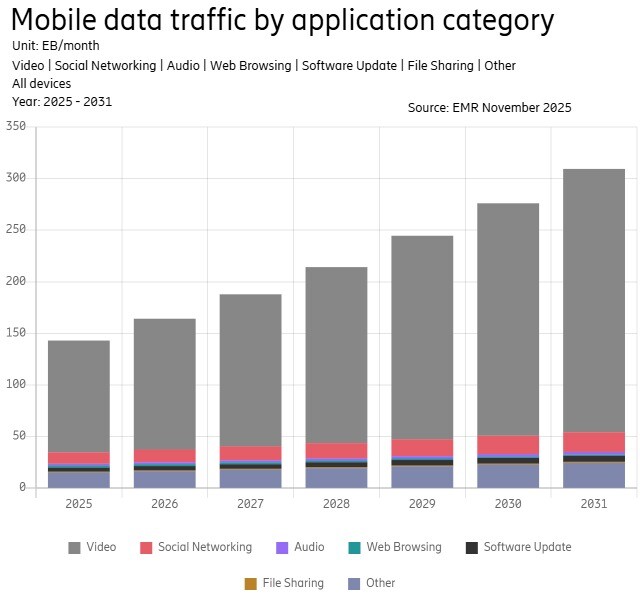
Ericsson Mobility Report, November 2025
HEVC: The industry standard for Global distribution
The ever-present hunger for higher video quality and the ubiquity of digital video gave rise to the need for an improved video coding standard. HEVC, also known as H.265, was developed to optimize video compression, easing the burden of video on storage systems and global communication networks. HEVC was completed in January 2013, a decade after the publication of its predecessor, the AVC standard. The improvements are undeniable. HEVC is roughly twice as efficient as AVC[1][2]. It also enables new capabilities that were not possible under the previous standard. Some examples are UHD television and video with higher-dynamic range, wider colour gamut, and greater representation precision.
From 2015 onward, a growing number of devices have integrated HEVC technology.[3] Today, HEVC can be implemented via both hardware devices and software systems, enabling deployment across a wide range of services applications, and device types. HEVC is currently embedded in most consumer electronics, and is used by major streaming services. The commercial ecosystem of products, services, and technologies that implement or rely on HEVC are estimated to be hundreds of billions of US dollars.
The architecture of efficiency: Adaptive block coding
The HEVC standard relies on a block-based hybrid video coding architecture. In simple terms, each video frame is divided into blocks, which are encoded using prediction. Intra-picture prediction estimates a block using information from neighbouring blocks within the same frame; inter-picture prediction reconstructs blocks over time using data from previously coded frames. Rather than encoding a block independently, the encoder transmits the difference between a predicted block and the original block.[4] Because this difference is much smaller, the amount of data that must be stored or transmitted is substantially reduced.
A key improvement in HEVC lies in the flexibility of its block structure. Earlier standards, such as H.264, relied on fixed macroblocks of 16 × 16 pixels,[5] which could only be split into smaller fixed-size blocks. HEVC replaces this approach with a more adaptive quadtree structure.[6] The largest coding unit, known as the Coding Tree Unit (CTU), is typically 64 x 64 pixels. This unit can be encoded as a whole or split into smaller Coding Units (CUs), depending on image content. This allows the encoder to match block size to visual complexity.
As follows, HEVC supports a much wider range of block sizes and a more adaptive coding approach. Large blocks are well suited for smooth regions,[7] while smaller blocks capture fine details or complex textures more efficiently. By selecting block sizes based on actual content, HEVC uses fewer bits for simple areas and provides greater precision where detail matters. This makes compression more efficient without reducing perceived quality.
Beyond compression efficiency, HEVC supports higher resolutions and frame rates, as well as enhanced dynamic range and improved colour quality[8]. These capabilities enable its use for UHD television distribution, real-time conferencing, and high-security surveillance systems.
Ericsson’s HEVC leadership
A significant part of the technology behind the HEVC standard originates from Ericsson’s key contributions to ITU and MPEG, the bodies responsible for developing HEVC.[9] A key indicator of technical standing is the number of a company’s proposals to ITU adopted into the standard. On that basis, Ericsson holds a 4.7% share of adopted technical contributions, reflecting its leadership position in the development of HEVC.
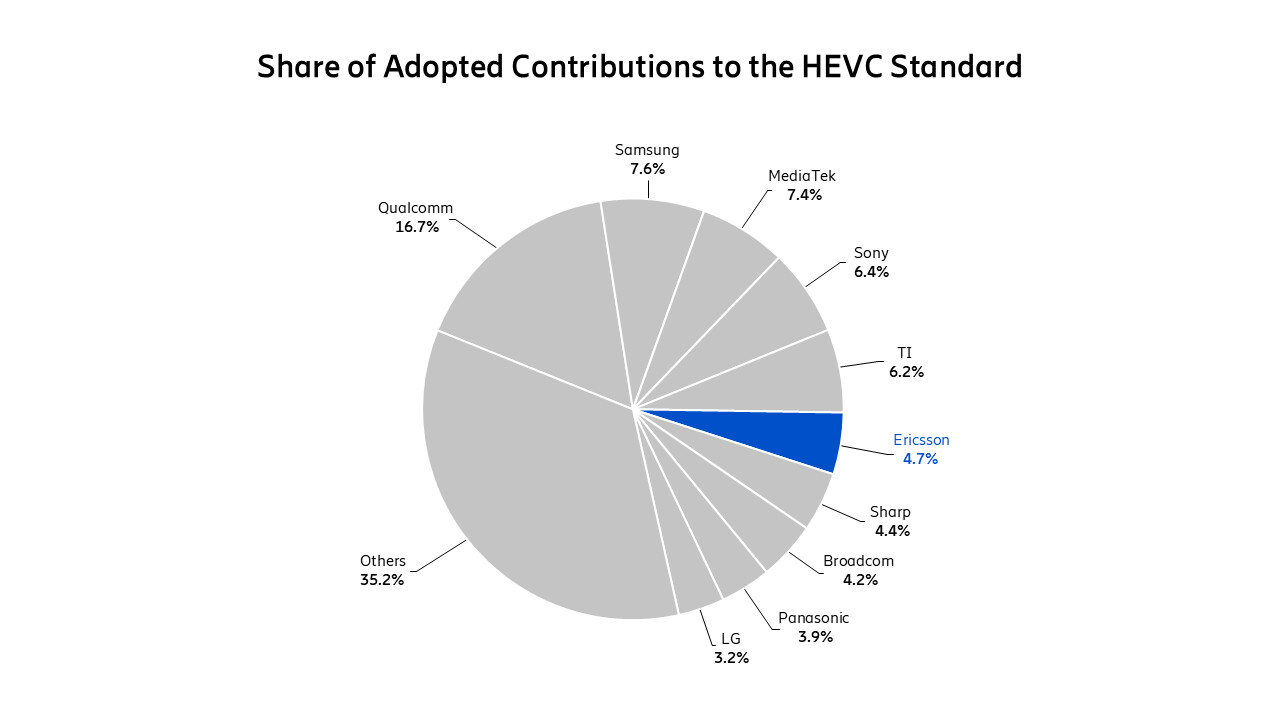
Share of adopted contributions to the HEVC standard based on contributions to ITU. February 2026
Another important indicator of strength is the technical impact of adopted proposals. Since the beginning, Ericsson has made crucial contributions to the standard. For example, Ericsson invented how decoded pictures are handled in modern codecs, including HEVC and VVC, providing superior efficiency and error robustness compared to previous codecs. Another example is the HEVC deblocking filter which contributes significantly to its excellent perceptual quality. Here, Ericsson designed both the filter decision logic and filter function used in HEVC’s normal filtering mode.
Moreover, Ericsson has actively contributed to later enhancements and extensions of HEVC. One example is Adaptive Resolution Change (ARC), a feature that enables prediction using lower resolution reference pictures without requiring intra pictures[10]. Furthermore, in 2012 Ericsson launched the world’s first HEVC encoder for mobile, the SVP 5500, designed to deliver high quality video at very low bandwidths.
In recognition of our technological contributions to H.265/HEVC, Ericsson was one of the companies representing the JCT-VC and VCEG standardisation organizations when these organisations in October 2017 were awarded a Technology & Engineering Emmy® Award for H.265/HEVC.[11]

Per Fröjdh, Director of International Standards, Ericsson, at the Technology & Engineering Emmy® Award for H.265/HEVC, October 2017
Ericsson has been able to deliver these breakthrough technologies due to our long-term commitment to innovation. Since more than 40 years, we have led research teams focused on developing video codecs. Ericsson’s researchers have helped educate the industry on video coding by authoring dozens of papers and book sections in the field.
In the 1980s, H.261 was standardised within the CCITT, under CCITT Study Group XV. CCITT later became ITU-T. H.261 was published by CCITT and subsequently maintained by ITU-T. Ellemtel, jointly owned by Ericsson and Televerket, played a key role in the H.261 standardisation in CCITT. Ellemtel developed a hardware video encoder and decoder supporting 384 kbps H.261. The units resembled large rack cabinets and were about one meter high and around 60 centimeters wide. The team designed their own chips, using a silicon compiler. These chips supported functions such as the motion prediction. Since then, Ericsson has been an active contributor to major video standards, including H.263, MPEG-4, H.264, HEVC, and VVC. During the HEVC standardisation process, Ericsson played a leading role in several subgroup activities, drove multiple core experiments evaluating technologies, chaired a number of ad-hoc groups, and supported technology convergence by guiding breakout group discussions.
Cycle of innovation
For decades, Ericsson has invested heavily in internal research and development (R&D), collaborated with key industry partners, and contributed to the development of video codec standards. Today, Ericsson employs more than 27,000 researchers globally and reinvests close to 20% of its annual global revenue into R&D, amounting to USD 5 billion in 2025. This long-standing commitment has resulted in a leading portfolio of over 60,000 patents, many essential to video codec standards like HEVC. Ericsson licenses these patents on reasonable terms and a non-discriminatory basis (RAND), supporting HEVC’s success.
At the same time, Ericsson is working with partners to advance video coding standardisation. We aim to ensure that the next generation of codecs (H.267 – expected to be finalized around 2029-2030) can support the immersive video experiences planned for the 6G era. As the evolution of video codecs continues, this alignment is crucial for future 6G network performance.
Significant investment in R&D creates cutting-edge technologies, which companies typically protect with patents. When contributed to and adopted in video codec standards, these technologies form a portfolio of standard essential patents (SEPs). Ericsson has indicated that it is prepared to grant licenses under its HEVC portfolio on reasonable terms. This enables further investment in R&D to develop the next generation of video codec standards, sustaining a continuous cycle of innovation.
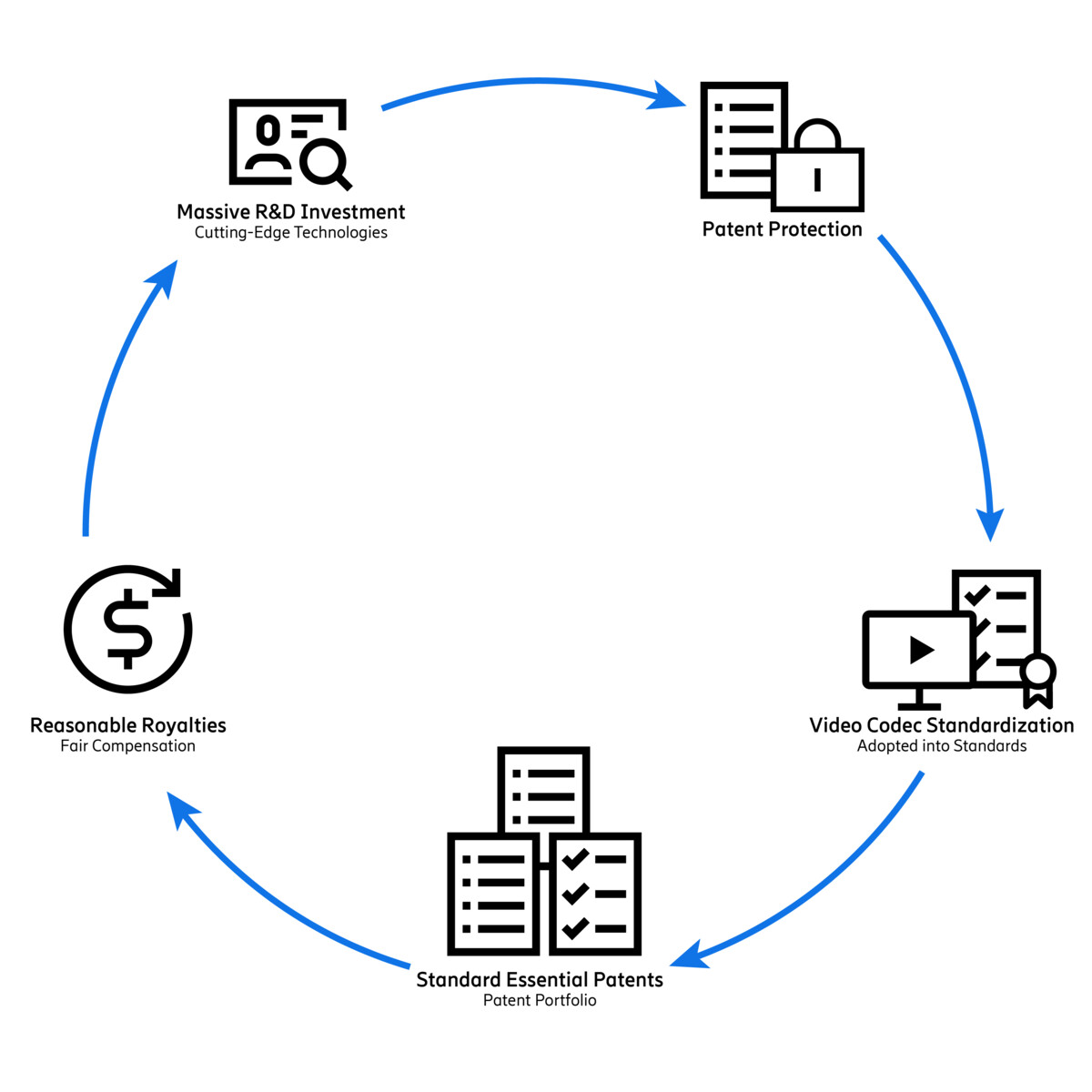
Ericsson. A virtuous cycle of innovation
Benefits of bilateral and third-party platforms licensing
Licensing revenues are key to maintain the HEVC ecosystem. At Ericsson, we license our premium HEVC portfolio through different models.
We usually engage in good faith bilateral negotiations because they offer flexibility. These discussions allow tailored agreements that reflect each counterparty’s needs while remaining within the RAND range. Some licensees request access to our non-SEPs, or to our technical know-how. When both sides own relevant patents, we may agree on cross-licences. Bilateral negotiations can also support multi-year partnerships across technology generations. One agreement may combine all or several of these aspects. For these reasons, bilateral negotiations are often preferred by both parties.
At the same time, third-party licensing platforms can offer efficiency and scale. One example is Avanci through its Avanci Video program. Avanci provides a streamlined licensing solution for the broader market through published royalty rates. By participating, Ericsson seeks to reduce administrative friction and accelerate the global adoption of HEVC technology.
This dual track model ensures that market participants gain predictable access to HEVC technologies under RAND terms. It also secures the returns required to fund the next generation of video innovation.
Conclusion
Ericsson has contributed extensively to the standardisation of HEVC and previous video coding standards over decades and has continued to lead as a major contributor to VVC, the most recently finalized global video standard.
Behind HEVC success lies years of research and development, commitment to collaboration and innovation, a leading patent portfolio, and fair licensing practices. This is Ericsson’s story. We stay ahead of the game to deliver the best technologies possible, transforming businesses and consumer experiences alike.