









Ericsson, China Mobile and OPPO complete 5G SA network slicing-based differentiated connectivity field verification for consumers
- English
- 简体中文
Ericsson, together with China Mobile and OPPO, have successfully completed China Mobile’s first consumer-oriented User Equipment (UE)-level slicing and application-level slicing test on the live 5G Standalone (SA) commercial network in Dezhou city, Shandong province. The test effectively validated the usage of network slicing technology, combined with AI-powered service recognition at the UE level, to deliver differentiated service experiences. This is a breakthrough achievement in 5G experience assurance.
Building on existing network capabilities, User Equipment-level slicing extends deployment scenarios by targeting specific users and terminals. Application-level slicing, enabled by User Equipment Route Selection Policy (URSP), has been the key driver of change across three aspects of China Mobile’s 5G SA network: enabling an end-to-end process, establishing a complete technical validation chain, and exploring how hosting applications on slices can deliver enhanced service capabilities in China Mobile's 5G SA network. The commercial deployment of these capabilities still requires further ecosystem maturity and broader support from commercial terminals. Going forward, all parties will collaborate to jointly advance the development of the industry ecosystem.
The test covered application scenarios including uplink for livestreaming, short video download and upload, multiple functionalities with AI-powered glasses, and providing a robust connection for mobile gaming. It successfully achieved fine-grained resource allocation and isolation at both the user and application levels, delivering validated results for typical services in terms of guaranteed throughput and latency optimization on the existing 5G network.
Verification Scope:
-
Enhanced livestreaming powered by application-level slicing and OPPO’s AI recognition capability
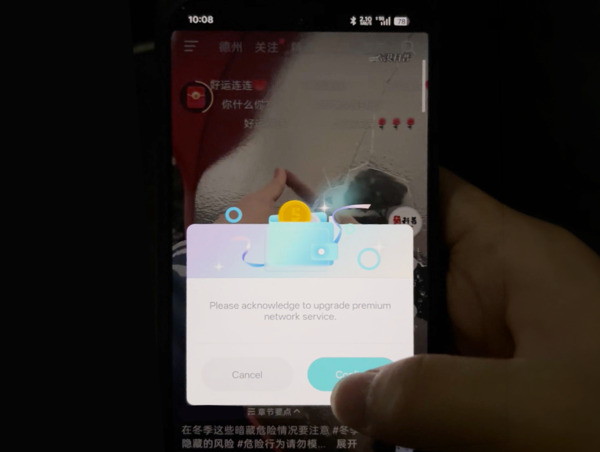
The application-level slicing test achieved a seamless closed-loop experience of “stutter detection – slice switching.” When mobile users experienced buffering while watching short videos or during uplink livestreaming, the OPPO device could automatically notify the user and switch the traffic to a dedicated slice if user selected to boost the connectivity. Combined with radio resource partition feature, network resources were prioritized and allocated to short-video or uplink livestreaming applications.
-
Optimized UE-level slices ensure premium mobile internet experience for selected users
Under a high-load and network congestion scenario, the uplink livestreaming and short-video services can maintain stable uplink and downlink speeds, achieving more than a twofold improvement compared to standard network performance. For gaming scenarios, user-perceived latency was reduced by at least 30 percent compared to conventional networks, effectively resolving key pain points related to video and gaming experiences under heavy network load.
-
AI glasses powered by Device-level slicing
AI agents have become a very popular application in China today. In the China market, the “AI object recognition” feature of AI glasses captures images and uploads them to a cloud-based AI agent for voice interaction. Achieving human-like interaction in this process places extremely stringent requirements on network latency.
Leveraging user-level slicing and latency-priority scheduling technologies, the average uplink and downlink air-interface RTT (round-trip time) latency for the AI object recognition service was reduced by at least 30 percent compared to conventional networks, significantly enhancing user perception of AI agent-based services from the network side.
This technology can also be seamlessly applied to real-time image analysis in industrial remote inspections, as well as intelligent tour guidance in cultural and tourism scenarios, enabling truly delay-free operational responses.
Network slicing is a key capability for building a hierarchical and differentiated service assurance framework in mobile networks. Through end-to-end logical isolation and resource scheduling, it enables differentiated and highly reliable quality of service for various applications.
Ericsson and China Mobile have long engaged in joint innovation, continuously advancing scenario exploration, solution validation, and commercial deployment of slicing technologies, and jointly promoting their large-scale application in industry digitalization and key scenarios.
Ziming Ni, Head of Networks Solution, Ericsson China, says: “This field test is of great significance, as it demonstrates our ability to deliver solutions that address network speed assurance and ultra-low latency requirements across diverse scenarios. Ericsson will continue to support operators in innovating and advancing differentiated connectivity, enabling new digital experiences and empowering users as well as a broader range of industries.”