Five employee paths shape the future of work
Various contexts and priorities mean employees envision and strive for different work futures
One vision fits none
There is no single answer regarding how the future of work will look like or how to enable it. The future of work is uncertain and multifaceted, with various paths and outcomes shaped by the diverse desires and needs of employees, the objectives and approaches of companies, and cultural and societal factors. Society will accelerate this evolution as it becomes more individualistic.
In our research, we have looked at employees' wants and needs and identified five alternative paths employees will lean into to shape their future work lives. The different paths are based both on more recently emerged drivers, such as increased digitalization, flexibility and project-based work and more traditional motivators, such as the search for stability, career, and financial drivers.
The paths we identified are Projects first, Flexibility first, Stability first, Career first, and Technology first, each named after the central driver for employees in each group (Figure 4). In all the markets studied, the paths are represented in differing degrees. We observe that some paths are more prevalent in some areas than others, which suggests that the various core drivers resonate with the cultural context in each market. We also see generational differences, with some paths preferred by certain age groups. These results reflect how context and life stage have impacts on what drives and motivates professionals. Employees who pursue a path will value and be driven by factors related to its core driver when determining how to shape their future work lives.
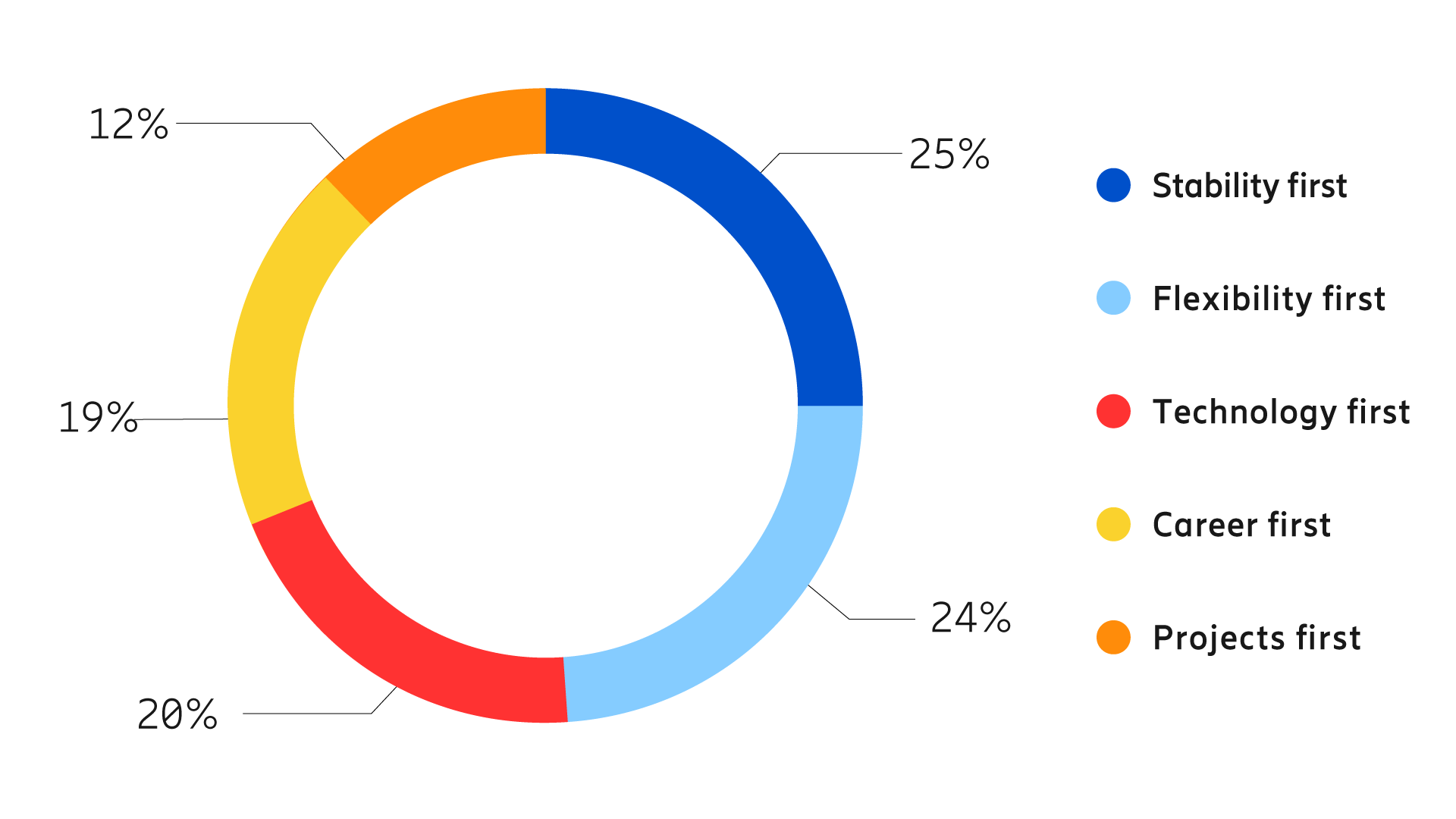
Five employee paths shaping the future of work
Stability first
One in four employees has a more pragmatic view of their work, even when looking for a future job. Work priorities for this group focus on factors like job stability, a fun social atmosphere and salary, but ultimately, they are mainly looking for a stable work life. This view on the future workplace is more common in western countries, especially among Generation X and baby boomers. This group is least interested in working at different locations outside of the workplace itself. On average, this group imagines a future with approximately 30 percent remote work compared to 40 percent among all employees.
Flexibility first
Up to one in four employees believe the emergence of the future work life is driven mostly by more flexibility in where and when they work. Around 45 percent of this group already think flexibility is available in their current work, compared to an average of 47 percent in the rest of the working population. However, at 77 percent, they have twice as high expectations of future flexibility compared to 40 percent among other employees.
No specific demographical subgroups or types of workers are more common in this path. Instead, the main distinguishing character is the higher focus on family, friends and leisure time in relation to the importance set on status, work and money.

Technology first
Roughly one in five employees share this view of the future of work, particularly within Asian and Middle Eastern markets. The future of work concept is centered around the availability of the latest, best and most relevant technology. The focus on technology as an enabler of workplace empowerment comes from more than just earlier positive experiences. This group has 30 percent more experiences with bad connectivity or other technology issues than other groups. The dominating factors for accepting a new job are the technology used at the workplace and the salary. This group also strives to work for larger companies.
Career first
Around 1 out of 5 employees state that both their current and future primary way of looking at work is nearly categorically driven by creating a career and having a position that symbolizes status. This path is slightly stronger among millennials in Asia, where nearly 3 out of 10 employees prefer this path.
While this group does not express higher expectations of technology for future work tasks, they generally show much higher usage of technology at work, especially for networking and keeping up to date with innovations and work opportunities. For example, they use social networking and video conferencing services nearly 30 minutes more every day than the average employee.

Projects first

This outlook on the future of work favored by 1 out of 8 employees emphasizes flexibility and working on a project- or temporary-assignment basis. Remote work can and will play an important role in this setup. Employees in this group can be characterized as potential gig workers who wish to make the most of technological advancements and the opportunities presented by a globalized labor market. Advocates of this view (20 percent) are commonly found in the upper or mid classes of emerging markets. Approximately half of the group are managers, business owners or sole traders.

Final reflections
It is abundantly evident that the COVID-19 pandemic has significantly impacted work life, and the changes it has sparked will impact how we work, view work and use technology in the foreseeable future. Decision-maker and employee opinions on the future of work are generally similar. Our survey shows that digitalization and flexible workforce management are key factors in their vision of the future. The views and priorities of decision-makers and employees do, however, differ from one another. Employers should be aware that employees will approach the future of work differently and should endeavor to reconcile their needs with the company. To accomplish this, decision-makers must understand employees' preferred paths, consider their input, communicate openly and consistently, and have an inclusive mindset when making decisions regarding the future of work.
When it comes to technology, employees inclined toward one of the five paths will gravitate toward different types of technological devices and tools for work. Simplified ways of working and cloud technology that bridges multiple devices and platforms will be critical for accommodating any paths. At almost 80 percent, most of the decision-makers already recognize that having a setup to handle multiple connected devices will be critical for their business.
Employers will need to consider several key aspects when creating the future of work regardless of the dominating path among employees. One crucial factor is understanding how a digital culture plays into the traditional corporate culture. Another is ensuring that technology is set up to support the promoted values, behaviors, and business and compliance standards across the virtual and physical divide. This should be approached through technological enablement, autonomy, and worker empowerment.
Decision-makers and employees focus on different areas to reach their goals and enable the emerging future work life. Employees, as individuals, aspire to change their lives as per the five different paths. On the other hand, as employers, decision-makers focus on related but different areas such as workforce management (including core processes like HR, costs, productivity, upskilling and ways of working), technological empowerment (making decisions and investments in platforms, devices, and applications) and automation (seeking to increase efficiency and simplification of work processes).
While there is some alignment between the views of employees and decision-makers on the future of work, friction is inevitable. Employees in our study voiced disagreements on the type of technologies companies should invest in, and some fear becoming redundant with the increased usage of technology and automation. There are also concerns surrounding the risk of monitoring and integrity violations with the rise of remote work. Decision-makers must acknowledge that cutting headcounts through automation is not the only option. Previous industrial revolutions changed how work is done, transformed the workplace, and both created and eliminated certain jobs. Given today's increased focus on human-machine interaction, Industry 5.0 is expected to generate new jobs rather than replace them in fields such as analysis, strategy, and leadership.
In summary, flexibility an intentional digital setup that supports humans and simplifies how we work will make the workplace of the near future possible if handled in the right way. It is based on fast, reliable, and secure data connectivity that allows systems and people to exchange data. A fresh perspective on work drives the redefined work life; a culture and set of values that place transparency, equity, and humanity at the forefront; and an environment where technology empowers leaders and staff to collaborate and thrive.