











Spectrum in a dynamic market
Microwave spectrum is a key 5G transport asset. In recent years, we have seen shifts in frequency use, the introduction of 5G NR in traditional microwave bands, and development of E-band into a high-volume band. What trends do we see now and for coming years?
Globally installed base
Today there are around 10 million transceivers installed for backhaul around the world. Figure 3 describes regional usage of microwave spectrum, where the size of each circle represents the installed base.
One of the biggest findings in this updated report is that compared to five years ago, the installed base of E-band (70/80 GHz) has grown from 1 percent and is now around 6 percent of the total installed base. This puts it on a par with 38 GHz, a high-volume band for 20 years. Usage of E-band will continue to grow in coming years with both standalone and multi-band deployments.
Other bands that have grown over past years are the 32 GHz band, which will take over some deployments from 26 and 28 GHz when being repurposed for 5G New Radio (NR), and 6 and 11 GHz which continue to grow due to increasing rural capacity demands. There has also been a significant increase of 13 GHz links in India.
Of the bands identified for IMT (International Mobile Telecommunications) at the World Radiocommunication Conference 2019 (WRC-19), countries have started to assign spectrum within the bands identified for IMT globally 24.25–27.5 GHz and 37–43.5 GHz. Allocations in the 28 GHz band for mobile usage have also been happening across the globe. The 28 and 38 GHz bands have been allocated in the US, whole or parts of 26 GHz in European countries, and 26 or 28 GHz in countries in Asia Pacific, and Central and Latin America. The decisions to license for 5G NR are taken individually, country by country, and many more countries are already in the process of assigning these bands for 5G NR. The 42 GHz band (40.5–43.5 GHz) is currently being
harmonized for MFCN (Mobile/Fixed Communication Networks) in Europe, allowing 5G NR deployments, but the transition of the 42 GHz frequency band to 5G NR use in Europe is unlikely to happen before 2025. For WRC-23, the upper 6 GHz band is up for consideration for IMT identification.
There are 10 million transceivers in global use.
E-band transceivers account for 6 percent of the global installed base.
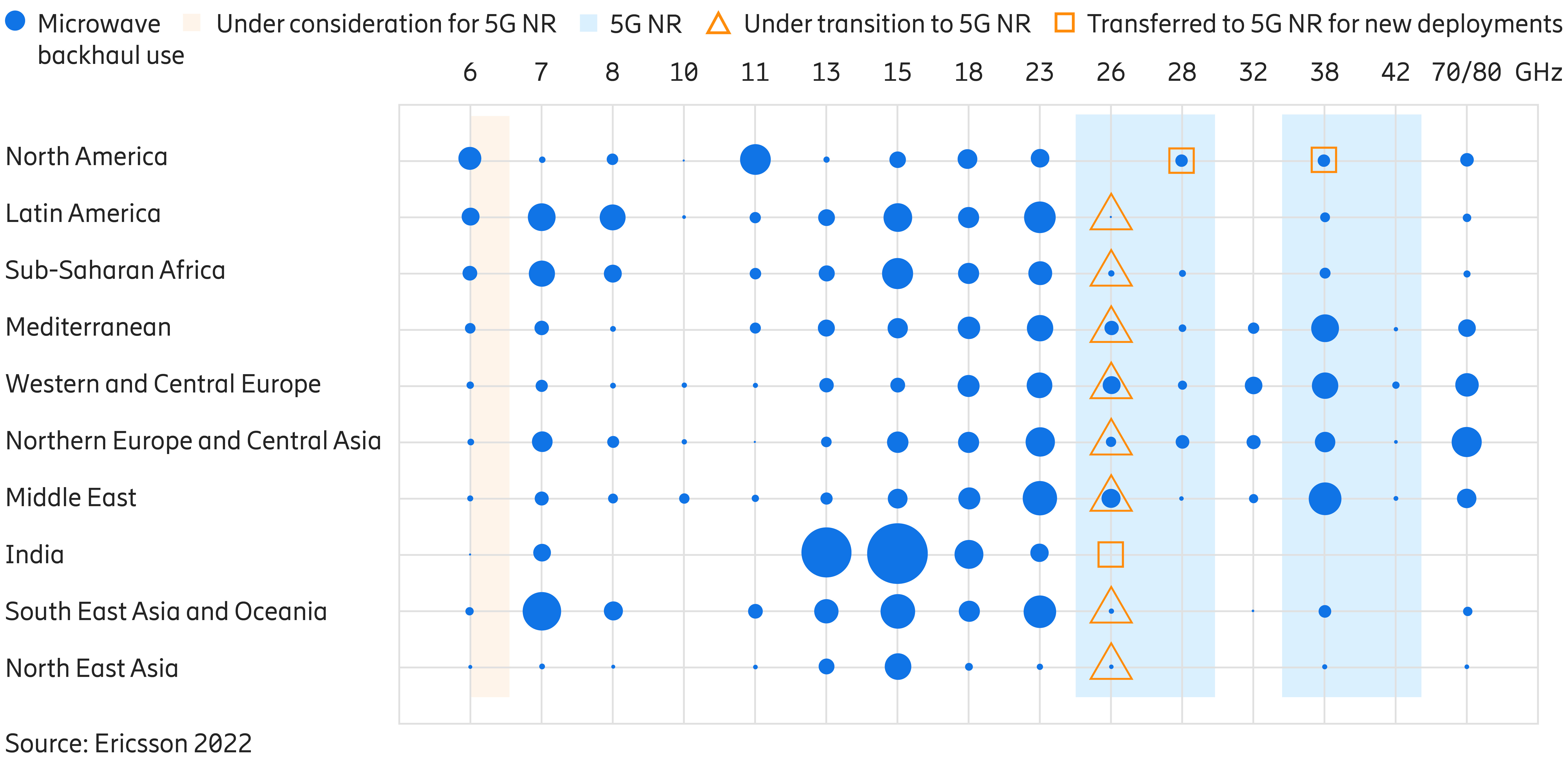
Figure 3: Global and regional view on used microwave spectrum including 5G impact on backhaul spectrum
Some countries have allocated 5,925–6,425 MHz (lower 6 GHz) for licensed exempt use, e.g. Wi-Fi, NR-U (NR in unlicensed spectrum), and very few have expanded this allocation up to 7,125 MHz, like the US. The FCC has tried to introduce regulations to allow co-existence with fixed-service transport. However, we are still in the early days of understanding the real impact on fixed service. It remains to be seen what impacts license exemption will have on 6 GHz fixed service over time and if issues arise, how they will be solved as unlicensed spectrum is not controlled. Deployment of unlicensed services in fixed service bands, which are designed for interference-free environment and are sensitive due to its short traffic burst, should be avoided. Sharing with another licensed service, such as 5G NR, is more feasible, requiring coordination where needed at a national level.
New deployments per frequency range
Focusing on new deployments in the different frequency ranges, Figure 4 shows actual and predicted shares from 2015 to 2027. The following high-level trends can be seen:
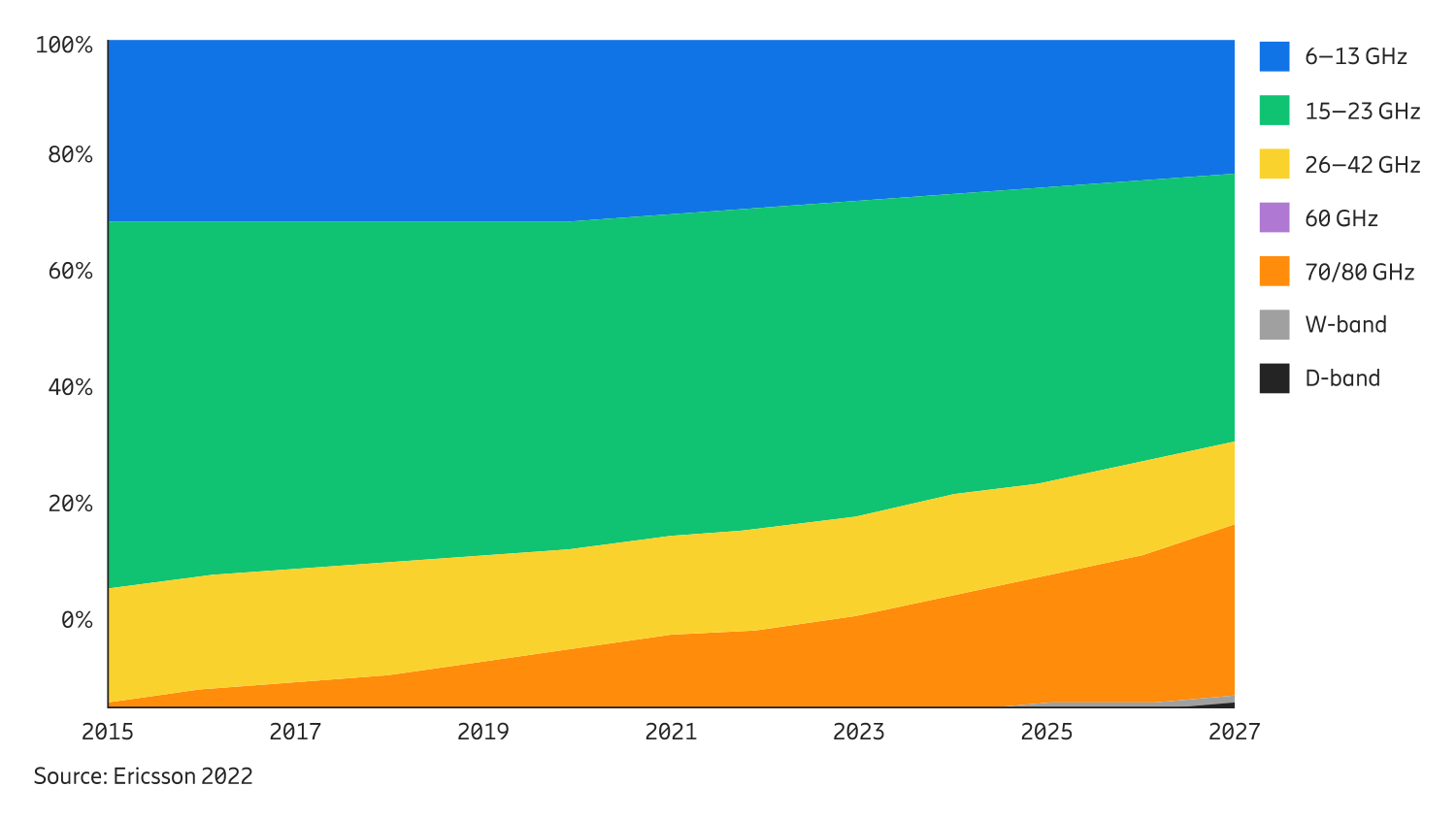
Figure 4: New deployment share per frequency range
In 2027 E-band (70/80 GHz) will account for 25 percent of new deployments, both as SA and in multi-band solutions.
E-band
The most significant change in the microwave spectrum the last 10–15 years has been the introduction of the E-band (70/80 GHz). This is a band that allows very wide channels and multi-Gbps capacity in a single radio, enabling 5G NR capacities in microwave backhaul.
Five years ago, the E-band was already well established in multiple markets. However, the E-band share of the global market was still low and the number of markets deploying E-band in high volumes were limited. Based on the assumption that India, the world’s largest microwave market, would soon open up the E-band, we predicted in 2017 that the deployment share of E-band would be 20 percent by 2025.
Today, we are slightly behind that prediction by one or two years due to delays in E-band introduction in India. But now, the Indian 5G NR spectrum auction has taken place, and authorities acknowledge that sufficient backhaul spectrum is needed to enable the 5G NR roll-out and they are therefore also allotting E-band carriers to service providers.
With this significant movement in India, as well as uptake in multiple other countries around the globe, we therefore estimate that the previous prediction of a global new deployment share of 20 percent by 2025 is still within reach and that it will continue to grow to 25 percent by 2027. This 25 percent will be a combination of links using E-band as standalone and E-band in multi-band configurations.

V-band
A band that was predicted to grow was the V-band (60 GHz), especially in small cell backhaul applications. The predictions were quite modest but did not materialize due to small cells not taking off, a scattered spectrum availability, and the preference for licensed spectrum for backhaul applications. The V-band will now instead be used by unlicensed services, both indoor and outdoor, as short-range devices with WiGig technology.
Traditional bands
Within the traditional bands (6–42 GHz), there has been some movement between bands. 6 GHz is still going strong in the low end of the spectrum, but some shift of volumes towards 7 and 8 GHz is expected when unlicensed services (such as Wi-Fi or NR-U) start densifying. Countries with rural usage of 6 GHz are expected to coordinate with licensed 5G NR.
At the high end of the spectrum there is some movement away from bands that have been allocated to 5G NR, like 26, 28, 38 and 42 GHz in favor of the 32 GHz band. Going forward, this will depend greatly upon 5G NR high-band uptake and availability of other bands, such as 32 GHz. This is market specific, and each country has its own prerequisites. For example, the 26 and 38 GHz bands are well-established high-volume bands in Europe and the Middle East, so in those markets it will be a very long-term transition from fixed services usage to 5G NR.
W- and D-band
The frequency bands between 92–175 GHz (W- and D-band) offer 5 times as much spectrum as the E-band. This makes them key spectrum resources for the evolution of 5G NR and 6G wireless backhaul, but they are also in consideration for future 6G access, a solution that accommodates the needs of both services and ensures an equally powerful access and backhaul development is to be considered. The W-band alone (92–114 GHz) offers close to twice the amount of spectrum available in the E-band. In late 2020, in one of the first field trials with pre-commercial W-band radios, it was shown that the W-band will offer similar performance to the E-band in terms of both hop length, availability and transport capacity. To benefit from the existing ecosystem, W-band radios will support similar channel bandwidths, modulations, antennas, and output powers as the E-band. The radio chain in both E- and W-band radios will be based on gallium-arsenide (GaAs) technology, a proven and well-known technology for wireless backhaul radios.
However, in the short term it is not expected that GaAs will cover the full D-band (130–174.5 GHz) with sufficient performance. D-band radios will therefore be based on silicon-germanium (SiGe) technology. As a consequence, D-band radios will not be able to reach similar system gains to E- and W-band radios. Nevertheless, broad channel andwidths and a high carrier frequency enable radios with high-gain antennas and a small form factor which will be of mportance for connecting future small cell radio networks in urban environments.
Maturity of the different bands
The traditional bands (6–42 GHz) remain the backbone for wireless backhaul.
The E-band (70/80 GHz) has made a remarkable journey and can now be considered to have entered the maturity stage, (see Figure 5). This does not mean that no further advancements will be made. It is rather that it is now a stable, high-volume mass market, with product refinements and a good component ecosystem.
There have been first-generation products on the market for a long time for the V-band (60 GHz), but the market and volumes have never taken off. The V-band has been caught in the classic product introduction chasm, as previously described, and is not expected to continue the journey up the maturity curve (for fixed services).
Over the last five years we have seen a rapid maturation beyond 100 GHz radio technology, and today there is standardization, plans and pre-commercial point-to-point radios available for trials in the W-band. Both W-band and D-band are untapped high-capacity spectrum resources that today have interests from multiple industries. Therefore a solution that accommodates the needs of both 6G access and fixed service backhaul needs is required. Commercial volumes in these bands are not expected until around 2025 and beyond depending on spectrum band.
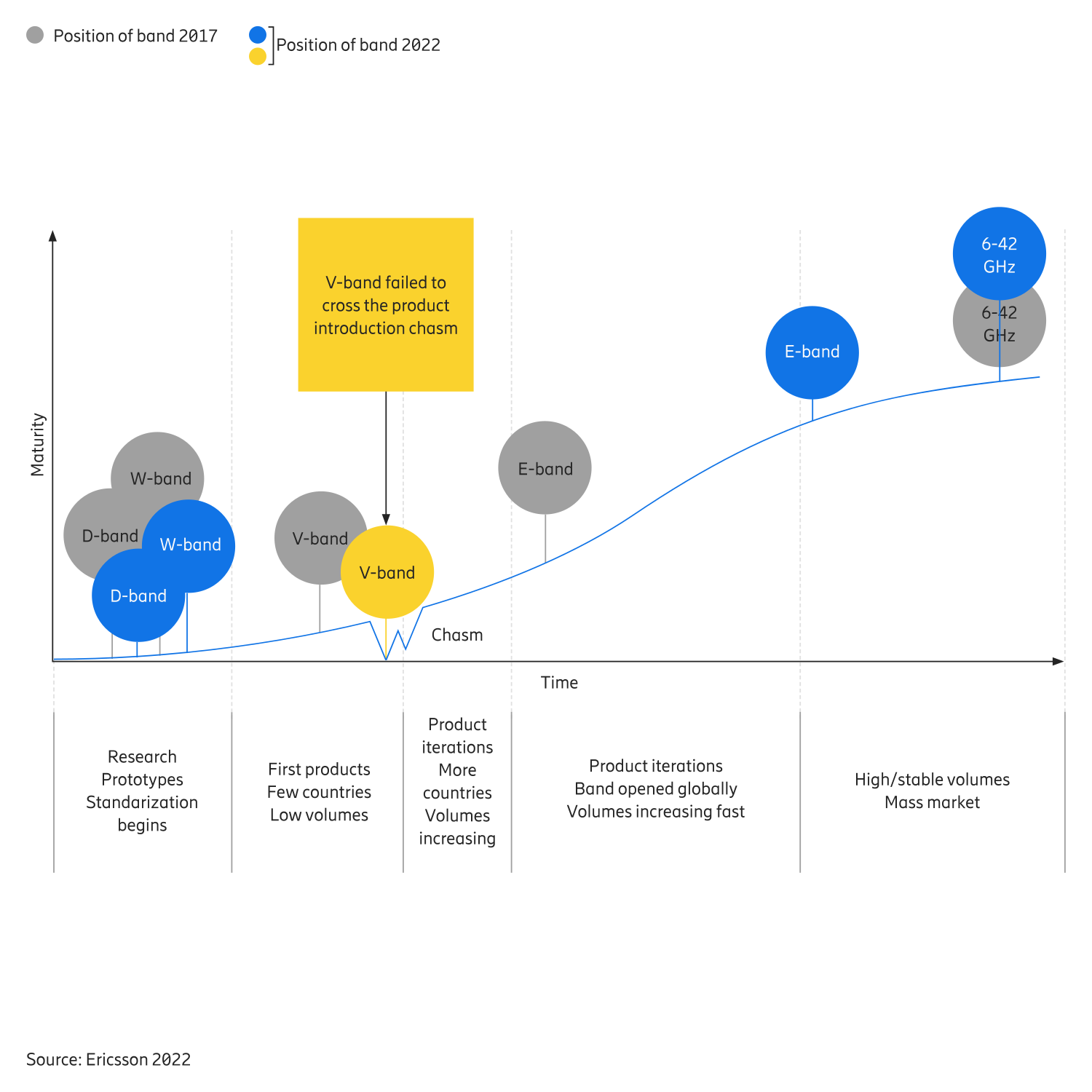
Figure 5: Time and steps to reach maturity in a new frequency band
Major technology steps take around 10 years from start to early maturity.