









Microwave backhaul: perfect fit for fixed wireless access
More than 70 percent of all service providers are now offering fixed wireless access (FWA), and microwave can contribute to the continued FWA growth.
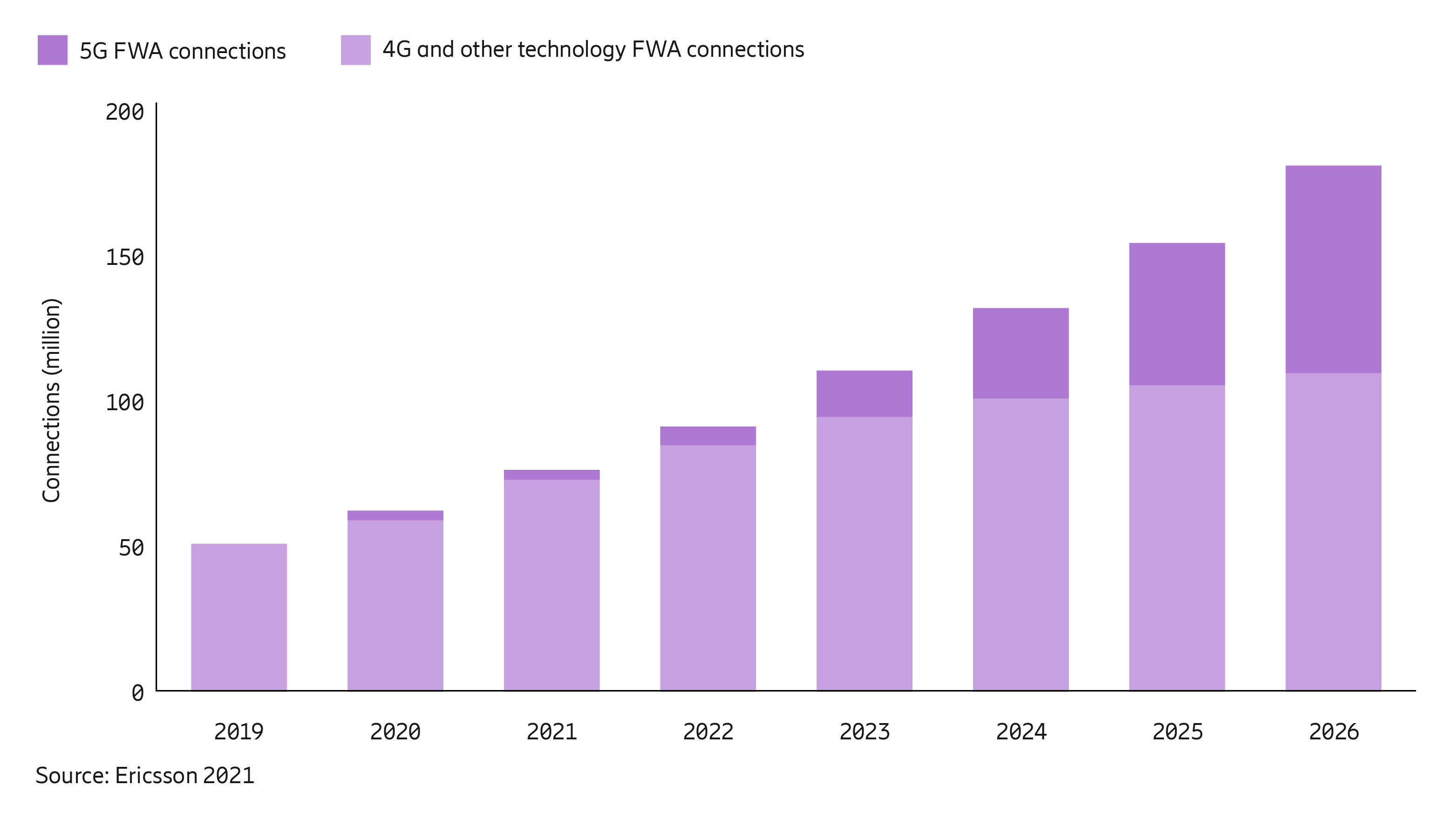
Figure 13: The growing number of FWA connections
COVID-19 is accelerating digitalization and demand for fast, reliable home broadband connectivity. FWA is the quickest alternative for service providers to meet this demand. By the end of 2026, FWA connections are forecasted to exceed 180 million – around 25 percent of the global total mobile network data traffic. 5G FWA connections are expected to grow to over 70 million by 2026, representing about 40 percent of total FWA connections*.
Service providers already have most of the network components needed to offer an FWA service. Adding FWA capability merely involves increasing coverage in a well-defined, geographically selective way and adding access and backhaul capacity, as well as customer premises equipment (CPE), all while observing the FWA traffic model and its differences from mobile broadband when dimensioning the network. Once connections and usage have increased, there might be a need to scale, add network capabilities and densify network grids.
*Ericsson Mobility Report (June 2021)
How can microwave assist with a successful FWA deployment?
FWA networks will need to support different types of services with defined QoS KPIs. Fast time to market (TTM) and low total cost of ownership (TCO) are also important. This implies that the transport network also needs to support these requirements (see Figure 14). Microwave technology has several ways to cater to capacity needs, and with advanced QoS mechanisms, can even support network slicing. Online gaming is an FWA service that requires a lower latency. Microwave is just that – a low-latency solution. To have low TCO, it is important to reuse existing network assets, including transport, whether it is fiber or microwave backhaul.
When expanding FWA to a new site where dark fiber is unavailable, or fiber is too costly or slow to deploy, microwave backhaul with E-band or Multi-band offers fast and cost-effective roll-outs with high capacity. Microwave can also be used as a temporary solution while waiting for fiber. The main factors determining the capacity of the last-mile transport for FWA are the maximum cell peak rate and average cell throughput rate during busy hours. Compared with mobile broadband deployments, the calculation of those rates must be adjusted to accommodate the targeted number of FWA connections, and the data rate offered to subscribers under the given radio conditions. In general, the average cell throughput for FWA deployments will be much higher than with mobile broadband-only deployments, and more predictable since the location and number of households is fixed.
The evening is the FWA busy hour; there could be several 4K video streams per connection, each requiring high capacity. Microwave transport offers a scalable and future-proof solution on new or existing sites, with up to 10Gbps with E-band or Multi-band solutions.
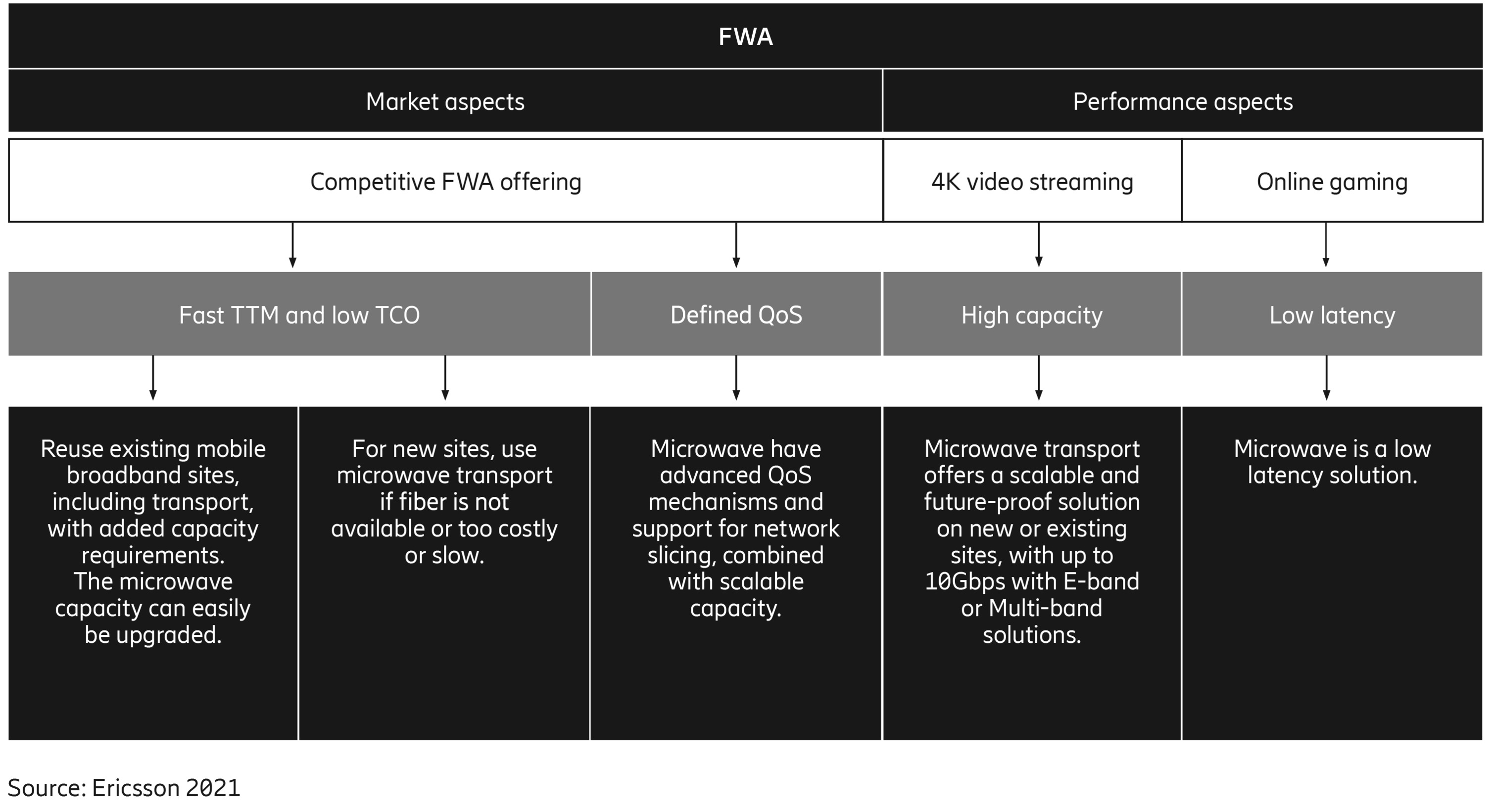
Figure 14: Microwave supports FWA requirements
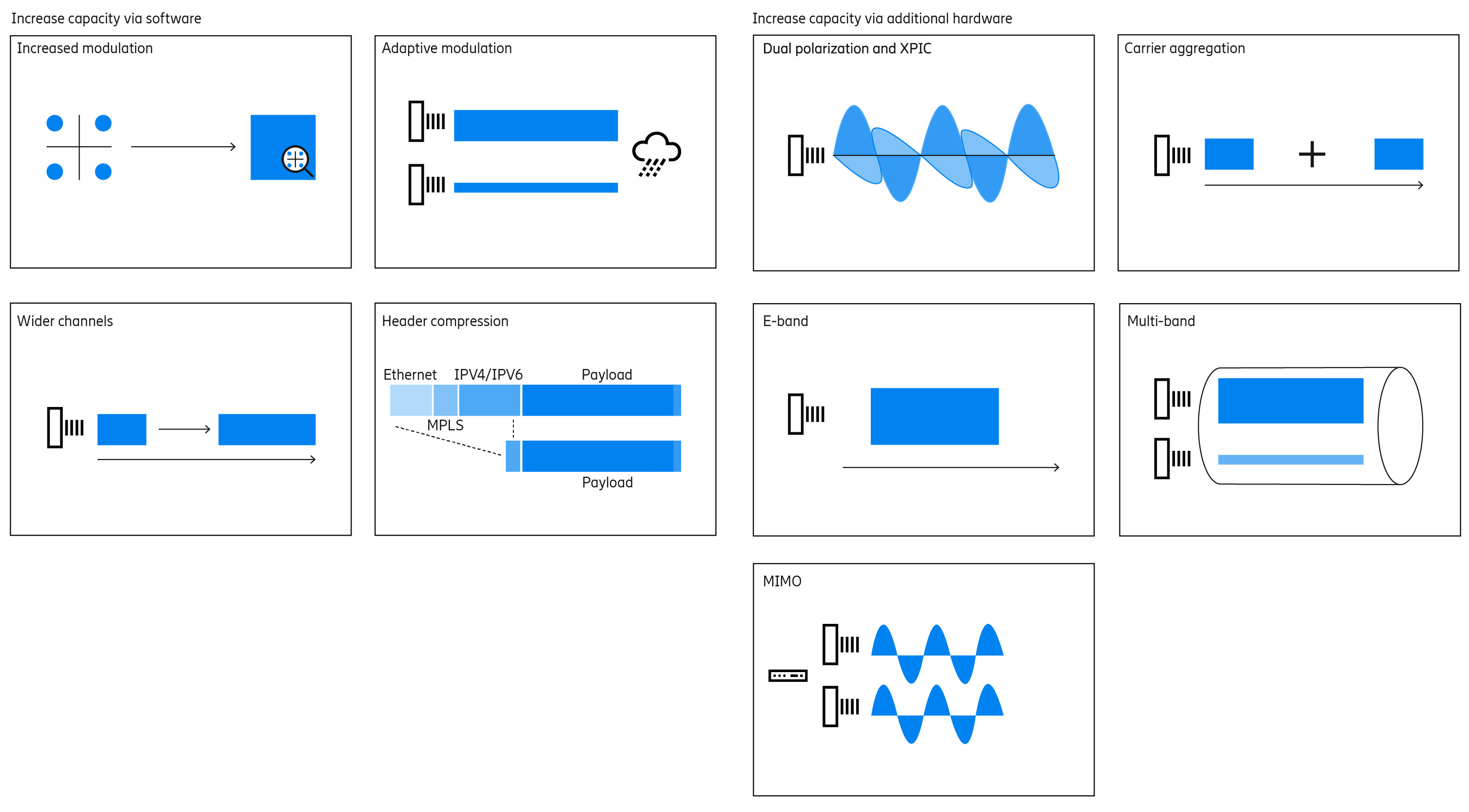
For existing sites with microwave backhaul, the capacity can easily be increased via software, increasing the modulation, using adaptive modulation, wider channels, carrier aggregation (if the hardware supports it) and header compression. It is also possible to add additional hardware to increase capacity, like using dual polarization with XPIC, carrier aggregation, MIMO, or connecting an E-band radio to the existing traditional microwave radio in a Multi-band setup. These are easy, cost-effective ways to add the capacity needed for FWA.
Case study: European suburb
This example suburb has relatively mature LTE/New Radio (NR) mobile broadband, decent fixed broadband offerings (mostly ADSL), but no general fiber infrastructure deployed in the targeted areas.
We assume a population density of 2,500 people per km2, with an average of 2.5 people per household, and that there is an LTE/NR site present that can be expanded to support FWA.
The service provider uses the following as a basis for dimensioning the system with defined QoS offerings:
- The network should be able to connect at least 30 percent of households, with a first-year target of 15 percent.
- The households’ TV needs are assumed to be served by FWA, via an IPTV bundle.
- For video streaming, households should experience a minimum data rate of 30Mbps during busy hours. This corresponds to two 4K HDTV video streams, or multiple SDTV and HDTV streams. This is the guaranteed QoS for the 5 percent worst-served households in busy hours. The downlink data rate for a specific household depends on location – 95 percent will have higher or much higher data rates, up to 430Mbps in this scenario.
FWA connections are forecast to represent 25 percent of the global mobile data traffic by 2026.
For these FWA connections to the LTE/NR site, there are capacity requirements for both RAN and transport. For RAN, there will likely be additional radio units and basebands. For more information on ways to handle both the RAN and transport requirements, there are several examples in Ericsson’s Fixed Wireless Access Handbook, including this European suburb example. We will primarily focus on the transport aspect in this article.
Dimensioning the last-mile transport system is based on the maximum of the cell peak rate and average cell throughput rate during busy hours. Our example, with a minimum data rate of 30Mbps for the 5 percent worst-served households, results in a busy hour throughput rate of 330Mbps per site, with 15 percent of households connected. The cell peak rate of this same example is 430Mbps, resulting in transport capacity requirements of 430Mbps.
The existing mobile broadband capacity also needs to be considered, but the capacity required in the example is easily within the capacity range of microwave. When increasing FWA coverage to 30 percent of the households over 5 years, while the busy hour consumption increases by 2.1 times, the last-mile transport capacity increases to 1.4Gbps. This is still easily handled by a single traditional microwave link.
To summarize, FWA connections are forecast to represent 25 percent of the global mobile data traffic by 2026. Service providers have a great opportunity to utilize their existing mobile broadband network and start offering FWA in select areas. By reusing as much equipment as possible, a competitive FWA service can be offered with short TTM and low TCO. Transport is crucial to the successful FWA service, and microwave backhaul offers a scalable, future-proof solution for new or existing sites, with up to 10Gbps with E-band or Multi-band solutions.