



Skip navigation
""

Uplink traffic growth expected in the coming decade

AI, cloud and mobile set to drive significant growth in uplink traffic

Available in English 日本語 繁體中文

The accelerated development and convergence of AI, cloud and mobile will fundamentally shift future traffic patterns, driving significant growth in uplink demands on mobile networks in the coming decade.

Key insights

As AI, cloud and mobile converge, devices constantly send data to the cloud for real-time learning and personalization; this continuous feedback loop sharply increases uplink traffic.

AR/AI glasses use large AI models in the cloud, while autonomous vehicles (AVs)/droids transmit large datasets for training and remote functions, making them major uplink traffic drivers.  

To begin preparing for the increase in uplink, relevant 5G standalone (SA) networking features are becoming available.  

As intelligent devices increasingly rely on cloud-based processing, data is flowing in the uplink more than ever before. Yet, this shift is more complex than a simple surge in uplink demand. While AI-driven systems like AVs and AR glasses continuously send data to the cloud, advances in on-device intelligence, compression and smart data transport are reshaping how and when that data moves. The result is a more dynamic balance, where networks must support both the growing appetite for real-time cloud and the efficiencies that keep bandwidth use sustainable. Understanding this interplay is key to preparing for the next wave of connected intelligence.

Convergence of AI, cloud and mobile

The convergence of AI, cloud computing and mobile technologies represents one of the most transformative shifts in the digital era. Together, they create a powerful ecosystem where intelligence, scalability and accessibility reinforce each other: cloud platforms provide the computational infrastructure and storage capacity needed to deploy and train advanced AI models; mobile devices serve as both a data feed and the end-user interface to deliver these AI-powered cloud services, enabling personalized and context-aware experiences in real time; and networks provide ubiquitous and dependable connectivity between cloud and devices.

AI models hosted on the cloud can process massive datasets and deliver insights instantly to mobile users, whether they are powering smart assistants, enabling real-time language translation, or optimizing logistics and healthcare operations. Mobile devices therefore act not only as endpoints, but as data generators, feeding continuous streams of contextual information (such as location, behavior and sensor data) back to the cloud which, in turn, improves AI models through feedback loops.

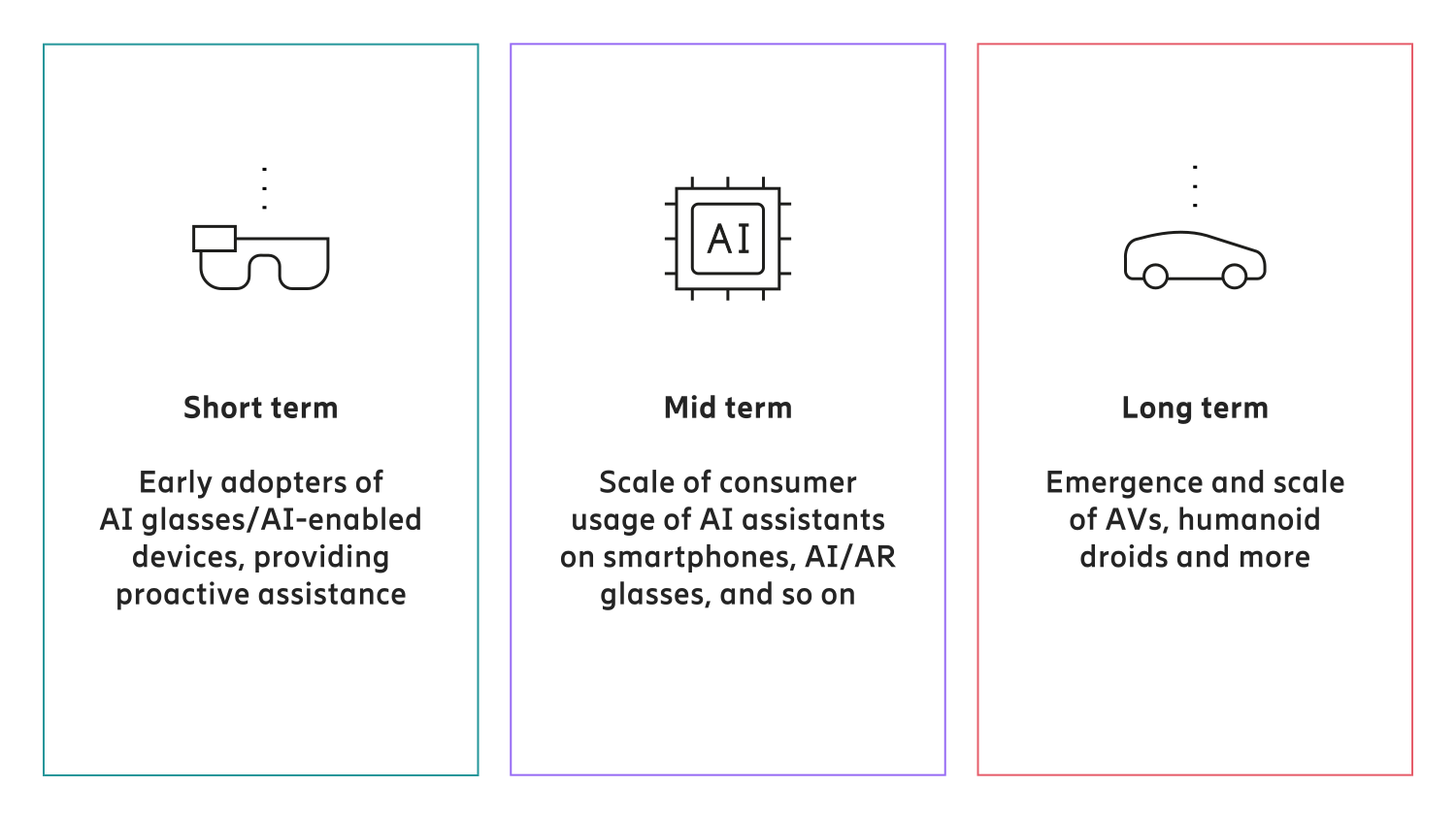
Figure 23: Future drivers of uplink traffic
Future drivers of uplink traffic
Infographic showing future drivers of uplink traffic: in the short term, this will be “Early adopters of AI glasses/AI-enabled devices, providing proactive assistance”; in the mid term, this will be “Scale of consumer usage of AI assistants on smartphones, AI/AR glasses and so on”; and long term, this will be “Emergence and scale of autonomous vehicles, humanoid droids and more.”

The future drivers of uplink traffic

As the convergence mentioned earlier happens, data rates increase further as a result. This will be particularly notable in the uplink.

In the enterprise and industry sectors, for instance, 5G-native laptops, AI-enabled Internet of Things (IoT) devices, AVs, humanoid droids and drones will require significant uplink capacity. AVs and droids will transmit a lot of data to the cloud, as they collect a lot of training data, require data to be stored for legal reasons and sometimes require remote interventions. In the consumer space, personalized agents will be used on smartphones and emerging devices like AI and AR glasses, or similar companion devices. Some will be activated on demand, while other agents will be on all the time.

As a result, the uplink traffic will increase significantly over the coming years and, indeed, is becoming telecom’s new “currency.” Short term, this will be driven by the early adoption of AI glasses; mid term, by the adoption of AI assistants over AI/AR glasses at scale; and long term, by the large-scale deployment of AVs and possibly humanoid droids.

To effectively handle such an increase in uplink traffic, advancements such as carrier aggregation (CA) and Massive Multiple-Input Multiple-Output (M-MIMO) – available in 5G SA – enable more flexible and efficient use of spectrum across both frequency division duplex (FDD) and time division duplex (TDD) bands.

For example, uplink traffic can be anchored on a low-band FDD carrier to maximize coverage and enhanced with FDD M-MIMO to boost capacity. Meanwhile, downlink capacity can be boosted through aggregation between FDD and a mid-band TDD carrier, leveraging TDD M-MIMO for higher throughput and improved overall performance.

Uplink requirements of current AI glasses

To date, approximately 2 million smart glasses from leading manufacturers have been sold in the US – amounting to approximately 1 percent market penetration – with ambitions to sell millions per year going forward. The success driving these sales is in connecting the user to an AI agent that delivers sentient engagements based on video and audio input from the glasses.

Going forward, some models will use AI capabilities right on the glasses and/or tethered devices; however, advanced AI capabilities will need to run in the cloud and – when inference time of the models is low – the uplink network characteristics become critical.

A recently announced smart glasses model has an advertised video capture resolution of 1,440 x 1,920 pixels. Multimodal AI on-demand engagements typically require framerates in the order of 5–10 frames per second (FPS) while being used. Always-on agents, on the other hand, are likely to use lower and perhaps dynamic framerates, such as 1 frame every 5–10 seconds. The on-demand agent can make use of video codecs with a compression ratio of about 0.1 bits per pixel (bpp). At the given resolution and a frame rate of 5 FPS, this yields about 1.4 Mbps in the uplink. It is further assumed that for users of these AI agents, about 20 percent are “power users” at 100 min/day, with the remaining 80 percent being “ordinary users” at 10 min/day. This yields an average of 28 min/day.

The always-on agent will need to use image compression, at about 0.5 bpp; at the given resolution and a frame rate of about 0.1 FPS, this yields about 0.14 Mbps. It is then assumed that the agent is on for about 8h/day.

The resulting increase in the uplink percentage with regards to today’s global average baseline of about 2 GB per month is shown in Figure 24. Per user, the always-on agent consumes a slightly higher uplink than the on-demand agent under these assumptions. For a given device penetration, given the value on the x-axis in Figure 24, some users may adopt an always-on agent whilst others prefer on-demand. The future demand will therefore be between these two curves. This potential growth of uplink traffic underlines the importance of network capacity planning, spectrum allocation and RAN feature developments.

Figure 24: Uplink traffic increase with regards to today’s uplink baseline versus AI/AR glasses penetration

Future demand will be somewhere between the lines for on-demand AI-agents and always-on AI-agents

Next steps

Ericsson Mobility Calculator

Explore the relationship between the usage of various app types and monthly traffic per subscription with our interactive Mobility Calculator tool.

Explore the calculator

Ericsson Mobility Visualizer

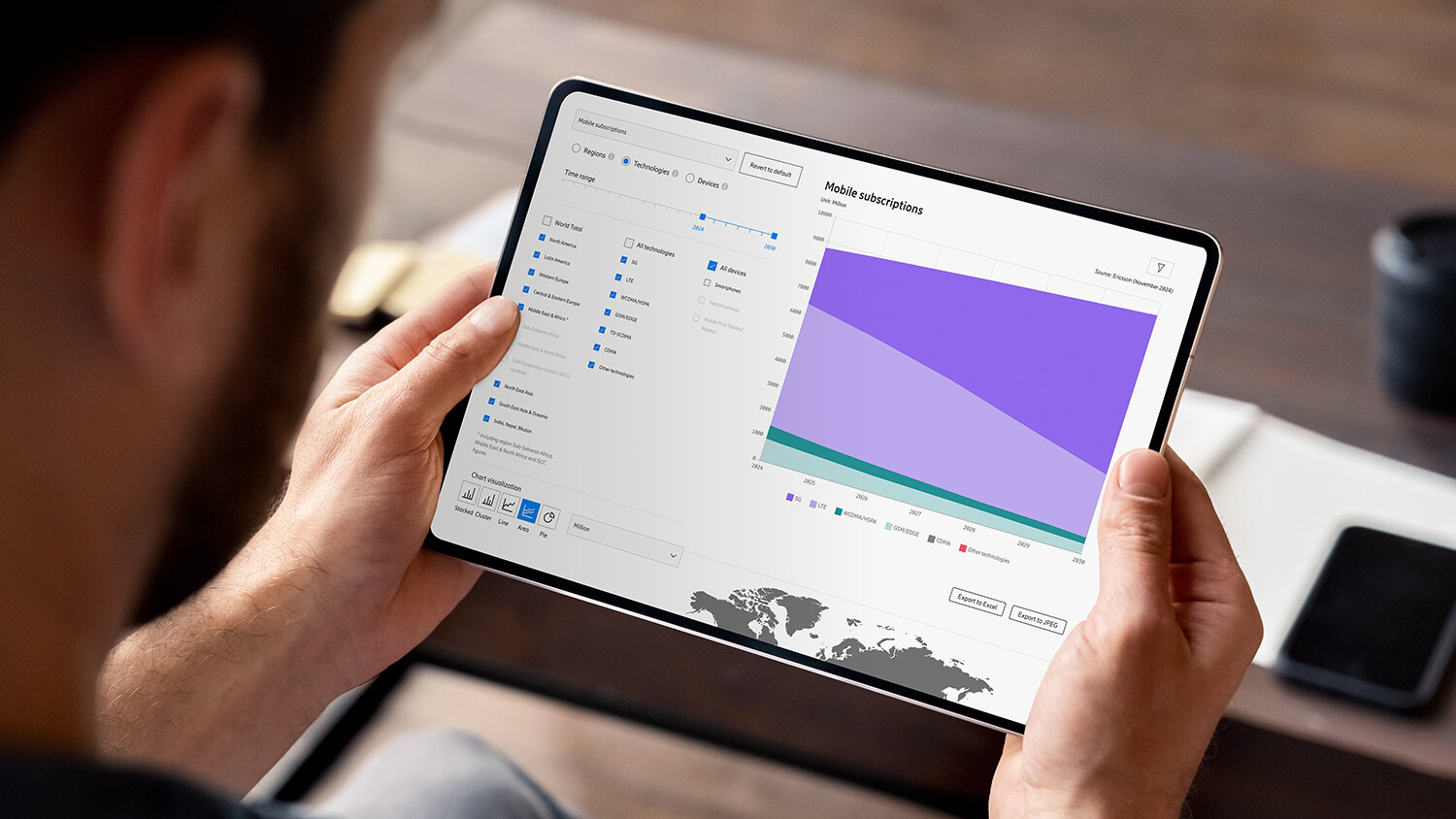
With our Mobility Visualizer tool, you can examine the forecast data that underpins the Ericsson Mobility Report in our interactive web application.

Discover the data

Articles

Discover the Ericsson Mobility Report articles where we discuss trends, case studies, service provider opportunities, and the past, present and future of connectivity.

Discover the articles

Ericsson Mobility Report

Our forecasts are based on past and current data, validated with extensive network measurements. Discover the latest figures for 5G, IoT, fixed wireless access and more.

Explore now
Subscribe to receive Ericsson Mobility Report updates

Get the latest Ericsson Mobility Reports and quarterly updates – the moment they are published!

The face of mobile communications is changing faster than ever. Stay up to speed with projections and analyses of the latest trends in the mobile industry, including subscriptions, mobile data traffic and population coverage.

Subscribe now to get the full reports and quarterly updates sent directly to your inbox.

Subscribe now