When SoftBank deployed multiple network slices in a real-world trial at the 2026 Formula 1 Japanese Grand Prix, the main focus was on enhancing user experience while enabling multiple use cases to be delivered simultaneously, each with connectivity optimized for its specific requirements.
Key insights
To deliver differentiated service quality while maintaining a seamless connectivity experience for general attendees, SoftBank’s approach at Suzuka Circuit was based on a simple principle: First, build sufficient network headroom, then, apply intelligent control.
Continuous granular monitoring and closed-loop automation proved essential for maintaining service quality under changing traffic conditions.
The results highlighted the ability to shift mobile connectivity – from maximizing speed and capacity – toward delivering connectivity optimized for the requirements of each service and user group.
At the 2026 Formula 1 Japanese Grand Prix at Suzuka Circuit, SoftBank ran a real-world trial that deployed five network slices over a shared 5G standalone (SA) infrastructure, with multiple use cases running simultaneously. To support this, SoftBank increased the network capacity, resulting in improved spectral efficiency through Massive Multiple-Input Multiple-Output (MIMO) and the addition of millimeter-wave capacity. Combined with software-based controls, including network slicing and per-minute optimization via closed-loop automation, this allowed quality to be managed at a granular level. Together, these measures confirmed that quality for specific use cases can be maintained while preserving a seamless connectivity experience for general attendees.

This article was written in collaboration with SoftBank Corp. (SoftBank), a leading communications and technology company operating one of Japan’s most advanced 5G networks.
The connectivity challenge
This spring, more than 315,000 people passed through the Suzuka Circuit’s gates over three days. They streamed videos, posted to social media, and tapped their phones to pay for food and merchandise – all at once. Behind the scenes, broadcast crews were also transmitting high-resolution footage, while operations staff coordinated logistics across the venue.
In this kind of scenario, different types of communication, each with different quality requirements, are competing for the same radio spectrum in the same physical space. Speed alone isn’t the answer. The real challenge is figuring out how to deliver the right quality for each type of service and how to maintain that quality when the network gets congested.
There is also a tension at the heart of this challenge: Allocating resources for high-value use cases risks degrading the experience for ordinary attendees. Serving both groups well requires more than just slicing the traffic. It means first building enough overall capacity, then applying control. SoftBank used this year’s Suzuka Circuit event to put that approach to the test.
What was tested
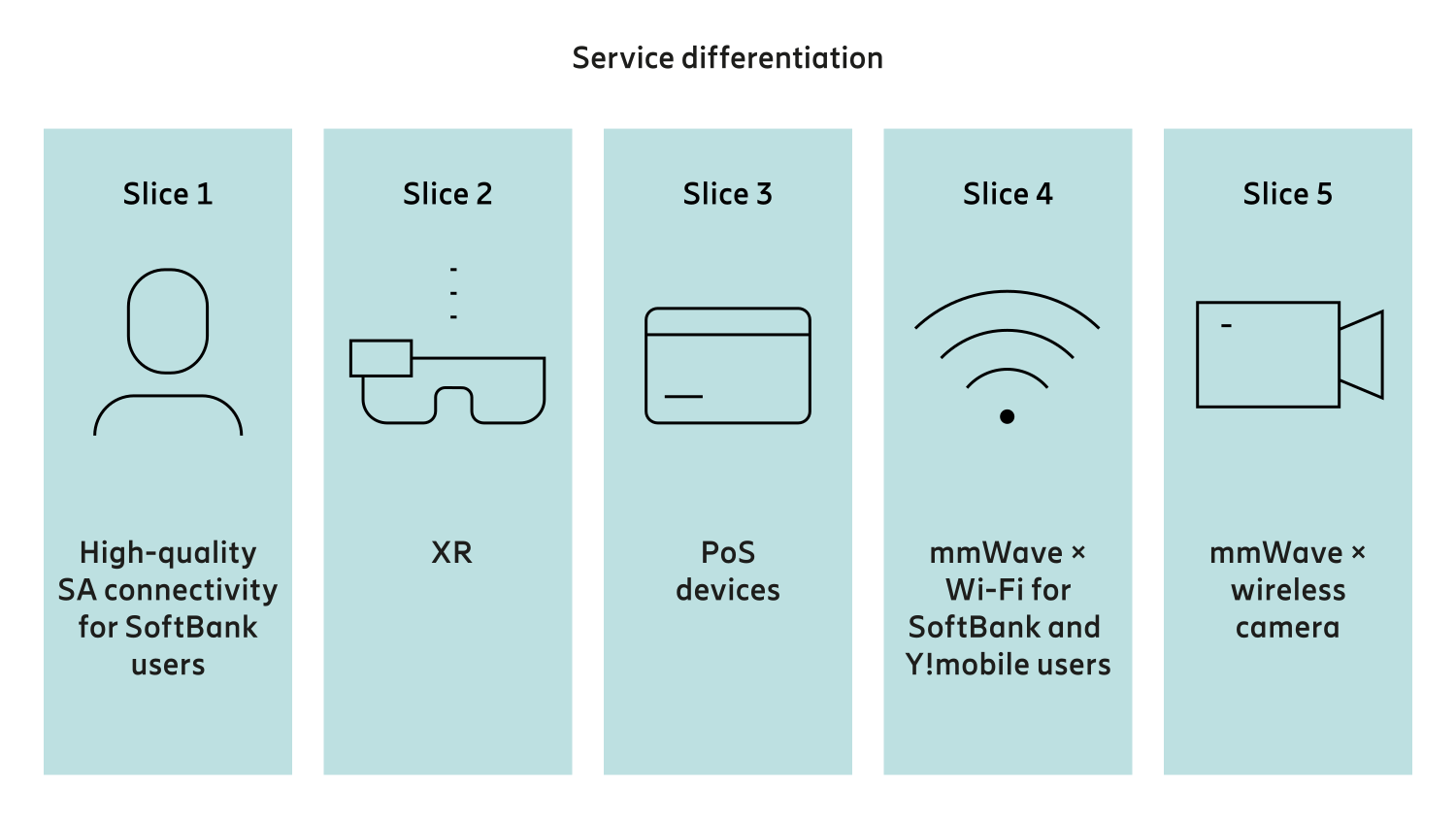
SoftBank implemented a 5G SA-based network slicing trial, constructing five logical networks, or slices, on a shared physical infrastructure while running multiple use cases in parallel, each assigned different quality parameters.
The slice architecture was built on a foundation of increased network capacity. High-capacity Massive MIMO deployment more than doubled the number of cells, significantly improving both downlink and uplink capacity through higher-order antenna configurations and multi-band operations. In addition, the early adoption of the latest features – such as throughput control, low-latency optimization, and millimeter-wave coordination – further enhanced performance and capacity. The underlying design philosophy was straightforward: First, raise the floor for everyone, then apply intelligent control. The intention of building headroom into the network before carving out slices was to maintain a seamless experience for general users, even when differentiated quality control was applied to certain portions of traffic.
Figure 17: SoftBank’s differentiated connectivity service offerings
What the validation revealed
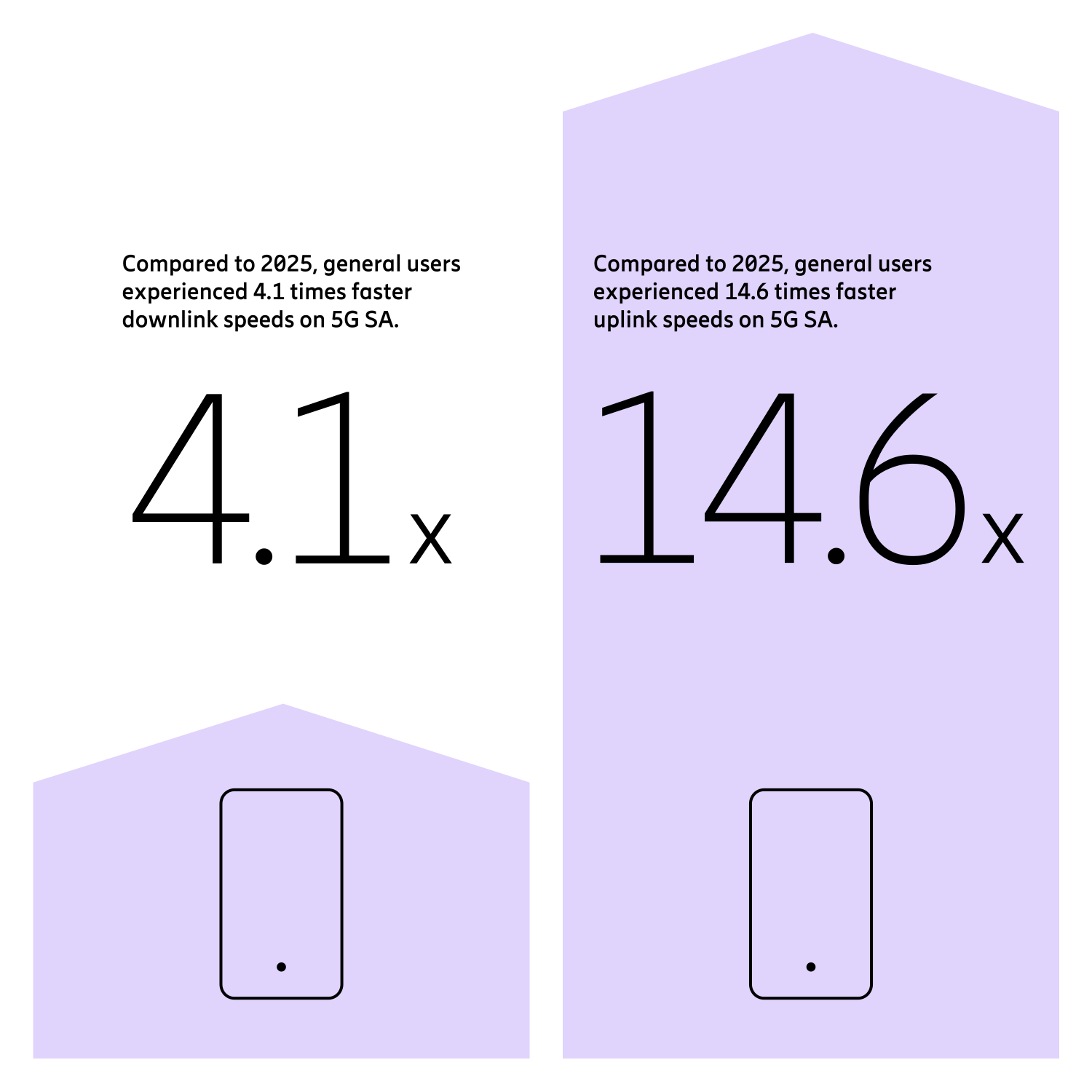
Importantly, and aligned with the design philosophy, was the validation that premium services and general connectivity services can coexist. The combination of Massive MIMO-driven capacity expansion with network slicing made it possible to ensure quality for specific use cases without affecting general attendees’ connectivity. In fact, in this scenario there were clear improvements compared with the same event in 2025. For general attendees, based on average performance over the weekend, 5G SA customers experienced a performance uplift of 4 times in the downlink and more than 14 times in the uplink, while for non-standalone (NSA) customers this was around 1.5 times and 6 times respectively.
Beyond the general users, the specific performance requirements of the multiple slices running in parallel were all fulfilled with the needed connectivity. For payment slices, what matters is not speed, but responsiveness. For QR code payments and point-of-sale (PoS) terminals, high throughput is not a strict requirement. What these services need is a connectivity experience that is immediate and uninterrupted even under congestion. From a network perspective, that means low latency and stable sessions, rather than raw bandwidth. During the validation, terminals assigned to the payment slice maintained stable connectivity even as the congestion in the surrounding environment grew. Throughout the event, even during periods of congestion, there were no reports of service unavailability. This confirmed in a live event setting what is theoretically well understood: Different use cases, that call for different definitions of what “good connectivity” actually means, can be delivered.
For broadcast, millimeter-wave delivers the capacity needed in the uplink. Transmitting broadcast-quality footage from a live venue has very different requirements from, for example, a fan uploading a short clip. Continuous delivery of high-resolution, low-compression video demands wide, stable bandwidth in the uplink. The trial confirmed that millimeter-wave spectrum is well-suited to this role, and it was used for the live broadcasting of four programs. Beyond the measured performance itself, the setup also demonstrated practical operational value for live production teams, reinforcing confidence in wireless broadcasting workflows during the event.
Figure 18: Relative performance improvements in 2026 for general attendees on 5G SA compared to 2025
The need for granular monitoring of SLAs
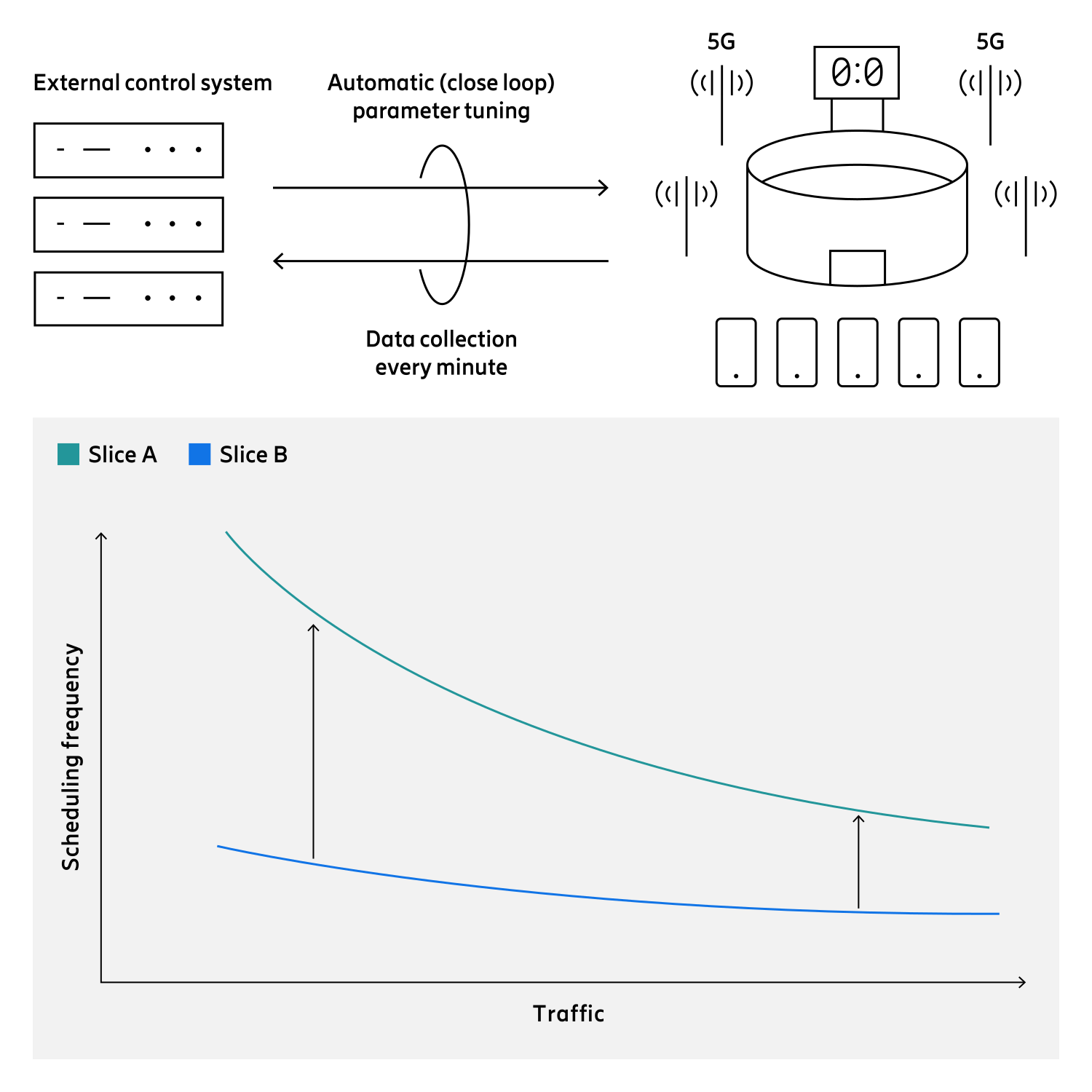
A less obvious but important finding had to do with the granularity of monitoring. In traditional operations, KPIs are typically collected at 15-minute intervals. But traffic at an event venue shifts quickly, driven by crowd movement, purchase surges, and broadcast schedules. At 15-minute granularity, a temporary SLA breach on a given slice could go undetected until it has already had an impact. In some cases, by the time an automated optimization would have triggered, the moment and the event itself will have already passed. During this validation, per-minute observability was established, providing greater visibility into each slice’s status and enabling high-speed automated adjustment of radio parameters in response. The conclusion was that per-slice SLA management only becomes operationally meaningful once monitoring granularity is fine enough to keep pace with actual network behavior. Introducing slicing without updating how the network is monitored leaves a practical ceiling on how precisely quality can actually be maintained.
Figure 19 illustrates how intent-based service differentiation is used on network slices to ensure SLA fulfilment. In this example, flexible control is applied across Slice A and Slice B, each with different SLA requirements during different traffic conditions (normal and high traffic). Slice A has a more demanding SLA than Slice B. Under normal traffic conditions, Slice A has more scheduling frequency than Slice B, and more bandwidth. As traffic increases due to congestion during the event, the external control system optimizes the network automatically to fulfil the SLA for high-traffic conditions. As a result, the more demanding SLA for Slice A can be fulfilled, while still delivering on the SLA for Slice B.
Figure 19: Intent-based service differentiation
Applying the learnings to commercial operations
“Not having to think about connectivity” is increasingly what attendees at large events simply expect. This validation showed, in concrete terms, what it takes to deliver that experience. Serving attendees seeking a premium experience alongside those who simply expect reliable connectivity requires not only expanded physical capacity, but also intelligent control technologies – neither alone is sufficient. That’s one of the key lessons from the Suzuka Circuit trial. More broadly, connectivity design at large-scale events is not only a matter of engineering, but also of determining what kind of experience should be delivered, to whom, and under what operational structure. In that sense, this work goes beyond a purely technical evaluation and provides insights into future network design and operational approaches for large-scale events.
Beyond speed: Toward quality-based connectivity
For many years, mobile network evolution was primarily discussed in terms of higher speeds and greater capacity. However, as networks become increasingly tied to business outcomes and user experiences, service quality optimization is becoming just as important as raw throughput. The Suzuka Circuit validation demonstrated that different services can require fundamentally different definitions of “good connectivity.” In some cases, the requirement is extremely high uplink throughput, while in others it is low latency, stable sessions, or predictable responsiveness under congestion.
From this perspective, network slicing is not simply about traffic separation. It represents a shift toward intent-driven connectivity, where network behavior can be adapted according to the specific requirements of each service or user group. While many of these capabilities have been discussed since the early stages of 5G, large-scale real-world validation has remained limited. The Suzuka Circuit trial provided an opportunity to validate multiple technologies together under live operational conditions, rather than as isolated technical functions.
SoftBank will continue applying these insights across broader real-world environments as it evolves its network to deliver differentiated connectivity experiences and create new service value.