Uplink is becoming the new bottleneck in mobile networks, driven by AI-powered and user-generated content. As traffic patterns shift, networks designed for downlink dominance must evolve to support a more uplink-intensive future.
Key Insights
AI-driven applications – spanning smartphones, AI/AR smartglasses and autonomous vehicles – are inherently uplink heavy, generating continuous data streams that challenge traditional downlink-dominated traffic patterns.
Uplink traffic growth is already outpacing downlink for many service providers, with field measurements indicating capacity constraints under peak load. Scenario modeling suggests that additional AI traffic will result in uplink traffic being three times higher in 2031 compared to 2025.
Current networks are not dimensioned for sustained uplink demand, calling for a step change in design – from 5G software and hardware enhancements in the near term to 6G-native uplink innovations over the longer horizon.
AI is rapidly enabling new use cases and accelerating the design of new applications and devices. This enables hyper-personalization that increases app engagement and gives rise to an entirely new class of fully autonomous, agentic AI systems. As the adoption of new use cases increases, network performance requirements rise significantly. While these services will increase both downlink and uplink traffic, the impact is particularly pronounced on the uplink, reshaping network performance and design priorities.
Uplink traffic on the rise
Mobile networks have historically been designed and dimensioned for downlink dominated traffic, driven mainly by consumption of content such as video streaming and web browsing. Analysis of mobile network traffic growth across 55 service providers globally in 2025,[1] comparing downlink and uplink growth rates at network level, shows a clear and consistent pattern – uplink traffic is growing faster than downlink for most service providers and, in many cases, significantly faster:
- 43 out of 55 service providers experienced a higher uplink growth rate than downlink
- 17 out of 55 service providers experienced a more than 1.5 times higher uplink growth rate than downlink
While downlink traffic still dominates in terms of absolute volume, shifts in traffic patterns are becoming evident, with increasing uplink traffic. Naturally, uptake of new devices and applications that drive uplink traffic occurs at different speeds across markets. In areas with fast adoption and heavy usage, uplink capacity will be strained sooner, requiring urgent measures to meet the increased demand.
Near term: AI-native smartphones and changes in user behavior drive uplink growth
In the near term, large-scale uplink traffic growth is driven primarily by smartphone applications,[2] as evolving smartphone user behavior contributes to an increase in uplink demand. As hundreds of millions of 4G devices are replaced by 5G smartphones each year, the base of high-resolution devices (1080p and higher) continues to grow.
Because a typical smartphone HD (720–1080p) video call generates about 1–3 Mbps per uplink stream, each upgrade effectively raises the potential uplink load, leading to a steady increase in overall uplink traffic.
User-generated content – especially short-form clips and live streaming from smartphones – together with smartphone-to-cloud storage is also driving increased uplink usage. In addition, digital-native demographics continue to grow, with more people spending additional time on their smartphones, amplifying these uplink effects when averaged across the global population.
Mid term: AI/AR smartglasses and agentic AI systems drive additional uplink growth
The AI and AR smartglasses market is still in an early phase, but it is growing rapidly. Global shipments reached around 10 million units in 2025, and multiple analyst firms project strong double-digit growth over the coming years. Services used with these types of devices can put high requirements on the network uplink performance. Depending on the specific use case, uplink throughput can range from 1 Mbps to 10 Mbps. As camera feed, audio and sensor data are continuously streamed to cloud AI for real-time processing, the download-to-upload ratio is typically 1:8 (heavily uplink-dominated). However, because AI/AR smartglasses are power constrained, device original equipment manufacturers (OEMs) often employ an aggressive duty-cycling schedule to extend operating time, which increases the instantaneous uplink requirement even further.
Long term: Autonomous vehicles, AI agents and drones will drive future uplink growth
A single 5G network can support a wide range of autonomous vehicle use cases, from (near) real-time training data collection and autonomous driving telemetry to remote assistance, future vehicle-to-everything (V2X) safety messaging and vehicle-as-a-sensor use cases:
- Autonomous driving telemetry: The telemetry requires intermittent 1–10 Mbps uplink, running almost continuously during operation but without hard real-time latency requirements, while safety-critical functions remain local in the vehicle. Today’s telemetry consists mainly of data such as basic kinematics and position data, operational status data, and surrounding environment data and perception metadata.
- Remote assistance: Live video uplink of several Mbps with less than 100 ms latency and extremely high reliability, but used for less than 1 percent of the operational time.
- V2X and vehicle-as-a-sensor: Vehicles in the future will be able to form a distributed set of sensors, which will be used for many purposes, such as providing safety messaging and spatial data collection. This will drive much higher uplink and downlink capacity and reliability requirements.
For commercial drones, the network requirements are already demanding, as autonomous flight typically requires around 100 kbps of resilient, low-latency downlink throughput for command-and-control, while telemetry and live HD video streaming during flight can generate several Mbps of uplink traffic per camera. Similar patterns appear in other enterprise use cases, including AI/AR-assisted field services, 5G-native laptops and a growing number of intelligent devices.
Each autonomous or AI-enabled unit effectively becomes an uplink-intensive endpoint. As AI systems strive to understand and interact with the physical world, the network itself turns into a critical data source. Positioning, timing and radio-based sensing information can be used to infer rich environmental context – from spatial geometry and object motion to situational dynamics. This further reinforces the need for robust, high-performing uplink connectivity.
Autonomous systems may evolve into an entirely new use-case class. Autonomous software AI agents are typically almost always on, continuously streaming information about their physical surroundings in the uplink. This can enable new types of services, such as continuous “recording of my life,” real-time physical security perimeters, or spatial advertisement opportunities. Data rates vary by application, from a few hundred kbps to several Mbps, but importantly, this creates an always-on uplink background load that current networks are not dimensioned for.
Autonomous droids can also be considered part of the agentic use-case category, as they execute tasks and manipulate the physical environment in a similar way to software agents in the digital domain. The droids’ spatial intelligence, together with other tasks requiring compute offload, is expected to generate uplink traffic of several Mbps, while downlink traffic for control commands is often below 1 Mbps.
Figure 20: AI traffic impact on uplink growth
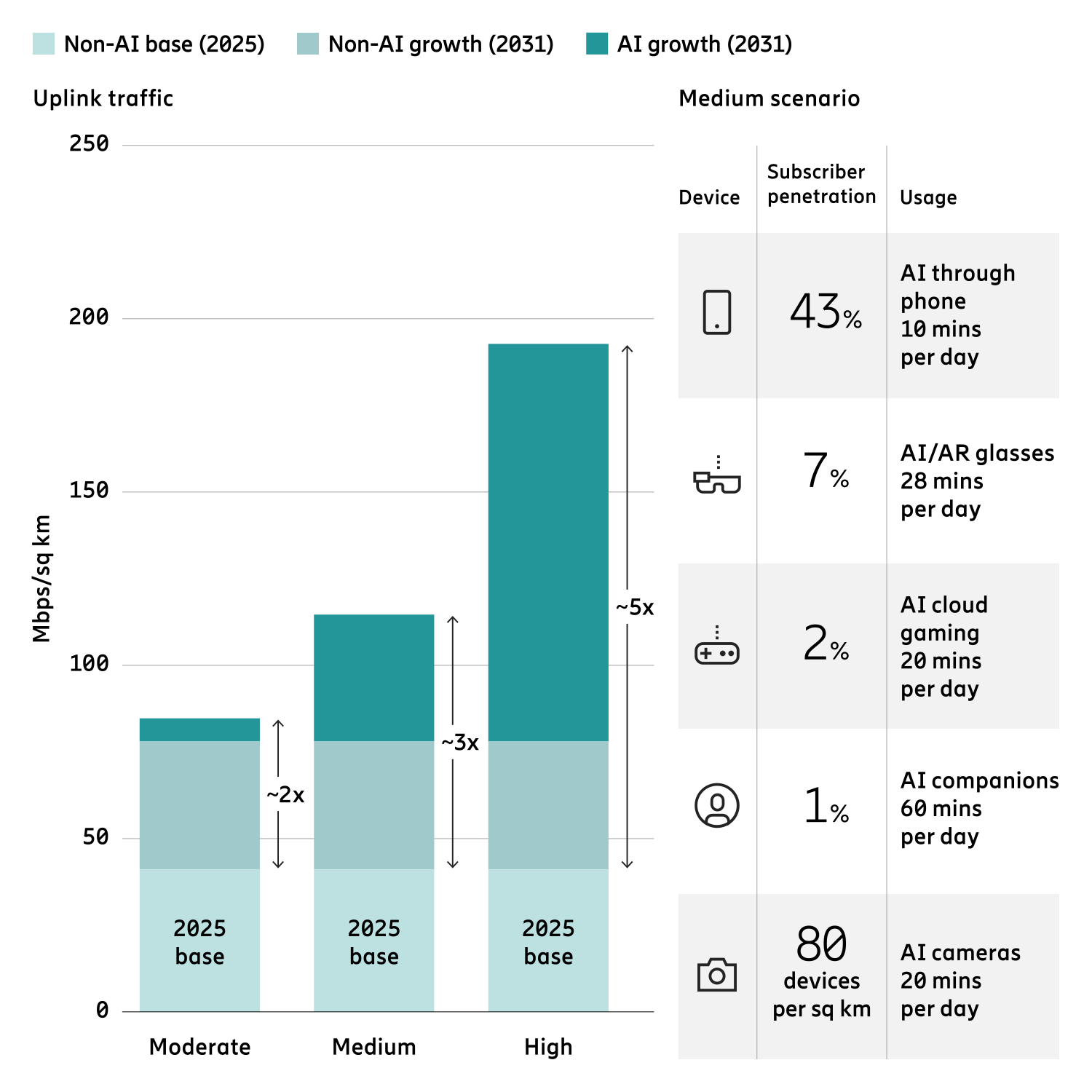
Note: % here refers to AI device subscriber penetration among the population in an urban area, with a subscriber density of 1,155 subscribers per sq km.
Scenario modeling: AI traffic impact on uplink growth
Our current forecast projects that global mobile data traffic will approximately double between 2025 and 2031. To assess the potential impact of new AI-related traffic on uplink growth in a geographical area, three scenarios were simulated with different assumptions on AI-device penetration and application usage, based on a typical urban subscriber density of 1,155 subscribers per sq km. These scenarios consider a mix of emerging AI-enabled devices, including AI/AR smartglasses, AI cloud gaming, AI companions and AI-enabled connected cameras for different use cases. The analysis shows that increasing adoption of AI-driven applications can significantly change traffic composition and accelerate uplink growth in mobile networks.
The three scenarios analyzed were:
- Moderate: AI usage is limited and primarily smartphone-based, with low penetration of AI/AR smartglasses, so the additional AI traffic remains small compared with the expected baseline growth.
- Medium: AI usage through smartphones has reached substantial penetration, AI/AR smartglasses are gaining notable traction, and AI cloud gaming and AI companion usage have begun. The additional AI traffic results in uplink traffic being 3 times higher in 2031 than in 2025.
- High: AI usage is pervasive across smartphones, AI/AR smartglasses have significant penetration, and AI cloud gaming and AI companion usage show strong uptake. The additional AI traffic results in uplink traffic being five times higher in 2031 than in 2025.
Depending on the pace of AI application adoption, uplink traffic could increase significantly compared with the 2025 baseline. This growth is expected to be driven not only by consumer usage, but also by industrial applications. In the medium adoption scenario, the analysis assumes that 43 percent of subscribers use an AI assistant on smartphones, 7 percent use the same application on smartglasses, 2 percent engage in AI-assisted cloud gaming, and 1 percent interact with AI companions. In addition, the scenario assumes 80 AI-assisted connected industrial devices per sq km, including AI-enhanced security cameras, autonomous vehicles and other similar devices.
AI-driven use cases are inherently more uplink-intensive, driven by real-time interaction, video capture and continuous data generation. To secure a good user experience, the analysis assumes an average uplink throughput requirement of 1.5 Mbps across the applications, with a corresponding downlink throughput requirement of 0.5 Mbps. The actual requirements for delivering an ideal user experience are likely to be considerably higher for many demanding use cases.
While uplink traffic is expected to grow faster than downlink traffic, mobile networks are still expected to remain downlink-dominated. In the high uplink traffic growth scenario, AI-supported applications account for 20 percent of the total traffic increase, whereas in the medium uplink traffic growth scenario they are expected to account for 8 percent.
Uplink performance is not scaling with new services
The expected increase in uplink traffic over the coming years will have a profound impact on network dimensioning, deployment and operations. Networks are typically dimensioned for the fifth-percentile outage users, that is, the minimum performance needed to ensure an adequate or better experience for 95 percent of users. This is captured in the relationship between uplink traffic per area (Mbps/sq km) and the fifth-percentile per-user throughput (Mbps).
Figure 21: Uplink capacity lags expected traffic growth
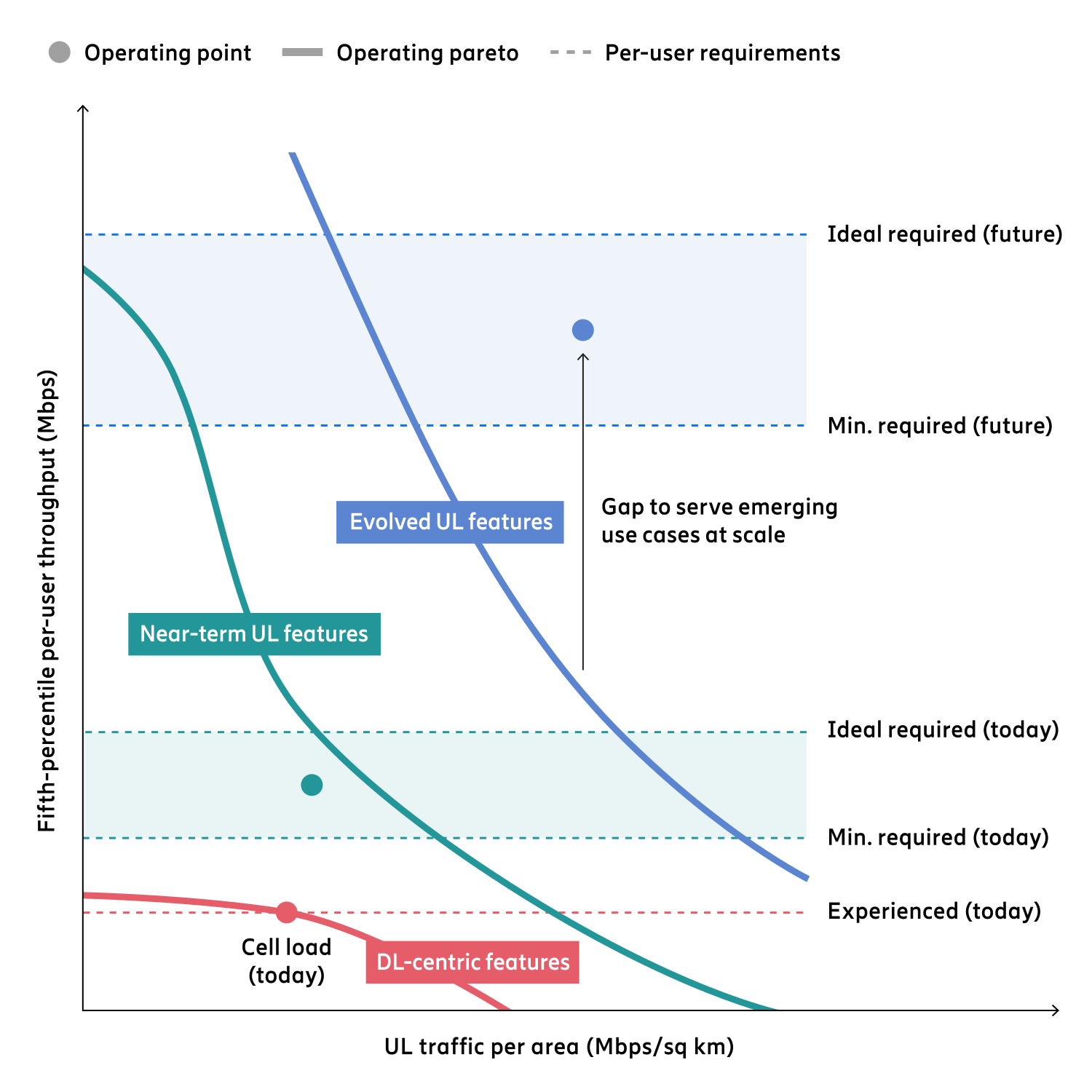
The red operating point (see Figure 21) reflects today’s reality for many service providers around the world. At current uplink traffic loads, users at the cell edge experience very low uplink throughput, showing that the minimum required uplink performance is constrained by both coverage and capacity. Already available near-term uplink-enhancing features, for example, 5G standalone (SA) and uplink optimized primary cell (PCell) selection, can move performance toward the green curve (where networks ideally should be today), but a significant gap remains when future demand is considered.
Even with uplink improvements, such as advanced multi-antenna techniques (FDD MU-MIMO), coordinated uplink transmission between sites, (inter-site UL CoMP) and wider low-band spectrum, today’s (and near-term) network configurations will still not meet minimum – or ideal – per-user uplink throughput targets at scale in the future. This is represented by the blue operating curve in Figure 21 and the gap to serve emerging use cases at scale. Overall, the figure highlights a structural imbalance, demonstrating that uplink capacity is not keeping pace with expected traffic growth and service requirements. Without substantial increases in uplink capabilities and more efficient resource utilization, service providers will struggle to deliver a consistent user experience for new emerging use cases.
Evolving the network for future demands
The rise of AI-native, sensor-rich and immersive applications is pushing mobile networks beyond their roots as content-delivery platforms into intelligent networks. However, networks optimized for downlink-centric streaming are poorly aligned with devices that continuously upload sensor, video and telemetry data for cloud and edge processing. This shift places uplink, rather than downlink, as a key bottleneck that must be addressed in future network evolution.[3]
Service providers can start evolving by maximizing existing network assets through software-driven uplink enhancements, extracting immediate gains in both capacity and coverage without requiring major hardware changes.
The next step is targeted radio evolution to structurally improve uplink link budgets and capacity. Deploying advanced frequency division duplex (FDD) radios with higher receive diversity (for example, 8RX), adding new FDD bands, and leveraging Massive MIMO and advanced antenna systems can materially boost uplink coverage and throughput. These upgrades are particularly important in mid- and low-band spectrum, where uplink performance is most constrained, significantly boosting overall network capacity. In parallel, service providers can prioritize solutions that explicitly enhance uplink gain, ensuring that radio investments are aligned with the emerging asymmetry in traffic demand.
Beyond radio upgrades, service providers can increase network density and spectrum availability to sustain long-term growth. Adding macro and indoor sites, refarming existing spectrum, and introducing new bands will be critical to scale uplink capacity per area unit.
Embedded AI is also becoming indispensable in the RAN, as telco-grade AI models outperform the highly optimized traditional algorithms. There are clear gains in terms of spectrum efficiency and network capacity, in both uplink and downlink. Embedding AI-driven software is already providing clear benefits for service providers in terms of performance while providing a foundation for AI-native systems.
Looking further ahead, 6G capabilities, such as uplink/downlink decoupling and contention-based uplink access, will enable more flexible and efficient resource utilization, allowing networks to dynamically adapt to uplink-heavy traffic patterns and support next-generation, real-time applications at scale.
New monetization models for uplink-centric connectivity
Network evolution must be accompanied by new monetization models. Differentiated connectivity enables clearly defined performance tiers for uplink-intensive services, each associated with its own service-level agreement (SLA) and price point. Rather than relying on best-effort uplink capacity, these models make reliability and predictability monetizable attributes.
Premium differentiated services are designed and priced to ensure sustainable delivery of assured outcomes. This includes provisioning capacity where needed and applying prioritization selectively, particularly in contention-driven scenarios where performance can be meaningfully improved. By focusing on situations where network intelligence can add real value, differentiated connectivity delivers confidence and fairness across the service experience for all users.
With 5G SA and network APIs, applications and automated systems can request and be billed for differentiated uplink performance in real time. This supports event-based premiums for guaranteed uplink performance during peak demand, continuous assured tiers for services requiring consistent performance, and API-driven usage models embedded directly into applications. Together, these approaches establish uplink connectivity as a distinct, outcome-based value proposition and provide a scalable foundation for monetizing uplink-centric and AI-driven services.