











Citizen's Broadband Radio Service (CBRS)
The Citizen's Broadband Radio Service (CBRS) offers a 150 MHz slice of the 3.5 GHz band in the U.S. for deploying private 5G/LTE networks. It complements Wi-Fi, fulfilling enterprise needs for broader coverage, reliable connectivity, and advanced traffic segmentation.
Evolution of CBRS OnGo spectrum
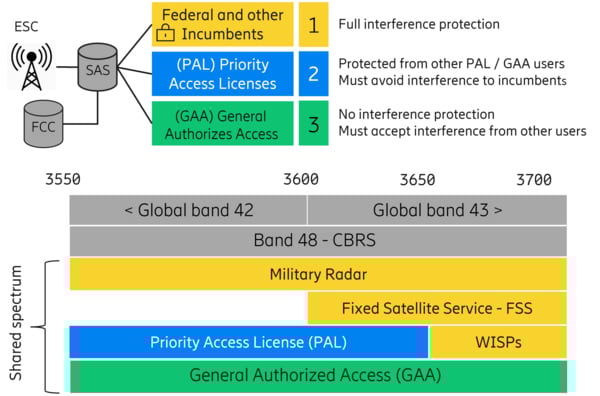
Prior to 2019 the CBRS band was used exclusively by Federal incumbents for military radar and fixe satellite services. In 2019 the US government opened the CBRS band for shared access. The band provides 150MHz of prime spectrum for commercial communications innovation.
The band consists of three tiers with the federal incumbents at the top, followed by priority access licensees (PAL), and at the bottom Generally authorized access (GAA) users. PAL and GAA users must yield to the incumbents and PAL users are provided interference protection from the GAA users.
To enable spectrum sharing and protection of incumbents and PAL holders, the band is managed by a spectrum access system known as a (SAS). The SAS is connected to the environment sensing capability (ESC) networks along the coasts as well as Portal dynamic protection areas (P-DPA) inland so commercial operations must yield to incumbent activities as needed. Ericsson does regular interoperability testing with the leading SAS providers.
The band has undergone tremendous growth in the past four years. As of October 2023, according to the SAS providers, there are 374,000 CBRS base station devices (CBSDs) and 300,000 customer premise equipment (CPEs) deployed. As of October, there have also been 245 CBSDs and 669 UEs certified with the FCC.
Why CBRS?
The Citizen's Broadband Radio Service (CBRS) spectrum in the United States is revolutionizing wireless connectivity by offering enterprises access to mid-band spectrum for 3GPP compliant networks. Unlike Wi-Fi, CBRS delivers superior coverage, capacity, and security, meeting the rising demand for 5G services in enterprises. It also allows major CSPs to bolster their networks, enhancing capacity and performance for customers. Additionally, CBRS enables neutral host operators to serve the unconnected areas and allows for the innovative combination of private and neutral networks. This fusion creates a robust communication ecosystem, propelling enterprises and CSPs into a new realm of connectivity possibilities.