









5G and a world without traffic jams

Head of Sales Readiness Connected Vehicles
Head of Sales Readiness Connected Vehicles
Head of Sales Readiness Connected Vehicles
I know that, in my own day to day, few things are more irritating than being stuck in traffic, moving at a snail’s pace while staring at the motionless rear of the car in front of me. Of course, I’m not alone in this experience. In 2019, drivers around the world lost on average an additional 1 hour and 27 minutes in traffic on top of their normal commute times, with the typical US driver losing 99 hours in total for the year. In the UK, that number was 115 hours. And those numbers don’t seem to be going down. In fact, as populations around the world continue to grow, traffic jams and congested roadways are only increasing. But despite the rising number of drivers everywhere, the end of the infamous traffic jam may well be in sight thanks to the innovative potential of the latest mobile generation: 5G.
5G for connected cars
As the disruptive technology bringing instant network response times, enhanced connectivity speeds, and increased reliability to improve some of the most essential processes in our societies, 5G has the ability to make roadway commuting quicker, easier, and more efficient than ever before.
Connected cars running on 5G networks will be able to efficiently and instantaneously communicate with each other as well as with the environment, giving drivers notifications and warnings about what's going on around them. Using light detection and ranging (LiDAR) technology, cameras, and sensors to collect and share important road information with other vehicles (for example, braking data to warn approaching vehicles about unexpected events), they’ll be able to provide real-time updates on everything in their surroundings — from weather and road conditions to potential traffic hazards.
“We have already enabled vehicle-to-vehicle communication in most of Europe,” says Martin Kristensson, Vice President Digital Business at Volvo Cars. “We track if a Volvo car turns on its hazard lights, and then we send that information over the mobile network to the Cloud to warn all the other Volvo cars approaching that position.” This way, incoming are alerted to accidents or other conditions ahead, allowing them time to take appropriate action, such as choosing an alternative route.
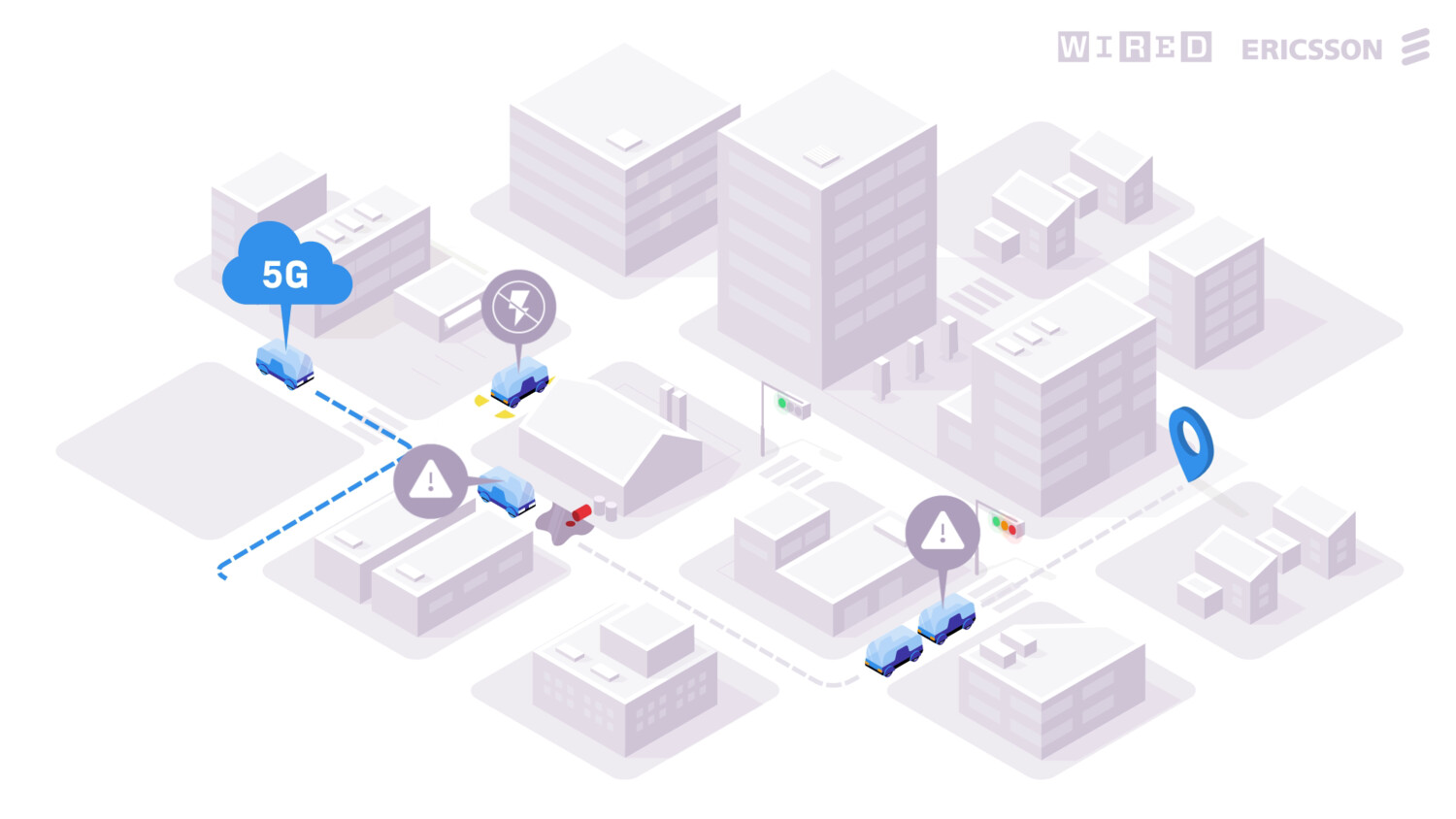
Caption: 5G will enable real-time road updates on everything from weather conditions to traffic hazards
Crucially, 5G networks will enable V2V communication even when cars are outside the line of sight, utilizing 5G sensors to complement their LiDAR and radar capabilities to detect and communicate with other vehicles. Some of these features are actually in use today, running on 3G or 4G technology; however, they’re limited to small-scale applications. “To enable this to happen at a larger scale with more vehicles and more cooperation between vehicles, you need 5G,” says Claes Herlitz, our VP and Head of Connected Vehicles here at Ericsson. “There's a multitude of reasons: energy consumption, bandwidth necessary for the amount of data transmitted, and faster network response time, for instance.”
It’s precisely this expansion of connected car capabilities that 5G will bring to change the entire driving experience, heading off many of the factors that we see contributing to traffic congestion (for example, collisions caused by unexpected road conditions or preventable accidents). With robust computing power and extensive memory capacity, 5G-connected cars will be able to transmit information and make intelligent decisions faster than humans.
Beyond ushering in the next generation of connected capabilities, 5G is also leading the automotive industry in another disruptive use case: driverless vehicles.
A driverless future
From automated public transportation to personal driverless cars, 5G will deliver the bandwidth and responsiveness needed to make self-driving vehicles a reality. Driverless buses on downtown streets will be able to communicate with each other in real time as well as with self-driving taxis, with motorcycles, and with a range of infrastructure elements (think traffic lights and management systems) — all adding up to a connectivity ecosystem operating seamlessly together. On motorways, trucks will communicate with each other to maintain set distances and speeds for linked convoys (a process known as “autonomous platooning”), reducing congestion and fuel consumption for greater roadway efficiency.
For individuals in their personal autonomous cars, driving will shift from a hands-on task to an effortless riding experience, increasing comfort and enjoyment as well as safety. In fact, we’re more than likely to see the practice of car sharing increase as a result. According to Founder and CEO of Digital Business Innovation Srl, Antonio Grasso, this can only be a good thing: "Sharing the car does not mean giving up comforts; it means sharing one's passion and commitment for a sustainable future and contributing to greater liveability of urban spaces."
We’re also likely to see more people opting for autonomous-car-as-a-service (CaaS) alternatives to their own cars as the preferred way to commute.
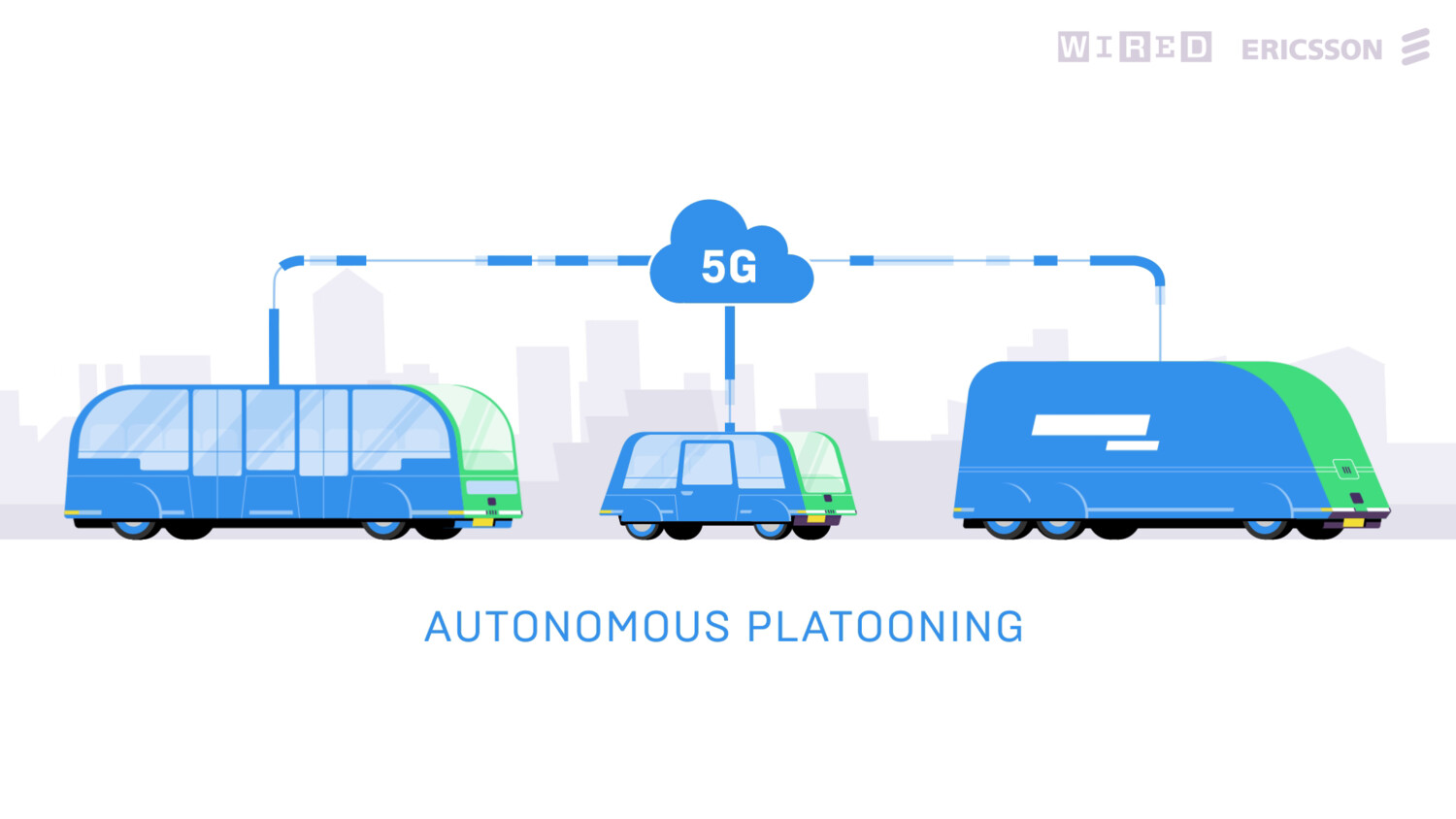
Caption: Autonomous platooning: a smoother, more efficient experience
“5G will also be important because when you're riding in an autonomous car, presumably, you want to do something else, and you might consume media,” Kristensson adds.
As to what effect all of this will have toward ending traffic jams completely, 5G will certainly aid in reducing the growing levels of congestion we see around the world today; however, even if the latest generation in mobile technology won’t completely free us from the infamous traffic jam, according to Kristensson — it might not matter. “Maybe there will still be traffic jams, but it will be a more enjoyable experience to be in that traffic jam because you're not driving yourself, and you can do video calls, work remotely, or watch a movie. Maybe you won't care that much that you're stuck in traffic anymore.”
Traffic time well spent
This actually aligns with one of the key findings from our recent Ericsson ConsumerLab report, Augmenting the daily commute. According to the study, 1 in 4 respondents said that despite having a 45-minute or longer commute per day, they would be willing to add an additional 20 minutes if they could have an improved commuting experience. Tellingly, those individuals who ranked as the most satisfied during their commutes reported spending more time engaged in digital experiences to pass the time, including using smartphones and other portable devices.
This is yet another dimension in which 5G will improve the traffic experience, offering a wider array of hands-free digital options for drivers and letting autonomous car passengers effortlessly stream their favorite movies and TV shows, play online video games, and more.
Jam or no jam — approaching a better tomorrow
Applying 5G to unlock the full potential of connected vehicle technology will bring a more safe, enjoyable, and environmentally friendly driving experience to the world. According to our Ericsson Mobility Report, the automotive sector will be among the top four industries providing 5G-enabled services by 2030. Whether this means that a world without traffic jams is well and truly on our horizon remains to be seen; however, as we’ve explored, there’s reason to believe that even if they do stick around, congested roadways won’t be the tiresome, taxing affairs they are today.
This article was originally published on Wired.co.uk
Read more
Read Paving the road for connected cars and the future of mobility.
The future of commuting? The key is in connectivity.
Here’s our blog post, The future of logistics is predictive. Here’s how.
Read more about how we work with self-driving vehicles.
Learn why connected cars need a great network.