










Seniors and technology during Covid-19: the latest insights

Senior Researcher, Consumer & IndustryLab

Senior Researcher, Consumer & IndustryLab
Senior Researcher, Consumer & IndustryLab
There have been two major consequences of the Covid-19 crisis on seniors and their use of technology. The first is that their internet usage has accelerated during the pandemic, while many of them have suffered from isolation, loneliness and being less mobile. As a result, they’ve been using their devices and the internet as helpful tools.
The second is that before the pandemic hit, seniors had gradually been closing the smartphone usage gap between them and younger generations. Since the spread of Covid-19, this has stopped. The younger generation has increased their internet usage even more. And on top of that, a new digital gap is emerging among the digital heterogenic seniors.
Together with a reliable mobile network, learning digital skills is crucial for seniors if they want to take advantage of developing tech solutions, many of which will improve seniors´ quality of life. In the long run, falling behind on internet skills might have negative effects for seniors. For example, in the area of health care, more health appointments, services and products are migrating online, as many of us have experienced during the pandemic.
In this first of two blog posts, we’ll discuss how seniors are suffering in different ways – both today and before the development of Covid-19, and how they’re currently dealing with these struggles. The second blog post will focus on seniors´ interests in different emerging tech solutions, which would further improve their quality of life. And more importantly, how these solutions can be best implemented for seniors to actually adopt them.
The focus on young-old seniors
The insights from this blog post are primarly based on an Ericsson ConsumerLab study among so-called ‘young-old’ seniors aged 65-74 years and who used the internet in 2019, just before the Corona crisis developed in eight countries; US, Brazil, Germany, Italy, UK, Sweden, China and Japan.
The results from the study is representative for approximately 200 million seniors. But this blog post will also include insights from an extensive Covid-19 study conducted in April 2020, making it possible to analyze both the seniors´ life before and during the pandemic.
The purpose of the ConsumerLab senior study was to investigate how the so-called young-old seniors – who still have a relatively good health and are still mobile – used the internet before and during the crisis. The study also maps their expectations and fears of getting older, and uncovers their interests in different tech solutions that solve their daily issues.
The study does not cover the ‘middle-old’ (75-85 years) or the ‘oldest-old’ seniors (86+ years) and their particular life situation, as many would be living in a form of elderly care where their health would be closely controlled and monitored due to their health issues, dementia or a low grade of mobility.
One of the reasons to focus on young-old seniors is to study the internet usage of their smartphone. Remember that young-old seniors have a smartphone experience that middle-old seniors don’t have. A person who is retiring at 65 years old today has likely had 10-12 years worth of smartphone experience – for work, and/or for leasure time, before retiring. This is in comparsion with middle-old seniors (75-84 years) today, who never really had any experience with a smartphone and using apps before retiring. Most of the time they had to learn how to use a smartphone and apps once retired.
Seniors were closing the generational digital gap
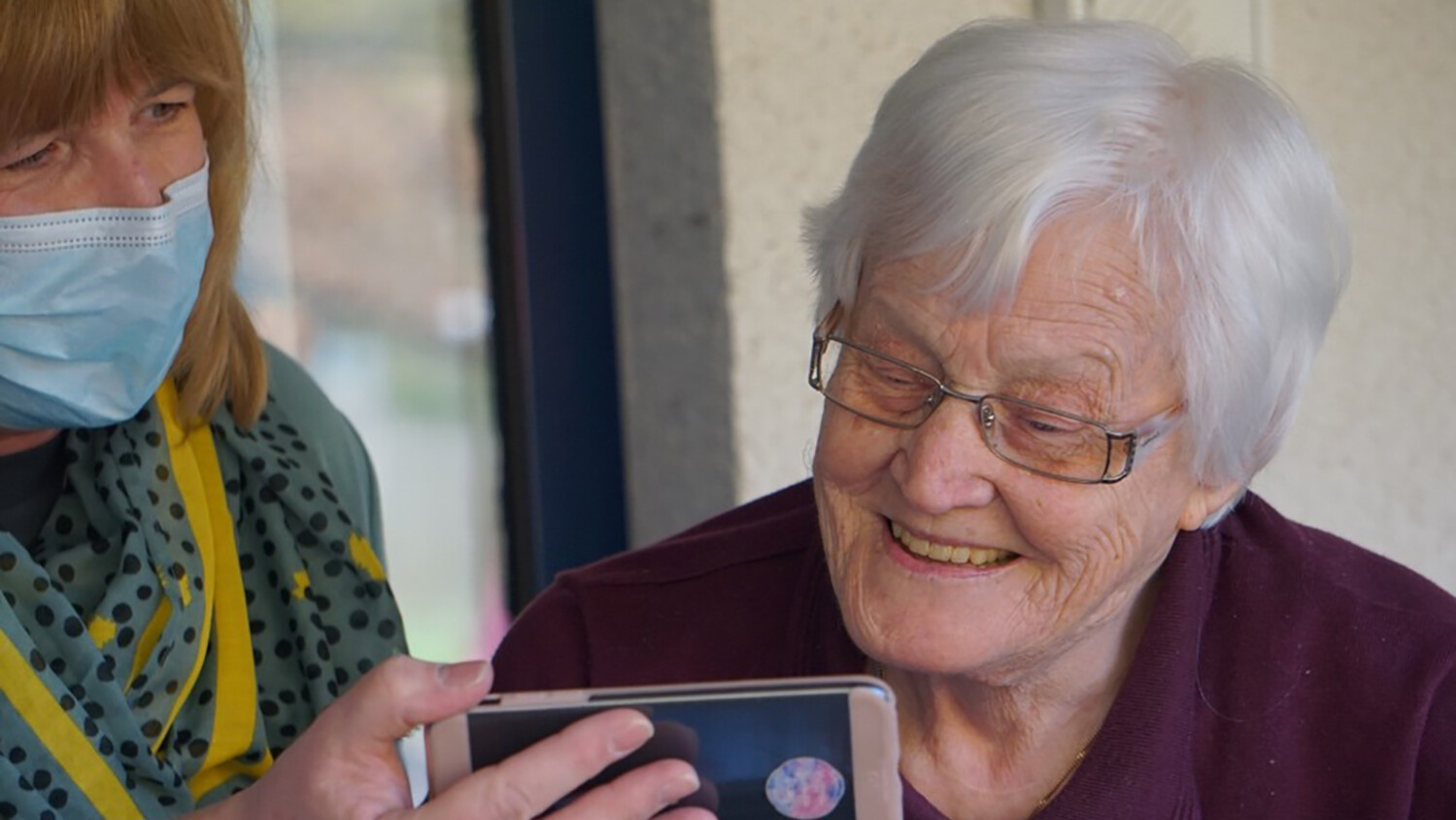
When the iPhone was born in 2007, seniors initially fell behind in the digital skills gap, the uptake of devices and the use of different apps on smartphones, compared to younger generations. But seniors gradually caught up. In fact, they were getting near to closing this gap before the pandemic struck society with lockdowns and other restrictions in the first quarter of 2020.
Source: Georg Arthur Pflueger, Unsplash
Figure 2, below, shows how seniors aged 60-69 years old had been closing the digital gap (in the sense of time spent online) in comparison with the total population.
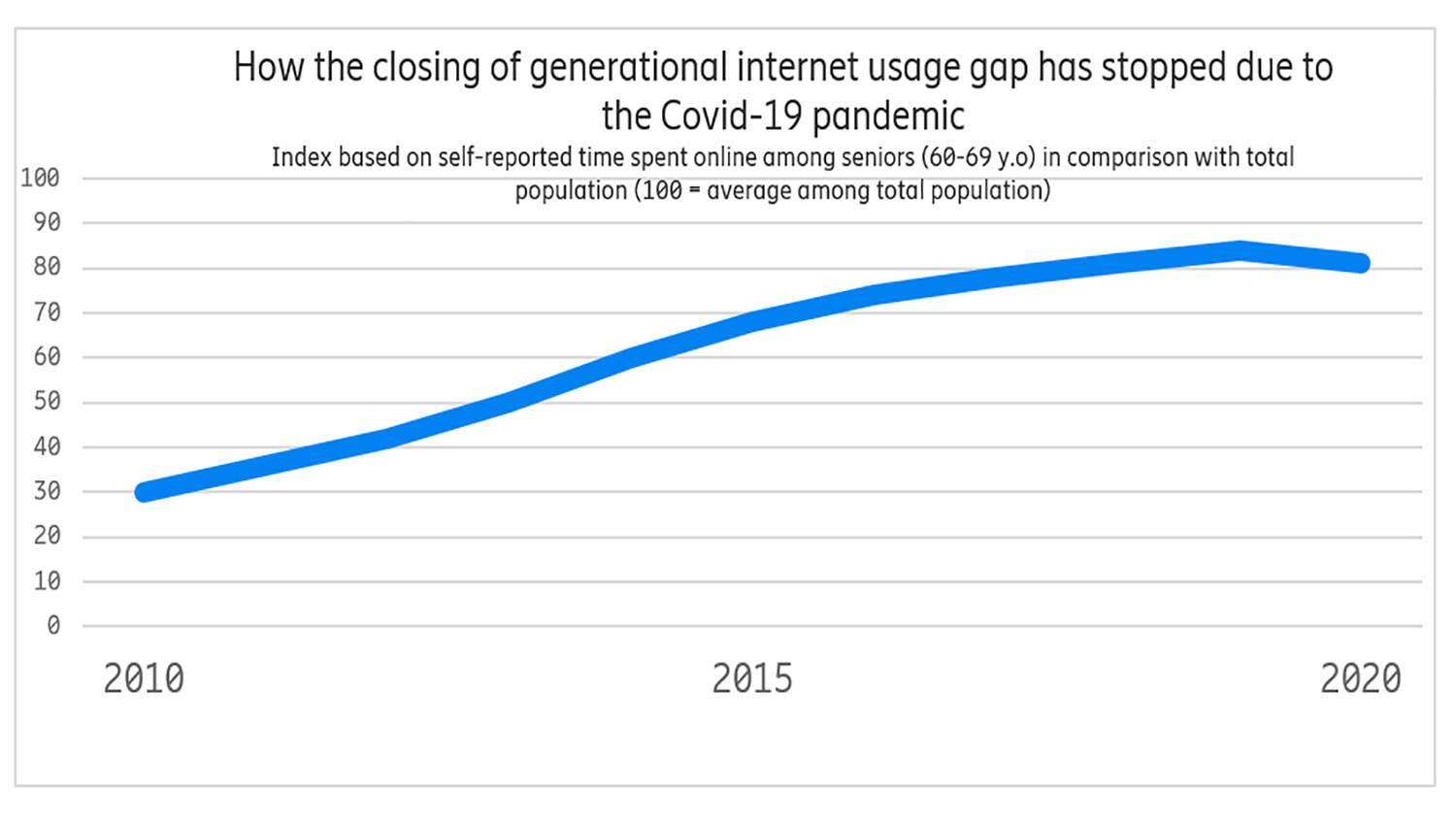
Figure 2: How the internet usage gap has stopped since the outbreak of the pandemic. Source: Ericsson Consumerlab Analytical platform 2010-2020. Base: Population 15-69 y.o. within 17 countries (Argentina, Australia, Brazil, Canada, Czech Republic, China, India, Indonesia, Italy, Japan, France, Russia, South Korea, Spain, Sweden, UK, and US).
One of the reasons that seniors had been catching up with younger generations is that every year there are new, more digitally experienced seniors replacing older seniors who are falling outside the upper limit of the age interval. Another reason is that the ‘new’ seniors are more likely to find it easier to pick up new online habits once they become seniors. This is due to their relatively high digital experience, but also often due to family and friends who encourage them, and want them to benefit from devices and apps for aspects such as communication, information or just for having fun.
However, once the Covid-19 crisis struck, this generational digital gap stopped closing. Not because seniors used the internet less – they actually started using it more – but because younger generations increased their internet usage even more due to the situation the pandemic put them in. They were forced to start working from home, have all their meetings as videomeetings and carry out most of their daily activities online.
Seniors' fears: unpacking the 'afflictions flower'
Despite most young-old seniors being healthy and very active, many had certain challenges and afflictions before the Covid-19 crisis, many of which have been exacerbated during the pandemic. In figure 3, key afflictions have been put together to illustrate the situation many seniors are already in, or fear to be in, when they get older.
The picture shows the flower that identifies different challenges and afflictions: being less mobile, more alone, spending more time in one place – at home for instance, the difficulties of shopping (especially grocery shopping), the worries about illness and society, and not being able to have as much fun as they like.
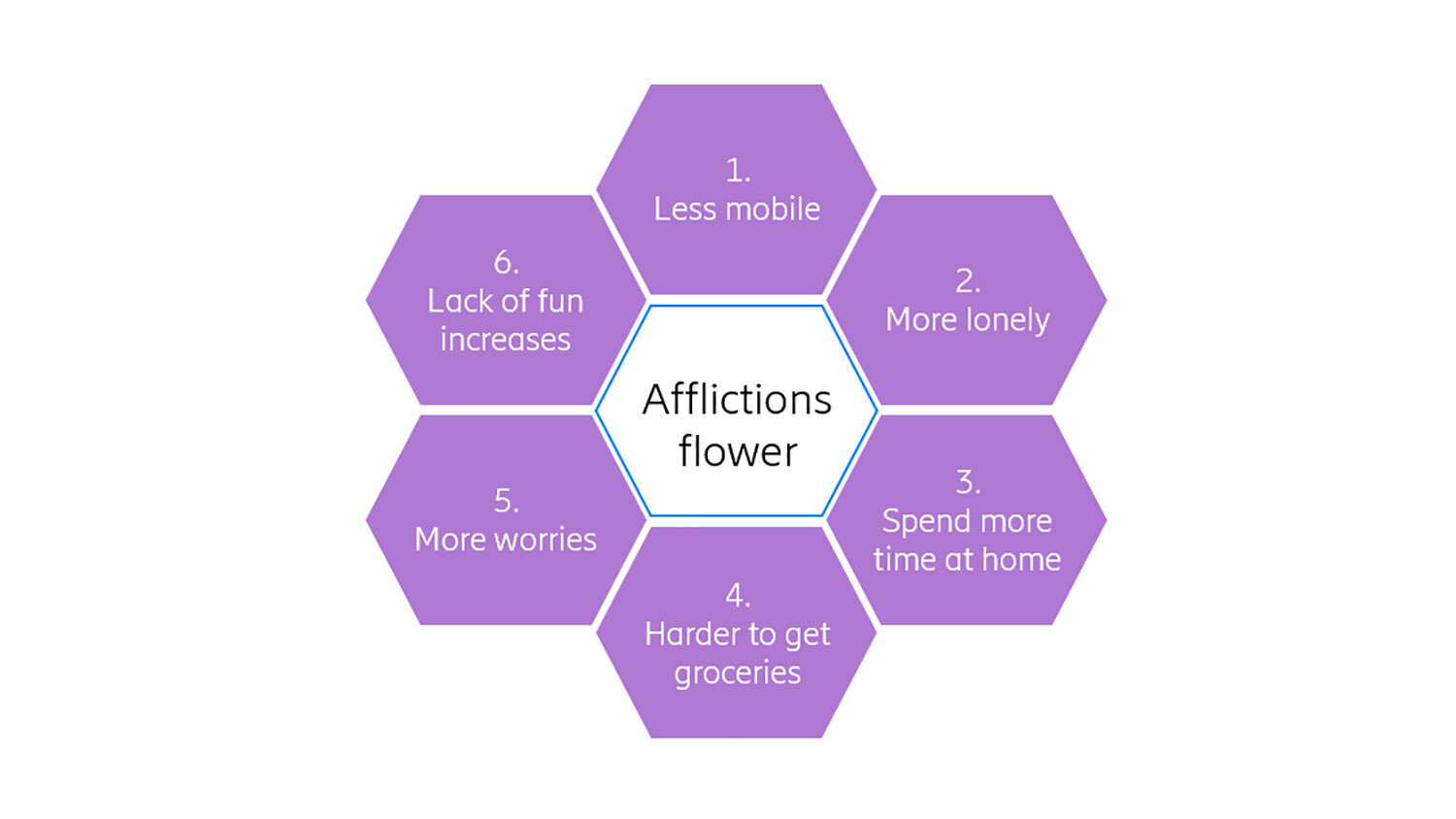
Figure 3: The afflictions flower.
Being less mobile during the Covid-19 crisis
Half of the young-old seniors across all countries surveyed feared a lack of mobility when they got older. Being mobile means both the ability to walk around in and outside where they live, but also being able to drive a car, manage to take the bus or other vehicles to get to places in or around their location. We all know that, for example, unsafe driving increases with age in terms of physical limitation, such as poor eyesight, diminished reflexes and medical issues. It can also increase more mental limitations such as drowsiness, confusion, forgetfulness, and so on.
From our Covid-19-based study ‘Keeping consumers connected’ conducted in mid April 2020, we see that many of these young-old seniors have already experienced these restrictions of mobility. A majority of those seniors who drive a private car, use public transport, ride a bike or moped, take a taxi or even share taxi rides, said they are using these forms of transport much less now compared to before the crisis. These seniors even walk less than before. As many as 4 in 10 said they walk less now, during the crisis, than before, while only 3 in 10 said they walk more now than before.
More lonely, and more time spent at home
Our senior study showed that before the crisis 3 in 10 young-old seniors spent most of their time alone. During the crisis, they’ve been even more isolated. As many as 9 in 10 seniors said they had been impacted somehow by the crisis, and most of them, 7 in 10, said they had been highly ‘socially’ impacted by the crisis.
As many as 8 in 10 also predicted that they would be spending more time at home in the future compared to before the crisis. An effect of being forced to spend most of one’s time at home is differring levels of health issues like of depression. During the pandemic in April, as many as 1 in 3 of the seniors were already afraid of depression in their household due to increased isolation.
Purchasing groceries is difficult – and boring
Another issue is of course, shopping for groceries. Generally, the older and more tired seniors get, the less interested they’ll be in going to the supermarket themselves. Already before the crisis, half of respondents considered buying groceries as heavy work – and boring – so they wouldn’t have wanted to do this when they get older.
Now during the pandemic, they’re also facing a bigger challenge getting groceries due to lockdowns and other restrictons. As many as half of the seniors said that the crisis had a high impact on them being able to get groceries.
Worries of illness and social unrest
Seniors are also suffering from worry about getting older and sick. From in-depth interviews with them before the crisis, it was obvious that this was something many seniors had in mind on a daily basis.
During the crisis, seniors expressed more worry about getting sick with Covid-19 in comparison with the younger generations. Further, they also worry more that their family and friends might get sick. Other indications showed that they worry more for societal aspects of coronavirus related consequences, such as increased violence and crime due to the effects of national restrictions.
Last but not least, seniors have more internet worries than others during this unique period in time. This includes things like getting hacked, being victims of online fraud or that fake news online will create unrest in society. Added to this are their worries about the kind of world their grandchildren will grow up in. Already before the pandemic, 6 in 10 seniors expressed their worries for their grandchildren’s future.
Having fun is put on hold
This ‘Rolling Stones’ generation is one that’s eager to have fun in life. Some people say this is the generation that never will grow up, after living through the first ever youth culture revolution the world experienced at the end of the 1950s and throughout the 1960s. Not surprisingly, almost all, 9 in 10, agreed that retirement for them means spending most of their time on hobbies, enjoying life and doing other fun things.
However, the Covid-19 crisis has, of course, had a very negative impact on this aspect of having fun in life. For example, 63 percent of the seniors across the surveyed countries surveyed said already in April that the crisis had had a large impact on them having fun, by limiting them in visiting the restaurants they wanted.
ICT – a helping tool in crisis
In a tough situation, and throughout the period in which the seniors have been locked down in their respectively country, this suffering has been somewhat eased through the increased usage of devices and internet services – essentially, ICT. Almost all, 9 in 10, claimed that their devices and the internet had helped them a lot during the crisis, in one way or another, in their daily life.
This means that as many seniors, or perhaps more, may have been helped by ICT than younger generations. As many as 3 in 4 have, for example, been supported through having online contact with their friends and family. But ICT has also helped seniors with grocery shopping and delivery, other forms of online shopping, helping seniors to exercise and gain access to healthcare.
Figure 4 reveals that ICT has helped seniors across several countries. However, it seems that ICT has not played as important role in Sweden, where the low figures can be linked to the fact that the country had not been put in lockdown. Instead, citizens were asked to follow certain recommendations from the Swedish authorities.
We’ll be covering how different tech solutions could meet the future needs of suffering seniors in the next blog post.
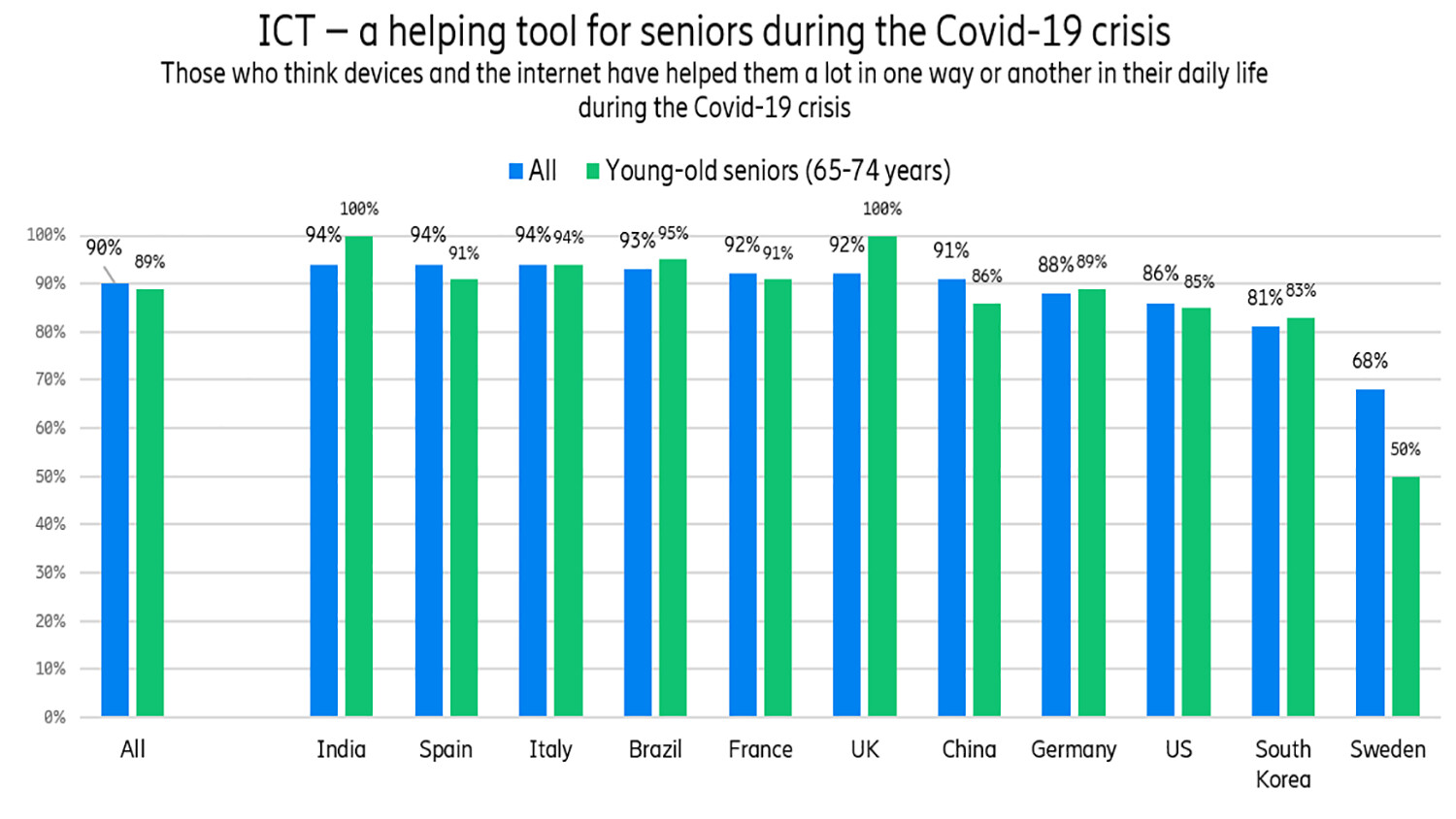
Figure 4: How seniors think ICT has helped them during the pandemic. Source: Ericsson Consumer & IndustryLab, Keeping consumers connected in a COVID-19 context (Mid-April 2020). Base: Population smartphone users aged 15-69 years. within Brazil, China, France, Germany, India, Italy, South Korea, Spain,Sweden, UK and US.
Seniors are gradually increasing their usage of internet activities
As mentioned in the beginning of this blog post, the internet gap between seniors and the younger generations stopped shrinking during the crisis, even though seniors have been using their smartphone more than ever.
In a comparison between 2016 and 2020 the chart down below shows that seniors with smartphones have increased their usage in all six examined internet activities. Half of them browsed the internet daily in 2016, now as many as 81 percent do that daily.
Moreover, half used instant messaging and used social media on a daily basis back then, compared to now, when 7 in 10 do it in 2020. More interestingly is perhaps that watching short video clips and using video calls have increased. From 2 in 10 who watched videos on a daily basis in 2016, now half of them are doing it daily. Even the use of video calls has increased during these years – from 16 percent daily to 38 percent daily.
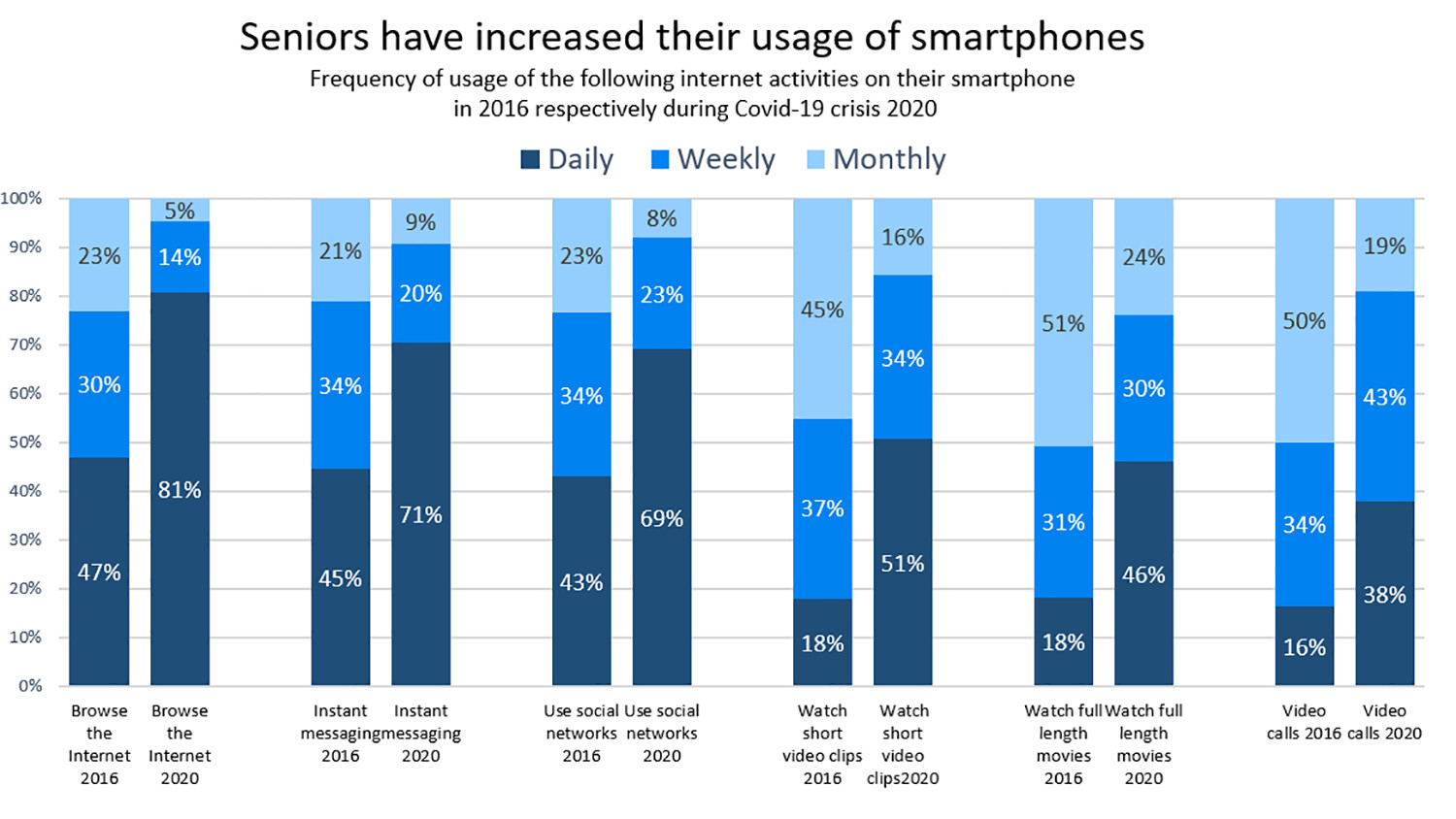
Figure 5: How seniors have increased their usage of smartphones. Source: Ericsson ConsumerLab Analytical platform. A comparison between 2016 and 2020 during the Corona crisis. Base: Population smartphone users using respective internet services aged 65-69 years within eight countries (Brazil, China, Insia, Italy, Spain, Germany, UK, and US).
This increase of internet activity usage on a smartphone can also be linked to the crisis itself. Namely, up to half of young-old seniors claimed they increased the usage of these different internet activities specifically due to the crisis.
Health and exercise pull the seniors towards the internet
A reliable mobile network has played an important role for seniors on the internet during the Corona crisis from a health perspective. In April, 3 in 10 seniors answered that they had downloaded some form of Corona-related app due to the crisis. By then, 2 in 10 had also used a remote consultation app and had been in contact with someone in the health sector – although there are still a somewhat smaller share of seniors doing this, compared to younger generations.
Seniors have also experienced purchasing medical supplies online. In April, at least half the seniors who used the internet said they usually buy medical supplies online on their smartphone at least monthly. The crisis has had an impact on this behavior too. During the crisis about 20 percent of them had started, or increased, purchasing medical supplies online.
Source: Joshua Hoehne, Unsplash
Exercise has moved to the internet for seniors. Since many have had a hard time going to the gym, or even take a stroll outdoors, more seniors see the possibilities with online health activities. Not surprisingly, 3 in 10 think online health activities could replace, or at least supplement going to the gym even after the crisis.
Increasing tech polarization: the five emerging senior segments
Whether or not the digital gap between generations remains or continues to close after the crisis, will remain to be seen. But it’s clear that we’re also seeing another type of gap increasing. This is the gap within the seniors group.
A cluster analysis identified five different senior segments mainly based on their interaction with their devices and their usage of internet activities. Two of these senior segments were identified as being relatively slow in their uptake of devices and usage of internet activities. Those two groups are called the ‘old traditionalists’ and the ‘striving pensioners’.
Characteristics for the ‘old traditonalists’ include the fact that many of them don’t have any children. More often, they claim that they feel alone and that they don’t see their relatives so often. Members of this senior segment have fewer devices than average seniors, and they do fewer online and offline activities compared to the average senior. Across the surveyed countries, this senior group consists of about 20 percent of the seniors.
Similarly, fewer of the ‘striving pensioners’ have children. They’re more likely to live alone than the average senior, and they often have more health problems or have financial restrictions that limit their quality of life. Members of this segment also have relatively few devices, but on the other hand they watch TV on a TV screen more often than others. This segment makes up 26 percent of all young-old seniors.
Striving pensioners and old traditionalist are the two segments who use internet the least. Together, they make up almost half of the internet-using young-old seniors, and are most at risk of falling behind even further when new technology is introduced to the market.
The senior segment called ‘sociable grandparents’ consists of 25 percent of the young-old seniors. More than the average, they are often married and likely to live in apartments. The name also reveals that they socialize with friends more than the average senior. Interestingly, they’re less likely than other seniors to think that they will be lonelier the older they get. Regarding devices and usage of internet activities, they are on an average level.
The two remaining segments, also about a 3 in 10 of all seniors, are the two segments that have and use devices and internet activities more than on average.
We call the first of these segments the ‘mature life connoisseurs’. They are often married, and they define themselves more often than not, by being well educated and having a higher than average income. This reflects in the kind of life they lead, since they consume more, socialize with friends more, and to larger extent, exercise more than the average senior.
They also drive a car and use all kinds of devices more, from smartphones and tablets, to internet TV and connected home alarms. For them, life is a pleasure. But they’re also very aware of what’s going on in society, like being aware of climate change. Mature life connoisseurs account for around 13 percent of the seniors aged 65-74 years across the countries surveyed.
Last but not least, say hello to the ‘ageing techies’. This segment does not primarly use devices and the internet for usage purposes for example. Their main driver is an interest in the technology itself. They are relatively often well educated, active, they more often make money from their hobby, consume more, socialize with friends more often, but also show an excitement for technology. In principal, they have more devices and use internet more often that average. Being tech interested also reflects on the fact that they have and use smart speakers more often than others in their household. The segment is 16 percent of the young-old seniors in the surveyed countries.
Polarization due to usage of internet services – but worse are differences in attitudes
The growing gap between the segments mentioned above can be shown in different ways. The ageing techies are unique; using the internet more often, followed by the mature connoisssieurs. The other three senior segments use internet services less frequently.
For example, let’s take the experience of accessing social media to watch short video clips. As many as 70 percent of the ageing techies browse the internet every day, while only 29 percent of the traditional seniors did this 2019. The same pattern is found regarding video experiences. Video clips are viewed by 47 percent of the ageing techies on a daily basis, compared to 11 percent of the traditional seniors.

Figure 6: Tech usage polarization among the five senior segments. Source: Ericsson ConsumerLab Analytical platform, Senior study, October 2019. Base: Online population aged 65-74 years within Canada, China, Germany, Italy, Japan, Sweden, UK, and US.
Something else that’s concerning with this tech gap within the seniors is that they have different attitudes towards future technology. This will probably give them different conditons to use and therefore benefit from future tech solutions, which could improve their quality of life. In our study, 47 percent of the ageing techies expressed excitement about AI, while 52 percent said that they were fascinated by the possibilities that new mobile 5G technology could bring. Only 23 percent respectivlely, 25 percent among the traditional seniors thought this.
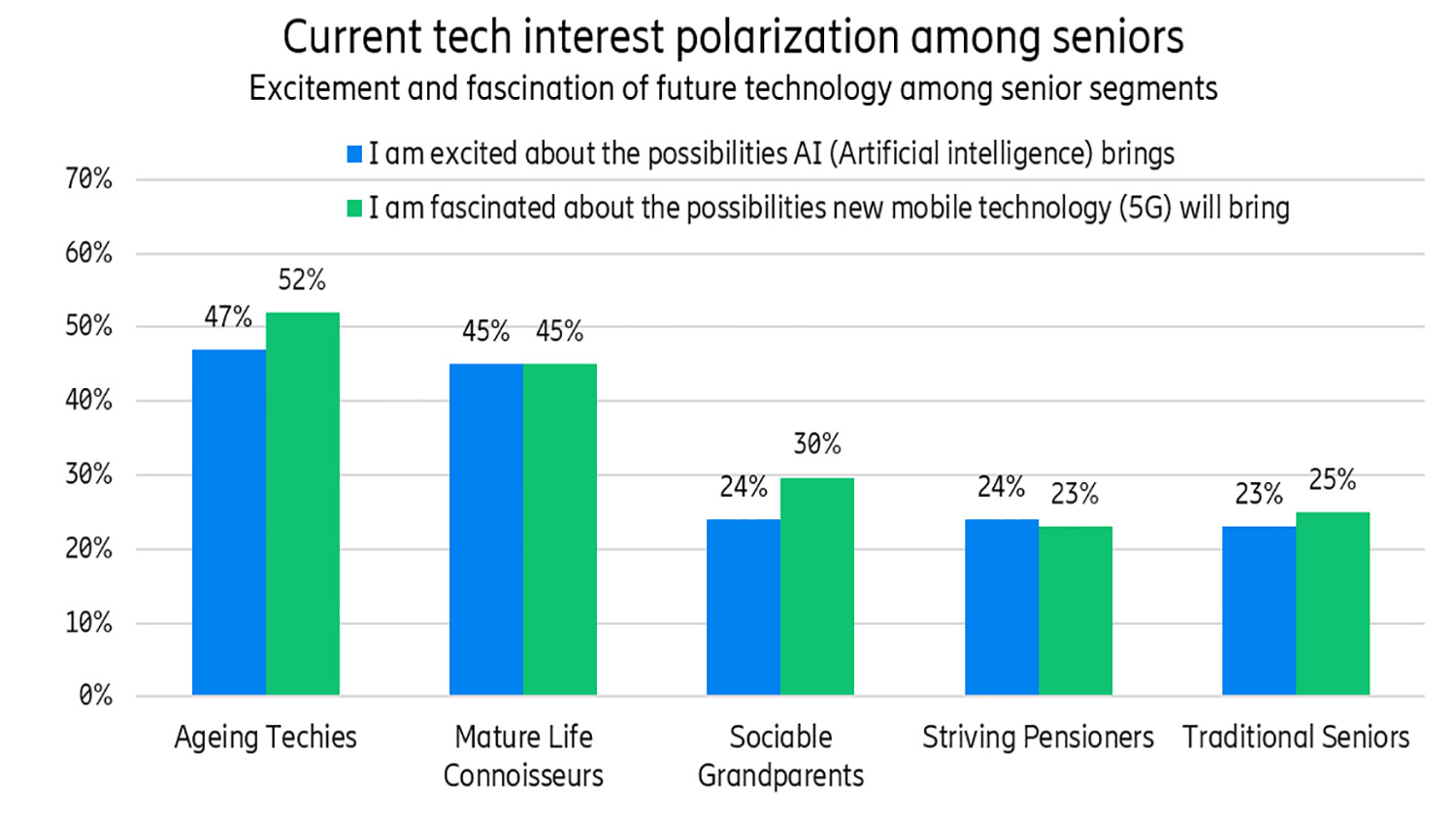
Figure 7: The differences in current tech interest. Source: Ericsson ConsumerLab Analytical platform, Senior study, October 2019. Base: Online population aged 64-75 years. within Canada, China, Germany, Italy, Japan, Sweden. UK and US.
The outlook: second billion of seniors is arriving. Let’s get to work
Many companies and institutions are starting to look at seniors as an interesting single, socio-demographic group, due to the increasing number of seniors in society. According to the World Health Organization (WHO), there’ll be nearly two billion seniors over 60 years old by 2050. This would mean that the number of seniors will have tripled since the year 2000.
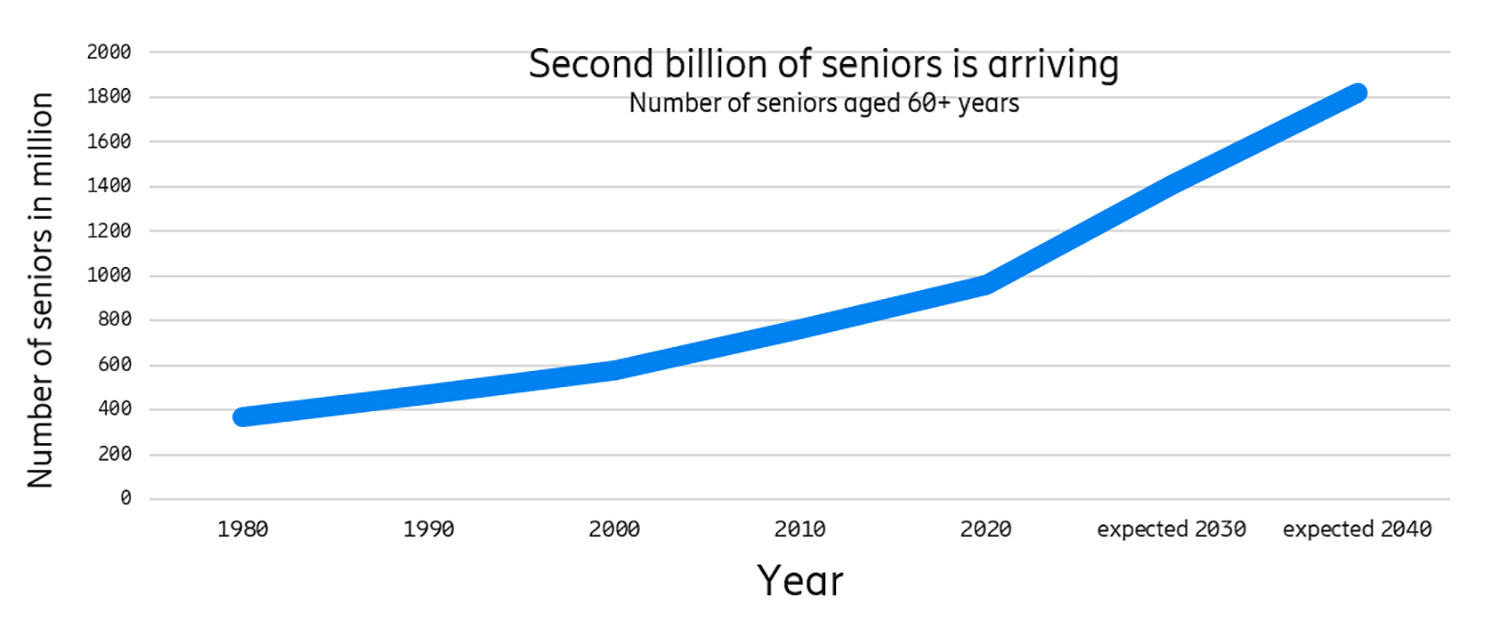
Figure 1: The projected increase of seniors in society. Source: UN Demographics 2019.
There’s no doubt we need to improve how seniors access and use their devices and the internet. After all, all seniors should have a right to be able to benefit from tech solutions, not just the ones who are the most interested.
Don’t forget to check back in for the next post in the series, where we’ll focus on how the next generation of tech solutions are perceived by seniors, and how these solutions can best be implemented to best fit seniors’ needs, so that as many of them as possible can use them and benefit from them.
Want to know more?
- Explore ConsumerLab: discover more of our extensive consumer research.
- Read out report, Connectivity in a COVID-19 world.
- Read our letter to G20: The road to recovery will be digital first.
- Explore 5G