










Multi-band microwave antennas—A magic bullet for boosting microwave capacity

Customer Solutions Sales Director – Transport

Customer Solutions Sales Director – Transport
Customer Solutions Sales Director – Transport
The latest Ericsson Mobility Report shows mobile network data traffic grew 44 percent between Q2 2020 and Q2 2021, reaching 72EB/month. Simply put, backhaul bottlenecks cannot be tolerated, given new 5G use cases driving demand for more video, more gaming, Extended reality (XR) and mission-critical communications. So, for transport network architects, engineers and planners, getting more capacity through point-to-point microwave radio links, while maintaining the ability to connect at long distances, and providing required link availability while keeping site footprint to a minimum becomes a major challenge. While Multi-band antennas have been around for a little while, improvements in the technology have really advanced the possibilities for microwave backhaul, providing more and better options in many more deployment situations, even as capacity requirements grow.
So, how can I increase capacity on my microwave links?
The mainstay to boost capacity using common carrier bands has typically been focused on better, more efficient use of available spectrum. Things like wider channels, higher order modulation, cross polarization interference canceling (XPIC) and payload optimization functionality have been implemented, and have made significant improvements.
Multi-band techniques, which use the parallel operation of two microwave links working in different frequencies, help with the capacity and operational challenges, but come with the extra cost of having two antennas per site. For example, link-bonding techniques allow the creation of a single virtual link of the capacity carried by two frequency bands. This can increase link capacity and availability say, when 6GHz is combined with 11GHz. 6GHz allows for very long hops with max capacities governed by the number of channels, channel spacing and the modulation, but may be susceptible to interference from Wi-Fi 6E devices. 11GHz channels offer more spectrum to boost capacity, but 11GHz could suffer from rain fade.
Another example is using tradition bands and E-band together. Combining E-band spectrum (80GHz) with traditional band (15/18/23/28GHz) is a great way not only to upgrade capacity of microwave links, but also to extend the reach of the hop. A microwave link that leverages the high availability of a traditional band along with the high capacity of E-band is another way to solve capacity bottlenecks in a service provider’s network. These examples prove a link with both frequencies can provide higher capacity and higher availability. However, even if there is spectrum available to increase capacity on the microwave link, often there is not enough space on the tower to add more links with more antennas.

Enter Multi-band antennas—A great way to boost capacity
Without the magic bullet of Multi-band antennas, it is often impossible or not cost-effective to deploy multiple bands for a single link due to the need for multiple antennas. Continuing the example above, 6GHz links typically require 6 feet and larger dishes for long-haul links while 11GHz links typically require up to 6ft antennas. There are exceptions to the antenna sizes, but in general a provider would need two 6ft dishes or larger installed in a tower.
Multi-band antenna products were introduced to help alleviate not only the need for more bandwidth, but also with the installation costs created by having two antennas with the consequent tower lease increase if the provider does not own the tower.
The first dual-band antennas in the market started combining the spectrum of E-band (80GHz) and the spectrum in the common carrier band, like 18GHz and 23GHz in North America. Now additional band combinations are available: dual-band antennas covering common carrier bands. These types of dual-band antennas can combine traditional frequency bands like 6GHz and 11GHz links on a single parabolic reflector.
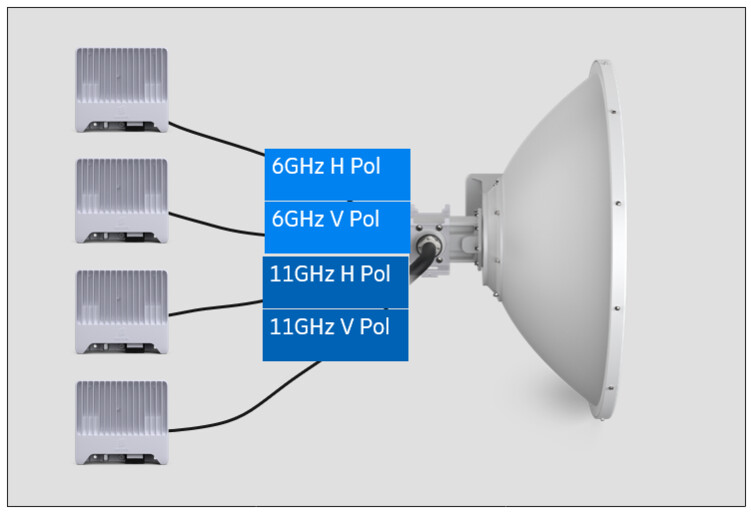
Advantages of multiband techniques like link bonding can now be implemented without the downside of multiple large antennas. This can make the difference between setting up a link or not, especially in a tower crowded by many antennas. Now, we can quadruple link capacity, complemented with lower cost of installing one Multi-band antenna vs. two single band antennas, lower transportation cost, and tower lease costs cut by half. This makes a very attractive business case for a Multi-band antenna.
A customer’s voice
When I spoke to one of our customer that will implement the multi-band antenna, combining 6 and 11GHz they said: ”The rollout of the dual band antenna for the 6/11 GHZ spectrum is of great benefit to the replacement of our 11GHz antennas in Maine. We are able to overlay 2 separate bands that greatly increase our Microwave bandwidth capacity without the additional loading of 2 separate dishes. Some of the structures we will be deploying these antennas on are greatly impacted by the latest TIA-222-H standard which uses ultimate gust wind speeds, updates to seismic loading considerations, etc that can reduce allowable loads on our towers. Having a stricter standard and using the Ericsson dual band antennas, allows us greater capacities and not exceed the critical structural loads on existing towers. It’s a welcome solution for carriers increasing broadband across our nation”

Takeaways
Navigating through the Gs: 2G/3G/4G and now 5G, we have witnessed how demand for backhaul bandwidth increases constantly. Bandwidth is like money—you can never have enough! In the quest to deliver more bandwidth with microwave technology, Multi-band antennas along with link-bonding techniques offer customers higher link capacity by combining two frequency bands, and the possibility to meet a required link availability with lower TCO. Ericsson has a long tradition offering microwave products that solve not only the challenges associated with ongoing increased capacity, but also continued product evolution that is backward compatible.