










How 5G integrates with TSN-based industrial communication systems

System Manager, Digital services

Senior Expert, Industrial mobile networks

Principal Researcher, Deterministic networks
System Manager, Digital services
Senior Expert, Industrial mobile networks
Principal Researcher, Deterministic networks
System Manager, Digital services
Senior Expert, Industrial mobile networks
Principal Researcher, Deterministic networks
The industrial automation industry is undergoing a digital transformation – also referred to as Industry 4.0. Connecting the physical production world to a digital representation can provide flexibility and efficiency gains through better observability, control and planning of the automation system. Interconnecting multiple machines, devices, the cloud, and people, makes information accessible from anywhere in a factory. The resulting full transparency across processes and assets transforms the production plant into a cyber-physical production system. Smart manufacturing is made possible by adopting novel paradigms such as cloud computing, embracing digital twins and applying Artificial Intelligence in the management and control.
The communication technology enablers for this transformation are TSN on the wireline side and 5G on the wireless side. Both technologies have been designed to provide converged communication on a common network infrastructure for a wide range of services, including for time-sensitive applications that require deterministic, reliable, and low-latency communications.
The 5G Alliance for Connected Industries and Automation (5G-ACIA), just published a white paper describing how 5G has all essential capabilities required to interwork with TSN for industrial automation. There are significant benefits that can be achieved for industrial use cases with the introduction of TSN and 5G wireless communication, for example due to increased flexibility in the deployment of industrial equipment and the network. This requires 5G to provide robust support for Ethernet-TSN communication services and interworking with wired TSN networks.
As one of the founding members of 5G-ACIA, we were deeply involved in developing the white paper.
The 5G-ACIA white paper describes the functional capabilities needed to seamlessly integrate 5G with TSN based on the requirements of industrial applications. It also provides brief overviews of the 5G and TSN functions needed to support time-sensitive applications.
In the following sections, we will share some insights from the white paper on how 5G can integrate seamlessly with TSN and be used practically in a factory.
Industrial use cases
A future-proof industrial network consists of three connectivity levels as shown in Figure 1.
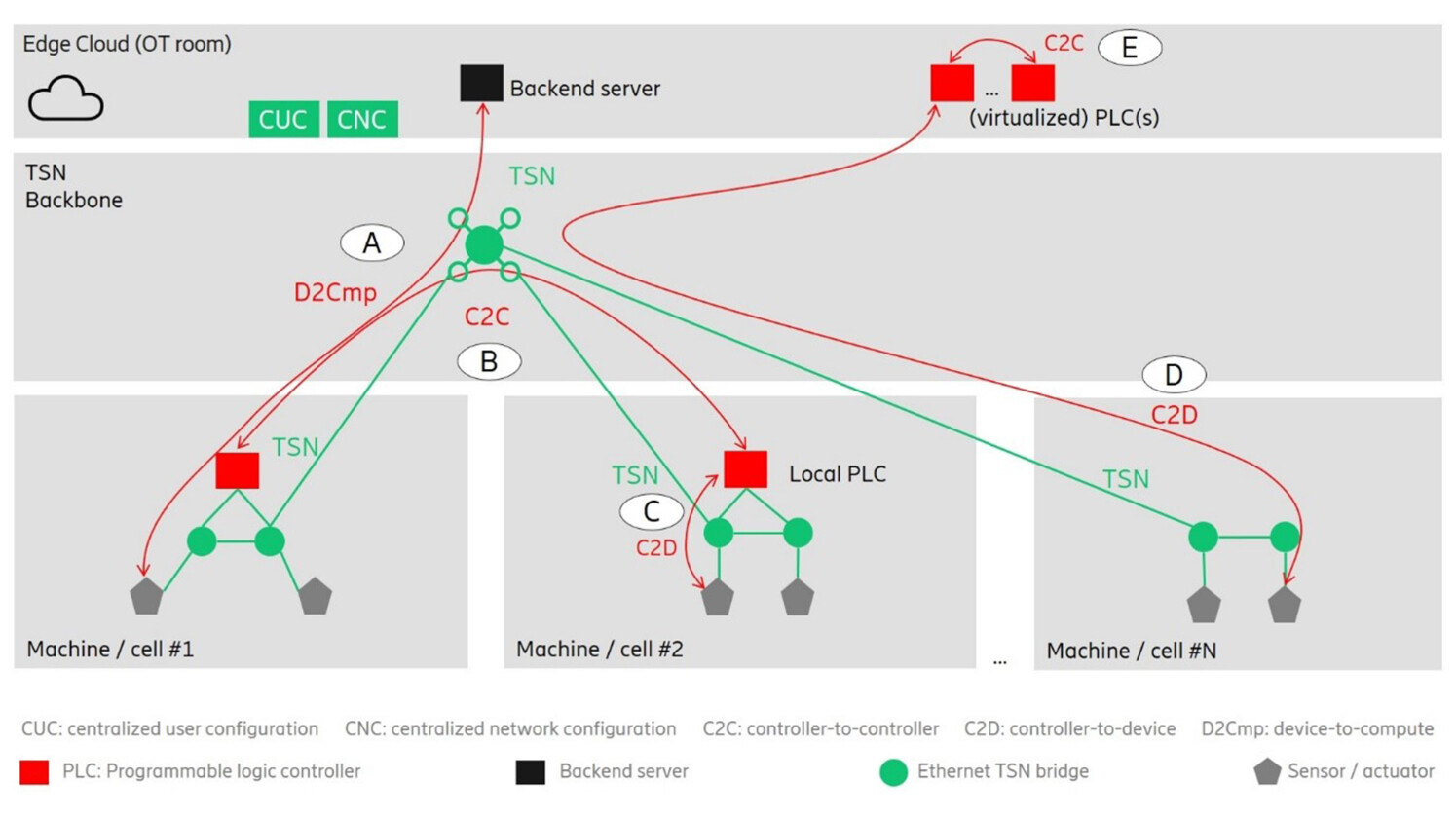
Figure 1: Example of the introduction of TSN in a factory.
The operational technology (OT) room hosts centralized control and management functions are located, it can also host the enterprise edge cloud. On local machine and cell level, multiple machines and production cells are located. Each machine/cell is equipped with field devices (sensors or actuators, for example) and may have a local programmable logic controller (PLC). The TSN backbone provides transport services for the central management level and local machine level. The connectivity service can be either between multiple local machines or between the central management level and local machines.
A machine/robot is equipped with field devices that are controlled by a PLC. The real-time communication between a PLC and field devices is shown in Figure 1, where stream C represents Controller-to-Device (C2D) communication, which is needed for motion control or closed-loop control applications, for example. When multiple machines/robots perform cooperative tasks, the PLCs of different machines need to be coordinated. The communication between controllers is called controller-to-controller (C2C) communication, which is represented by stream B in Figure 1. C2D and C2C communications are highly critical There are also other traffic types, which are not time-sensitive, and are used, for example, for monitoring, data collection and analytics. This type of communication, as shown in Figure 1, stream A, is called Device-to-Compute (D2Cmp) communication, which typically takes place across the entire production facility, for example among field devices and a computer/server at a central room or enterprise edge cloud.
In an Industry 4.0 production environment with a converged network infrastructure enabled by TSN, control applications are no longer bound to the local network segment on field-level; they can be located almost anywhere in the factory. For instance, stream D in Figure 1 illustrates that field level devices in machine/cell #N are controlled by a virtualized PLC located in an edge cloud. The PLC of machine/cell #N can communicate with other virtualized PLCs via stream E thus implementing C2C communication within the edge cloud.
TSN: converged industrial communication based on Ethernet
TSN is a set of standards specified by IEEE 802 to enable Ethernet networks to give QoS guarantees for time-sensitive and/or mission-critical traffic and applications. TSN is a toolbox that includes four categories of tools: resource management, traffic shaping, reliability and time synchronization. Each category contains multiple tool options. For example, resource management basics and configuration models are defined by the IEEE 802.1Qcc standard. In a fully centralized configuration model, a Centralized Network Configuration (CNC) can be applied to the network devices (bridges), and Centralized User Configuration (CUC) can be applied to user devices (end stations). TSN guarantees the deterministic latency for critical data by various queuing and traffic shaping techniques, such as scheduled traffic (IEEE 802.1Qbv) and Ethernet frame preemption (IEEE 802.3br and IEEE 802.1Qbu).
Ultra-reliability is provided by Frame Replication and Elimination for Reliability (FRER) (IEEE 802.1CB) where data flows are transmitted with multiple copies over disjoint paths in the network. Per-Stream Filtering and Policing (IEEE 802.1Qci) improves reliability by protecting against bandwidth violation, malfunctioning, and malicious behavior. The generalized Precision Time Protocol (gPTP) (IEEE 802.1AS) is the TSN tool for time synchronization of network bridges and also end stations.
A TSN-based industrial communication network is a converged network that allows a mix of various traffic types. Service requirements range from best-effort traffic to critical real-time traffic. TSN allows for the convergence of many different services running on a common network, while still having tools to prioritize time-critical services and provide them with deterministic communication performance, enabling C2C and C2D use cases. The 5G-ACIA white paper lists example uses of TSN features for the different traffic types (Table 1).
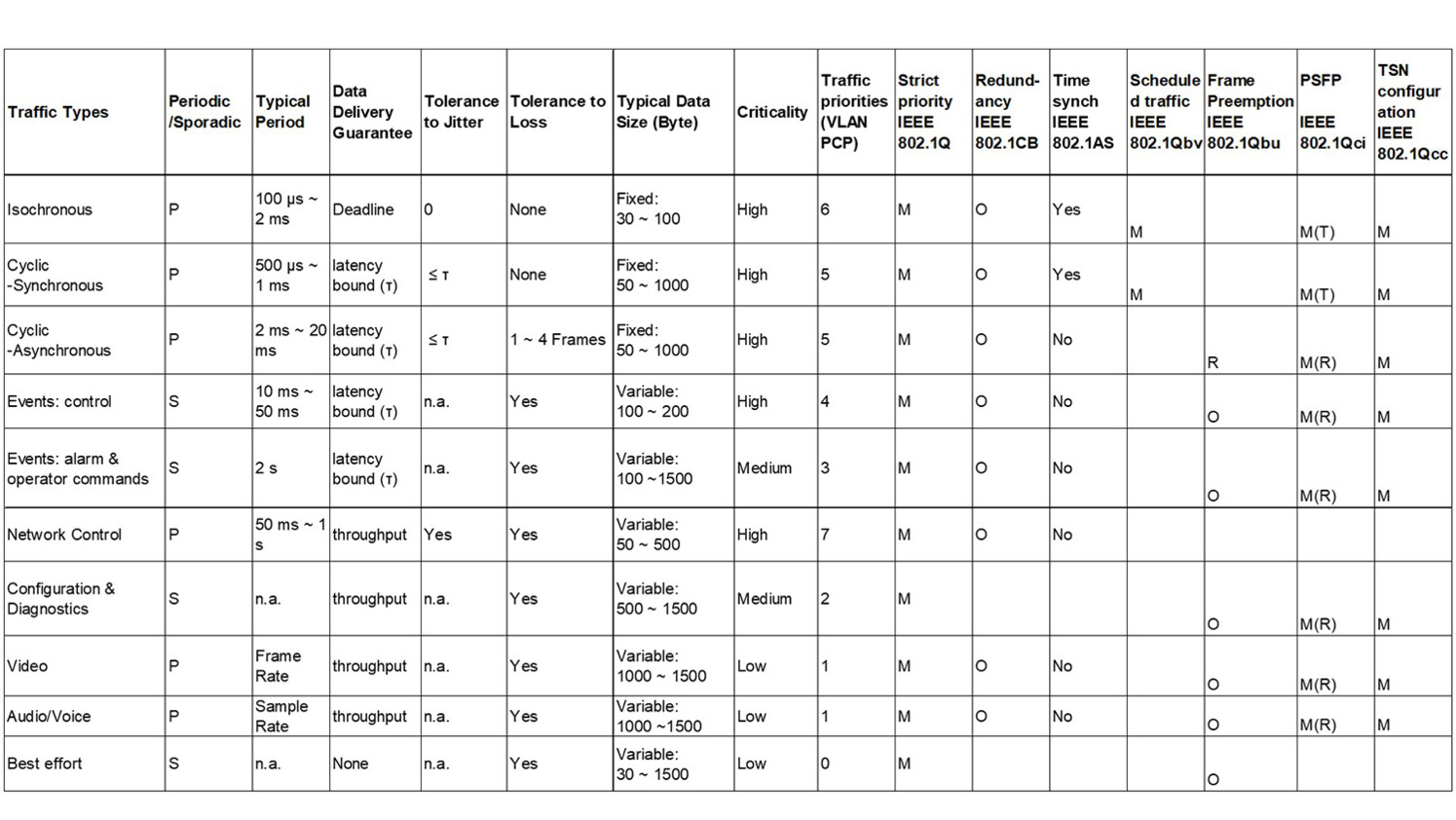
Table 1: Industrial automation traffic types, service requirement and related TSN features. Terms: M: mandatory, O: optional, R: recommended, (R): rate-based policing, (T): time-based policing.
5G-TSN deployment in a factory
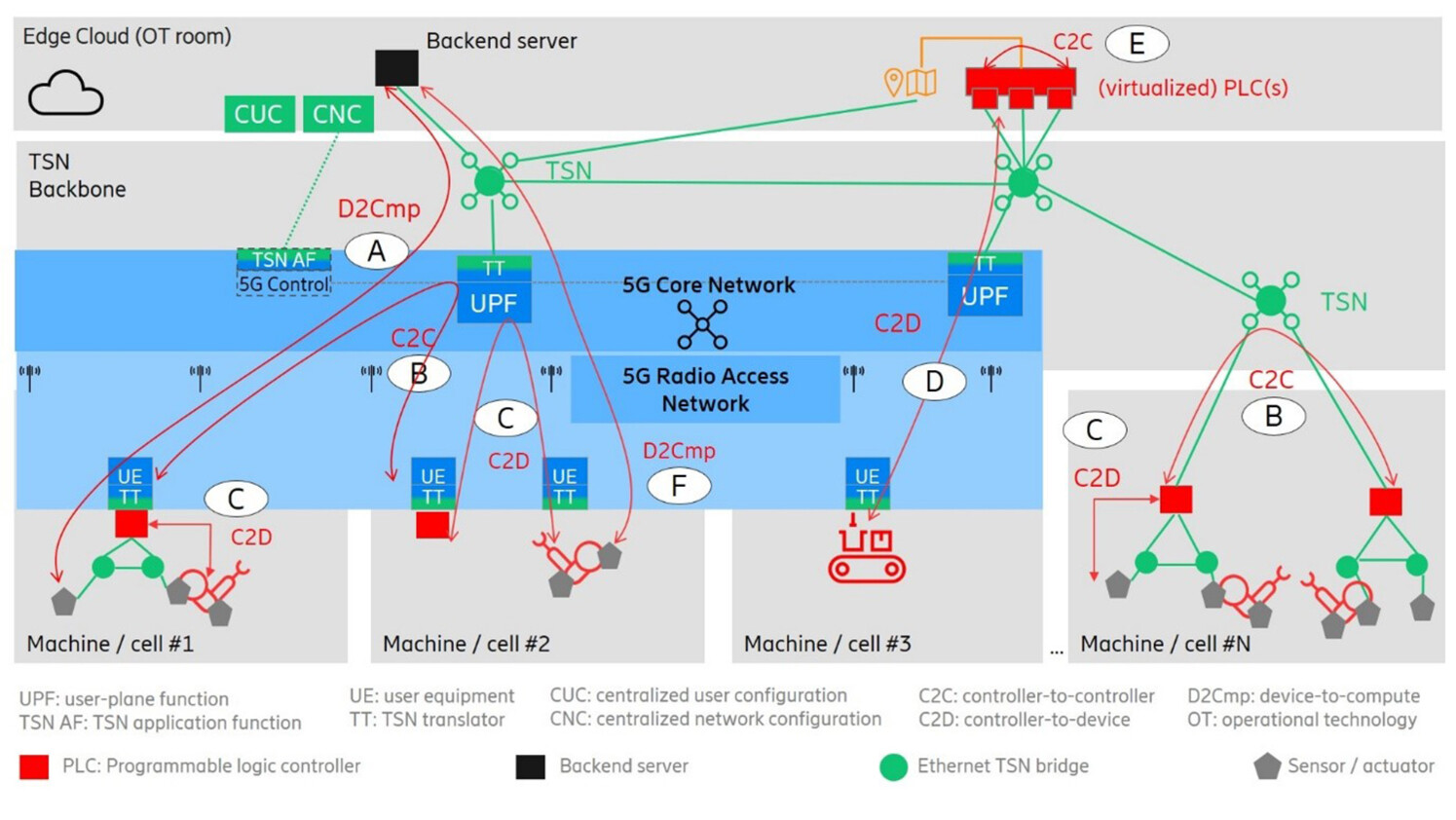
Figure 2: Adoption of 5G in industrial automation.
With the standardized support for TSN, a 5G system is perceived as a set of IEEE-compliant virtual Ethernet-TSN bridges when it is deployed in a factory. The 5G system consists of 5G core network and radio access network. The 5G User Plane Function (UPF) is a gateway to the wireline network, and the radio access network spans over the production plant to provide wireless connectivity to the mobile devices. The TSN Translator (TT) function enables interworking between 5G and the wireline TSN network. On the control plane, a 5G bridge provides a management function (the 5G TSN Application Function (AF)) that interacts with a CNC of the TSN network.
5G can support various industrial use cases as described in the previous section by providing communication services on the three earlier described network levels as shown in Figure 2.
Machine/cell #1, as shown in Figure 2, illustrates a 5G-TSN integration scenario where 5G virtual bridges are used in the industrial TSN backbone. Machine/cell #1 can use a 5G User Equipment (UE) instead of a cable to connect to the backbone. 5G interconnects machines/cells, as shown in Figure 2, stream B, and provides C2C communication via “UE-to-UE” communication, that is, communication from one UE via the 5G network back to another UE.
Inside the local segments of machines/cells, sensors/actuators may be connected to the PLC via an existing wireline network (as illustrated by stream C in Figure 2); both TSN and legacy fieldbus protocols can be used within the machine/cell. For D2Cmp, the non-time-sensitive data stream A in Figure 2 is first transmitted from field devices to the 5G UE via the wireline network inside machine/cell #1, then further delivered to a back end server or edge cloud at a central room via the 5G wireless connectivity. The UE attached to the PLC can also communicate with other PLCs through the backbone to achieve C2C communication as shown by stream B.
Machine/cell #2 depicts an integration example where the 5G bridge extends from the backbone into the machine/cell segments. In this case, 5G also provides wireless connectivity for the devices inside a local machine/cell. For instance, a PLC and a field level device are attached to separate UEs, therefore the C2D communication takes place between one 5G UE via the 5G network to another 5G UE, as depicted in stream C in Figure 2. In addition, 5G introduces significant flexibility when connecting data collectors and equipment to the edge cloud for D2Cmp communication. This is shown in TSN stream F in Figure 2; as the field device is attached to a UE, the data can be directly transmitted to the edge cloud, which itself is connected to the UPF of the 5G system.
Due to the flexibility of 5G wireless, the machine/cell #3 can be mobile, for example an AGV or mobile robot. Devices of machine #3 can be controlled by a virtualized PLC at a central room or edge cloud, as shown by stream D in Figure 2. The 5G system provides wireless connectivity on all three network levels. C2C communication between virtual PLCs in a central room is depicted by stream E in Figure 2.
Machine/cell #N has only wireline connectivity. It shows an example of co-existence between 5G and wireline TSN in the same factory shop floor. It means, in a likely brownfield introduction of 5G in a factory, existing machines that are connected via wire to the industrial backbone network are not impacted by the newly introduced 5G and can communicate with 5G connected machines via the backbone network.
Standardization
3GPP has performed significant standardization work to enable 5G-based industrial communication and support TSN: in Release 15, ultra-reliable and low-latency communication (URLLC) was specified for 5G; in Release 16 the support for TSN was added, and further improvements are continuing in Release 17. 5G standardization work for IIoT includes understanding how TSN is applied in a smart factory environment, and 5G features have been specified to integrate and interact with the TSN network.
A 5G system has been specified to appear towards an external TSN network as a set of virtual TSN-capable 5G bridges. The 5G core network function TSN AF provides interaction with the CNC for reporting the 5G bridge capabilities, and obtaining configurations, like frame forwarding for the 5G system bridge, as well as the TSN-specific configurations for things like per-stream filtering and policing (IEEE 802.1Qci) and time scheduling for traffic classes (IEEE 802.1Qbv).
The 5G system has a QoS framework that can be used for transmitting traffic with differing QoS characteristics, and a mapping to TSN stream configurations has been specified. For example, the IEEE 802.1Q strict priority can be supported, by mapping the 802.1Q priority (priority code of point) to a priority level of a specific 5G QoS identifier. 5G also introduces time synchronization over the 5G system via gPTP according to IEEE 802.1AS; something that enables synchronization of network nodes and end devices to a grand master clock over 5G. The 5G system acting as a time-aware system can relay TSN timing information to an industrial application anywhere in a factory. It can support synchronization for up to 128 separate gPTP time domains simultaneously.
More about 5G-ACIA and our white paper work
5G-ACIA launched in April 2018. It aims firstly to establish a common language between operational technology (OT) and Information and Communications Technology (ICT) and, secondly, to ensure that the requirements of the industrial domain are considered in 5G standardization, ultimately paving the way for a 5G ecosystem for the industrial domain. The alliance has grown substantially, approaching 80 global members. It has been investigating how 5G is important for the automation industry with studies in areas including use cases and requirements, traffic modeling, industrial ethernet, non-public network deployments, security, network exposure, and more recently, time-sensitive networking.
Partners across the different industry sectors (including the operational technology industry, mobile network operators, and equipment vendors), worked closely together to achieve an industry-wide understanding and consensus on the topic. The EU-funded 5G-SMART project, led by Ericsson, contributed with deliverables from its work on integration of 5G with TSN. 5G-SMART is a consortium of industry partners and research institutes that are exploring 5G-enabled smart manufacturing concepts and validate them in 5G testbeds.
As mentioned earlier, TSN is an important subject in the automation industry. There are other related and important topics that 5G-ACIA will investigate in the coming year, like the profiling of industrial 5G devices, the architecture and use cases for Edge Cloud, the relationship of 5G to the Asset Administration Shell, or a certification framework for industrial 5G. In addition, testbed activities will be launched during the first half of 2021 where players from ICT and OT will show how 5G is able to address some of the industrial use cases in real environments, such as production factories.
Further reading
Read the 5G-ACIA white paper, “Integration of 5G with Time-Sensitive Networking for Industrial Communications”, January 2021.
5G-SMART deliverable 5.1, “First report on new technological features to be supported by 5G standardization and their implementation impact”, December 2020.
5G-SMART deliverable 5.2, “First report on 5G network architecture options and assessments”.
Learn more on how 5G meets Time Sensitive Networking.
Ericsson Technology Review, 5G-TSN integration meets networking requirements for industrial automation.
Discover how Ericsson works with Private Networks for industries.
Explore how Ericsson works with Industry 4.0.
Read more about Core network
Discover how 5G core unleashes a new era of scalable and service-rich cloud-native networks.
Explore 5G core solutions that make it possible for you to deploy, scale and evolve your operations across multiple deployment scenarios.