










A technical overview of time-critical communication with 5G NR

Master Researcher, Radio networks

Senior Researcher, Radio networks
Master Researcher, Radio networks
Senior Researcher, Radio networks
Master Researcher, Radio networks
Senior Researcher, Radio networks
Everyone knows about 5G; it provides higher throughput, lower latency, and supports a wide range of use cases and devices that go well beyond smartphones. Even exciting new real-time applications that require time-critical communication will now be possible. Guaranteeing low latency with high reliability – what we call bounded low latency or ultra-reliable low latency communication (URLLC) – is of key importance for those applications. In this blog post, we explain the features introduced to the 5G NR standard that keep its latency within guaranteed bounds.
Guaranteeing an upper latency bound is the differentiating factor between URLLC and enhanced mobile broadband (eMBB). For eMBB, the system aims at maximizing data rates and latency is delivered on a best effort basis. It is noteworthy that, so far, there is no other wireless technology supporting these time-critical use cases on scale. In this respect, 5G NR is an absolute game changer. Here we’d like to guide you through 5G NR’s technical features and show you how.
Where is bounded low latency (URLLC) needed?
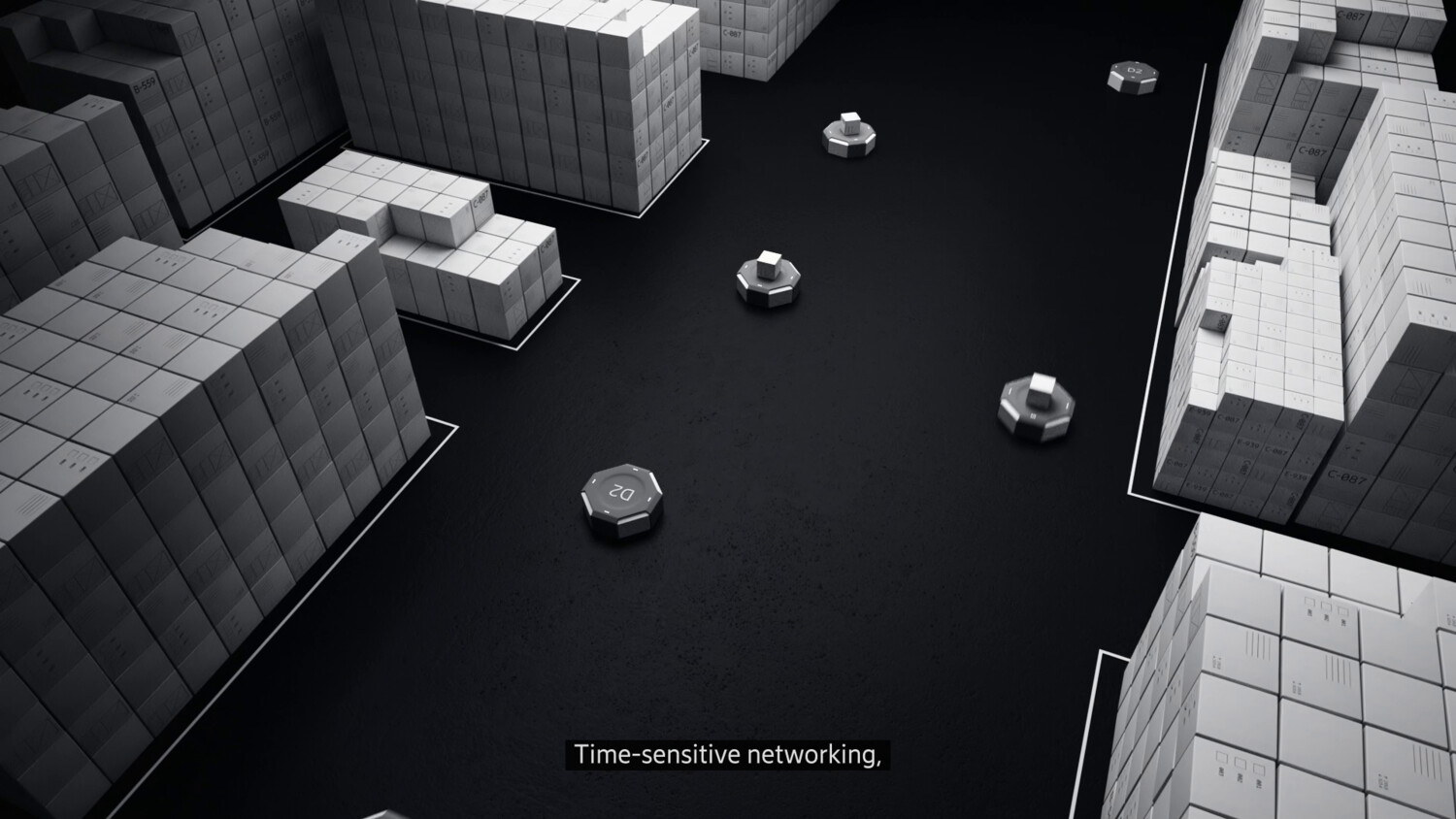
Many industries can benefit from integrating devices with time-critical requirements wirelessly into their systems.
Let’s think about some examples:
- Imagine AR glasses used by everyone in the street, just like smartphones today. You would see navigation signs, translated text or other information blended in onto your AR glasses. To allow for small-form factors and long battery life, heavy processing needs to be off-loaded from the AR device itself to the edge cloud. A 5G connection with bounded latency makes this possible.
- Similarly, real-time media or online gaming devices wirelessly connected via 5G can be enhanced with additional information and processing in the edge cloud and provide much richer interactivity with other users.
- Vehicles and machines operating in hazardous environments can be remote-controlled, based on video or AR overlay, with a robust wireless connection. The vehicles may even be integrated in a mobility automation system controlled by the edge cloud itself.
- In smart manufacturing environments, simplicity and flexibility for any reconfiguration of the factory is dramatically increased by replacing cables with dependable wireless connections. Sensors and machines, like robots, may then be operated by the central controller in a server room of the factory.
These use cases all depend on a fast, dynamic response to changes in the environment, and therefore rely on interaction between the wirelessly connected entities with short round-trip times, which for the use cases above, lie in the tens of millisecond to one millisecond range. It’s important to reach these latencies with a very high probability (reliability) for the systems to operate properly. These reliabilities, expressed in success rates of packets reaching the latency, are in the order of 99 to 99.999 percent.

Read more about Critical IoT
Find more examples of use cases and their requirements in this Ericsson Technology Review article on Critical IoT connectivity.
Click here
What’s the problem that needs to be solved?
In wireless communication, the reliability bottleneck was traditionally the radio interface. Over-the-air transmission reliability is limited by the available bandwidth and signal-to-noise ratio at the receiver, which is impacted by signal pathloss and link stability of the wireless transmission.
So, what can be done to improve reliability for a single connection? You could, for example, allocate more spectrum to make the transmission of the same information wider in frequency while keeping the latency the same. Alternatively, you could make the transmission longer in time or repeat the same information when needed, as is achieved with hybrid-automated repeat request (HARQ) retransmissions, which would, however, increase the latency.
In cellular systems, spectrum resources are scarce and are shared among all connected devices in the cell. Devices require more or less time and spectrum resources to keep the connection up, depending on application requirements and on their current radio conditions. So, to improve reliability, the system needs to be organized so that the right amount of spectrum is used by the right device at the right time.
How does 5G NR provide URLLC and bounded low latency?
The base station with its scheduler is the controller (the “brain”) of all devices in the cell. Quality of service (QoS) and bounded low latency are achieved by centralized admission control and scheduling of the wireless frequency resources, which are typically licensed frequency bands assigned to a network operator. The scheduler can choose from a variety of features to achieve QoS in terms of latency and reliability for the user.
For a certain segment of spectrum, the NR base station (gNB) scheduler can choose the spectral characteristics of a signal, which also includes the duration of a schedulable transmission slot, i.e. the time granularity. For a typical NR mid-band spectrum around 3.5 Ghz, the slot duration is 0.5 ms; and for mmWave spectrum it is even shorter, i.e. 0.125ms.
Furthermore, processing times also need to be accounted for. In NR, the encoding and decoding of the transmissions can be as fast as a fraction of the actual slot duration. Another latency component is the alignment delay, i.e. the time from when data becomes available until the next transmission slot starts. The NR standard also allows sub-dividing a slot further into sub-slots. With seven sub-slots, the duration would be shortened from 0.5ms to ~0.071ms for mid-band, or from 0.125 ms to ~0.02 ms for mmWave. Latency-critical application data would, when using these techniques, wait less until the next transmission opportunity and as a result, transmit the data faster over the air. In addition, the round-trip time until a HARQ retransmission occurs scales down – if it’s the case that the initial transmission did not succeed.
In figure 1 below, we get an impression of how fast NR can deliver data over the air, with and without retransmissions and for different configurations. Please note that the results are based on typical processing delay values, while actual product performance may differ depending on implementation. We assumed a typically used time-division duplex (TDD) split of 4DL:1UL (DDDSU) slots for the resources into downlink (DL) and uplink (UL) in these spectrum ranges. A worst case alignment delay between traffic arrival and slot start is assumed.
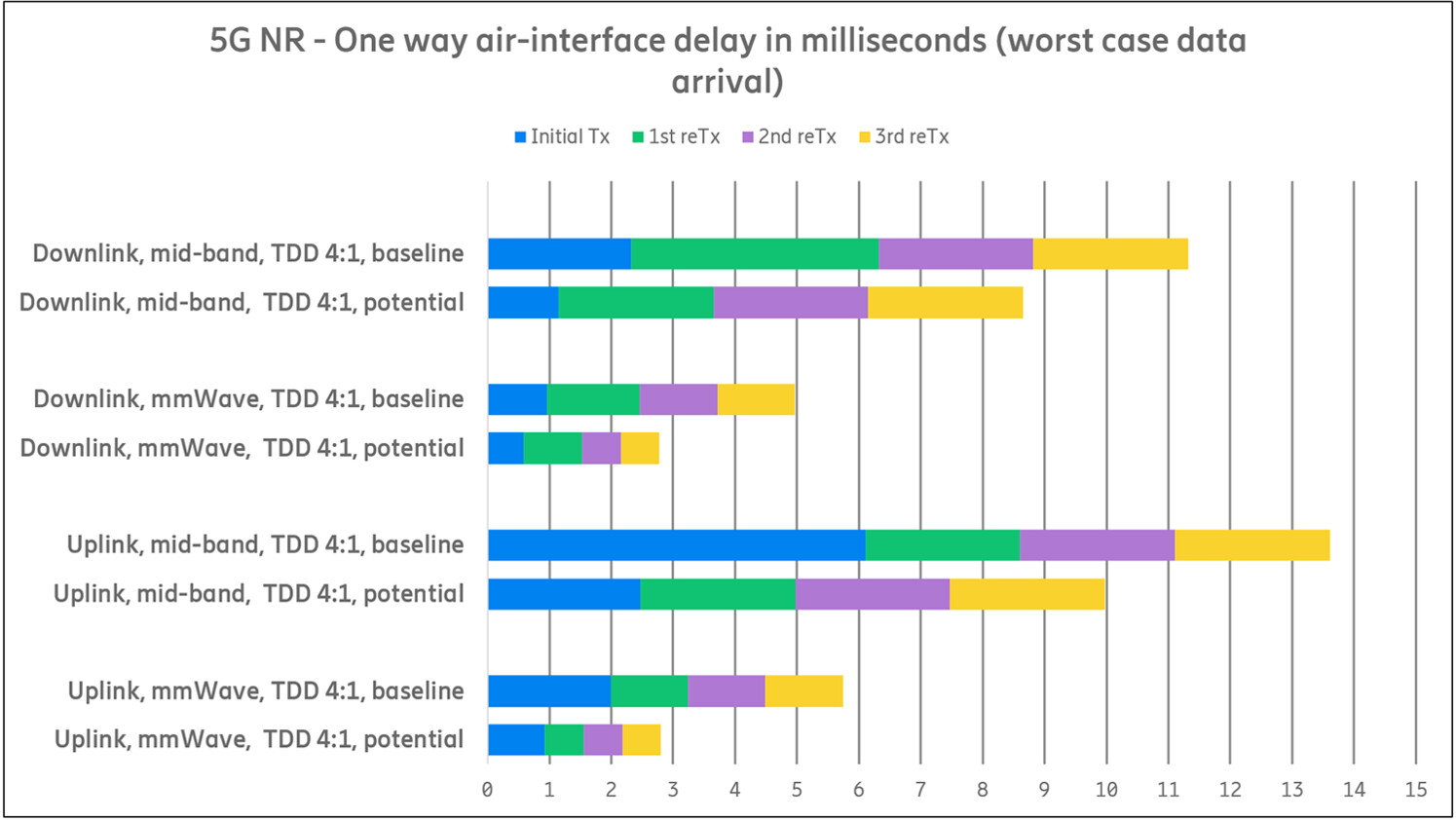
Figure 1: 5G NR one-way radio interface delay in milliseconds.
|
Assumptions for the figure: TDD configuration DDDSU, with D=DL slot, U=UL slot, and S=mixed slot |
|
Baseline:
Scheduling delay is 0.5 ms. |
|
Potential:
|
We can also rely on the extra robust transmission modes specified for NR for increased reliability, for both data and control radio channels. Reliability is further improved by various techniques, such as multi-antenna transmission, the use of multiple carriers and packet duplication over independent radio links. NR also provides full mobility support, which is an important reliability aspect not only for devices that are moving, but also for stationary devices in a changing environment (for example, with other objects like vehicles or machinery moving into the line of sight of the stationary device).
As mentioned, since the NR over-the-air transmissions in both UL and DL are centrally scheduled by the gNB, we can ensure radio resource efficiency, fairness of resource usage, and differentiated QoS treatment among applications and users. While in dynamic DL scheduling, transmission can be initiated immediately when DL data becomes available in the gNB, for dynamic UL scheduling, it is more complicated. If UL data becomes available but no UL resources are yet assigned, the UE indicates the need for UL resources to the gNB via a scheduling request (SR) message, and is subsequently assigned the needed resources for transmission.
To avoid the latency introduced in the scheduling request loop, UL radio resources can also be pre-scheduled.
In particular for periodical traffic patterns, as one would find in the critical communication use cases mentioned above, the pre-scheduling can rely on the UL configured grant (CG) feature. With this feature, periodically recurring UL resources can be preassigned for a device. Many of these configurations are supported in parallel, to serve multiple parallel UL traffic flows on the same device. An example is an industrial robot with multiple servo engines, sensors and a camera connected via the same 5G device to the system. In this case, besides time-critical data, other non-critical data (for example video or updates) needs to be transmitted too, from time to time.
However, it’s important to ensure that the non-critical data does not block the critical data transmissions. Therefore, as part of giving priority and faster radio access to URLLC traffic, NR introduces prioritization and pre-emption, where URLLC data transmission is prioritized or even pre-empts ongoing non-URLLC transmissions.
In Figure 2 below, we can see how multiple parallel critical (URLLC) and non-critical (eMBB) data flows of a UE can be scheduled efficiently. Periodically configured grant resources with a robust allocation are provided to the time-critical recurring data, while a larger segment of resources with a normal allocation is provided to the non-critical data bursts, dynamically and on-demand only. Restrictions can be configured for the critical data flows to only use the robust configured grant resources. This in turn allows scheduling of the non-critical burst data with a spectrally efficient non-robust dynamic grant without the risk of transmitting critical data on it.
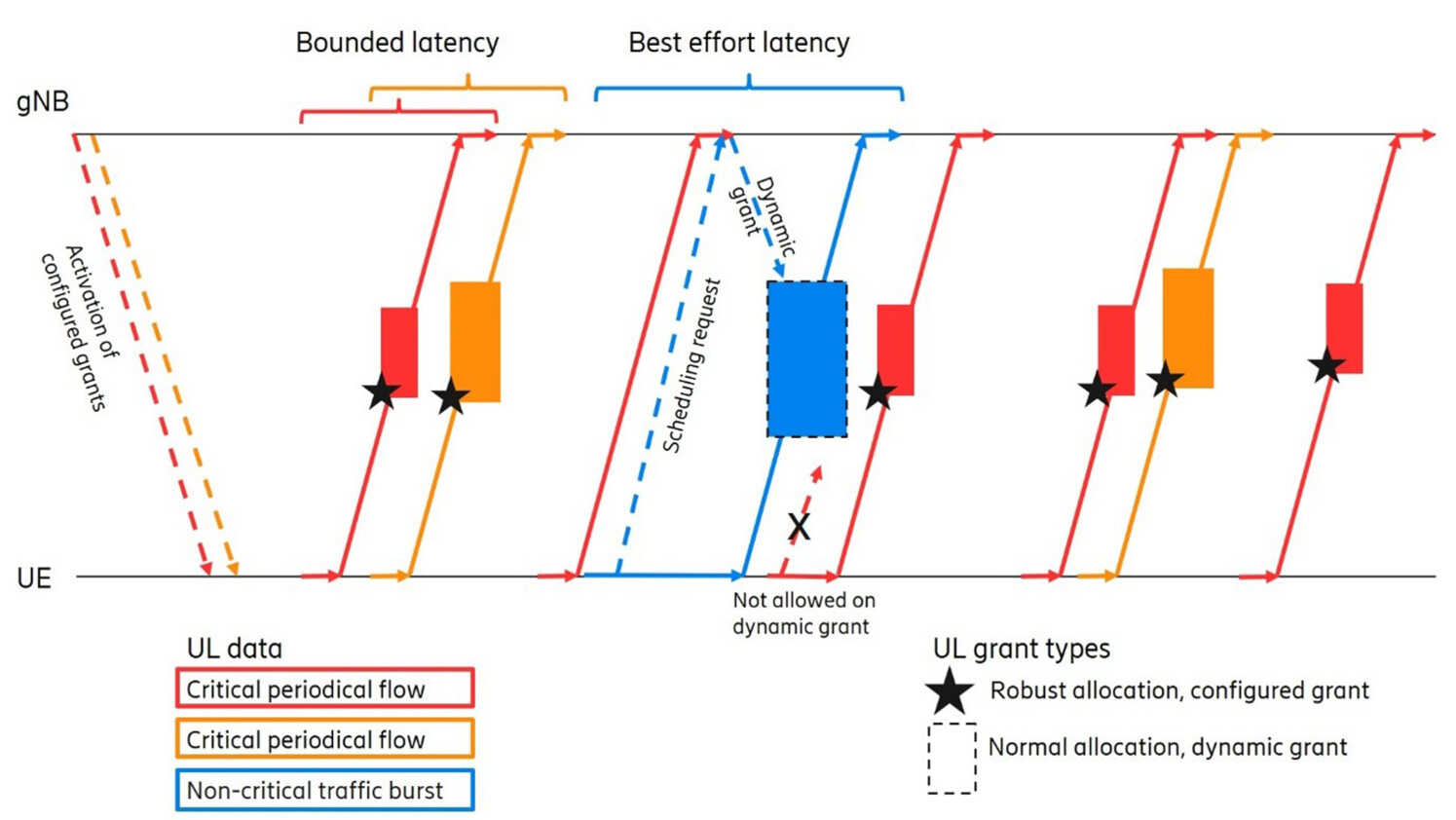
Figure 2: Configured grants for time-critical periodical data intertwined with an on-demand grant for non-critical data bursts.
5G is ready for real-time applications
5G NR is equipped to reach the challenging requirements of time-critical communication use cases. With 5G, we will see exciting new real-time applications in the areas of media and AR, remote driving and industrial control systems coming to life soon.
Read more about 5G and Industry IoT
Whitepapers:
5G evolution: 3GPP releases 16 & 17 overview.
Read more about our research on 5G evolution and 6G.
Explore IoT