










Using the CSP network for enterprise service innovation

Senior Product Marketing Manager

Senior Product Marketing Manager
Senior Product Marketing Manager
Recently, TIM announced they are partnering with Google Cloud and Ericsson to create Italy’s first 5G Cloud Network. This move will benefit TIM’s enterprise customers by providing 5G based edge offerings, including digitalizing and automating their logistics and production processes. This important milestone increases communication service providers’ (CSPs) ambitions in this segment and will be a key source of revenue growth for the industry going forward. Earlier, Telstra and Telefónica Germany both took bold steps in this direction. It’s encouraging to see these three leading industry players stepping up their efforts to provide new services.
For decades CSPs have been very strong in providing connectivity related services towards both consumers and enterprises. With 5G and edge computing becoming more common, new service opportunities are sharply increasing, especially in the enterprise market. But how can CSPs utilize existing assets, combine the new capabilities associated with service exposure, orchestration and edge and become even more relevant to their business customers?
Meeting enterprise needs in the emerging ecosystem
To facilitate the innovation and introduction of new enterprise services, CSPs are starting to evolve their networks to make the 3GPP based wireless communication platform ready for new use cases, through programmability and ease of use.
At the same time, the enterprise supplier landscape is changing, partnerships, co-creation and other forms of cooperation are a must for designing and delivering a solution - starting from a use case perspective rather than from a technology perspective. Hyperscale cloud providers (HCPs), operations technology (OT) vendors, system integrators (SI), specialized and generalists, network vendors and, of course, application developers are part of this new ecosystem. CSPs are also key players, turning their networks into platforms for fast development and delivery of new services based on self-service capabilities and automation. These platforms will provide capabilities such as congestion prediction, prioritized access, application detection, guaranteed maximum latency, especially for application developers, system integrators and hyperscale cloud providers.
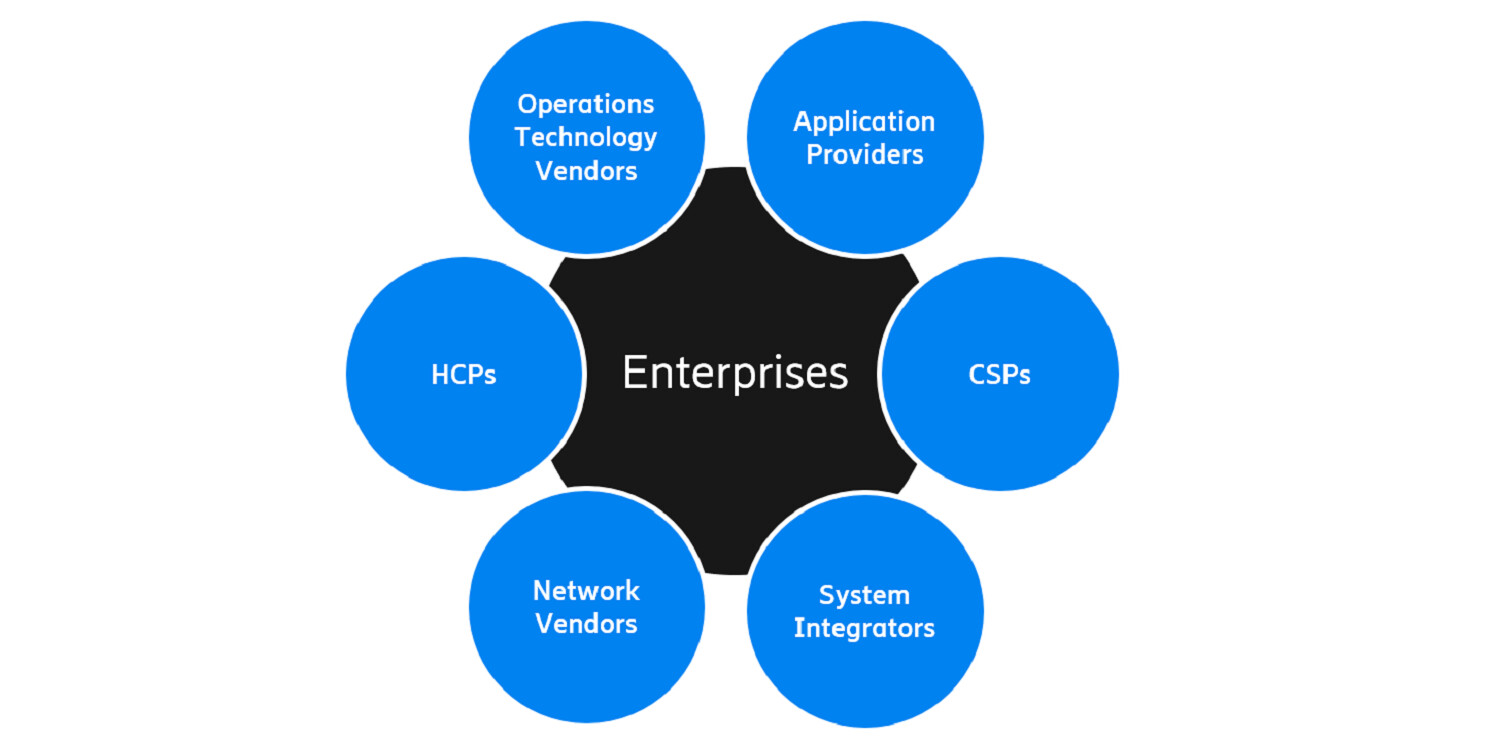
The enterprise ecosystem
Three key enablers for new CSP enterprise business
The 5G network is the most foundational enabler for CSPs addressing the enterprise opportunity. In addition, orchestration, automation and exposure will play key roles in making many new use cases happen. Using these capabilities will create a more flexible and innovative service creation environment and it will be easier for developers to take advantage of a vast number network capabilities when creating new or improving already existing applications. The ecosystem overall can look forward these three main benefits:
- Increased choice for enterprises, as CSPs make network capabilities and applications available in multiple ecosystems with orchestration across multi-cloud and multi-vendor environments.
- Dramatically decreased customer provisioning time - from weeks to minutes when onboarding virtual network services for enterprise business, such as SD-WAN.
- Delivered end-to-end (e2e) services with automated workload placement, deployment, and network slice orchestration across all sites. Automation and zero-touch capabilities are foundational in minimizing the need for human intervention.
Orchestration and automation
With the additional capabilities brought by 5G, it is imperative that networks are agile in communicating with the broader enterprise ecosystem in a simplified manner. Exposure via strategic APIs is key when engaging with the ecosystem, but given today’s complex, manual network operations, the response times for inbound API requests could take weeks to months. Hence, network automation is fundamental.
Many 5G use cases are expected to be geographically distributed and technically diverse in terms of cloud environments. Some examples of key areas of automation that are underway and relevant in this context are virtual network functions/cloud native network functions (VNF/CNF) orchestration on multi-clouds, HCP orchestration, smart workload placement and service level agreement (SLA) management and assurance. Particularly relevant going forward, given the competitive and partnering dynamics, is HCP orchestration.
Service exposure
Service exposure means making network capabilities, such as data and network services, easily available for customers and partners to innovate without the need for detailed knowledge about the network. With assigned security and data integrity policies, network data and resources can be accessed by different ecosystems to enrich applications. The exposed capabilities add value to internal or external users, for example around connectivity, optimization, identity, security, data and analytics.
New capabilities increase service providers’ relevance
CSPs have a great opportunity to increase their relevance in the ecosystem and grow beyond being specialized connectivity providers by utilizing their unique capabilities and assets in connectivity, end-to-end customer experience, and edge computing in combination with orchestration and service exposure. By leveraging a multi-cloud approach, CSPs can make deployments more flexible and meet most technical requirements from applications. Multi-cloud means that private (on-prem) cloud, telco cloud and public clouds can be used in various combinations to deliver optimal service. This will make it easier to deliver customer tailored use cases and specific solutions targeting various enterprise and industry vertical needs.
What can an equipment vendor like Ericsson contribute with in the ecosystem? As an example, we are supporting TIM in exploring the CSP value in the enterprise ecosystem by executing a proof of concept together with Google, where Ericsson is providing key components such as 5G Core deployed on our Cloud Container Distribution while Ericsson Orchestrator is used as the end-to-end resource and application orchestration solution. This is a side-by-side deployment, which means that 5G Core is running in the telecom cloud environment and the enterprise applications are running in the Google Cloud environment. This architectural setup is able to support a clear business ambition from TIM to scale it up for commercial implementation.
To learn more about how Ericsson works to support CSPs in their enterprise ambitions from an orchestration, exposure and edge perspective, please view our web page for enterprise service orchestration.
To read the latest news about Ericsson and Google Cloud’s partnership to deliver 5G and edge cloud solutions for telecommunications companies and enterprises, read this press release.