










Converging cellular and non-cellular capillary networks in the last hop of the last mile

Principal Solution Manager, MANA BD CTO Team

Principal Solution Manager, MANA BD CTO Team
Principal Solution Manager, MANA BD CTO Team
In previous blogs, we reviewed power grid structure and how LTE plays a major role interconnecting power generation with distribution through substations. We then addressed the last mile of power delivery, where it is increasingly critical to protect people and assets in communities. This blog addresses the last hop in the last mile, where wireless connectivity is often delivered over legacy non-3GPP wireless. These capillary networks in the last hop feed into reliability of private LTE wide area networks in the last mile.
The power grid today contains numerous purpose-built capillary networks, each optimized for a single use case. Capillary networks consist of a capillary gateway (CGW) and many devices served by that gateway. Performance, reliability and consolidation call for multipurpose networks in the last hop. The logical next step is to merge these access networks by leveraging the common core infrastructure provided by private LTE through Converged Cellular Capillary Networks.
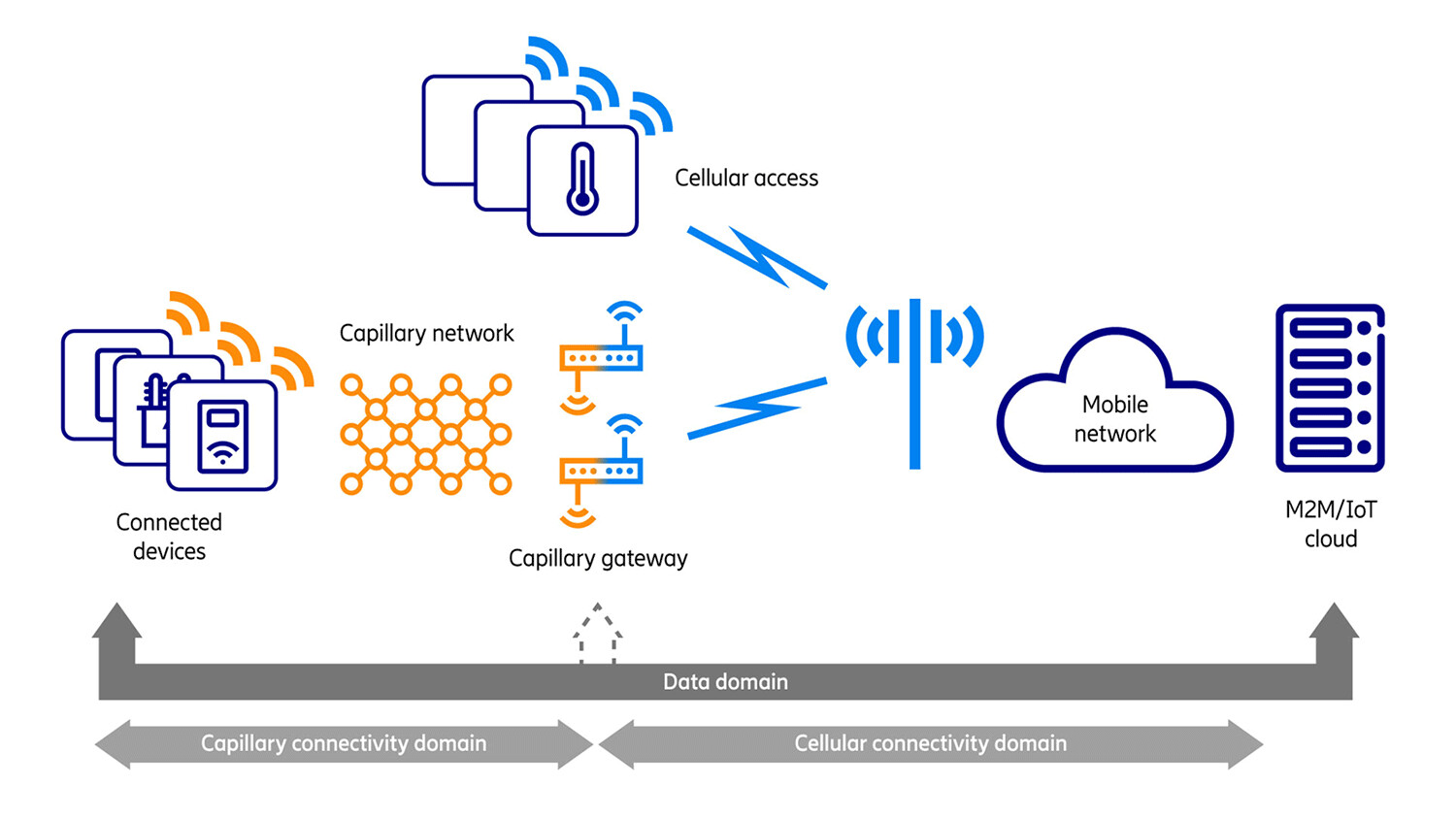
Figure 1: Converged Cellular Capillary Networks bring 3GPP and non-3GPP devices into a single multi-use-case network.
Connectivity today
To address the last mile and the last hop, cellular technologies such as LTE have evolved with new device and network categories that include wideband LTE, narrowband IoT and Category M. These categories allow simpler and less expensive LTE modems for connected devices that can increase LTE coverage by 15–20dB. Ericsson deployments in the vast stretches of Australia have leveraged this enhanced coverage to enable connectivity far and wide. This extended network can also enable Utilities access to devices in remote or challenging locations, such as a smart meter in a basement. With the price of LTE modules dropping, these “chip-under-glass” devices constitute the cellular access components.
Capillary networks and the local, short-range communications technologies that enable them provide connectivity for millions of devices with many individual use cases. Examples of the technologies include Bluetooth Low Energy (BLE), IEEE 802.15.4 and IEEE 802.11ah. These mesh networks provide connectivity efficiently to devices within a specific local area. Typically, capillary networks connect to the edge of a communication infrastructure to, for example, reach utility head end systems hosted on the internet or in a cloud.
Connecting a capillary network to the global communication infrastructure can be achieved through a cellular network, which can be a wide-area network or an indoor cellular solution. The gateway between the cellular network and a mesh capillary network acts just like any other user equipment when that gateway is enabled with a SIM.
The converged cellular capillary network
A capillary network consists of the following (see Figure 1):
- Devices that may not be compliant with end-to-end 3GPP security but have a well-established trust relationship with their gateway. These may be running on license-exempt, low-power short-range technologies such as Wi-Fi, Zigbee or BLE.
- Capillary gateway (CGW) serving these devices and providing a connection to the internet.
- Cellular connectivity domain that connects these gateways to the internet or device head end systems. These are often served with best-effort consumer networks today, and can be enhanced with dedicated private LTE networks.
One advantage of integrating capillary gateways into a common LTE core is the ability to move some head-end and meter data-management processing towards the edge. This enables pre-processing on capillary network data earlier at the community level to optimize processing at existing head ends.
Here are three other advantages of consolidating across single use capillary gateways and common LTE core, with more details following:
- Consolidation, priority and pre-emption can be applied across 3GPP and non-3GPP networks, with each of the CGWs use cases mapped to QoS in the LTE packet core. Consolidation of use cases at the head end is now possible as the LTE packet core can classify traffic based on the CGW.
- Scalable management of devices across use cases is now possible on a common management infrastructure. Delegated configuration of devices reduces network planning and offers centralized security and reliability of a common private LTE core.
- Smart multiple use case devices can evolve to re-select based upon use case to the correct CGW, as the converged architecture allows for the device to be assigned an updated priority without impacting CGW functionality.
Consolidation, priority and pre-emption
To provide QoS end-to-end, a bridge is needed between the QoS domains of the capillary and cellular networks. This bridge specifies how traffic from one domain (through a domain-specific QoS treatment) is mapped to a specific QoS level in the other. The specifics of the QoS bridge are determined in a Service Level Agreement (SLA) established between the providers of the capillary network domain and the cellular connectivity domain, or between the service owner (in the data domain) and the connectivity domain providers. Consolidation can be extended on the common LTE core to include centralized IP pools that are shared between capillary networks. Such consolidation allows for more seamless use case transitions in a multipurpose scenario and better predictability in design of the Converged Cellular Capillary Network. Many of the concepts used in Ericsson networks to manage competing priorities in traffic flows are easily applicable for addressing the complexities of a capillary network.
Scalable management
A range of tasks is now fulfilled by network management. One example is ensuring automatic configuration and connectivity for devices connected through a capillary network. Also, network management establishes access control restrictions and data treatment rules for QoS based on SLAs, subscriptions and security policies. In addition, a utility provider can use the management function to adapt service policies and add or remove devices.
Network management of connected devices in capillary networks poses new challenges, especially as compared to management of cellular networks. This is partly due to the vast number of connected devices, which is far greater than the number of elements handled by today’s network management systems. Instead of handling devices as individual nodes, economies of scale can be achieved by handling devices in groups that use policies and managed parameters that are more abstract and also fewer in number.
A significant challenge for network management is the provision of full end-to-end scope, an issue that is particularly evident when different domains in the end-to-end chain are provided by different business entities. The best way to overcome this limitation is to interconnect the network management systems in the different domains. The resulting cross-domain management provides end-to-end management opportunities. For example, QoS in both the capillary and the 3GPP domains can be matched, and alarms from both domains can be correlated to pinpoint faults. Business Support Systems with the added intelligence from AI/ML algorithms enable efficient management of the mixed network
Smart multiple use case devices
As devices evolve to doing multiple things (your electric meter reporting on the weather?), the single use-case gateways have to either evolve, or the devices need to get smart in selecting the right gateway. The process of gateway selection by the device is functionality that can be leveraged from the common LTE core infrastructure. Some of the criteria involved in this selection would include the collection of connectivity and policy constraints per gateway, applying those constraints in picking a gateway, informing the gateways of that decision and rerouting of device traffic based on the new use case activated by the multipurpose device. Design considerations may lead to co-location of this intelligence within the core network, or individually within the gateways.
Conclusion
The grid modernization journey towards consolidation of the last mile with the last hop requires many considerations. Convergence of 3GPP (cellular) and non-3GPP (non-cellular) networks is possible with a Converged Cellular Capillary Network that allows for the following:
- Consolidates SIM, eSIM and non-SIM solutions in a single wireless network.
- Aligns IP planning and address preservation and predictability across multiple connectivity domains to set the stage for evolution of those domains towards LTE.
- Work and schedules LTE solutions across capillary gateways to balance performance, load and use cases.
- Manages devices and network elements in a common architecture.
- Extends security relationships between domains to establish greater control over the flow of information.
With over 145 years of experience working across wireline and wireless technologies, we are excited to be part of digital transformation in the utilities space too. I look forward to deep diving in my next blog into how capillary networks introduced in this blog will integrate into 5G and other wireless technologies—bringing it all together!
Read the entire blog post series where we unpack the state of the digital power grid and show how private networks are enabling utilities to achieve their goals.
- Wireless: The smart network for the smart grid and grid modernization
- Wireless brings low latency, high performance to interconnect generation, distribution in the power grid
- The wireless power substation: transformation towards power grid sustainability
- Why LTE wireless brings power grid security, convenience, and convergence to the last mile
References:
- Capillary networks – a smart way to get things connected
- Gateway Selection in Capillary Networks
- Wi-Fi for the Internet of Things
Read more
Explore modern network management approaches that give you greater visibility and control across today's increasingly complex networks.
Discover how private networks deliver secure, reliable and tailored connectivity for enterprise and industrial environments.