The power of 5G Carrier Aggregation

Strategic Product Manager, Business Area Networks

Strategic Product Manager, Business Area Networks
Strategic Product Manager, Business Area Networks
Strategic Product Manager, Business Area Networks
Strategic Product Manager, Business Area Networks
Strategic Product Manager, Business Area Networks

Why is Carrier Aggregation important for 5G?
A wise person once said that nothing is impossible when you leverage the power of Carrier Aggregation for 5G. While that person may or may not be real, the message is 100 percent true. Carrier Aggregation for 5G can play a significant role in extending coverage and increasing network capacity.
First, let’s look at what a fully coordinated, multi-layer 5G network is. It has three layers, each with its own set of characteristics and benefits as shown in Figure 1 below.
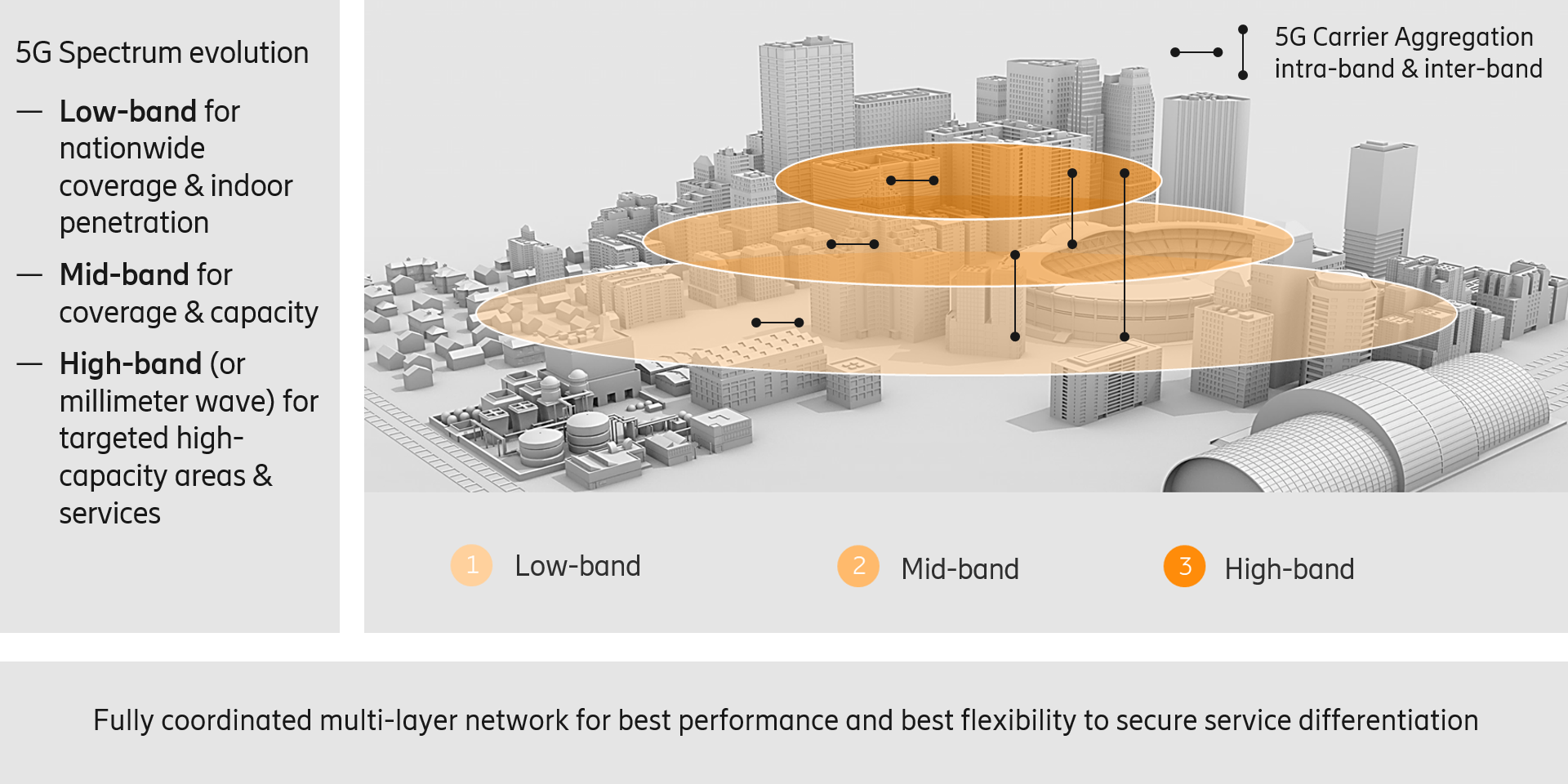
Figure 1: A Complete 5G Network with Carrier Aggregation
5G low-band (below 7GHz frequency division duplex, FDD) is the most commonly deployed band. It provides a wide coverage area because it has a lower frequency. However, it is limited in capacity.
5G mid-band (below 7GHz, time division duplex, TDD) is the sweet spot for 5G deployments. It has a higher bandwidth and capacity compared to the low-band. However, its uplink coverage is more limited than the low-band.
5G high-band or millimeter wave (above 24GHz) delivers unprecedented peak rates and low latency but comes with poorer uplink coverage compared to both the mid- and low-bands.
To support the wide range of 5G deployment scenarios from large cells with sub-1GHz carrier frequency up to millimeter wave (mmWave) deployments with very wide spectrum allocations, 5G supports a flexible numerology. This flexible numerology allows a range of subcarrier spacing (SCS) from 15kHz to 240kHz with different slot lengths, as illustrated in tables 1.1 and 1.2 below. In comparison, LTE only supports a fixed 15kHz subcarrier spacing and a fixed slot length of 1 millisecond (ms).
| Frequency range designation | Frequency rance |
|---|---|
| FR1 | 410MHz - 7125MHz |
| FR2 | 24250MHz - 52600MHz |
Table 1.1: 3GPP definition of 5G frequency ranges
| Frequency band | Duplex mode | Numerology | Sub-carrier spacing (SCS) | Slot length |
|---|---|---|---|---|
| FR1 Low-band | FDD | 0 | 15KHz | 1ms |
| FR1 Mid-band | TDD | 1 | 30KHz | 500us |
| FR2 High-band | TDD | 3 | 120KHz | 125us |
Table 1.2: 5G frequency bands
Given the diversity of spectrum available globally, it is essential that we aggregate the different frequency bands using 5G Carrier Aggregation. This is done to improve cell coverage and deliver higher peak rates.
Let’s refresh our memory: The basics of Carrier Aggregation
Carrier Aggregation was first introduced in long-term evolution (LTE) by the third-generation partnership project (3GPP) Release 10 to combine different chunks of spectrum for higher peak rates. It turned out to be very successful and Carrier Aggregation has become an industry standard (it even gets capital letters!).
When a network aggregates two or more chunks of spectrum, one will play a more important role than the other(s). Each chunk is referred to as a component carrier (CC), with the most important one being the primary component carrier (PCC). The following are called secondary component carrier(s) (SCC). One thing that distinguishes the PCC from the SCC is that all the uplink data, as well as both control and user data, is sent on the PCC. The cell serving the PCC is called a primary cell (PCell) and the cell serving the SCC is called a secondary cell (SCell).
In 5G, different frequency bands with diverse numerologies and slot lengths add complexity to Carrier Aggregation. Now, the Carrier Aggregation design needs to be clever enough to combine PCells and SCells that could differ in terms of slot lengths.
Maximizing mid-band coverage with Carrier Aggregation
Let’s look at downlink (DL) Carrier Aggregation between the low- and mid-bands: The low-band has a slot length of 1 millisecond (1ms), whereas the mid-band has a slot length of 500 microseconds (us). This means that in 1ms, there is 1 DL slot for data transmission for the low-band, but 2 DL slots for data transmission in the mid-band. The Carrier Aggregation feature design must account for this difference while coordinating between the PCells and SCells. Also, it must do so while transmitting data over the air to the end-users in the network. Ericsson has come up with an innovative design for DL Carrier Aggregation that overcomes this complexity of different numerologies. We became the world’s first vendor to release this feature when we launched it in December 2020.
The higher frequency TDD (mid-band or high-band) is much more limited in coverage compared to the low-band, and the coverage-limiting channels are in the uplink (UL). This impacts the DL coverage of the TDD cell. Ericsson's low/mid-band DL Carrier Aggregation feature combines carriers belonging to different numerologies. By using low-band as the primary cell, the coverage-limiting UL data and control channels of the mid-band carrier can be moved to the low-band as illustrated in Figure 2 and Figure 3. This increases the overall mid-band DL cell coverage, which means that now the mid-band spectrum can be accessed by more users in the network, leading to an increase in overall network capacity.

Figure 2: Increasing mid-band downlink coverage with Carrier Aggregation
| CA | DC | |
|---|---|---|
| SSB | ||
| MSG1 (PRACH) | ||
| MSG2 (PDCCH, PDSCH) | ||
| MSG3 (PUSCH) | ||
| PDCCH (DCI) | ||
| PUCCH (UCI, SR, HARQ, FB) | ||
| PDSCH (data) | ||
| PUSCH (data) | ||
| CSI feedback (PUSCH/PUCCH) | ||
| RLC ack (PUSCH) | ||
| SIB1 (PDCCH/PDSCH) |
Can be moved from mid-band to low-band
Cannot be moved from mid-band to low-band
Can be moved with Release 16 Cross Carrier Scheduling
Figure 3: Carrier Aggregation (CA) versus Dual Connectivity (DC): Moving coverage limiting control channels to the low-band
Advanced RAN Coordination: Key enabler for Carrier Aggregation
Advanced radio access network (RAN) Coordination is an Ericsson innovation that provides a low-latency coordination interface between two RAN Compute products. It enables high-performing 5G Carrier Aggregation even when the carriers are split across different RAN Compute products.
This coordination framework allows service providers the flexibility to deploy carriers across the same site or different geographical sites while aggregating the frequency bands for higher peak rates and coverage extension. It means they can configure a dynamic coordination set of partner RAN Compute products that changes as the user moves around in the network – with all coordination features such as Carrier Aggregation and UL-coordinated multi-point (CoMP) possible within the coordination set. This interface is commonly referred to as E5. In LTE, it is called Elastic RAN.
During 5G Carrier Aggregation feature development, the feature design was enhanced to handle the complexity of supporting Carrier Aggregation across different numerologies, as described above. This new design allows more flexible round-trip time requirements between the two 5G base stations (gNBs) as compared to LTE. The new 5G coordination framework is called Advanced RAN Coordination and it is an enabler of inter-numerology and inter-RAN Compute Carrier Aggregation features.
Advanced RAN Coordination (ARC) is a future-proof solution, supported across the RAN Compute portfolio. We build on our in-depth knowledge to develop high-performing future Cloud RAN solutions too. Embracing and evolving our design philosophy, ARC will be used to support inter-platform Carrier Aggregation between Ericsson Radio System (ERS) and Cloud RAN platforms as well- demonstrating the true potential, scalability, and benefits of our innovative coordination framework.
Superior performance with Carrier Aggregation
Ericsson has been leading the way when it comes to mid-band coverage extension with Carrier Aggregation. Field results from customer deployments and trials show TDD DL cell coverage extension gain of more than 60 percent mid-band reach compared to dual connectivity, allowing a higher number of end-users to access the TDD spectrum. In the case of the 3.5GHz mid-band, the Coverage Boost capabilities of Ericsson´s 5G Carrier Aggregation have been confirmed during Ericsson’s Carrier Aggregation trial together with Telia Norway.
We believe that aggregating spectrum is one of the most efficient ways to enable higher single-user peak rates and increase spectrum efficiency in communications service providers’ networks. We expanded our Carrier Aggregation offering back in 2019 to include the frequency bands in 5G. The first Carrier Aggregation feature to be introduced was for mmWave: 4CC DL Carrier Aggregation for up to 4x100MHz of spectrum.
Today in mmWave, we support 8CC DL CA aggregating up to 800MHz of spectrum with a peak rate of 4.2Gbps, and 2CC UL Carrier Aggregation with a peak rate of 216Mbps.
At this point, you may be asking yourself- How do these higher peak rates with Carrier Aggregation benefit me as a consumer? To answer that, let’s say you are downloading an episode of your favorite TV series to watch during your commute. A 45-60-minute episode is approximately 1 gigabyte (GB).
- With mmWave 8CC DL CA, it would take you only 1.9 seconds to download the full 1GB episode
- With mid-band 2CC DL CA, it would take you only 2.6 seconds to download the full 1GB episode
We think this is pretty fast. No matter what TV show you’re currently binge-watching, in just a few seconds you’ll have nearly an hour’s worth of entertainment for your trip home!
The Carrier Aggregation evolution story
Ericsson’s long tradition of supporting Carrier Aggregation functionality stretches all the way back to 2010 when the first combination in LTE was introduced. Over the years, the number of frequency bands and component carriers that can be supported has grown significantly.
The biggest difference and also the biggest challenge compared to previous technologies is the many different combinations that can be supported in 5G Carrier Aggregation. Aspects like standalone (SA) and non-standalone (NSA), intra-RAN Compute and inter-RAN Compute, intra-numerology and inter-numerology, intra-band and inter-band, all contribute to very complex network requirements.
Ericsson’s innovative solution is designed to help service providers achieve Carrier Aggregation for many different band combinations. Today Ericsson offers both SA and NSA feature support for:
- mmWave downlink 8CC and uplink 2CC carrier aggregation
- Mid-band downlink 2CC carrier aggregation
- Low-band downlink 3CC carrier aggregation
- Low/mid-band downlink 2CC carrier aggregation with FDD as PCell
An ecosystem that benefits everyone
We are avid supporters of third-party interoperability. This is why Ericsson has the most ambitious interoperability design test program in the industry. The goal is to secure base station and user equipment (UE) interoperability with 3GPP compliance.
Ericsson is heavily influencing the Carrier Aggregation ecosystem- we collaborate with all major chipset vendors for the benefit of the whole industry. We have achieved significant milestones with key customers and ecosystem partners.
Delivering a great 5G user experience with Carrier Aggregation
We are continuously designing innovative solutions for optimizing 5G networks. With 5G Carrier Aggregation Coverage Boost between low-band and mid-band, we are increasing the cell coverage of the mid-band enabling it to have a much higher capacity- making it a more spectrum efficient investment for service providers.
Throughout this journey of evolving 5G Carrier Aggregation features from concept to reality, our focus has been on improving both the performance and the spectral efficiency of networks to deliver a great 5G user experience. This focus and strategy has made Ericsson an industry leader in 5G Carrier Aggregation, and we are just getting started!
Read more:
- Explore the Tech Unveiled blogs and videos
- Visit the Ericsson Carrier Aggregation in 5G page
- Explore 5G