









Why no one path can lead to full enterprise resilience

Research Leader Industry Lab

Research Leader Industry Lab
Research Leader Industry Lab
Listen to the audio
In April of 1997, my American relatives, living in Grand Forks, North Dakota, woke up to the sound of sirens – the Red River was reaching a 100-year flood level event. The efforts made by the fire brigade and countless volunteers had not been enough and the water quickly flood a massive part of the town. Over 50 000 people were forced to evacuate their homes and businesses.
The cause of this natural disaster was an unfortunate combination of an unusually harsh winter of 1996-97, combined with the 1997 spring floods and a blizzard on April 5-6, 1997.
Thousands of people, including my relatives, were forced to watch as their homes were destroyed by the water masses. In total, the disaster caused over $5 billion in damage to the region (National Oceanic and Atmospheric Administration, 1997b).

Above: The growing frequency of natural disasters, such as the Red River floods in April 1997 (above), places new demands on enterprises to ensure resilience in coming years. Image source: U.S. Army Corp of Engineers.
In fact, over 5 200 businesses had been damaged, destroyed, or negatively impacted by the events leading up to the 1997 flooding. In Grand Forks alone, 3 out of 4 homes, 16 out of 22 schools and over 300 businesses were flooded!
To make matters even worse, several buildings in the center of Grand Forks caught fire, and the flooding made it incredibly difficult for the firefighters to get to those buildings and put out the fires. Eleven buildings, including the Grand Forks Herald building, were completely ruined by the fire, along with their news archives stretching back 120 years. Additionally, sixty apartment units were engulfed by the flames before the fire could be contained.
Truth be told, I had more or less forgotten all about this whole catastrophe, if it had not been for an enterprise resilience research study that we just concluded at Ericsson IndustryLab that covered exactly the topic of unexpected events and crises. As we were interviewing enterprise decision-makers in both Europe and the US about how they and their companies deal with natural disasters, pandemics and other disruptive events, the memories of the events in 1997 suddenly came back to me.
A more disruptive future awaits
According to the findings in the study, four times the number of enterprise decision-makers and employees believe that there will be more frequent and severe disruptive events in the future, compared to those that don’t.
Also, as many as 42 percent of today’s enterprise decision-makers say that natural disasters caused by climate change (such as flooding and storms) are now a key challenge for their business, with more saying they expect it to be a key challenge in future.
However, not all events are considered equal. Those identified as being the likeliest and most severe by decision-makers were energy crises, pandemics and cyberattacks. It would appear that recent world events such as the pandemic and the business consequences of the Russian invasion of Ukraine have intensified discussions among decision-makers on disruptive changes, risk management and other means of strengthening resilience.
But what does resilience actually mean for today’s enterprises?
In the Future of Enterprise #3 – “Time to rethink resilience” report, we consider an enterprise to be resilient if it is capable of handling systemic disruptions that can be random, accidental, or even intentional. How can enterprises not only survive but also evolve and thrive during times of crises and disruptive changes? We dig a little deeper into those questions below.

The future of enterprises #3
How are enterprises planning to deal with future disruptive events?
Explore moreDifferent strokes for different folks…
It may not come as a great surprise that companies differ in how they carry out their business objectives depending on their size, service/product type, industry sector and capital available, among other factors.
In our report, we identify and explore five different paths to enterprise resilience that companies are taking today, all based on the attitudes and approaches to resilience amongst the surveyed enterprises.
These five paths are:
- Employee-led
- Agile and cost-efficient
- Automation first
- Sustainability pays off
- Innovation through digitalization
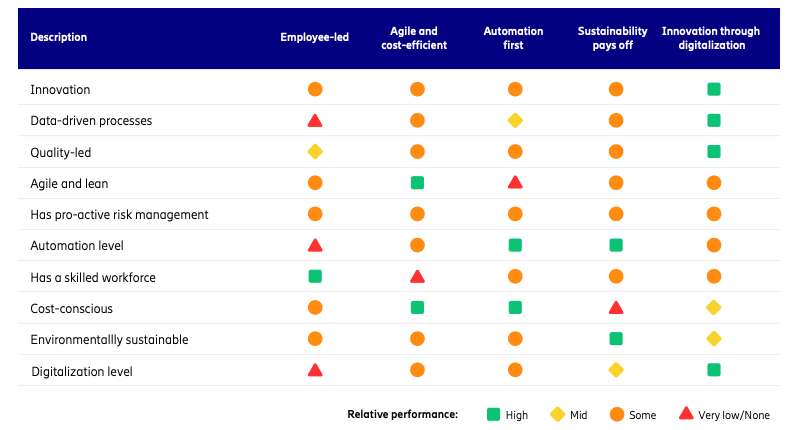
Above: Overview of key characteristics for each of the five paths to resilience.
Despite several differences – which I will cover more in detail in just a moment-- a few characteristics were also shared between the different paths.
Innovation and digitalization were key components across all five paths, as was proactive risk management and environmental sustainability. A key takeaway is thus that ICT solutions, including but not limited to cloud, telepresence and advanced wireless connectivity such as 5G were identified as core enablers across almost all resilience paths!
Let’s take a look at each of those resilience paths in more detail.
1. Employee-led: Investing in employees can offer financial strength
About one in five of enterprises surveyed have a stronger focus on employees, their skills, and work quality. Having the financial muscle to invest in attracting employees with the right skills, as well as upskilling existing employees, can lead to further financial strength, thus creating a virtuous circle.
Amongst those taking the employee-led path, resilience is often defined as being financially strong. Enterprises on this path put as much trust into ICT solutions to increase their resilience as those across other paths. These solutions include areas such as cloud, 5G and telepresence. On the other hand, they tend to exhibit less trust in areas such as AI, AR/VR and remote-controlled vehicles and machines. These enterprises have, on average, the lowest share of high-resilience ratings – more than ten percentage points lower than the path with the highest share.
It is worth mentioning that these relative differences are rather small – at most, an eleven. percentage point shift between agreeing to a great extent and agreeing to some extent. Almost none disagree on any of the resilience characteristics, regardless of their path.
2. Agile and cost-efficient: Offshoring a key resilience strategy
Only nine percent of the surveyed enterprises have taken the ‘agile and cost-efficient’ path, where key differentiators are cost-efficiency, as well as being lean and agile. Offshoring and geographical relocation are key resilience strategies which can be linked to their focus on cost-efficiency.
These enterprises display a higher-than-average risk assessment of disruptive events but are fairly average in the extent of their digitalization efforts. These enterprises are also noted for putting just as much trust as others into ICT-enabled solutions such as 5G, AR/VR, telepresence and remote-control solutions as resilience enablers. When it comes to AI and cyber security solutions, a lower share of enterprises on this path put their trust there.
Though enterprises following this path are agile, they are perhaps not as proactive as other enterprises when it comes to resilience. Similar to the employee-led path, enterprises on this path tend to rate themselves as less resilient compared to most other paths.
3. Automation first: Ensuring resilience through the pandemic
One in four enterprises surveyed are more focused on automation and cost efficiency, most of which are typically larger, more traditionally oriented enterprises. Through a continued focus on automation rather than technological innovation, resilience can be achieved while keeping productivity up.
These enterprises tend to put a lot of trust in ICT solutions as resilience enablers, including areas such as 5G, AR/VR and remote-control solutions. At the same time, few of these enterprises have confidence in cloud, telepresence, AI and cyber security solutions.
Nearly half of enterprises taking this path came out of the pandemic better off than before, which is twelve percentage points higher than the average enterprise. This also fits well with their high estimation of their resilience, as this path has the largest share of high-resilience rates – more than ten percentage points higher than the path with the lowest share.
4. Sustainability pays off: Enterprises in it for the long term
One in five enterprises surveyed follow a path dedicated to environmental sustainability. This is also the only path where enterprises are reported to act less cost-consciously, implying that making sustainability a top priority means accepting that it could come at a short-term cost for these companies.
These enterprises have a somewhat higher trust in remote control and AR/VR solutions and average trust in 5G as resilience enablers. They show a relatively lower level of confidence in cloud, telepresence and cyber security solutions.
Nevertheless, they also came out of the pandemic better than the average company. This path has the second-largest share of high-resilience-rated companies, five percentage points higher than the path with the lowest share.
5. Innovation through digitalization: The digital pathfinders with high trust in resilience-enabling ICT solutions
One in four enterprises surveyed had improved their resilience by following a path that is as cost-conscious as other paths but with a key focus on innovation, data-driven processes and data mining. Enterprises on this path are typically not traditional at all.
These enterprises also put significantly higher trust into almost all resilience-enabling ICT solutions such as cloud, AR/VR, telepresence, e-commerce, AI and cyber security. They also value 5G highly and are on par with the rest regarding remote control solutions. They are also more active when it comes to business model innovation, particularly regarding digitalization and cybersecurity.
Remarkably, although these enterprises would not typically describe themselves as being environmentally sustainable companies, they nevertheless seem to have taken many steps to be sustainable, even more than enterprises on the “Sustainability pays off” path. By being forward-looking, innovative and utilizing digitalization opportunities wherever possible, this path enables a digital resilience that has helped these enterprises come out of the pandemic better off.
Which path can lead to true resilience?
Individual enterprises choose their path based on their unique starting points and business focuses. This enables them to make the most suitable and logical steps toward resilience. Therefore, it is neither simple nor perhaps fair to compare these five paths with each other. Nonetheless, the illustration below shows how each path ranks in terms of sustainability maturity and level of digitalization.
Enterprises choosing the innovation path are regarded as resilience frontrunners. While those focusing on sustainability, automation and cost-efficiency are deemed the followers. Those with an employee-led approach have the most ground to make up to achieve enterprise resilience.
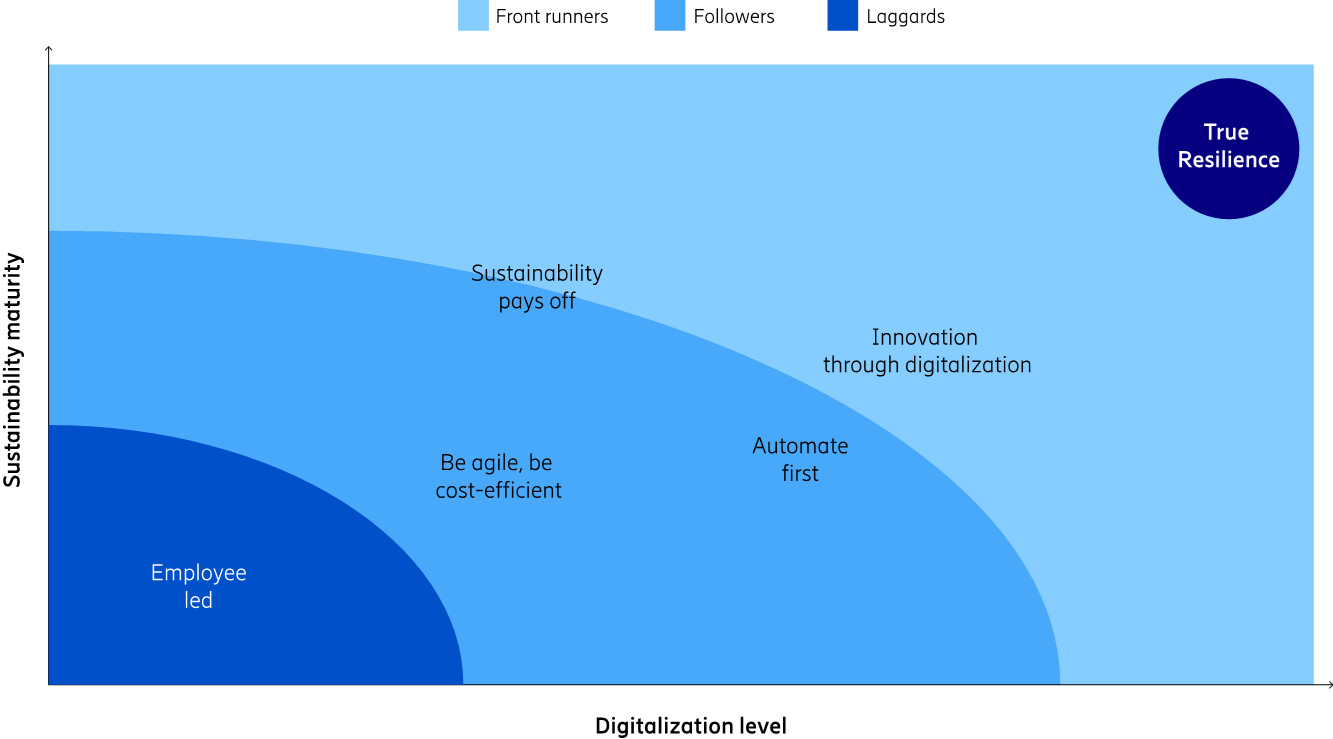
Above: The five paths to resilience based on their respective average digitalization level and sustainability maturity.
As you can see, the end goal of true, long-term resilience ends up in the upper right corner –
None of the five identified current paths to resilience will thus be enough on their own. Going forward, enterprises need to rethink their strategy and definition of resilience. The traditional meaning of being prepared for disruptive events will no longer be sufficient. And combining components from each path will be vital to achieving long-term resilience – a truly sustainable future for all.
So let’s look at the practicalities of what that means. As I see it, two fundamental paradigm shifts will be needed to enable enterprises to reach long-term and true resilience:
Shifting to long-term, efficiency-based resilience
Short-term resilience that is based on a duplication of resources (such as installing diesel generators as a power-grid grid back-up) needs to shift to a more environmentally sustainable, long-term efficiency-based resilience.
Dematerialization through digitalization (such as using less production material or freeing up office space when employees can work remotely) enables company resilience by reducing cost, increasing profitability and ensuring flexibility. For example, over 80 percent of enterprises surveyed have already invested in technologies that allow more flexible remote working.
Shifting to proactive innovation and business model evolution
Recovery-oriented resilience needs to shift towards pro-active innovation and business model evolution. Already today 80 percent of decision-makers include this in their resilience strategy, and close to 60 percent of them plan to intensify their efforts in future.
By having the required innovation capabilities and financial muscle, enterprises will be able to pro-actively handle crises before they even occur. Being data-driven and agile can enable companies to adjust their offerings quickly, shift to new target groups or change how their offerings are brought to market.
The enterprises continued digitalization journey will be a core factor in this evolution – AI and advanced data analysis can enable both enhanced recommendations and automation, assuming the availability of accurate, relevant and timely data. This in turn will require stable and high-performance ubiquitous connectivity.
Another factor in accelerating innovation and business model evolution is the vast and continuously expanding global availability of developers, applications, and open APIs. For example, there are countless applications that provide guidance on how to increase resilience, ranging from risk assessment and business continuity planning apps to apps that teach individuals to handle stress better.
Connected sensors, remote controlled processes, and cloud-based processing capabilities also present additional opportunities to enhance both enterprise and societal resilience. The importance of having ubiquitous, high-speed, low latency connectivity therefore aligns well with the fact that 61 percent of decision-makers and 53 percent of employees firmly believe 5G networks will be an essential innovation platform for their work.
The final word
I can’t help thinking back to the 100-year flooding of Grand Forks in 1997 – what if they had had all the technological capabilities that we have at our disposal today? Would the Grand Forks Herald still have its 120-year news archive intact? And could Grand Forks business owners and homeowners have mitigated the consequences so that no-one had to abandon their businesses and homes at all? It may be too late for that disaster, but it’s not too late for the next.
Learn more
Read Ericsson IndustryLab’s enterprise resilience report in full
Take a look around Ericsson’s acclaimed 5G smart factory
Learn more about the future of enterprise across sectors such as automotive, energy, manufacturing and more.
Blog post: Five ways digitalization can help build global resilience in 2023