










Three expert insights from under the hood of connected truck ecosystems
Connectivity is transforming the global trucking market, driving mature ecosystems onto uncharted roads as they accelerate into a world of electrification and autonomous driving. So, what can communication service providers (CSPs) do to ensure they’re on board for this journey? Let’s find out.

Strategic Marketing Director

Product Marketing Manager Automotive & Industry

Master Researcher

Head of Thought Leadership

Strategic Marketing Director
Product Marketing Manager Automotive & Industry
Master Researcher
Head of Thought Leadership
Strategic Marketing Director
Product Marketing Manager Automotive & Industry
Master Researcher
Head of Thought Leadership
Listen here
When you’re stuck behind a truck, it can be hard to appreciate what they do for us by keeping our supply chains running. But these motorized beasts form a critical cornerstone for our economies. According to Eurostat, almost one quarter of all freight transportation in the EU was made by road in 2021, a figure that has only grown in recent years. But with demands increasing when it comes to fuel and operational costs, rapid deliveries and regulations on carbon emission reductions, we must find new ways of approaching these challenges. And emerging technology, fueled by connectivity, is steadily taking over the wheel.
Welcome to the world of smart connected trucks.
Key insights from our experts
- To get the most value from connected truck fleets, uninterrupted coverage and capacity are needed, as well as prioritization of some of the important truck communication services over regular mobile broadband (MBB) traffic.
- Some countries have already regulated Level 4 autonomous driving (AD), and, in most such cases, permanent connectivity between a vehicle and a remote supervisor is legally mandated. If this connectivity is lost, the vehicle must safely stop – which can create expensive scenarios for the fleet operator. Deployment of AD trucks is easiest in rural areas due to lower traffic intensity, rarer occurrence of vulnerable road users (VRUs) like pedestrians, and longer distances without the need for assistance. However, these types of areas are where coverage today is generally weaker.
- CSPs can (and should) take action now. First, by closing existing coverage gaps on roads, while gradually growing capacity in line with the deployment of smart connected trucks. Second, by engaging early on with key players in the road transportation ecosystem to establish themselves as the preferred premium connectivity partner.
Read on to gain a more in-depth understanding of the ecosystems around the new generation of smart trucks, as well as some concrete tips for how CSPs can position themselves early and take advantage of the opportunities on offer.
Where are we – and how did we get here?
This evolution of road freight transport isn’t a sudden occurrence. For many years, connected technology has been used to make road transportation safer and more efficient – from the early freight management systems of 50 years ago to the disruptive breakthrough of GPS enabling better positioning and route planning.
But today, connecting the different parts of the transportation value chain and enabling real time data to flow between actors is more crucial than ever if we are to address the challenges facing us – from climate change pressures to commercial ones. And that involves bringing connectivity outside the cab.
There are two key elements to this. The first is empowering truck drivers and fleet operators through the Internet of Things (IoT), providing them with important insights from the cloud-connected fleet and improving operations overall. The second is implementing new data sources and technologies that allow the vehicles to be operated more efficiently. As trucks are becoming more connected – with new types of sensors, data sources and stronger cloud processing power – we are seeing a rapid introduction of new technologies like remote supervision, on-demand remote operation and electrification, with the final goal of full autonomous driving (AD).
The global connected truck market is predicted to grow by more than 16 percent per year up to 2028, driven by growing demands for higher productivity and efficiency, increased flexibility, high-velocity supply chain operations, and the need for end-to-end visibility – all of which rely on a higher level of connectivity and automation to be successful. It’s therefore no surprise that, according to a report from MAN Truck and Bus, 80 percent of commercial vehicles will be connected by 2030.
At the same time, the eruption of electric vehicles is supporting the decarbonization of the transport system. Many truck manufacturers (original equipment manufacturers, or OEMs) expect that 50 percent of all new trucks sold in 2030 could be electric. These electric vehicles also come with a fundamentally changed digital architecture, allowing for more advanced software and services, which also means a lot of new business opportunities for those who identify them and act early.

Erik Ekudden, Chief Technology Officer, Ericsson and Christian Levin, President and CEO, Scania Group talk 5G for sustainable transportation and the critical role of connectivity for the heavy transport industry, electrification and digitization.
Getting into gear: exploring smart truck ecosystems
Earlier in our ecosystem evolution blog series, we explored five lenses for understanding the ecosystems around 5G – one of which was thing-centric ecosystems. These ecosystems focus on creating value within and around a smart physical device, and are particularly attractive for CSPs, as connectivity is at the heart of the device. Here CSPs can bring more insights into the ecosystem on how this connectivity can help drive value for all actors. To bring the theory to life, let’s dive deeper into some connected truck ecosystem examples, where digitalization disrupts the established relationships among the main stakeholders.
The new generation of smart trucks
Road freight using internal combustion engine (ICE) trucks has been going on for nearly a century, so we can classify this as a mature ecosystem. Today, there's a set of big international players that manufacture trucks and sell them to fleet operators that transport the goods. However, as trucks get digitalized, connected and electrified, we see a lot of new technology players entering the ecosystem, aiming to improve the efficiency, safety and sustainability of the trucking industry.
Using connectivity, trucks share data with the fleet operator and the cloud, increasing productivity and road safety. Moreover, these trucks can be easily tracked, with access to real-time insights into their operating condition, allowing the fleet operators to efficiently manage logistics and transportation activities. Government initiatives (such as the European Union’s Intelligent Transport Systems (ITS) Directive on the provision of information services for safe and secure parking places for trucks and commercial vehicles) are also driving the deployment of smart connected truck services. More built-in sensors, more data transmitted and received, and advanced data analytics all increase the relevance of information and communication technology (ICT) players in the ecosystem. The key players and their roles are explained below.
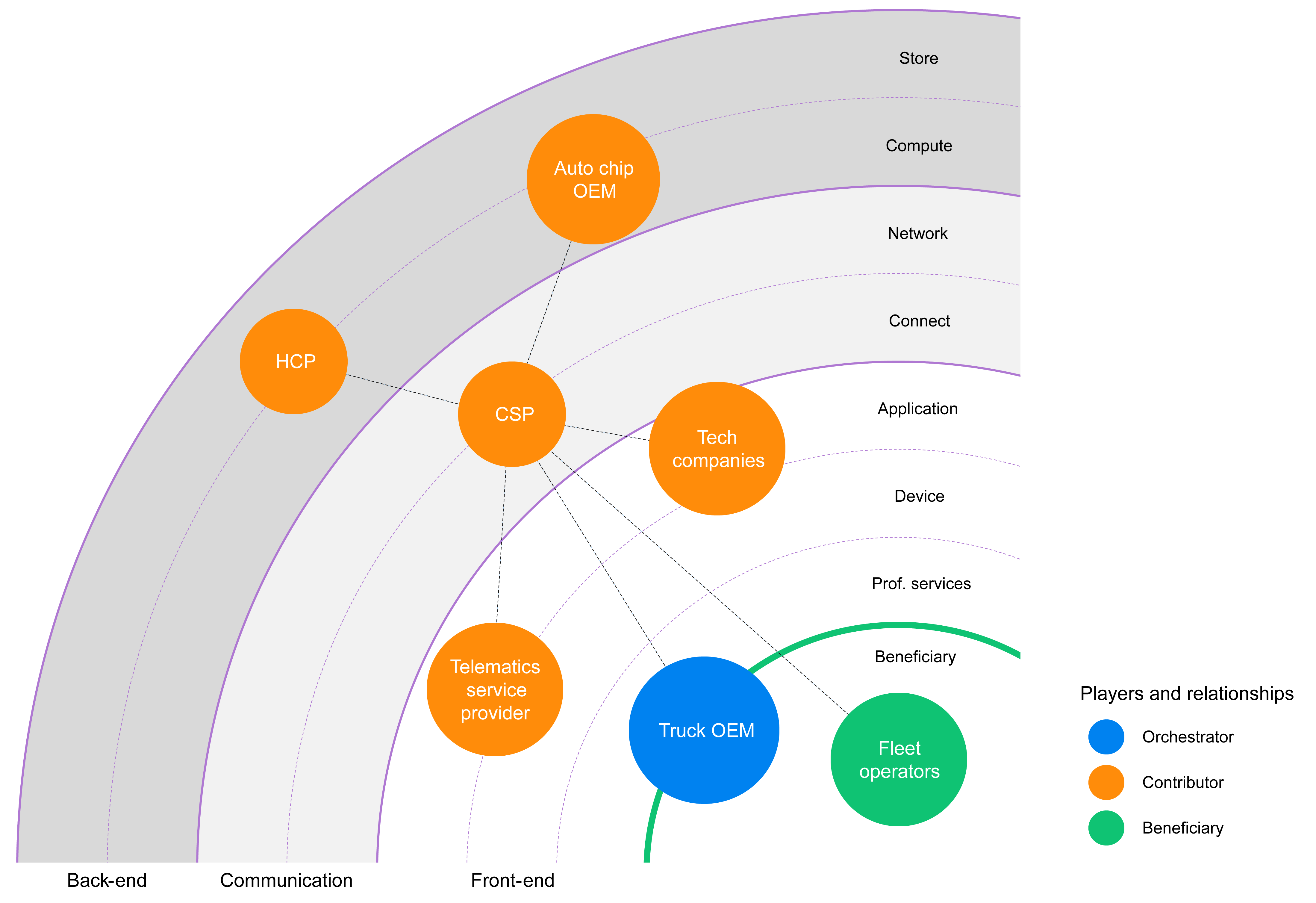
Map of today’s smart connected truck ecosystem – with remote driving and supervision, new players will enter the ecosystem. Note: this graphic is simplified and IT-centric, where several actors are not visualized.
- Fleet operators (beneficiary): own or lease trucks, employ drivers, operate the trucks and fulfil delivery services to end customers – for example, DB Schenker or Schneider.
- Truck OEMs (orchestrator): design and manufacture trucks with integrated technology and sell them to fleet operators – for example, Daimler Trucks, Scania or Volvo Trucks.
- Technology companies (contributor): develop software and technology for self-driving vehicles and value-added services – for example, Vay, Waymo or Cruise.
- Telematics service providers (contributor): offer telematics services that also include fleet management, to allow the collection and transmission of data from or about the truck – for example, ZF Transics, Trimble Transportation or Geotab.
- CSPs (contributor): provide trucks with connectivity access for tracking, monitoring and over-the-air (OTA) update purposes – for example, AT&T, Verizon or T-Mobile.
- Automotive chip providers (contributor): provide computation and connectivity chips for trucks – for example, Qualcomm or NVIDIA.
- Hyperscale Cloud Providers (HCPs) (contributor): provide compute and storage on public clouds – for example, AWS, Google Cloud or Microsoft Azure.
As trucks become connected, digitalized and electrified, players like Qualcomm that were traditionally smartphone chip players, are put in a prime spot as a technology provider in the automotive space. Qualcomm provides not only 4G or 5G and in-car connectivity, but a cockpit platform for digital services, car-to-cloud services, as well as the ride platform supporting AD and advanced driver assistance systems (ADAS) with their Snapdragon digital chassis offering. CSPs providing reliable and highly available connectivity are key to enabling those value-added services.
As well as providing uninterrupted connectivity, several CSPs also provide additional services, such as advanced telematics and fleet management. These enable fleet operators to track their assets and improve their operational management, creating more efficient, cost-effective processes and safer, more sustainable transportation. For example, Verizon Connect provides advanced fleet management software based on various GPS tracking solutions, offering dashboards, reports and alerts to fleet operators. Typically, CSPs follow established business models on the market, with a monthly price per vehicle, a minimum contract period, and the plug-and-play GPS tracking hardware included free of charge.
Telematics and fleet management services are heavily contested domains, with truck OEMs, independent platform providers and CSPs all vying to get their share of the market. Trucks increasingly come with built-in fleet tracking capabilities, which are also integrated with predictive maintenance functionality. However, pre-integrated factory solutions do have disadvantages in terms of flexibility, customizability and ease of upgrades when it comes to more complex use cases or scenarios – especially for a fleet with mixed vehicles. Here the industry has typically tended to incorporate aftermarket solutions, which could be a good segment for CSPs to partner within and grow their reach in the road transportation ecosystem.
Remote driving and supervision
The remote driving ecosystem on public roads is at low maturity and still developing. It promises to simplify truck logistics significantly, as drivers could potentially be pooled into central locations (or even work from home eventually), reducing costs and streamlining operations. Today, remote driving (tele-operated driving) is a use case where the driver remotely controls the vehicle over 4G or 5G networks. All vehicle functions including steering, braking and throttle are executed by a remote driver situated in an operations center.
Many companies, including CSPs, have tested remote driving as a stepping-stone towards driverless operations. For example, technology startup Halo launched a remotely operated car service in Las Vegas back in 2021. Passengers could summon a car in the city, which was remotely operated by Halo staff in another facility, connected via the T-Mobile 5G network. In another example from this year, Vay – a Berlin-based technology company – was granted permission to remotely drive cars on public roads in the city of Hamburg without a safety driver on board. In this set-up, the tele-operator remotely controls all vehicle functions via the connectivity of multiple cellular networks, ensuring redundancy and safety. The traffic situation is reproduced via camera sensors and transmitted to screens in the remote driving station.
At the end of last year, Einride – a Swedish transport company specializing in electric and autonomous vehicles – did a first-time pilot of a fully electric autonomous heavy-duty vehicle on a US public road. Utilizing Ericsson’s private connectivity network technology, the vehicle (called a Pod) was able to function seamlessly, as real-time data (including video stream) was continuously shared with the supervising ‘Remote Pod Operator’. The vehicle was part of actual workflows and safely transported goods between GE Appliances’ manufacturing facility and warehouse.
While remote driving requires permanent direct control over the vehicle, remote supervision of autonomous vehicles on the other hand only involves human oversight and intervention – for example, by remote driving when requested by the vehicle. The remote operator in the latter scenario is meant to supervise the operations of several vehicles, and only intervene when requested to do so, such as if problems are encountered. In such a circumstance, manual tele-operation could be a way for the fleet operator to solve the issue, but the operator could also be prompted to provide or approve a path for the vehicle and then monitor its safe execution.

Watch trucking veteran Tiffany Heathcott become the world’s first Remote Pod Operator. Video courtesy: Einride
As mentioned in our key insights, remote supervision is now mandated in many areas currently testing driverless vehicles, and if the internet connection provides insufficient service quality, the vehicle will need to stop in a safe manner. Therefore, uninterrupted 5G coverage and capacity to stream the video feed from the truck to the remote operations center will be fundamental enablers of such a service. Resolving traffic scenarios where the vehicle is not able to proceed on its own can be costly, as the operator may have to physically attend to the vehicle.
Currently, multiple modems and SIM cards are often used in parallel, to ensure they have the best coverage available from all public mobile networks. With advanced 5G functionality, CSPs are able to serve the demands of autonomous truck fleets through a single service contract. While the technical realization of the service could still rely on network infrastructure from more than one CSP, the service is simple and streamlined for the fleet operator.
A lot of new technology players are heavily impacting the way vehicles will be operated in the future. Providing the necessary communication infrastructure for vehicles to operate safely and efficiently is the key role CSPs can play and build upon within this ecosystem.
The road ahead
Connected trucks already generate massive amounts of data – and this will only continue to grow as we continue along the road to autonomous transportation. Camera feeds, sensor data for asset diagnostics and maintenance, tracking of goods, smart locks, driver assistance and CO2 emission monitoring, not to mention transparency towards consumers – all this data and demand will make connectivity much more of a centerpiece in the transportation ecosystem.
Providing uninterrupted coverage with sufficient capacity is the ticket to play for CSPs in the road transportation ecosystem of tomorrow. Leading CSPs are already expanding and exploring additional services beyond connectivity, offering telematics and fleet management services to fleet operators. By guaranteeing Quality of Service (QoS) to avoid overload of the network due to regular consumer MBB traffic, CSPs can also offer premium connectivity to the ecosystem through Service Level Agreements (SLAs), enabling new services like remote supervision of autonomous driving trucks, for example.
To grow revenue in the smart connected truck ecosystem, CSPs need to position themselves early by:
- Approaching the road transportation ecosystem with an open, co-design mindset. Engage in pilots or “living labs” with truck OEMs, fleet operators and new entrants to gain a better understanding of industry specifics demands.
- Addressing existing coverage gaps on meaningful roads for transportation and logistics, and growing capacity gradually in line with the deployment of smart connected trucks. Not all use cases need to be guaranteed with a certain QoS, as best-effort communication may be good enough for many of the smart connected truck use cases. As remotely supervised vehicles are deployed more and more on public streets, these players will look for CSP partners to solve their specific connectivity needs, offering highly available premium connectivity with realistic requirements on latency and throughput for faster and easier expansion.
- Understanding the ecosystem needs and leveraging cloud services enriched with exposed network data (via network APIs) to create extra value.
This is clearly one of the most promising industries in which to apply ICT service capabilities to transform and disrupt the existing truck ecosystem. Whether it is real-time tracking and supervision, route optimization, data analytics or improved customer services, CSPs have an important role to play in what is to come.
The possibilities – much like the road ahead – are endless.
Contact the authors
We hope you’ve found our ecosystem evolution blog series insightful. If you have questions you’d like answered about the smart connected truck ecosystem, feel free to contact the authors via email or reach out to them directly via their LinkedIn profiles: Harald Baur, Johannes Schygge, Maciej Muehleisen, or Peter Linder.
Acknowledgment: The authors of this ecosystem evolution blog series would like to acknowledge the work and contributions of Arthur D. Little, who conducted a joint analysis with us early in 2022.

The road to autonomous transportation
How connectivity will make autonomous transportation scalable, efficient and sustainable
Explore the perspectivesRead more
Download the one-page cheat sheet summarizing the key messages from this post.
Find out more about our ecosystem evolution blog series.
Explore the road to autonomous transportation, how connectivity will make autonomous transportation scalable, efficient and sustainable.
Read the key insights from Erik Ekudden, CTO of Ericsson and Christian Levin, CEO of Scania on the importance of intelligent, advanced and emissions-free heavy road transport.
Discover what consumers think about letting go of the wheel and what’s next for autonomous cars in our ConsumerLab Report on the self-driving future.
Find out how IoT-powered fleet telematics can help a mid-sized truck transport company to save up to a million dollars annually in our IoT Connected Truck Transport Enterprise Report.